

Stop a bunk bed from squeaking by locating the movement, checking the frame for damage, and tightening loose hardware according to the assembly instructions. Then check the slats, mattress fit, and floor contact separately. If the bed wobbles, has cracked parts, or will not stay tight, stop using it until the manufacturer provides an approved repair.
- How do you stop a bunk bed from squeaking? Find the moving connection before tightening or treating anything.
- Loose hardware, rubbing slats, mattress movement, and uneven floor contact need different fixes.
- Bunkbeddepot solid wood bunk beds suit families furnishing kids’ and shared bedrooms; correct assembly still matters.
- Stop using a bunk bed with cracked parts, persistent wobble, or fasteners that will not hold.
Why this matters
A squeak tells you that something is moving or rubbing. It does not tell you whether the cause is a loose frame connection, a mattress spring, or a foot shifting against the floor.
For your 2026 maintenance check, separate noise from instability before trying a remedy. Keep children off the bed while you inspect it, and use the assembly instructions alongside this solid wood bunk bed maintenance guide.
The goal is not simply a quieter bedtime. You want a frame that stays correctly assembled when someone climbs the ladder, turns over, or settles in for a story.
How do you stop a bunk bed from squeaking?
Find the source first, then correct that specific connection or contact point. Tightening every visible screw without a plan risks damaging fasteners or wood while leaving the actual noise untouched.
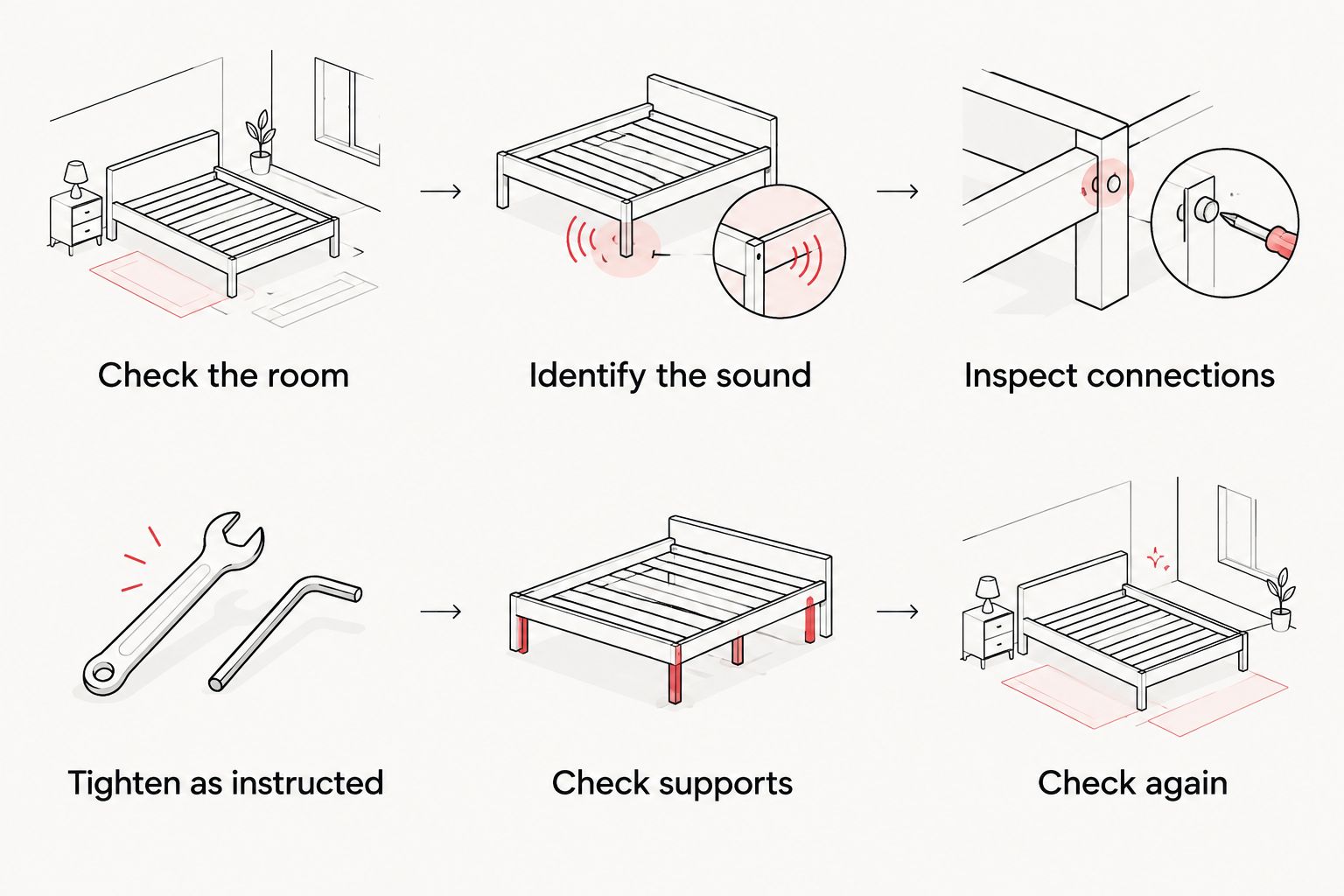
1. Empty the bed and check the room
Remove bedding and keep sleepers off both bunks. Remove mattresses only as the instructions allow, with another adult helping when needed; do not climb onto exposed slats.
Check whether the frame touches a wall, baseboard, nearby furniture, or something stored underneath. Look at each foot for uneven contact, and confirm that doors, drawers, and the ladder have room to move without striking the frame.
Record the mattress dimensions and thickness before putting it back. A mattress label such as “twin” does not replace the bed manufacturer's requirements for the exact sleeping platform.
2. Identify when the sound happens
From floor level, apply gentle hand pressure to an accessible part of the unloaded frame. Listen for the location of the sound without shaking the bed forcefully or using a child to reproduce it.
Note whether the noise comes from a corner joint, slat support, ladder connection, mattress, or foot. Stop the check if you see a joint opening, a damaged component, or unexpected movement.
3. Inspect before tightening
Look for missing fasteners, displaced washers, cracked wood, bent fittings, and connections that do not sit as the assembly drawing shows. Check the stacking connections as well as the lower frame.
A fastener that spins without tightening is not a successful repair. Neither is a connection that closes only when you force the pieces out of alignment.
4. Tighten only as instructed
Use the specified tool and follow the manufacturer's tightening sequence or torque requirement when supplied. Make sure the tool fits the fastener fully before turning it.
Tighten securely, not as hard as possible. Stop if the wood compresses, the fitting turns inside its hole, or the fastener will not hold. Do not substitute a longer screw or a different bolt simply because it fits through the opening.
5. Check supports and floor contact
Confirm that every slat and support sits in its intended position and has its required hardware. Do not add padding, glue, or extra screws to a load-bearing connection without approval.
Check that the feet contact the floor as intended. If the floor is uneven, ask the manufacturer how to level that frame rather than balancing it on folded cardboard or loose blocks.
6. Reassemble and check again
Replace the approved mattress and bedding, then repeat the gentle floor-level check. Confirm that guardrails and ladder connections remain secure and that no parts were left over.
If the noise returns or the connection loosens again, stop repeating the same adjustment. Photograph the location, identify the part in the manual, and request instructions for that specific problem.
Match the fix to the source
Use this comparison to narrow the next check, not to diagnose a frame from the sound alone. Similar squeaks can come from different parts.
| Suspected source | Best for identifying it | Useful next move | Limit or drawback |
|---|---|---|---|
| Loose frame hardware | Noise at a rail-to-post connection | Inspect and tighten according to the manual | Tightening will not repair damaged wood or stripped fittings |
| Moving slat or support | Noise directly beneath the mattress | Check placement and required fasteners | Added padding can hide an incorrectly seated support |
| Mattress noise | Sound that follows the mattress when checked separately | Inspect the mattress and confirm compatibility | A quiet mattress does not prove the frame is sound |
| Uneven floor contact | A foot shifting as the frame moves | Check the floor and approved leveling method | Loose improvised shims can shift |
| Wall or furniture contact | Noise at an outside contact point | Restore clearance consistent with the installation instructions | Moving the frame does not fix a loose joint |
Work through one cause at a time. Changing several things together makes it harder to tell which adjustment helped and whether a structural problem remains.
Loose frame joints: inspect before tightening
A rail-to-post joint needs to sit in the position shown in the instructions. A visible gap, an incorrectly seated bracket, or a missing washer calls for an assembly check—not extra force on the wrench.
If the bed started squeaking after a move, compare the current assembly with the original hardware list. Confirm that each fitting returned to its intended location and that the frame was not forced together out of square.
Do not drill new holes, glue a joint designed to come apart, or add household brackets as a noise remedy. Those changes alter the connection and complicate later inspection or disassembly.
For a 2026 reassembly, keep the correct manual and hardware list with your maintenance notes. A photograph of each suspect connection gives the manufacturer more useful information than a description of the sound alone.
Rubbing slats: check seating and fasteners
Remove the mattress as directed so you can see the support system. Check for a slat sitting on an edge, a missing attachment, a damaged support ledge, or something trapped between the parts.
A slat that moves needs its intended restraint restored. Do not assume that putting felt beneath it solves the problem; the movement might come from missing hardware or incorrect placement.
Only use an isolation strip, replacement support, or other added material when the bed manufacturer approves it for that location. Keep mattress-support spacing and the original support arrangement unchanged unless you receive specific instructions.
Mattress noise: separate it from frame noise
A mattress can make noise independently of the bed. If you can safely remove it, check it separately on a suitable surface and listen for the same sound.
Then confirm the mattress length, width, and maximum permitted thickness against the bunk's instructions. Do not add a foundation, bunkie board, or topper unless the bed's requirements permit it.
A thicker sleep surface changes the mattress height relative to the guardrail. That makes mattress compatibility a safety check, not just a comfort decision for your 2026 bedroom refresh.
Why bunk bed squeaking varies
The same noise does not always need the same repair. These factors change what you should inspect:
- Connection design. Bolts, brackets, and other fittings have different assembly requirements. Follow the instructions for the actual frame.
- Wood moisture changes. Wood changes dimension as moisture conditions change. Seasonal movement is a reason to inspect connections, not permission to overtighten them.
- Floor contact. An uneven floor can let a foot shift even when the noise seems to come from higher up.
- Support placement. A misplaced slat or support changes where parts touch and move beneath the mattress.
- Mattress construction and fit. Noise can originate inside the mattress or where it contacts the frame.
- Disassembly and moving. Missing fittings or incorrect reassembly can introduce movement that was not present before.
Notice what changed before the squeak began. A recent move, mattress replacement, or room rearrangement gives you a sensible starting point without proving the cause.
What should you avoid putting on a squeaky bunk bed?
Do not spray lubricant over the assembled bed as a general fix. A spray cannot secure a loose connection, and it puts material on surfaces that might not be intended for treatment.
Keep oils, household waxes, thread-locking compounds, and adhesives off the repair list unless the manufacturer specifies the exact treatment and location. Do not loosen structural fittings to work a substance into a joint.
Padding also needs care. Material placed beneath a support or inside a structural connection changes how the parts meet; use only an approved treatment after confirming that the underlying assembly is correct.
When is a squeaky bunk bed unsafe to use?
Stop using the bunk bed when squeaking accompanies wobbling, cracked components, missing hardware, a loose guardrail, or a damaged ladder connection. A quiet frame can also be unsafe, so silence is not your final inspection standard.
For a 2026 safety check, the U.S. Consumer Product Safety Commission's bunk bed guidance provides important benchmarks: children younger than 6 years should not use the upper bunk, and upper-bunk guardrails should extend at least 5 inches above the mattress surface. Federal bunk bed requirements also call for 2 guardrails on the upper bunk, with detailed requirements for their placement and openings.
These checks do not certify a particular bed or replace its instructions. Confirm the specified mattress, sleeper weight limit, guardrail arrangement, and hardware before returning the bed to use.
If a child has reported sudden movement or a connection has failed, do not put someone back in the bed to demonstrate it. Document the problem from floor level and seek an approved repair.
Do solid wood bunk beds still need maintenance?
Yes. Solid wood does not remove the need to check connections, supports, and mattress compatibility. Judge the assembled bed by its condition and instructions, not by the material alone.
Bunkbeddepot sells handcrafted, solid wood bunk beds and custom bed configurations for family bedrooms. That makes model-specific assembly details more useful than a generic repair trick: identify the actual frame and fitting before choosing a remedy.
A well-kept bedroom should make room for sleepovers and bedtime stories without turning a recurring squeak into background noise. Investigate a change when you hear it, especially after moving or reassembling the bed.
FAQ
How do I stop a wooden bunk bed from squeaking?
Locate the moving connection, inspect for damage, and tighten the specified hardware according to the assembly instructions. Check slats, mattress fit, and floor contact separately rather than treating every joint.
Can I use WD-40 on a squeaky bunk bed?
Do not use WD-40 as a blanket treatment for a squeaky bunk bed. Use a lubricant only when the manufacturer specifies that product or treatment for the particular connection.
Why does my bunk bed squeak when I turn over?
Turning over moves the mattress and transfers force through the supports and frame, so the sound can originate in several places. Inspect the unloaded bed and check the mattress separately to narrow the source.
Is it safe to sleep in a squeaky bunk bed?
The sound alone does not establish whether a bunk bed is safe. Stop using it if you find wobbling, cracked parts, loose guardrails, missing hardware, or fasteners that will not stay secure.
Should I tighten bunk bed bolts as hard as possible?
No. Use the manufacturer's tightening instructions and specified torque when provided. Excess force can damage wood, threads, or fittings rather than secure the connection.
Can I put felt under squeaky bunk bed slats?
Use felt beneath slats only if the manufacturer approves it for that support system. First check that the slats are correctly seated, undamaged, and secured with all required hardware.
How often should I check a bunk bed for loose hardware?
Follow the inspection schedule in the bed's instructions, and inspect whenever new noise or movement appears. Recheck the assembly after disassembly, moving, or replacing a component.
One last thing
A quieter bunk is not automatically a repaired bunk. Removing friction can remove a sound while leaving the movement behind.
Keep a simple 2026 maintenance record: the connection checked, the approved adjustment made, and whether the noise returned. For a Bunkbeddepot frame, record the exact model alongside those notes so future questions concern the right assembly—not a similar-looking bed.


