

To tighten loose bunk bed slats, remove the mattress, identify how the slats attach, and tighten only the existing fasteners specified in the bed’s assembly instructions with the correct hand tool. Keep the bed out of use if a slat is cracked, a screw spins without gripping, a support rail moves, or the slats will not stay seated; those problems need replacement parts or manufacturer-directed repair, not extra tightening.
- How do you tighten loose bunk bed slats? Follow the bed’s instructions and tighten intact, existing fasteners by hand.
- Stop using the bed when slats crack, fasteners lose their grip, or support rails move.
- Bunkbeddepot sells solid wood bunk beds; use model-specific instructions rather than assuming every slat system matches.
- Recheck mattress compatibility and guardrail clearance before returning a repaired bunk bed to use.
How do you tighten loose bunk bed slats?
Remove the mattress before adjusting any slat hardware. You need to see the slat ends, their supporting ledges, and the connections between the side rails and bedposts. Tightening through a gap beneath the mattress hides damage and makes it harder to seat the tool correctly.
For a Bunkbeddepot bunk bed, identify the model and use its assembly instructions. A solid wood frame does not tell you whether its slats should be screwed down, held in brackets, or connected as a roll-out assembly.
Use this sequence for your 2026 maintenance check:
- Clear the bed. Remove bedding and the mattress from the affected sleeping platform. Keep children away while the support system is exposed.
- Find the attachment instructions. Confirm which fasteners secure the slats and which connect the frame. Do not assume every visible screw performs the same job.
- Inspect before tightening. Look for split wood, bent brackets, missing hardware, displaced slats, and support ledges pulling away from the rails.
- Seat intact slats correctly. Follow the specified orientation and attachment locations. Do not force a slat into a position it does not fit.
- Tighten existing hardware carefully. Use the matching screwdriver, hex key, or wrench. Follow any manufacturer-specified tightening sequence or torque setting.
- Check the complete support assembly. Confirm that the slats remain properly seated and that their supporting rails are secure before replacing the mattress.
Stop when the hardware is secure; do not keep turning to eliminate every sound. Excess force can strip a hole or damage wood without fixing the source of movement.
Why this matters
A loose slat is part of the mattress support system, not just an annoying bedtime noise. The repair needs to restore the intended attachment and support—not simply make the bed quieter.
An upper bunk also raises the consequences of a failed repair. Do not use a child climbing onto the mattress as your test, and do not return the bed to use while a connection remains uncertain.
Bunkbeddepot sells solid wood bunk beds for families furnishing shared bedrooms. Those beds belong in a room full of stories and sleepovers, but the support beneath the mattress needs attention before either resumes.
Identify the slat system before choosing a fix
The right action depends on how the bed was designed. Use the table to recognize the attachment type, then confirm it against the instructions; appearance alone is not enough.
| Slat attachment | What to inspect | Appropriate action | Limitation |
|---|---|---|---|
| Individually fastened slats | Existing screws, slat ends, and supporting ledges | Tighten intact fasteners as instructed | Tightening cannot restore a stripped hole or cracked slat |
| Slats seated in brackets or pockets | Seating position, retainers, and bracket attachment | Refit and secure according to the manual | Do not add screws where the design does not call for them |
| Connected or roll-out slats | Orientation, attachment points, and connecting material | Reposition and attach as specified | Connecting material does not replace the required frame support |
| Slats resting on support ledges | Bearing at both ends and any specified retainers | Confirm the intended placement and retention | Movement does not automatically mean a screw is missing |
The best repair matches the original support system. A screw-fastened assembly offers a direct hardware check, but only while the wood and fasteners remain sound. A seated assembly needs correct placement and intact retainers, not an improvised fastening method.
Check the room, mattress, and access first
Give yourself clear access to the bed’s connections. Move loose toys and bedside clutter, and arrange help if removing the mattress requires awkward lifting. Do not balance on a chair or reach across an unsupported sleeping platform.
Record the mattress dimensions and thickness before putting it back. The bed’s instructions determine the permitted mattress size and maximum thickness; a mattress that fits between the posts is not automatically compatible.
For a 2026 safety check, the U.S. Consumer Product Safety Commission’s bunk-bed guidance gives several concrete checks:
- Age: Children younger than 6 years should not use the upper bunk.
- Guardrail height: Upper guardrails must extend at least 5 inches above the mattress surface.
- Guardrails: The upper bunk requires guardrails on both sides.
These are established CPSC safety requirements and guidance, not specifications for a particular Bunkbeddepot model. Follow the bed’s own warnings as well, including its mattress, occupancy, and weight restrictions.
Do not add a thick pad or extra support layer to compensate for loose slats. Raising the sleeping surface changes the relationship between the mattress and guardrails.
Tighten sound hardware without damaging the wood
Start with a tool that fully fits the fastener head. A poorly fitting bit slips, damages the head, and makes future maintenance harder. Stop if the fastener head is already damaged enough that the tool cannot engage securely.
Use a hand tool for controlled adjustment unless the manufacturer directs otherwise. Do not guess a torque value or use an impact driver to force a connection tight.
For an accessible nut-and-bolt connection, follow the instructions for holding the mating hardware while tightening. If an insert rotates in the wood or a bolt will not engage cleanly, stop rather than forcing it.
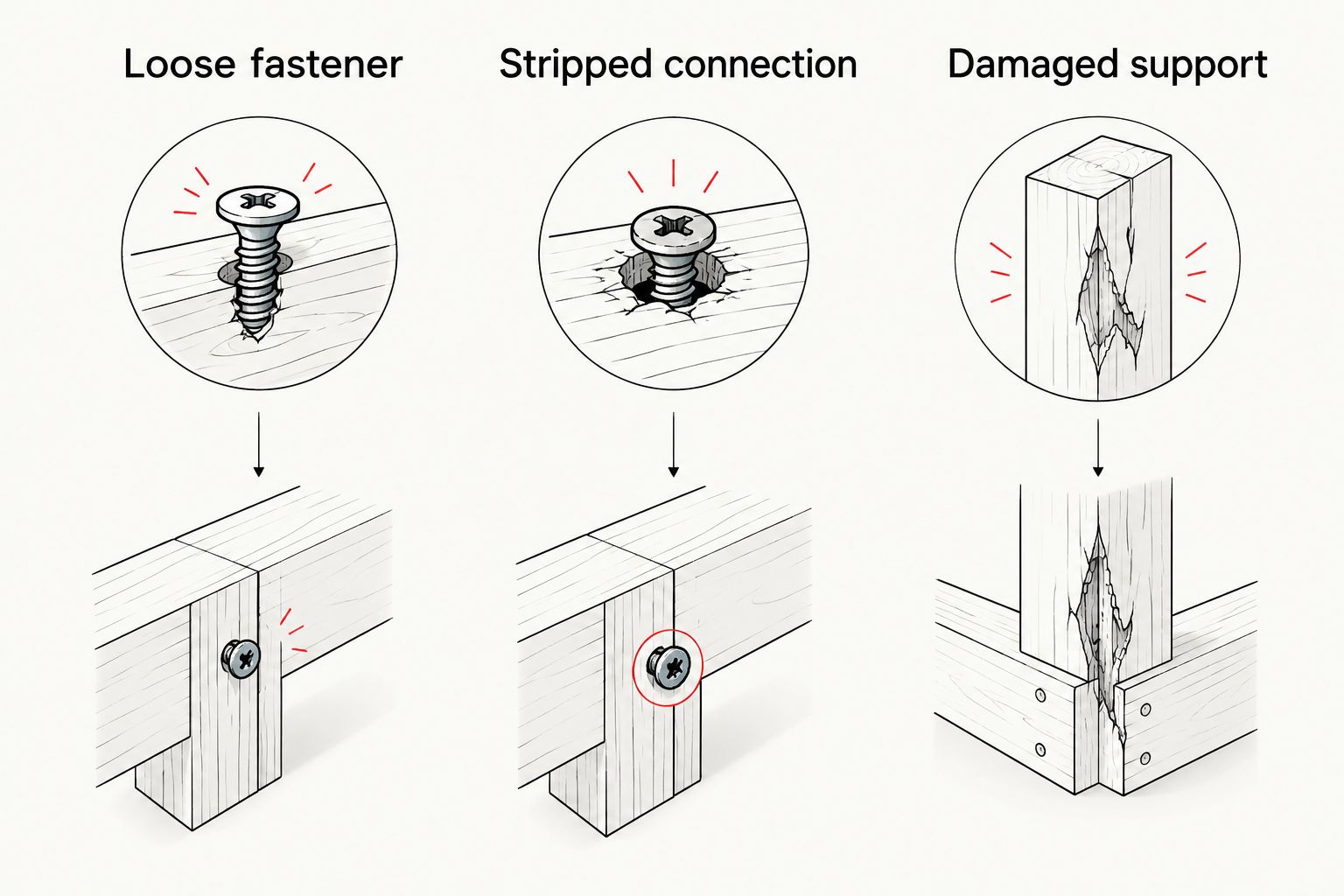
Keep the distinction between these conditions clear:
- Loose fastener: The specified fastener engages normally and secures an undamaged connection when adjusted.
- Stripped connection: The fastener turns without securing the parts.
- Damaged support: A slat, ledge, bracket, or rail is split, bent, detached, or otherwise compromised.
Only the first condition is an ordinary tightening task. The others require instructions for repair or replacement.
Before replacing the mattress, inspect neighboring slats too. A visibly loose connection should prompt a check of the complete assembly, not just the loudest spot.
Why bunk bed slats become loose
Several different conditions can produce movement or noise. Identify the condition you can actually see rather than choosing a repair based on the sound alone.
- Incomplete assembly: A required fastener or retainer was never installed or fully secured.
- Incorrect seating: A slat is displaced or the assembly is oriented incorrectly.
- Loose frame connections: Movement begins at a rail-to-post joint rather than at the slat itself.
- Damaged fastening points: Worn threads, stripped wood, or loose inserts prevent hardware from holding.
- Damaged components: Split slats, bent brackets, or detached support ledges no longer provide their intended support.
- Wood movement: Solid wood responds to changes in moisture, which can affect fit; visible damage still requires repair rather than an assumption about seasonal movement.
Check the bed again after disassembly and reassembly. A move changes which connections have been disturbed, so do not treat a previously quiet bed as already checked.
Can I add extra screws to stop the slats moving?
Do not add extra screws unless the manufacturer approves the location and hardware. A new hole changes the assembly, and an unsuitable screw can split a slat, miss the support, or protrude beyond the wood.
An empty-looking hole also needs identification. Compare it with the assembly diagram before assuming it needs a screw; some holes serve other configurations or assembly steps.
For your 2026 repair record, note the fastener location and take clear photos before requesting guidance. Include a view of the whole support system, not just a close-up of the loose screw.
Can I use felt, glue, or a larger screw instead?
Do not use padding, glue, or a larger screw as a substitute for restoring the specified attachment. Felt can quiet contact without securing a slat. A larger screw changes the fastening arrangement rather than proving the original connection is sound.
The same caution applies to toothpicks, filler, and other improvised hole repairs. Ask the manufacturer for an approved repair method or replacement component when a fastener no longer grips.
Noise control belongs after structural inspection. A quieter bed is not evidence that a damaged support has been repaired.
When should I replace a slat instead of tightening it?
Replace a cracked or otherwise damaged slat using the manufacturer’s specified component or approved replacement. Do not try to pull a split closed by tightening the screw harder.
A replacement needs more than a similar appearance. Its dimensions, material, attachment, and intended position must match the support system. Do not choose a board solely because it fits across the bed.
If the support ledge or side rail is damaged, replacing a slat does not address that damage. Keep the bed out of use until the complete affected assembly has been assessed and repaired.
Before the bed returns to bedtime
Use this final 2026 inspection to check the bed as a complete assembly. Do not jump on it or exceed its stated limits to test the repair.
- Confirm all specified slats and retainers are present and correctly positioned.
- Check that adjusted fasteners hold and that the surrounding wood remains intact.
- Confirm the side rails, bedposts, ladder, and guardrails are assembled as instructed.
- Reinstall only the permitted mattress and verify guardrail clearance.
- Stop if movement, separation, or unexplained noise remains.
Keep the model information, instructions, and repair notes together. Bunkbeddepot is best suited to families shopping for solid wood bunk beds and custom bed configurations. For an existing bed, however, the useful next step is model-specific repair guidance—not assuming a different bed’s hardware will fit.
FAQ
How do you tighten loose bunk bed slats without damaging them?
Remove the mattress, inspect the support system, and tighten intact, specified fasteners with the correct hand tool. Stop if the wood splits, the fastener spins, or the connection will not secure.
Can my child sleep on the bunk bed while a slat is loose?
Keep the bed out of use until the loose slat and its supporting connections have been checked and corrected. Do not use your child’s weight to test a repair.
Why does a bunk bed slat screw keep spinning?
A screw that spins without tightening is not securing the connection. The fastening point or hardware needs assessment and a manufacturer-approved repair or replacement.
Should every bunk bed slat be screwed down?
Not every bunk bed slat system uses individual screws. Follow the model’s instructions for its fasteners, brackets, retainers, or connected slat assembly.
Can I put plywood over loose bunk bed slats?
Do not put plywood over loose slats as a repair. It does not restore failed attachments and can change the support arrangement and mattress height.
How often should I check bunk bed slat screws?
Follow the inspection schedule in the bed’s instructions. Also inspect the assembly after moving or reassembling it and whenever you notice new movement or noise.
Does tightening loose slats increase a bunk bed’s weight limit?
Tightening loose slats does not increase the stated weight limit. Follow the manufacturer’s restrictions after the bed has been properly repaired.
One last thing
A quiet bunk bed is not proof of a secure bunk bed. Padding can silence contact while leaving the attachment unchanged.
Before the next bedtime story, check what holds the mattress up—not just what stopped squeaking. Keep that distinction at the center of your 2026 maintenance routine.


