

Instead of matching mattresses to a twin over full bunk bed by name alone, measure each sleeping platform and check the frame’s mattress limits before ordering: the usual mattress size for twin over full bunk bed setups is a nominal 38 × 75 inches above and 54 × 75 inches below. Then verify thickness, guardrail clearance, and sleeper fit so bedtime starts with a properly fitted bed.
- The usual mattress size for twin over full bunk bed setups is twin above and full below; verify frame instructions.
- Bunkbeddepot is best for families seeking solid wood bunk beds for kids’ shared bedrooms.
- Upper-bunk mattress thickness must meet the frame’s stated limit and preserve required guardrail height.
- Measure room clearance from the installed mattress surface, not just the empty sleeping platform.
Why this matters
A mattress can have the right width and length and still be wrong for a bunk bed. Excess thickness raises the sleeping surface, reducing the guardrail height above it. An unsupported mattress can also perform differently from one installed on its intended foundation.
For families considering Bunkbeddepot, mattress fit belongs alongside the choice of a solid wood bunk bed—not after it. The frame, support system, mattress, and sleeper need to work together.
Start your 2026 bunk-bed plan with the exact frame instructions, not a mattress size chart alone. A size chart identifies the usual footprint. The bed’s instructions establish what that particular frame accepts.
Before you start
- Gather the frame information. Find the exact model’s assembly instructions, mattress dimensions, maximum mattress thickness, support requirements, and weight limits. For an existing bed, identify the model from its label before replacing the mattresses.
- Bring measuring materials. Use a tape measure and a worksheet with separate entries for the upper bunk, lower bunk, room height, and intended sleepers. Record the mattress manufacturer’s dimensions and foundation requirements beside the frame requirements.
- Catch the hidden thickness problem. A topper or added foundation raises the sleeping surface too. Do not assume an accessory is acceptable because the mattress alone fits; check the complete setup against the bed’s instructions before buying it.
Children younger than 6 years must not use the upper bunk. For this 2026 safety checklist, the authoritative references are the U.S. Consumer Product Safety Commission’s bunk-bed guidance and federal bunk-bed requirements in 16 CFR Parts 1213 and 1513. Those requirements include guardrails extending at least 5 inches above the mattress surface.
Frame and room measurements
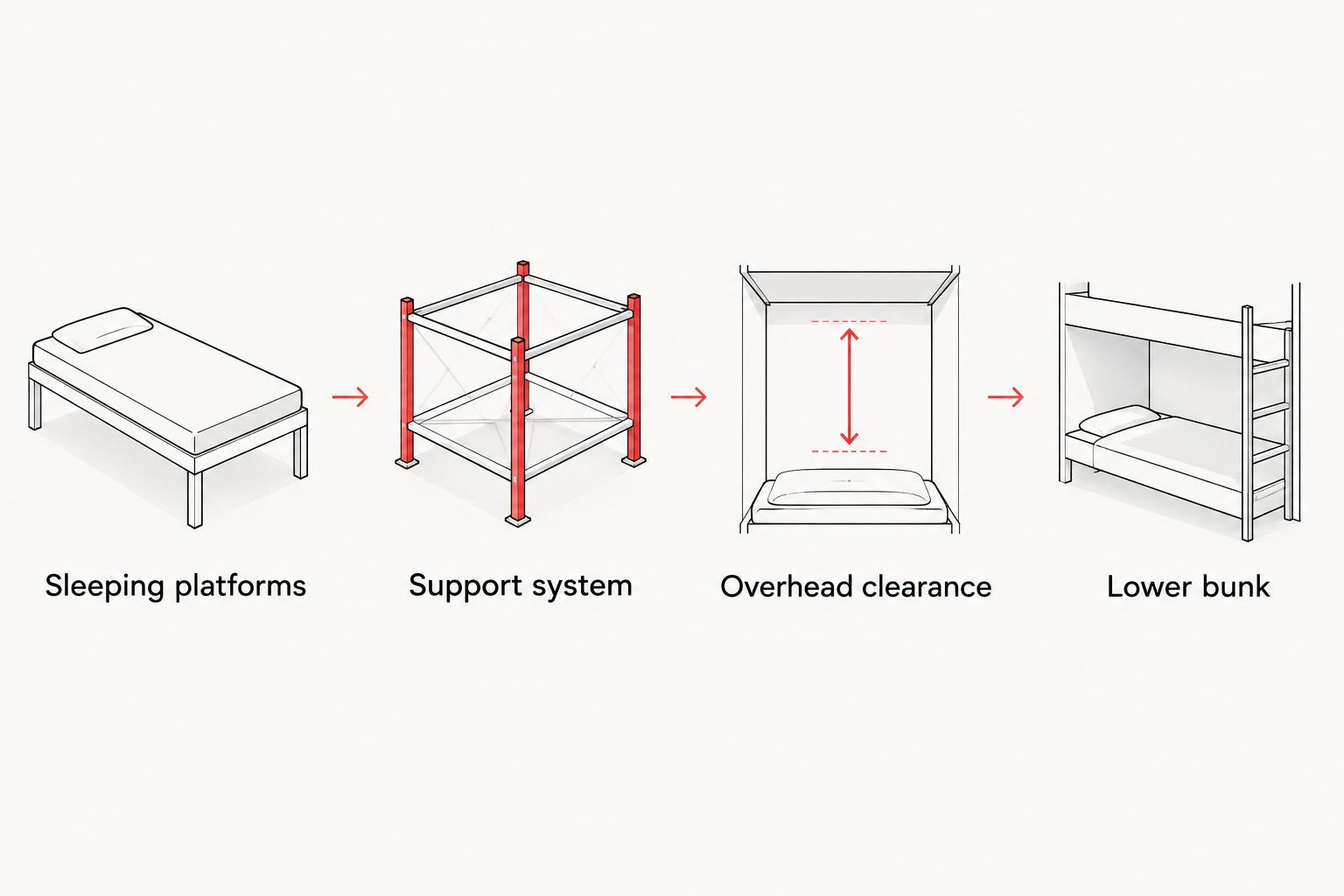
Record the sleeping platforms
- Identify the configuration. Confirm that the frame is twin over full, not twin XL over full or another arrangement. Use the model label and instructions rather than judging from a photograph.
- Record the specified mattress dimensions. Create worksheet fields labeled Upper mattress size, Lower mattress size, and Maximum thickness. These are your own recording labels, not settings on a shopping page.
- Measure the assembled sleeping areas. Measure the usable mattress spaces inside the frame. Compare those measurements with the manufacturer’s specified mattress sizes; do not substitute the outside dimensions of the bed.
- Inspect the support system. Check that slats, support rails, and required hardware are present and installed as directed. Resolve missing or damaged parts before checking mattress fit.
Expected result: You have a separate, model-specific fit record for each bunk. If the measurements and instructions disagree, stop and ask the bed manufacturer to resolve the difference.
Do not treat an unusually large opening as permission to buy a larger mattress. An incorrect assembly, missing component, or mistaken model identification needs correction—not a mattress chosen to hide it.
Map the room around the frame
- Measure the footprint. Include the frame’s full outside dimensions and the space needed to approach its ladder or stairs. Mattress dimensions do not describe the bed’s entire footprint.
- Measure overhead clearance. Record the distance from the upper support platform to the ceiling. Subtract the proposed mattress thickness to understand the remaining space above the sleeping surface.
- Check the intended sleeper. Consider sitting upright, climbing onto the bed, and getting down. Keep the bed away from ceiling fans and other hazards; follow the frame’s placement instructions.
- Check the lower bunk. Measure from the proposed lower mattress surface to the structure above it. A thicker lower mattress reduces sitting room even when it does not affect the upper guardrails.
Expected result: Your layout accounts for the installed mattresses and everyday movement, not just an empty frame that fits between walls.
Use the room measurements to custom bunk bed order workflow when the room layout also needs attention. Resolve access and ceiling conflicts before choosing mattress thickness.
Mattress dimensions and support compatibility
Match the size labels to actual dimensions
Use this comparison as a starting reference for standard U.S. mattress sizes. These are nominal dimensions; compare the actual mattress specifications with the frame instructions before ordering.
| Mattress option | Nominal dimensions | Best for | Useful feature | Limit to check |
|---|---|---|---|---|
| Twin | 38 × 75 inches | The upper bunk of a standard twin over full frame | Matches the usual upper-bunk footprint | Does not provide twin XL length |
| Full | 54 × 75 inches | The lower bunk of a standard twin over full frame | Provides more width than a twin | Adds width, not length |
| Twin XL | 38 × 80 inches | A frame explicitly specified for twin XL | Provides more length than a standard twin | Is not a substitute for a standard twin opening |
- Read the actual measurements. Compare the mattress maker’s stated width and length against the bed’s specified dimensions. Similar product names do not establish compatibility.
- Check sleeper length. A full mattress is wider than a twin, but both standard sizes are nominally 75 inches long. Choose a compatible longer frame if the intended sleeper needs more length.
- Check foundation requirements. Compare the mattress maker’s support requirements with the bed’s slat arrangement or platform. Do not add a box spring unless the bunk-bed instructions explicitly permit it.
- Record the match. Write the proposed mattress dimensions beside the required dimensions for each bunk. Keep upper and lower selections separate to prevent a delivery-day mix-up.
Expected result: Each mattress matches both the sleeping platform and its required support. A familiar size name is no longer your only evidence.
The wider lower bunk is useful for spreading out, but it does not solve a length problem. That distinction matters when a child grows taller or an adult will use the lower bed during family visits.
Set the finished mattress height
- Find the frame’s thickness limit. Record the upper and lower limits separately if the instructions specify different requirements. There is no universal mattress thickness that fits every twin over full bunk bed.
- Check the complete sleep surface. Include any manufacturer-permitted topper or other layer when assessing the finished height. Do not approve a setup using the mattress label alone.
- Verify the guardrails. With the upper mattress installed, check that the guardrail tops remain at least 5 inches above the mattress surface and that the setup follows the frame’s instructions.
- Keep the stricter requirement. Meeting the guardrail measurement does not cancel a lower maximum mattress thickness printed in the bed’s instructions.
Expected result: The installed upper mattress meets the frame’s stated limit and preserves the required guardrail height. The lower mattress also leaves usable room beneath the upper structure.
For the surrounding checks, use the bunk bed ladders to safety rail compliance workflow. Mattress fit does not replace correct guardrail installation, secure access, or proper assembly.
Replacement mattresses for an existing bunk bed
Replacing mattresses follows the same process as furnishing a new frame, with an added inspection of the bed already in service. Do not assume the old mattress was correct simply because the family used it for years.
- Remove the old bedding and mattress. Expose the support platform so you can inspect the assembly and read any accessible mattress warning labels.
- Recheck the frame. Look for loose hardware, damaged slats, and missing components. Follow the manufacturer’s maintenance instructions and resolve problems before returning the bed to use.
- Compare replacement specifications. Match the new mattress against the frame requirements, not merely the dimensions of the worn mattress.
- Repeat the installed-height check. A replacement with the same size name can have a different thickness. Recheck guardrail height and lower-bunk sitting room after installation.
Expected result: Your 2026 mattress replacement restores a verified setup rather than repeating an unchecked one.
This is also the time to reconsider sleeper placement. A younger sibling does not inherit the upper bunk just because an older child moves out. Apply the upper-bunk age restriction and the bed’s use instructions to the new arrangement.
Troubleshooting mattress fit
The mattress needs force to fit
Stop pushing it into place. Confirm the mattress dimensions, frame model, and assembly before proceeding. A compressed corner or bowed edge is not proof of a correct fit, and cutting or altering the mattress is not a remedy.
There is an unexplained gap around the mattress
Check whether the mattress is the specified size and whether the frame is assembled correctly. Do not fill gaps with pillows, foam scraps, or rolled bedding. If the specified mattress still leaves a questionable fit, ask the bed manufacturer to assess it before use.
The upper guardrail looks too low
Measure from the installed mattress surface to the top of the guardrail. Remove any unapproved added layers and recheck the frame’s thickness limit. If the setup still fails the required clearance, stop using the upper bunk until the mattress or assembly is corrected.
The lower sleeper cannot sit comfortably
Recheck the finished mattress height against the space below the upper structure. A thinner compatible mattress can improve clearance, but it must still meet both manufacturers’ requirements. If no suitable mattress gives the sleeper usable space, reconsider the bed configuration.
The mattress does not meet support requirements
Compare the mattress instructions with the installed support system. Do not improvise extra boards or a foundation that changes the bed’s design. Request an approved solution from the bed manufacturer and confirm that it also satisfies the mattress requirements.
Customize your workflow
Build a short fit record for each sleeping position: intended sleeper, required dimensions, maximum thickness, support requirements, and installed clearance. Keep the assembly instructions with that record so another caregiver can check the same information.
For Bunkbeddepot solid wood bunk beds, craftsmanship and mattress compatibility are separate buying decisions. The brand serves families furnishing shared bedrooms, but the exact model’s specifications must establish the permitted mattress and configuration.
Approve the frame and mattress as a pair. Then choose bedding that stays manageable around the guardrails and access point. Comfortable sleepovers start with a bed children can use as intended, not a pile of extra cushioning.
FAQ
What mattress size does a twin over full bunk bed take?
A standard twin over full bunk bed usually takes a nominal 38 × 75-inch twin mattress above and a 54 × 75-inch full mattress below. Confirm the exact dimensions and thickness limits in the frame’s instructions before ordering.
Can I use a twin XL mattress on the top bunk?
Use a twin XL mattress only when the upper frame is explicitly designed for it. A nominal 38 × 80-inch twin XL is longer than a standard 38 × 75-inch twin mattress.
How thick should the top bunk mattress be?
The top bunk mattress must stay within the specific frame’s maximum thickness and preserve the required guardrail height. There is no single thickness that works for every bunk bed.
How high must the guardrail be above the mattress?
Federal bunk-bed requirements specify guardrails at least 5 inches above the mattress surface. Follow the bed’s mattress limit and installation instructions as well; guardrail height alone does not establish a safe setup.
Can I add a mattress topper to a bunk bed?
Add a topper only if the complete setup complies with the bunk-bed manufacturer’s instructions. The topper raises the sleeping surface, so recheck total thickness and guardrail clearance.
Does a full mattress give a taller child more length?
A standard full mattress does not provide more length than a standard twin. Both are nominally 75 inches long; the full mattress provides additional width.
What should I check when replacing bunk mattresses in 2026?
Recheck the frame’s specified dimensions, thickness limits, support requirements, and installed guardrail height. Inspect the frame and hardware too, rather than assuming the old mattress established the correct fit.
One last thing
Measure again after the mattress arrives. Ordering dimensions are your selection check; the installed sleep surface is your final check. Confirm the fit before adding bedding, and keep the mattress labels and frame instructions together.
Finish your 2026 setup by having an eligible upper-bunk sleeper practice getting in and out while supervised. Notice where knees, hands, and heads meet the frame. That practical check belongs before the first sleepover, not after the lights go out.


