

Best overall for a wall-side bed: built-in drawers opening from the exposed side. Best for separating siblings’ belongings: drawers on both sides of a room-centered bunk. Best for combining storage with stair access: staircase drawers. Measure the bed footprint and the space each drawer needs to open before choosing a storage layout for 2026.
- The best bunk beds with built-in storage drawers fit the room with every drawer fully open.
- Choose single-side underbed drawers when a bunk sits against a wall.
- Choose staircase drawers only when the stairs and open drawers fit outside your walking route.
- Bunkbeddepot sells handcrafted solid wood beds; confirm drawer compatibility for the exact configuration before ordering.
Why this matters
Storage helps only when your family can reach it. A drawer blocked by a nightstand, rug, or bedroom door becomes wasted space, even when the bed itself fits neatly against the wall.
For your 2026 shortlist, rank the storage layout before the decorative details. Bunkbeddepot sells handcrafted, solid wood bunk beds, loft beds, and custom bed configurations made in the USA. Choose the exact configuration around your sleepers and room, then confirm its storage details.
The best storage bunk is the one your children can use without moving furniture. This guide ranks drawer arrangements by room fit, not named products with assumed features. Treat each arrangement as a layout to evaluate, not confirmation that a particular bed offers it.
What makes the best bunk beds with built-in storage drawers?
- Open-drawer clearance: Measure the complete drawer extension, not just the closed bed footprint. Keep access to the doorway clear.
- Sleeper fit: Match each sleeping surface to its occupant and the manufacturer’s stated limits. Storage does not compensate for an unsuitable bed.
- Mattress compatibility: Check the required mattress dimensions and maximum thickness for the exact upper bunk. Include any topper in the thickness check.
- Useful drawer interiors: Ask for internal dimensions. The drawer front does not tell you whether folded bedding or a storage organizer fits inside.
- Everyday access: Check handles, drawer travel, nearby furniture, and the floor beneath the drawer. A useful drawer opens without a room rearrangement.
- Safety and assembly: Confirm guardrails, access instructions, assembly requirements, and the manufacturer’s guidance for the selected configuration.
A useful buying comparison separates sleeping capacity from storage capacity. A wider mattress does not establish how much the drawers hold, and a taller bed does not establish usable space beneath it.
Storage bunk layouts at a glance
| Rank and layout | Best for | Standout benefit | Key limitation |
|---|---|---|---|
| 1. Single-side underbed drawers | A bunk against a wall | Storage opens into the accessible side of the room | All drawer access depends on one clear floor area |
| 2. Two-sided underbed drawers | A bunk away from walls | Separate access areas for shared belongings | Both sides need drawer-opening clearance |
| 3. Staircase drawers | Families choosing stair access | Storage occupies part of the stair structure | The stairs increase the overall footprint |
| 4. End-access drawers | A room with a clear bed end | Storage opens away from a blocked long side | The drawer can conflict with end-of-bed circulation |
These rankings describe layout advantages, not construction quality. For a 2026 purchase, use the exact bed drawing to check where drawers, access points, and guardrails sit. Do not infer those details from a similar-looking model.
1. Single-side underbed drawers: best for wall-side bunks
Single-side underbed drawers open from one long side of the bed. This arrangement suits a bunk placed beside a wall because the exposed side serves both everyday bed access and storage access.
Start with the objects you want to put away. Folded pajamas, spare sheets, and small toys require different drawer interiors; ask for measurements instead of judging capacity from a photograph.
Single-side underbed drawer pros:
- Keeps storage beneath the sleeping footprint.
- Concentrates drawer access on the side you can reach.
- Leaves the opposite side available for wall placement.
- Provides a defined place for bedtime belongings.
Single-side underbed drawer cons:
- A bedside table can obstruct the drawer nearest the head of the bed.
- Open drawers occupy the same floor area used to approach the bunk.
- Thick rugs and nearby floor objects need a clearance check.
Best for: A shared bedroom with the bunk against a wall and a clear aisle alongside it.
Before ordering, mark the drawer fronts on the floor plan. Check whether every drawer opens fully while the bedroom door remains usable. That is a better test than whether the frame fits between the walls.
Verdict: Buy this layout when the exposed side stays clear; skip it when furniture blocks drawer travel.
2. Two-sided underbed drawers: best for shared storage access
Two-sided underbed storage places drawer access along both long sides of the bed. It makes sense when the bunk sits away from the walls and each side has usable floor space.
This layout gives you separate places to assign belongings. One child can use one side for clothes while the other uses the opposite side, provided the actual drawer arrangement supports that division.
Two-sided underbed drawer pros:
- Gives each side of the room its own storage access.
- Supports a clear division of siblings’ belongings.
- Keeps storage beneath the bed rather than in another furniture footprint.
Two-sided underbed drawer cons:
- Requires opening clearance along both long sides.
- Loses its main advantage when one side sits against a wall.
- Competes with desks, dressers, and play space on both sides.
Best for: A room-centered bunk with accessible floor space on either side.
Do not assume two-sided access means greater storage capacity. Compare the actual drawer count and internal dimensions. The arrangement tells you where storage opens, not how much it holds.
For a 2026 room plan, sketch your existing furniture first. If moving a dresser creates enough room for the drawers but removes clothing storage you still need, the new layout has not solved the problem.
Verdict: Buy this layout for genuine access on both sides; skip it for a wall-side bunk.
3. Staircase drawers: best for storage within stair access
Staircase drawers place storage within a bunk’s stair structure. Evaluate this arrangement when you already want stair access and the bedroom has room for the complete stair footprint.
Keep the access decision separate from the storage decision. Stair access does not remove the need to follow age guidance, use guardrails, or check the manufacturer’s instructions.
Staircase drawer pros:
- Uses part of the stair structure for storage.
- Keeps some belongings outside the underbed area.
- Offers separate compartments for organizing smaller items.
Staircase drawer cons:
- The staircase adds to the bed’s overall footprint.
- Open drawers can obstruct the approach to the stairs.
- Drawer position and usable interior space depend on the exact design.
Best for: A bedroom that comfortably accommodates stair access without narrowing its main walking route.
Ask which direction each drawer opens. Then check whether an open drawer intersects the path to the upper bunk or the bedroom door. Close storage before anyone uses the access route.
For bedtime routines, accessible storage can give books and pajamas a predictable home. Keep those benefits grounded in the actual compartments: a drawer that fits socks does not necessarily fit a stack of storybooks.
Verdict: Buy this layout when stair access already fits your plan; skip it when storage is the only reason to add stairs.
4. End-access drawers: best for rooms with a clear bed end
End-access drawers open from the head or foot end rather than a long side. Evaluate this arrangement when side access is constrained but the selected bed end has unobstructed floor space.
The opening direction is the deciding detail. An end drawer that extends into the doorway or the route to a closet creates a different obstruction, not better storage.
End-access drawer pros:
- Moves drawer access away from a crowded long side.
- Can suit a room with usable space beyond the bed end.
- Keeps storage within the bed arrangement.
End-access drawer cons:
- Requires clear space beyond the selected end.
- Can conflict with access hardware or nearby furniture.
- Becomes inconvenient when the bed end serves as the room’s main passage.
Best for: A room with constrained side clearance and a genuinely open bed end.
Check the full arrangement, including the route to the upper bunk. A clear drawer front is not enough if the extended drawer blocks the place where a child needs to stand.
Verdict: Hold until the layout drawing confirms clear end access; skip it when the drawer opens into a passage.
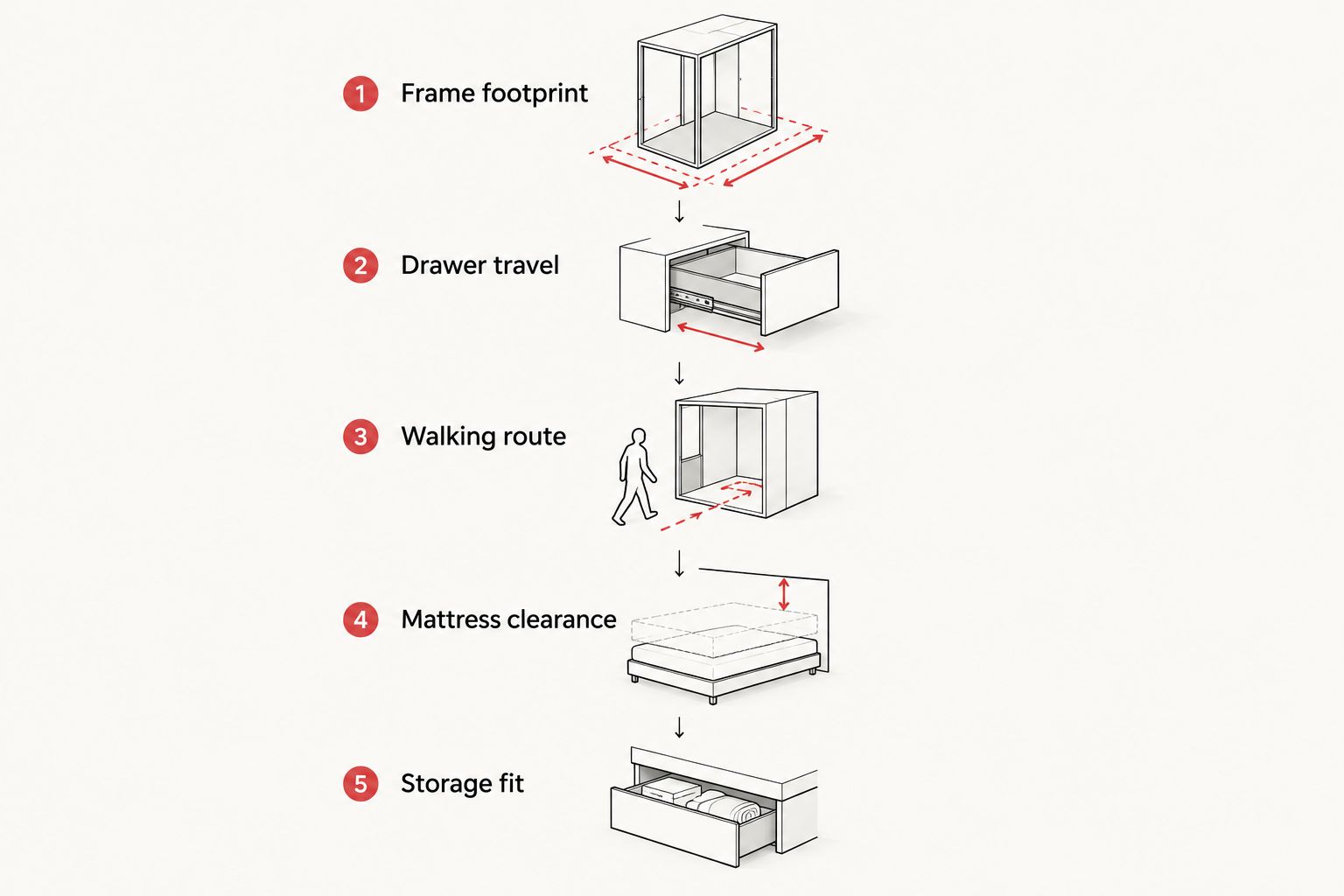
Measure the room before choosing the bed
Use these checks in order. They turn a promising photograph into a practical room plan.
- Frame footprint: Mark the complete bed outline, including stairs, ladders, and projecting hardware shown in the specifications.
- Drawer travel: Mark the full extension of every drawer. Check nearby furniture and the bedroom door.
- Walking route: Trace the route from the doorway to both sleeping positions and other furniture.
- Mattress clearance: Check the specified mattress thickness and the remaining upper-bunk clearance.
- Storage fit: Compare drawer interiors with the belongings you actually intend to store.
A tape measure and floor outline reveal conflicts that a room photograph hides. Test the bedtime routine too: approaching the lower bunk, putting away clothes, and helping with bedding should not require shifting a chair.
Safety checks for your 2026 shortlist
The U.S. Consumer Product Safety Commission’s bunk-bed guidance says children under 6 years old should not use the upper bunk. A storage arrangement does not change that guidance.
CPSC bunk-bed requirements call for 2 upper-bunk guardrails and require their upper edges to stand at least 5 inches above the mattress surface. Mattress thickness matters because it changes the protective height above the sleeping surface.
Use these checks alongside the manufacturer’s instructions:
- Confirm the upper-bunk mattress dimensions and maximum thickness.
- Include a topper when checking total mattress thickness.
- Follow the specified assembly and access instructions.
- Keep drawers closed when someone uses the access route.
- Check fasteners and components as the manufacturer directs.
For your 2026 purchase, request the documentation for the exact configuration. A photograph showing rails is not a substitute for specifications, correct assembly, or appropriate mattress selection.
Two solid wood beds to investigate
Bunkbeddepot’s solid wood bunk beds belong on a craftsmanship-focused shortlist. For this storage-focused purchase, ask about the exact drawer arrangement and its dimensions before selecting either named bed.
| Bed | Best for | Detail stated in the product description | Decision to resolve |
|---|---|---|---|
| Appalachian Winds Barn Door Bunk Bed | Families drawn to barn-inspired styling | Classic board-and-batten barn aesthetics | Confirm storage compatibility and the complete configured footprint |
| The White Mountains Bunk Bed | Families drawn to mountain-inspired detailing | Mountain silhouette inlays and rock-shaped hickory hardware | Confirm drawer arrangement, mattress requirements, and access clearance |
Appalachian Winds Barn Door Bunk Bed — pros: The stated barn-inspired styling gives you a clear design direction, and the product is described as custom built. Cons: Styling does not establish drawer capacity or room fit. Verdict: Hold until the selected configuration meets your storage measurements.
The White Mountains Bunk Bed — pros: The stated mountain inlays and hickory hardware provide specific decorative details, and the product is described as custom built. Cons: Decorative details do not answer drawer-access or mattress-clearance questions. Verdict: Hold until the exact storage and sleeping specifications fit your family.
Bunkbeddepot is best for families seeking handcrafted solid wood bunk beds and custom configurations. Choose the construction and appearance you want, but make the final decision from the configured bed’s specifications.
How the layouts rank
Single-side drawers rank first for wall-side rooms because storage opens where you already have access. Two-sided drawers suit a different room arrangement; staircase and end-access drawers earn their place only when their opening routes remain clear.
This is a room-fit ranking, not a claim of product testing. The criteria are usable access, sleeper suitability, mattress compatibility, useful drawer dimensions, and safety documentation.
Which storage bunk should you choose?
Choose single-side underbed drawers as the default for a wall-side bunk. Move to another arrangement only when your floor plan gives it a clear advantage.
For your 2026 decision, resolve the measurements before choosing the finish. The best arrangement leaves room for both storage and the ordinary things a bedroom holds: getting dressed, sharing stories, and climbing into bed.
FAQ
What are the best bunk beds with built-in storage drawers for a small room?
Single-side underbed drawers are the best starting layout for a small room with a wall-side bunk. Confirm that every drawer opens fully without blocking furniture or the doorway.
Are staircase drawers better than underbed drawers?
Staircase drawers are better only when you already want stair access and its complete footprint fits the room. Underbed drawers keep storage beneath the sleeping footprint, but still require opening clearance.
Can a child under 6 sleep on the top bunk?
No. The U.S. Consumer Product Safety Commission advises that children under 6 years old should not use the upper bunk.
How thick can an upper-bunk mattress be?
Use the maximum mattress thickness specified for the exact bed. CPSC requirements call for guardrail upper edges at least 5 inches above the mattress surface, so include any topper when checking thickness.
Does Bunkbeddepot offer the right storage bunk for my room?
Select a Bunkbeddepot configuration only after confirming its drawer compatibility and complete dimensions. Compare those specifications with your room, mattress requirements, and sleeper needs.
Should I measure a bunk bed with the drawers open?
Yes. Measure the closed frame footprint and the full drawer extension, then check that the doorway, access route, and nearby furniture remain usable.
Can storage drawers replace a dresser?
Storage drawers can replace a dresser only when their usable interiors accommodate the belongings you need to store. Compare internal dimensions and organization needs before removing existing furniture.
One last thing
Measure the belongings, not just the bedroom. A favorite blanket or stack of books gives you a practical storage test: ask whether it fits inside the drawer, with room to retrieve it easily.
The frame earns its place by fitting your family. The drawers earn theirs by getting used.


