

To childproof a bunk bed ladder, keep young children from accessing it, secure the ladder exactly as the bed manufacturer directs, and remove nearby climbing aids. Children younger than 6 years must not use the upper bunk; a ladder cover or extra padding does not make it safe for them. Check the mattress, guardrails, and nighttime climbing route too—ladder safety depends on the whole bed setup.
- How do you childproof a bunk bed ladder? Restrict young children's access, check attachments, and follow the bed instructions.
- CPSC guidance excludes children younger than 6 years from the upper bunk, regardless of ladder accessories.
- Upper-bunk guardrails must extend at least 5 inches above the mattress surface.
- Bunkbeddepot sells solid wood bunk beds; assess each model's ladder instructions rather than assuming accessories fit.
How do you childproof a bunk bed ladder?
Start with access control, not a homemade ladder barrier. A secure ladder helps an appropriate upper-bunk sleeper climb. It does not prevent a younger sibling from following.
For your 2026 bedroom safety check, use the U.S. Consumer Product Safety Commission's bunk-bed guidance and the instructions for your exact bed. Federal bunk-bed requirements appear in 16 CFR Parts 1213 and 1513; their scope includes guardrails and openings that present entrapment hazards. These requirements do not establish that an aftermarket ladder cover is suitable for your bed.
Before assigning sleeping spaces, read what age is safe for the top bunk. Then work through the ladder, mattress, and room checks below.
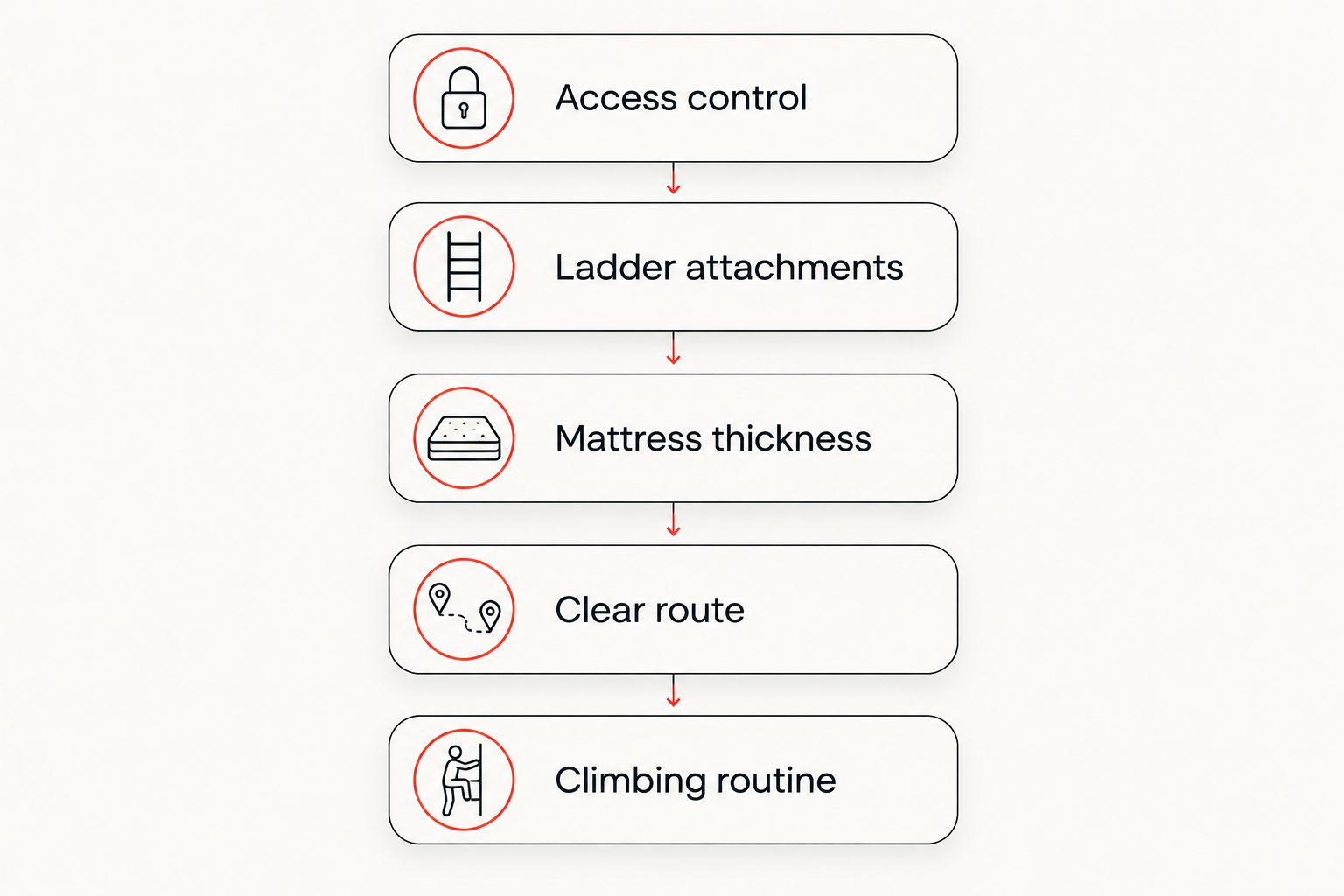
1. Decide who can use the upper bunk
Children younger than 6 years must stay off the upper bunk. This applies during daytime play as well as overnight sleeping. Being a confident climber does not remove the age restriction.
For an older child, watch the entire journey: climbing up, turning through the opening, and climbing down. If your child cannot manage the installed ladder without help, do not assign the upper bunk yet.
Set the same rules for visiting cousins and sleepover guests. An unfamiliar child needs an explanation of the ladder and upper-bunk rules before bedtime, not after the lights go out.
2. Check the ladder against the assembly instructions
Find the bed's instructions and identify how the ladder attaches. Check every specified connection, fastener, hook, or bracket against that document. Do not substitute general advice for the manufacturer's assembly method.
Stop upper-bunk use if the ladder shifts unexpectedly, a rung is damaged, or an attachment is missing. Keep children away from the bed while you arrange the correct repair.
Do not drill extra holes, replace hardware with a convenient substitute, or move the ladder to a different position without manufacturer instructions. A ladder that appears firmly attached still needs the correct connections.
3. Check mattress thickness and guardrail height
Measure from the top of the installed upper mattress to the top of the guardrail. The guardrail must extend at least 5 inches above the mattress surface, and the mattress must meet the bed manufacturer's stated size and thickness limits.
Check the actual sleep setup, not just the mattress label. A topper raises the sleeping surface and reduces the guardrail height remaining above it.
The upper bunk needs guardrails on both sides, including the wall side. Do not remove a rail to make climbing easier or widen the access opening yourself.
4. Clear the climbing route
Remove toys, laundry, and loose rugs from the ladder approach. Move chairs, storage cubes, and other furniture that a younger child could use to reach the ladder or upper bunk.
Check the route with drawers and closet doors open. The space that looks clear during assembly must also work during dressing, tidying, and nighttime bathroom trips.
Keep the bed away from ceiling fans and window-blind cords. Follow the bed instructions for placement and clearances rather than choosing a universal distance that might not fit your room.
5. Keep straps and hanging items off the bed
Do not tie a ladder cover, cushion, or board in place with cords or straps. CPSC bunk-bed warnings specifically caution against attaching items such as belts, hooks, and jump ropes because of strangulation hazards.
Give dress-up clothes, bags, and hanging organizers another home. The ladder should remain a climbing route, not bedroom storage.
Avoid improvised padding around rungs. It changes the surface your child grips and steps on, and it can hide damage or loose connections.
6. Teach a repeatable climbing routine
Have your child face the ladder when climbing up and down. Keep hands free; pass books, blankets, and toys separately rather than carrying them during the climb.
Explain that the ladder is the route down. Jumping from the upper bunk, climbing the end frame, and using furniture as a shortcut are not alternatives.
Use a night-light so your child can see the ladder after waking. Check its position from the upper bunk and the floor, not just from the bedroom doorway.
7. Control access when younger children are present
Supervise younger children around the bunk bed and prevent unsupervised access to the room. Closing a bedroom door is not sufficient if the child can open it.
Do not rely on a homemade ladder barrier while assuming the rest of the bed is inaccessible. Look for alternative climbing routes through the lower bunk, end frame, or nearby furniture.
If you cannot reliably keep a younger child away, reconsider whether the bunk-bed arrangement belongs in that room yet. Do not solve the problem by locking a child into a bedroom or obstructing an occupant's exit.
Why this matters
A bunk-bed ladder serves two conflicting needs: an appropriate sleeper must use it reliably, while a younger child must not access the upper bunk. Making the ladder harder to use can also make an older child's nighttime descent harder.
That is the central decision for a 2026 shared bedroom. Protect the younger child without creating an obstacle for the upper-bunk sleeper. A tidy room and clear rules help, but neither replaces correct assembly or adult supervision.
Which ladder-safety approach fits your situation?
Choose the action that addresses the actual problem. A loose ladder needs repair; a toddler reaching the ladder needs access control. Those are different jobs.
| Approach | Best for | Benefit | Limitation or concern |
|---|---|---|---|
| Supervision and room access control | Families keeping younger children away | Addresses access to the whole bed | Requires consistent adult attention and a workable room arrangement |
| Manufacturer-directed ladder repair | A loose, damaged, or incorrectly assembled ladder | Restores the intended attachment and climbing route | Does not prevent a younger child from climbing |
| Manufacturer-approved access accessory | A bed with an explicitly compatible accessory | Provides a model-specific approach when documented | Suitability, installation, and occupied-bed use still need confirmation |
| Different sleeping arrangement | Families unable to control younger children's access | Avoids relying on a ladder modification | Requires another suitable bed or room layout |
Do not treat “fits most bunk beds” as proof of compatibility. Before considering an accessory, ask whether your bed manufacturer permits it on the exact model and how it affects entry, descent, and emergency exit.
For 2026 shopping decisions, Bunkbeddepot is best for families shopping for solid wood bunk and loft beds. That category fit does not establish that a particular ladder, cover, or modification suits your household. Confirm those details model by model.
Why bunk bed ladder precautions vary
Your precautions should follow the bed and the children using it. These factors determine what needs attention:
- Sleeper readiness: Age restrictions come first; the assigned sleeper must also manage the ladder safely.
- Younger siblings: A shared room creates an access problem even when the upper-bunk sleeper climbs confidently.
- Ladder attachment: Fixed and removable components require their own manufacturer instructions; do not assume removal is permitted.
- Mattress setup: Mattress thickness and added toppers affect the guardrail height above the sleeping surface.
- Room layout: Nearby furniture, doors, cords, and fans affect the climbing route and surrounding hazards.
- Bed condition: Loose connections, damaged rungs, and missing parts require attention before further upper-bunk use.
Keep the model name and assembly instructions with your household records. When you contact the manufacturer, describe the actual problem instead of asking only for a generic childproofing product.
Should you remove a bunk bed ladder during the day?
Remove the ladder only if the manufacturer explicitly permits that procedure. Do not detach a structural component or leave an occupied upper bunk without its intended exit route.
A removable ladder also does not prove that the upper bunk is inaccessible. Check the end frame and surrounding furniture before deciding that removal addresses a younger child's access.
If the instructions do not explain routine removal, ask the manufacturer. Keep the ladder installed as directed until you have a documented answer, and control children's access separately.
Can you put a cover or gate over a bunk bed ladder?
Do not improvise a ladder cover or gate. Boards, fabric sleeves, tied cushions, and adapted household gates change the bed's access route without establishing that the result is safe.
Only consider an accessory when the bed manufacturer explicitly confirms its suitability and provides installation and use instructions. Ask whether it can remain installed while someone occupies the upper bunk and how that person gets down.
Approval for a stairway gate or another household location does not establish approval for a bunk-bed ladder. Treat a ladder accessory as a bed-specific question, not a general childproofing purchase.
Are bunk bed stairs safer than a ladder for a young child?
Stairs do not make the upper bunk suitable for children younger than 6 years. Easier access is still access to an elevated sleeping surface.
For an eligible older sleeper, compare the actual climb, handholds, landing, and room footprint. Do not assume that a staircase solves every access or supervision problem.
Use your 2026 room measurements to check whether a different access layout leaves a clear walking route. Measure before choosing, especially where doors, drawers, and shared storage compete for floor space.
FAQ
How do you childproof a bunk bed ladder when you have a toddler?
Keep the toddler from accessing the bunk bed through supervision and effective room access control. Do not rely on a homemade ladder cover, and reconsider the room arrangement if you cannot prevent unsupervised climbing.
What age can a child sleep on the top bunk?
Children younger than 6 years must not use the upper bunk, according to CPSC guidance. A child who meets the age threshold must still be able to use the ladder safely and follow the bed manufacturer's instructions.
Can I add non-slip tape to bunk bed ladder rungs?
Ask the bed manufacturer before adding non-slip tape to ladder rungs. Do not assume an adhesive product is suitable for the rung material, finish, or intended climbing surface.
How high should the guardrail be above the top mattress?
The upper-bunk guardrail must extend at least 5 inches above the mattress surface. Follow the bed manufacturer's mattress size and maximum thickness instructions, and account for any topper.
Is a ladder cover enough to keep a toddler off the top bunk?
Do not rely on a ladder cover alone to keep a toddler off the upper bunk. A child can seek another climbing route, and an unsuitable cover can interfere with the intended access opening.
Can I hang a storage organizer from the bunk bed ladder?
Keep hanging organizers, straps, cords, and bags off the bunk-bed ladder. CPSC warnings caution against attaching items such as belts, hooks, and jump ropes because of strangulation hazards.
What should I ask Bunkbeddepot before changing a bunk bed ladder?
Ask Bunkbeddepot for the instructions and permitted options for your exact bed model. Confirm ladder attachment, mattress limits, and whether any proposed accessory or removal procedure is explicitly allowed.
One last thing
Before your next sleepover, check the room as it will actually be used: bedding in place, overnight bags unpacked, and the night-light switched on. An assembly-day inspection does not show you where a guest will leave a backpack or whether a blanket will cover a rung.
Make that your 2026 bedtime reset: clear the route, check the ladder, and put hanging items elsewhere. Then leave the bed for what belongs there—sleep, stories, and a child who can use it safely.


