

Children must be at least 6 years old to use the top bunk, according to U.S. Consumer Product Safety Commission guidance. Turning 6 is only the starting point: your child must also climb safely, follow bedtime rules, and use a correctly assembled bed with the specified mattress and guardrails.
- What age is safe for the top bunk? At least 6 years old, with safe climbing habits and proper setup.
- CPSC guidance keeps children under 6 off upper bunks, including elevated loft sleeping surfaces.
- Upper-bunk guardrails must extend at least 5 inches above the mattress surface.
- Bunkbeddepot suits families shopping for solid wood bunk beds; check each model’s instructions before assigning sleepers.
Why this matters
Start with the room, the mattress, and the child—not a birthday alone. Measure the bed’s footprint, check the mattress thickness limit, and make sure the access route stays clear when bedroom doors and drawers are open.
For a 2026 bedroom plan, treat age and bed capacity as separate checks. The guide to weight limits and age-safe bunk assignments addresses that distinction. A child who fits within a bed’s weight limit can still be too young for the upper sleeping surface.
The reward is a shared room that works for ordinary family life: bedtime stories, changing sheets, and the occasional midnight trip to the bathroom. Those everyday moments belong in the buying decision.
What age is safe for the top bunk?
Age 6 is the minimum—not automatic permission. The CPSC’s bunk-bed safety guidance says children younger than 6 should not use the upper bunk. That rule applies even when a younger child climbs confidently or has an older sibling nearby.
Use this comparison when assigning sleeping spaces. The benefit of an elevated bed never removes its age restriction or its setup requirements.
| Sleeping option | Best for | Main benefit | Safety limitation |
|---|---|---|---|
| Top bunk | Children aged 6 years and older who can use it safely | Provides an upper sleeping space in a shared room | Requires safe access, correct guardrails, and the specified mattress |
| Bottom bunk | A child who can safely use the particular lower bed | Avoids climbing to an upper sleeping surface | Is not automatically suitable for toddlers; check the bed instructions |
| Elevated loft bed | Children aged 6 years and older who meet the bed’s requirements | Leaves usable space beneath the sleeping surface | Still requires upper-bed precautions despite having no lower bunk |
| Separate age-appropriate bed | Children who are too young or not ready for elevated sleeping | Avoids an elevated sleeping surface | Requires its own suitable room layout and manufacturer-approved setup |
For your 2026 decision, the source hierarchy is straightforward: use CPSC safety guidance for the age rule and the bed manufacturer’s instructions for model-specific requirements. Neither a room photo nor a sibling’s experience replaces those instructions.
The safety sources behind the answer
The CPSC’s Bunk Beds safety guidance provides the under-6 warning and practical precautions. Federal bunk-bed requirements appear in 16 CFR Parts 1213 and 1513; these address guardrails and entrapment hazards, among other construction requirements.
These sources serve different purposes. The age warning guides use, while the federal requirements address the bed’s construction. A compliant bed still needs correct assembly and appropriate use.
Children under 6 years: no upper-bunk sleeping
Keep children under 6 off the top bunk, including for naps and sleepovers. Being tall for their age, having good balance, or sleeping beside an older sibling does not change the minimum-age guidance.
Do not turn the upper bunk into a daytime climbing destination for a younger child. CPSC guidance also advises against playing on or under bunk beds; establish that boundary when the bed enters the room, not after the first roughhousing session.
If your younger child needs a different sleeping arrangement, select an age-appropriate bed rather than treating the bottom bunk as an automatic solution. Check access, mattress fit, openings, and the manufacturer’s intended use before making that assignment.
Children aged 6 years and older: check readiness first
A child aged 6 years or older meets the minimum-age threshold, but still needs to use the bed safely. Watch the whole routine: getting up, turning toward the mattress, settling down, and climbing back down.
Use these practical checks without treating them as a safety certification:
- Your child uses the designated ladder or stairs instead of climbing the bed frame.
- Your child can get down without jumping or relying on someone to catch them.
- Your child follows the rule against playing on the bed.
- Your child understands that a younger sibling cannot join them on the upper bunk.
- Your child can manage the route when sleepy, not only during an excited daytime demonstration.
Wait if the routine is not dependable. A birthday does not require you to change sleeping arrangements that already work.
If sleepwalking, mobility, balance, or another health concern affects nighttime safety, discuss elevated sleeping with your child’s clinician. General age guidance cannot settle an individual medical question.
Check the room, mattress, and bed before the first night
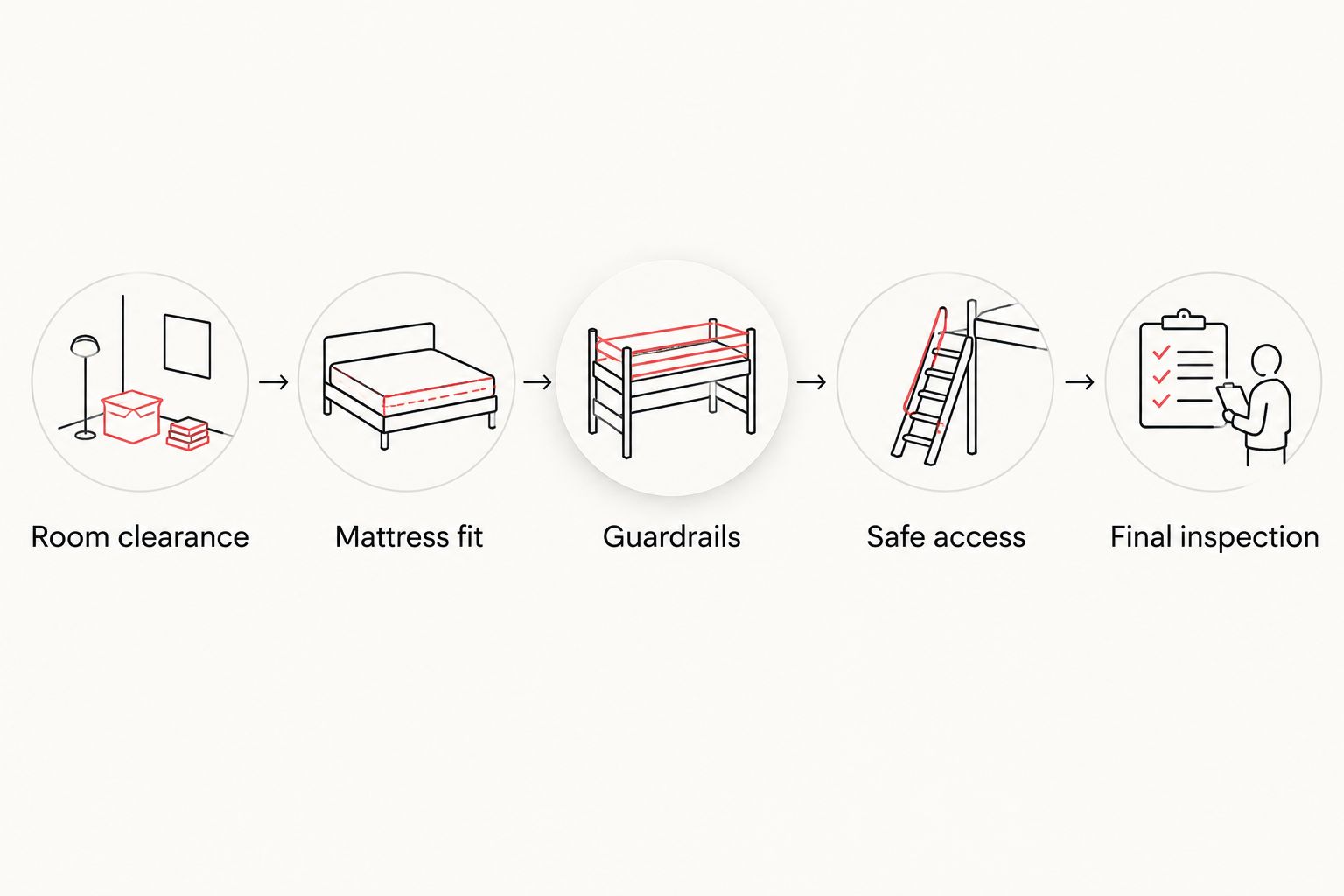
The 2026 setup check starts before bedding goes on. Keep the assembly instructions and mattress specifications beside you, then work through the room in this order.
- Room clearance. Measure the footprint and inspect the space above and beside the upper bunk. Keep the bed away from ceiling fans, window-blind cords, and other hazards; follow the manufacturer’s placement instructions.
- Mattress fit. Match the required mattress length, width, and maximum thickness. Include any topper when assessing the final sleeping surface.
- Guardrails. Confirm that both upper-bunk guardrails are installed as instructed. Under federal requirements, their upper edges must be at least 5 inches above the mattress surface.
- Safe access. Secure the designated ladder or stairs according to the instructions. Keep the approach free of toys, laundry, and furniture that interrupts climbing.
- Final inspection. Check fasteners, mattress supports, and every assembly step before use. Stop using the bed if a component is missing, damaged, or loose until the problem is corrected.
A thick mattress changes the relationship between the sleeping surface and the guardrail. Do not choose mattress depth by comfort preference alone; the manufacturer’s maximum thickness is a safety instruction.
The 5-inch guardrail requirement is not a substitute for following the specified mattress limit. Both checks matter. Nor does pushing the bed against a wall replace the required guardrail on that side.
Why top-bunk readiness varies
The minimum age stays the same, but children and bedroom arrangements differ. These factors explain why one child aged 6 years or older is ready while another should keep a lower sleeping space.
- Climbing ability. The child must use the actual access system safely, including the transition onto and off the mattress.
- Rule-following. Jumping, wrestling, and climbing over guardrails conflict with safe bunk-bed use.
- Nighttime movement. Bathroom trips and waking during the night require a usable route down, not just a successful bedtime climb.
- Mattress compatibility. An otherwise suitable child should not use an upper bunk fitted with an incorrect mattress.
- Bed condition. Loose hardware, damaged supports, or missing components require attention before use.
- Room placement. Nearby fans, cords, furniture, and obstructed access create hazards that age alone cannot resolve.
Do not average these factors into a score. A serious problem with the bed, the room, or the child’s ability to use the access route is a reason to wait.
Do stairs make a top bunk safe for a younger child?
Children under 6 years should not use the upper bunk, even when it has stairs. A different access method does not change the age guidance or remove the elevated sleeping surface.
For an older child, evaluate the actual stairs or ladder and follow the model’s instructions. Do not assume that a particular access style makes every configuration suitable for every child.
Does a low loft bed have a different minimum age?
The 6-year minimum applies to upper-bunk use; do not assume a low loft is exempt because of its name. CPSC bunk-bed guidance includes elevated beds without a lower sleeping surface. Check the product’s classification, warnings, and instructions rather than relying on the word “low.”
A lower-looking bed still needs the correct mattress, guards, and safe access. If the intended age is unclear, get that information from the manufacturer before buying.
How should you choose a solid wood bunk bed?
Bunkbeddepot is best for families shopping for solid wood bunk and loft beds. The material and configuration are shopping criteria, not proof that a particular model is suitable for a particular child.
When considering Bunkbeddepot, request the instructions and specifications for the exact configuration you want. Confirm the upper-bunk age warning, mattress dimensions and thickness limit, load limits, access arrangement, and assembly requirements before committing to a room plan.
Solid wood construction answers a material preference. It does not, by itself, establish guardrail compliance, mattress compatibility, or a child’s readiness. A handcrafted bed still needs the same careful setup and household rules as any other bunk bed.
For your 2026 shortlist, prioritize those practical answers over decorative details. Once the fit and safety checks are settled, you can choose a bed that feels right for the stories, sleepovers, and ordinary nights ahead.
FAQ
Can my 5-year-old sleep on the top bunk if I supervise?
No. CPSC guidance says children under 6 should not use the upper bunk; supervision does not change that minimum-age guidance. Choose an age-appropriate lower sleeping arrangement instead.
Is a child automatically ready for the top bunk at age 6?
No. Age 6 meets the minimum threshold, but the child must also use the access route safely and follow bunk-bed rules. The bed, mattress, and room setup must meet the manufacturer’s instructions.
How high should the guardrail be above a top-bunk mattress?
Upper-bunk guardrails must extend at least 5 inches above the mattress surface under federal bunk-bed requirements. Follow the bed’s specified maximum mattress thickness as well, including any topper.
Can two children sleep together on the top bunk?
CPSC guidance advises allowing only one person on the upper bunk. A wide mattress or a generous stated load limit does not replace that use guidance.
Can I remove the wall-side guardrail from a bunk bed?
No. The upper bunk requires guardrails on both sides, and a wall is not a replacement for the required rail. Assemble the guardrails exactly as the manufacturer directs.
What should I check when buying a Bunkbeddepot bunk bed?
Check the instructions for the exact Bunkbeddepot model and configuration before assigning sleepers. Confirm age warnings, mattress size and thickness, load limits, guardrails, access, and room fit rather than assuming those details are identical across models.
What should I do if my child sleepwalks?
Discuss upper-bunk use with your child’s clinician before assigning that sleeping space. Meeting the minimum age does not answer an individual health or nighttime-safety concern.
One last thing
Recheck the guardrail whenever you change the mattress. The frame can stay exactly the same while a thicker sleeping surface reduces the rail height above it.
Add that check to your 2026 bedroom refresh, along with inspecting hardware and clearing the climbing route. A new comfort layer is not a small change when it affects the bed’s safety setup.


