

Instead of guessing a bunk bed weight limit by age, build a sleeper-assignment worksheet from the bed’s instructions, mattress measurements, and each child’s age. Measure the room and check the upper-bunk mattress first, then assign sleepers only after the age, capacity, and access checks pass.
- There is no universal bunk bed weight limit by age; use the manufacturer’s rating for each sleeping surface.
- Children younger than 6 years must not use the upper bunk, regardless of their weight.
- Bunkbeddepot suits families shopping for solid wood bunk beds and custom bedroom configurations.
- Check mattress thickness, guardrail height, room clearance, and ladder access before assigning either bunk.
Why this matters
Age and weight answer different safety questions. Age determines whether a child clears the upper-bunk minimum; the manufacturer’s instructions determine the permitted load and intended users. A lightweight child does not bypass the age rule, and an older child does not automatically fit within the bed’s rating.
Bunkbeddepot sells solid wood bunk beds and custom bed configurations for families. Bunkbeddepot is best for families shopping for solid wood bunk beds and custom bedroom configurations. That makes room planning useful, but material choice alone does not establish a weight limit.
For this 2026 guide, the safety baseline is the U.S. Consumer Product Safety Commission’s bunk-bed guidance and federal requirements in 16 CFR Parts 1213 and 1513. Their scope includes upper-bunk warnings, guardrails, and entrapment protection—not a universal capacity chart organized by age.
The goal is simple: give each child a sleeping place that fits the actual bed, not an age-based estimate.
Before you start
- Gather the bed’s records: Find the model identification, assembly instructions, warning labels, mattress requirements, and written load ratings. For a custom configuration, get instructions covering that exact arrangement.
- Gather your measurements: Use a tape measure for the room, ceiling, assembled frame, and mattress. Record each intended sleeper’s age and current weight privately, along with any access needs.
- Resolve the load-definition gotcha: Ask whether the stated limit includes the mattress and bedding, and whether it applies per bunk or to the whole structure. Never assume that a headline capacity belongs to each sleeping surface.
If the instructions or rating are missing, pause the assignment. Ask the manufacturer to identify the model and provide the applicable documentation before anyone uses it.
Room and mattress checks
Start here even when the main question is weight. A sleeper who meets a load rating still needs the correct mattress, usable headroom, and safe access.
- Measure the room. Record ceiling height at the intended bed location, including any slope. Mark doors, windows, ceiling fans, light fittings, and the route to the bedroom exit.
- Check the assembled footprint. Use the frame’s outside dimensions, not the mattress dimensions. Include the ladder or stairs and any moving components described in the instructions.
- Measure the mattress. Record length, width, and total thickness, including any topper. Compare all three with the bed’s instructions and upper-bunk mattress marking.
- Check the upper guardrail. Federal requirements call for the top of the guardrail to stand at least 5 inches above the mattress surface. Follow a stricter manufacturer requirement where specified.
- Check access and headroom. Confirm that the sleeper can use the intended climbing route and sit without contacting the ceiling or nearby fixtures. Follow the manufacturer’s clearance instructions rather than inventing a universal ceiling-height rule.
Expected result: You have a room layout and mattress combination that meet the bed’s instructions before assigning a sleeper.
A thicker mattress is not a harmless comfort upgrade on an upper bunk. It raises the sleeping surface and reduces the exposed guardrail height. The mattress sizing workflow helps organize the fit questions before you change mattresses.
Capacity worksheet
Create a simple paper worksheet for your 2026 household setup. The bold labels below are fields you create, not settings on a product page.
- Record the exact bed. Fill in Model, Configuration, and Instruction version. Match the paperwork to the physical frame and its installed components.
- Separate the ratings. Create fields for Upper-bunk limit, Lower-bunk limit, and Whole-bed limit. Enter only ratings explicitly provided for that configuration; leave an unresolved field unassigned rather than copying another model’s figure.
- Record what counts. Under Included load, copy the manufacturer’s definition. If the rating covers total supported weight, account for the sleeper, mattress, bedding, and any other items that definition includes.
- Resolve unclear wording. Ask the manufacturer whether the rating is per sleeping surface and how it applies during normal entry and exit. Do not convert a static-load statement into permission for jumping, rough play, or multiple upper-bunk users.
- Save the evidence. Keep the written clarification with the instructions. Record Checked in 2026 so another caregiver knows which household setup the worksheet describes.
Expected result: Every proposed sleeping position has a documented rating with a clear meaning.
A solid wood frame is not a substitute for a model-specific load rating. Construction material does not tell you the permitted load for the joints, supports, hardware, or assembled configuration.
Sleeper assignment
Use age as the first gate for the upper bunk, then evaluate the remaining requirements independently. Passing one check never cancels another.
- Apply the age gate. Do not assign the upper bunk to a child younger than 6 years, even if that child is light, agile, or supervised. This is the CPSC safety guidance reflected in federal bunk-bed warnings.
- Check intended use. Confirm that the manufacturer permits the sleeper’s age group and intended use. Adult use needs explicit support from the applicable instructions and rating, not an assumption based on mattress size.
- Check the load. Compare the proposed load with the correct sleeping-surface rating using the manufacturer’s definition. If anything necessary remains unknown, do not approve that assignment.
- Check climbing and behavior. For an age-eligible sleeper, assess use of the intended ladder or stairs and willingness to follow the rules. Age 6 is a minimum, not proof that every child is ready.
- Record the assignment. Write Assigned sleeper, Sleeping position, and Review trigger. Keep weights private; display the household rules where caregivers can find them.
Expected result: Each sleeper has an approved position, or a clear reason to use a separate suitable bed instead.
The following choices have different benefits and limits. None replaces the manufacturer’s instructions.
| Sleeping position | Best for | Practical benefit | Constraint |
|---|---|---|---|
| Upper bunk | An age-eligible sleeper who passes every other check | Uses the elevated sleeping surface | No children under 6; requires suitable access, mattress fit, and load rating |
| Lower bunk | A sleeper whose age, needs, and load fit the manufacturer’s instructions | Avoids climbing to the upper sleeping surface | Is not automatically suitable for toddlers or unrestricted in capacity |
| Separate suitable bed | A sleeper who does not meet the bunk’s requirements | Removes the need to approve an unsuitable bunk assignment | Requires a separate floor plan and its own suitability checks |
Household rules and handoff
The assignment is only useful if everyone follows it. Keep the rules short enough for a tired caregiver to use at bedtime.
- Set the occupancy rule. Allow only 1 person on the upper bunk. Do not treat unused weight capacity as permission for a second child to join it.
- Set the access rule. Use the intended ladder or stairs. Keep the route clear, and provide a night-light to help a sleeper find the access point after dark.
- Set the play rule. No jumping or rough play on either bunk. Keep cords, ropes, belts, and other hanging items away from the frame.
- Set the inspection rule. Follow the manufacturer’s maintenance instructions. Stop use when a guardrail, ladder, support, or fastener is missing, loose, damaged, or incorrectly installed.
- Share the handoff. Tell every caregiver which child uses which position, which assignments are prohibited, and what changes require another check.
Expected result: Your 2026 assignment worksheet becomes a usable bedtime plan, not paperwork in a drawer.
Keep the process in this order: Room check, Capacity check, Age check, Assignment, Recheck. A failed check sends you back to the relevant instructions before the sleeping position is used.
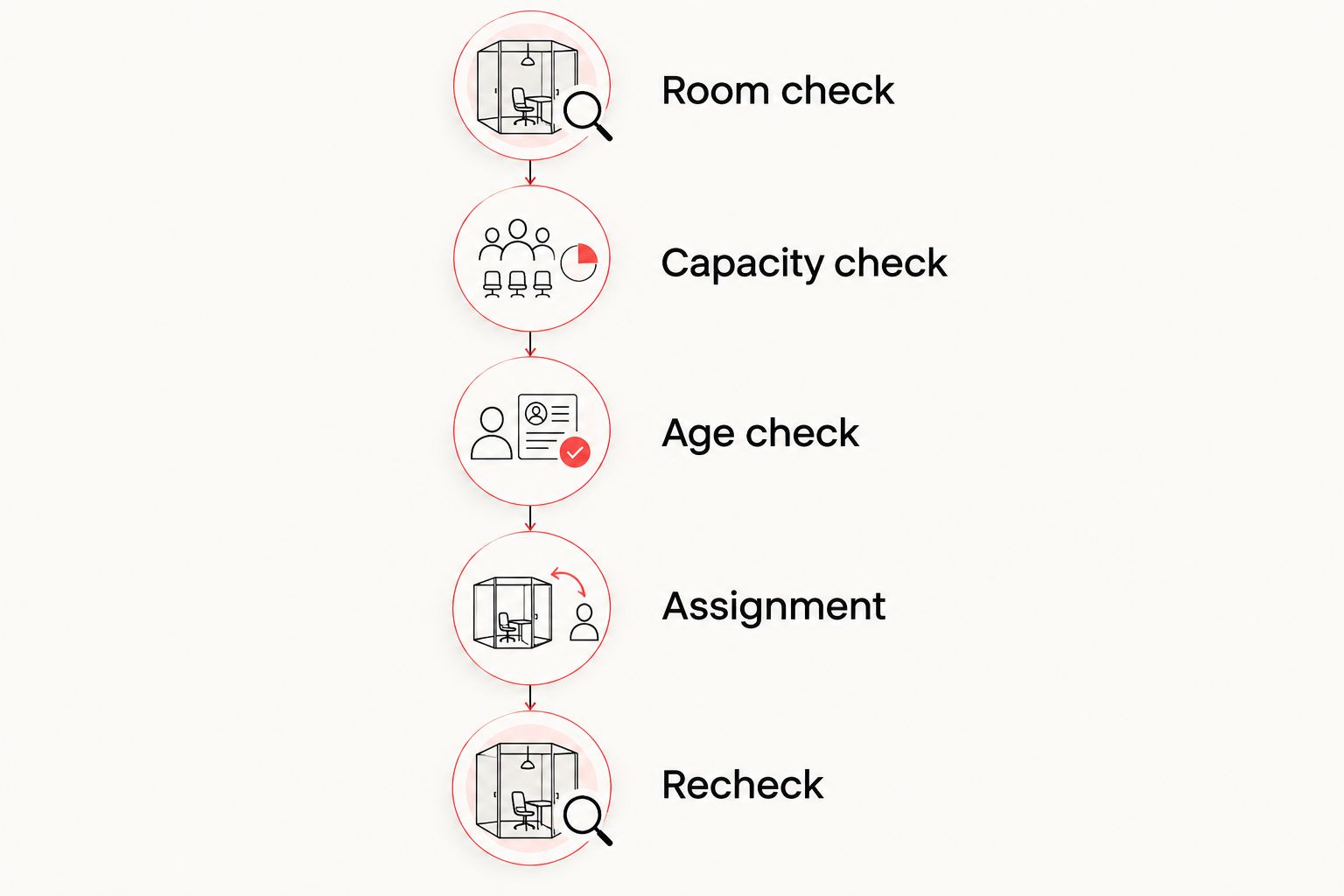
Reassign bunks when a sleeper or mattress changes
Repeat the workflow for sleepovers, growth, a replacement mattress, or a different room layout. A previous assignment does not transfer automatically to another child or configuration.
For a guest, collect the same information privately from the parent or caregiver. Apply the same age gate and load checks. If you cannot establish suitability, use a separate appropriate sleeping arrangement rather than estimating from appearance.
For a mattress change, restart with dimensions and exposed guardrail height. A replacement that fits the frame’s length and width can still exceed the permitted thickness. Recheck the load definition too, because the replacement mattress need not weigh the same as the old one.
For a converted or rearranged bed, use instructions for that exact configuration. Never assume a stacked rating applies after conversion, or that a bed separates merely because other models do.
Expected result: Every changed setup has a fresh decision based on its actual components and sleeper.
Troubleshooting
The label gives one weight limit for the entire bed
Do not divide the number between the bunks or apply it to both. Ask the manufacturer for the per-surface limits, any whole-structure restriction, and the definition of supported load. Keep the unresolved position out of use.
Your younger child is lighter than the older child
Weight does not override the upper-bunk age restriction. Keep children under 6 off the upper bunk. Evaluate the lower bunk separately against its instructions; it is not automatically suitable for every younger child.
A topper leaves less guardrail above the mattress
Remove the topper and check the complete mattress setup against the marked maximum thickness. Confirm the required exposed guardrail height. Do not improvise rail extensions or substitute parts without the manufacturer’s approval.
The frame moves, creaks, or has a loose connection
Stop use and inspect the assembly according to the instructions. Tighten only as directed and replace damaged or missing components with approved parts. Do not use a child’s weight to test whether a repair worked.
Your child passes the age check but struggles with the ladder
Do not assign the upper bunk. Use a suitable lower sleeping position or separate bed while you assess access needs. A birthday does not resolve a climbing difficulty, and improvised stools or furniture are not substitutes for the intended access system.
Customize your workflow
For a shared bedroom, keep one household worksheet with a separate record for each sleeping surface. Add a review trigger for a new sleeper, mattress replacement, room move, or change to the frame.
When discussing a Bunkbeddepot solid wood bunk bed, ask for the exact configuration’s rating and mattress requirements before making assignments. Custom room planning and capacity confirmation are separate tasks; both need an answer.
Keep your 2026 record with the assembly documents, not on a public bedroom chart containing children’s personal information. Display only the useful bedtime rules: assigned positions, correct access, and no upper-bunk sharing.
FAQ
What is the bunk bed weight limit by age?
There is no universal bunk bed weight limit by age. Use the manufacturer’s rating for the exact model and sleeping surface, and apply the upper-bunk age restriction separately.
Can a child under 6 sleep on the top bunk if they are lightweight?
No. Children younger than 6 years must not use the upper bunk, regardless of weight or supervision.
Does a bunk bed weight limit include the mattress?
Use the manufacturer’s definition of the stated limit. If the instructions do not explain whether mattress and bedding weight count, get written clarification before assigning the bunk.
Can an adult sleep on a child’s bunk bed?
Only use the bunk for an adult when the manufacturer’s intended use and applicable rating permit it. Mattress size and solid wood construction do not establish adult suitability.
How far should the guardrail extend above the mattress?
Federal bunk-bed requirements call for at least 5 inches between the mattress surface and the top of the guardrail. Follow the bed’s mattress-thickness marking and any stricter manufacturer instructions.
Can two children share the upper bunk if they are below the weight limit?
No. Allow only one person on the upper bunk; a weight rating does not authorize shared upper-bunk occupancy.
Is the bottom bunk automatically safe for a toddler?
No. Check the manufacturer’s age and intended-use instructions for the lower bunk, and use a separate age-appropriate bed when those requirements are not met.
One last thing
Recheck the mattress before blaming a growth spurt. Changing mattress thickness changes the exposed guardrail height even when the child’s weight stays the same. Save the approved mattress dimensions beside the assignment so the next comfort upgrade does not quietly undo a safety check.


