

Instead of repeatedly checking a wobbly ladder or guessing whether a thicker mattress leaves enough guardrail, work through the bunk bed ladder safety rail requirements before anyone sleeps upstairs. Measure the room, confirm the intended sleeper and mattress, assemble the exact configuration, then check the ladder and rails together.
- Bunk bed ladder safety rail requirements start with the specified mattress, secure access, and guardrails on both upper-bunk sides.
- Keep children younger than 6 years off the upper bunk, following CPSC safety guidance.
- Upper guardrails must extend at least 5 inches above the mattress top; thicker mattresses reduce that protection.
- Bunk Bed Depot suits families shopping solid wood bunk beds; verify each model’s instructions before choosing a configuration.
Why this matters
A bunk bed safety check starts with the mattress, not the ladder. Mattress thickness determines how much guardrail remains above the sleeping surface. Ladder placement determines where a child enters and whether the room leaves a clear approach.
Bunk Bed Depot sells solid wood bunk beds and loft beds for family bedrooms. That helps narrow the material choice. It does not replace checking the instructions, mattress limits, and safety documentation for the exact bed you choose.
The federal references for this 2026 checklist are the U.S. Consumer Product Safety Commission’s bunk bed guidance and 16 CFR Parts 1213 and 1513. These address entrapment and guardrail requirements; a parent’s room check does not reproduce the prescribed compliance tests.
Use this workflow to identify assembly problems and unanswered questions. Do not treat a tape measure, a sturdy feel, or a product photograph as proof of compliance.
Before you start
- Gather the exact model’s assembly instructions, hardware list, mattress specifications, warning labels, and manufacturer contact details. Keep a tape measure and the specified assembly tools nearby.
- Confirm the intended sleeper. CPSC guidance says children younger than 6 years must not use the upper bunk; an older child still needs to use the ladder safely and follow the bed’s warnings.
- Check the mattress and foundation combination before assembly. The overlooked problem is total sleeping-surface height: an added foundation or thicker mattress can leave too little guardrail above the mattress, even when the frame is assembled correctly.
Do not choose a mattress by its size name alone. Check its actual dimensions and thickness against the bed’s instructions, including any required foundation.
Room and sleeper fit
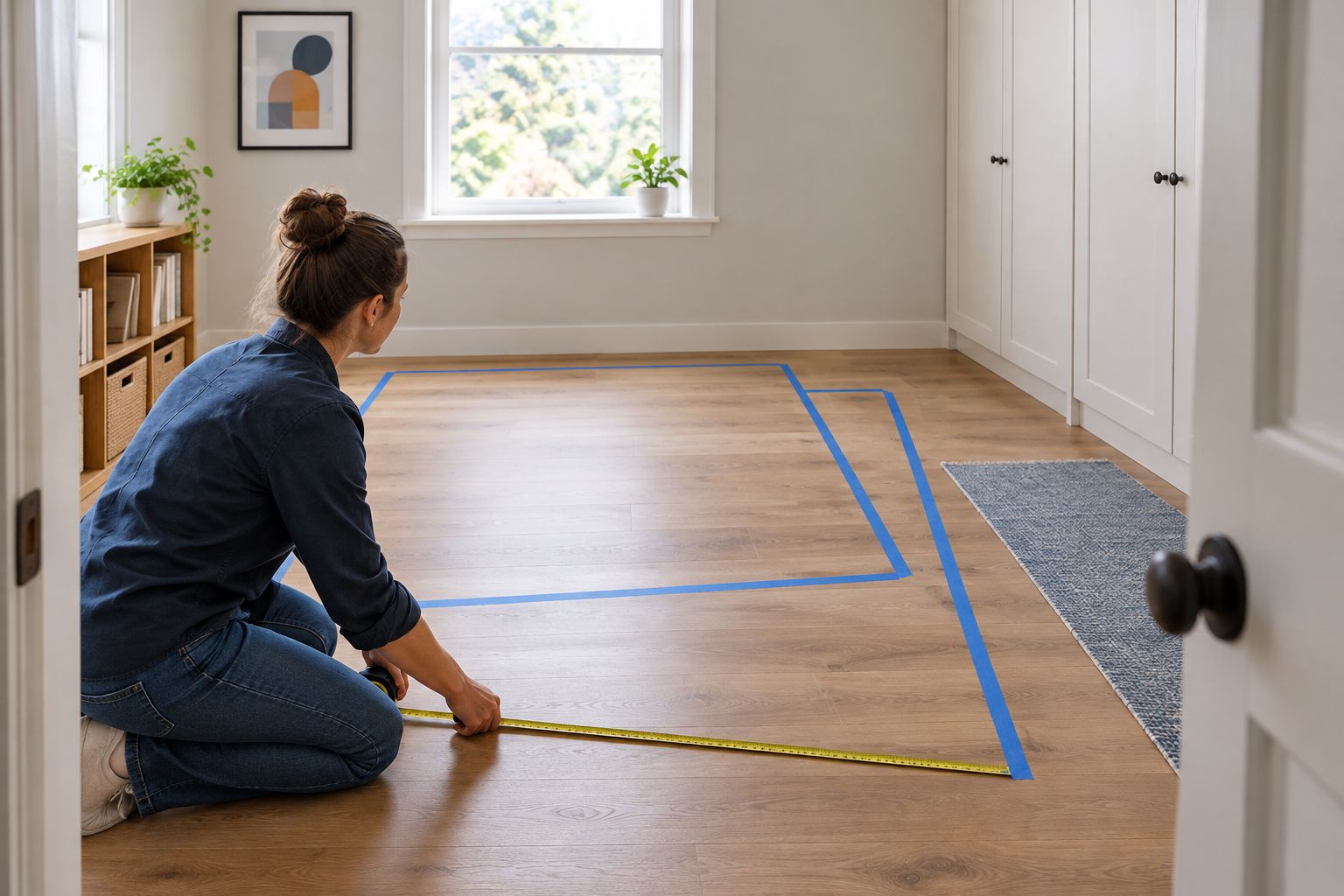
Measure the room
- Mark the footprint. Use the bed’s stated outside dimensions, not the mattress dimensions. Include the ladder’s projection into the room and any manufacturer-specified clearance.
- Check overhead hazards. Look for ceiling fans, light fixtures, sloped ceilings, and anything within reach of the upper bunk. Keep the bed away from window-blind cords and other hanging cords.
- Trace the climbing route. Open nearby doors and drawers. Confirm that the approach to the ladder does not depend on stepping over toys, furniture, or bedding.
- Check the sleeper’s position. Use the specified mattress height when assessing sitting space and access. A room that holds the frame is not automatically comfortable for its intended sleeper.
Expected result: You have a placement that accommodates the complete bed and a clear ladder approach without conflicts with nearby fixtures.
There is no single ceiling-clearance measurement that settles every bunk configuration. Follow the manufacturer’s instructions and assess the actual room rather than applying a generic clearance figure.
Match the sleeper
- Apply the age restriction. Keep children younger than 6 years off the upper bunk, including during sleepovers.
- Read the load instructions. Use the manufacturer’s stated limits and definitions. Do not assume a limit covers multiple people or excludes the mattress unless the instructions say so.
- Rehearse the route. After assembly passes inspection, supervise the intended sleeper climbing up and down without carrying objects. Follow the manufacturer’s climbing instructions.
- Set bedroom rules. No jumping, no playing on the upper bunk, and no improvised access from a dresser or chair. Follow the warning about the permitted number of upper-bunk occupants.
Expected result: The intended sleeper meets the age guidance, understands the rules, and can use the installed access route.
For your 2026 room plan, decide who sleeps where before choosing finishes. A younger sibling’s enthusiasm does not change the upper-bunk age restriction.
Mattress and guardrail checks
Confirm mattress fit
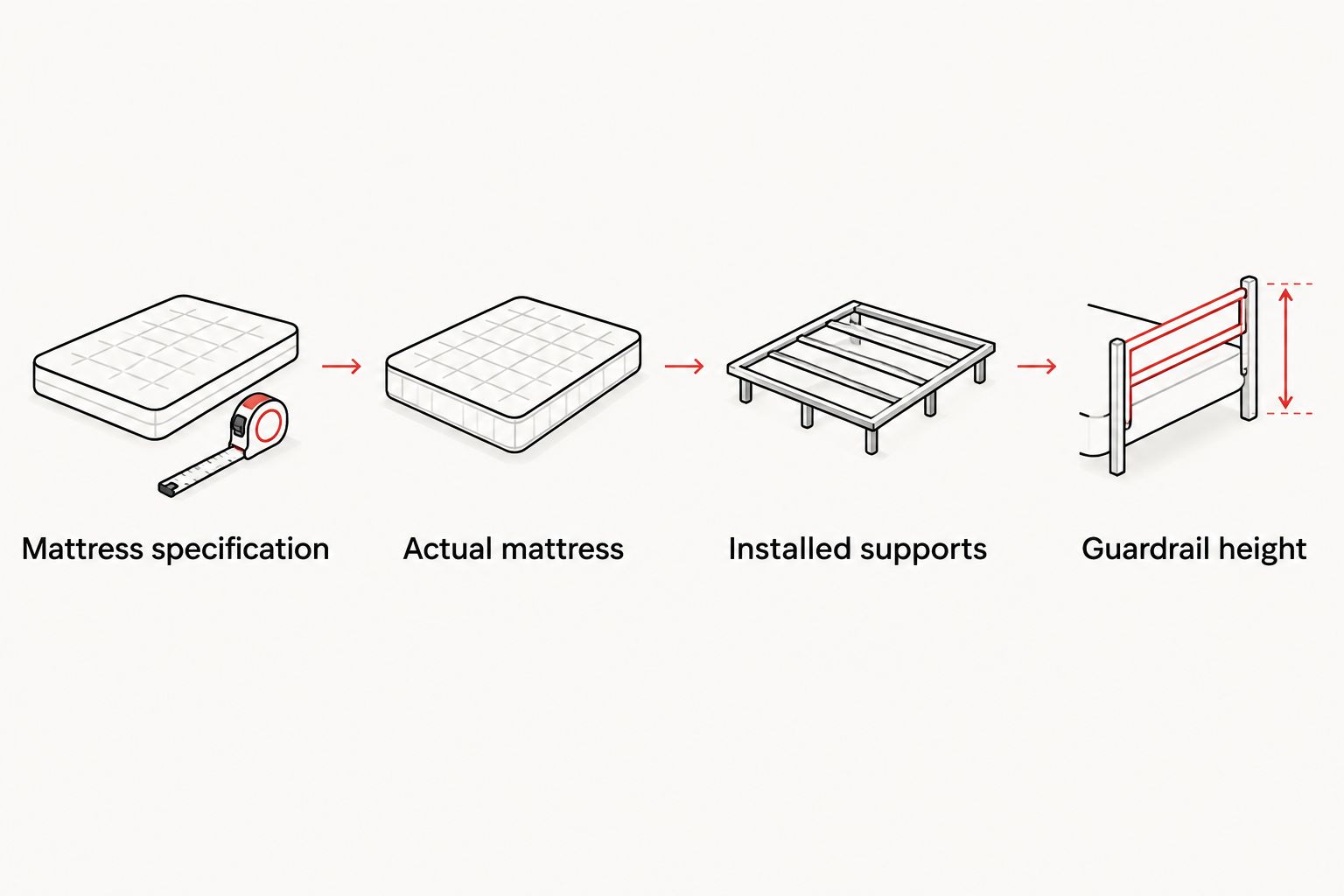
- Read the mattress specification. Locate the required length, width, maximum thickness, and foundation instructions for each sleeping level.
- Measure the actual mattress. Compare its dimensions with the instructions. Do not substitute a nearby size because it appears to fit inside the frame.
- Install the specified supports. Follow the instructions for slats, support hardware, and any foundation. Do not add a box spring or platform unless the manufacturer permits it.
- Measure above the mattress. With the specified mattress installed, measure vertically from its top surface to the top of the upper guardrail. Federal requirements call for at least 5 inches of guardrail above the mattress top.
Expected result: The mattress fits the specified opening and thickness limit, and the installed guardrails retain the required height above it.
That 5-inch measurement is a minimum requirement, not permission to exceed the manufacturer’s mattress-thickness limit. Both conditions must be satisfied. Account for any topper when checking the resulting sleeping-surface height.
Inspect the rails
- Check both long sides. Federal bunk bed requirements call for guardrails on both sides of the upper bunk. A bedroom wall does not replace a guardrail.
- Identify the continuous rail. The wall-side guardrail, or the side opposite the ladder, must run continuously between the end structures as specified by the federal rules.
- Check the access opening. Where a guardrail does not extend the full bed length, the gap between its end and the nearest bed end must not exceed 15 inches. Follow the exact model’s approved arrangement; this is not a DIY opening dimension.
- Secure every attachment. Install the specified rail fasteners and retention hardware. Do not omit a part because the rail appears to stay in place without it.
- Escalate suspicious openings. Ask the manufacturer about unexplained gaps around rails and end structures. Entrapment compliance involves prescribed test methods, not simply checking whether a child’s head appears to fit.
Expected result: Both rails occupy their intended positions, the access opening matches the approved assembly, and no safety question remains unresolved.
A home inspection cannot establish that a bed passes every opening test. For this 2026 safety check, use measurements to catch obvious mismatches and obtain the manufacturer’s documentation for questions about regulatory compliance.
Ladder installation and handover
Secure the access route
- Use the supplied ladder arrangement. Install the ladder in the location and orientation shown in the model’s instructions. Do not move it to the other end unless that configuration is explicitly permitted.
- Complete the connections. Fit every specified bolt, bracket, hook retainer, or other attachment that applies to that model. Use the required tools and tightening instructions.
- Inspect the climbing surfaces. Look for damage, loose steps, splinters, and anything that obstructs a foothold or handhold. Stop assembly if a component is cracked or does not fit as instructed.
- Check the transition. Confirm that the ladder leads to the intended upper-bunk opening without requiring the sleeper to climb over a rail.
- Clear the route. Keep bedding off the ladder and floor. Never hang belts, ropes, bags, or other items from the bed that create an entanglement or strangulation hazard.
Expected result: The ladder stays in its prescribed position, the climbing surfaces are sound, and the route reaches the intended opening.
Do not invent a load test by bouncing on the ladder. Follow the manufacturer’s inspection procedure and resolve movement or damaged hardware before use.
Record the handover
Save the instructions, model identification, mattress specifications, and assembly date together. Keep warning labels attached and readable. A simple 2026 setup record helps another caregiver understand the bed without relying on memory.
Before bedtime, demonstrate the route and explain the rules to every sleeper. Add suitable nighttime lighting so the ladder is visible, with cords kept away from the bed. The goal is an ordinary, repeatable routine—not a climbing adventure in the dark.
Repeat the workflow after a mattress or layout change
A mattress replacement, bedroom move, or manufacturer-approved conversion creates a fresh safety check. An earlier inspection does not cover a changed configuration.
| Workflow | Best for | Benefit | Limitation |
|---|---|---|---|
| First assembly | A new bed or newly assembled frame | Checks the entire setup before use | Requires complete instructions and all specified parts |
| Change-triggered inspection | A new mattress, moved bed, or approved reconfiguration | Catches differences from the original setup | Must revisit every affected connection and clearance |
After a mattress change, repeat the fit and guardrail measurements. After moving the bed, reassess the ladder approach, overhead hazards, and nearby cords. If you dismantled the frame, inspect and reassemble its connections exactly as instructed.
Only convert a bed when the manufacturer explicitly permits that conversion. A removable component is not evidence that another arrangement is approved.
Troubleshooting
The ladder shifts during climbing
Stop using the upper bunk. Compare the attachment points with the assembly instructions and check for missing retention hardware, incorrect positioning, or damaged parts. Ask the manufacturer for the specified correction; do not add improvised screws or brackets.
The guardrail looks too low
Measure from the mattress top, not the slats or frame. Check the mattress thickness and any added topper or foundation against the instructions. Do not remove supports or modify the rail to compensate for an incompatible mattress.
The ladder opening faces the wrong direction
Check whether the instructions permit a different orientation. If they do not, reposition the complete bed or reconsider the room layout. Do not cut a new opening or relocate rail hardware.
A gap looks unsafe despite correct assembly
Keep the bed out of use while the manufacturer reviews photographs, measurements, and model details. Federal opening tests use specified probes and procedures; an adult’s visual judgment cannot clear a suspected entrapment hazard.
Hardware loosens or wood is damaged
Follow the manufacturer’s maintenance instructions and report recurring movement. Stop using affected components if you find cracking, stripped connections, or damaged hardware. Tightening a connection does not repair damaged wood.
Customize your workflow
Keep a short bedroom-specific checklist with the assembly instructions: mattress specification, rail arrangement, ladder location, and the manufacturer’s maintenance directions. Repeat the relevant checks after changes and inspect the bed as directed.
For Bunk Bed Depot solid wood bunk beds, ask about the exact model rather than transferring specifications from a similar-looking frame. Wood construction does not establish mattress compatibility or regulatory compliance by itself.
When comparing materials, read the guide to solid wood bunk bed durability. Keep durability and safety documentation as separate buying checks: you need both.
FAQ
What are the bunk bed ladder safety rail requirements in 2026?
Check the manufacturer’s ladder installation instructions, guardrails on both upper-bunk sides, and the specified mattress dimensions and thickness. Federal requirements include at least 5 inches of guardrail above the mattress top; full compliance also involves prescribed opening tests and other requirements.
Can a child younger than 6 sleep on the top bunk?
No. CPSC safety guidance says children younger than 6 years must not use the upper bunk, even if an adult supervises climbing.
How high must a bunk bed guardrail be above the mattress?
The upper guardrail must extend at least 5 inches above the mattress top. You must also follow the manufacturer’s maximum mattress thickness and foundation instructions.
Does a wall replace the guardrail on one side?
No. Federal bunk bed requirements call for upper-bunk guardrails on both sides, including the side next to a wall. Follow the instructions for the continuous rail’s position.
Can I move a bunk bed ladder to the other end?
Move the ladder only if the manufacturer explicitly permits that configuration. Check the corresponding guardrail arrangement and access opening before anyone uses the upper bunk.
Can I check bunk bed compliance at home with a tape measure?
You can identify obvious fit and assembly problems, but a tape measure cannot establish full compliance. Federal entrapment requirements involve prescribed test methods; obtain model-specific documentation from the manufacturer.
Does a solid wood bunk bed automatically meet safety requirements?
No. Solid wood describes a material, not proof of compliance. For a Bunk Bed Depot bed or any other model, check the exact instructions, mattress limits, warning labels, and safety documentation.
One last thing
Replacing a mattress can change the safety of a bed without changing a single piece of wood. A thicker sleeping surface leaves less guardrail above it.
Keep the mattress specification with your 2026 bedroom records, not buried in an old order email. Then the next mattress purchase starts with the right dimensions—and bedtime can return to stories, sleepovers, and a clear route down to the floor.


