

Best overall: a solid wood bunk bed with straight-run stairs that fits the room and meets bunk-bed guardrail requirements. Best for shared bedrooms: a storage-stair configuration. Best for preserving access along a wall: an end-mounted staircase. The best wood bunk beds with stairs in 2026 are the ones whose stair access, guardrails and mattress fit you can verify before ordering.
- Best wood bunk beds with stairs in 2026: choose straight-run stairs for everyday access, then verify guardrail and mattress fit.
- Storage stairs suit shared bedrooms when you need places to put everyday items.
- Bunk Bed Depot suits families seeking handcrafted, made-in-USA solid wood beds; confirm stairs on the exact configuration.
- Children under 6 should not use the upper bunk, according to U.S. Consumer Product Safety Commission guidance.
Why this matters
Stairs change how a bunk bed works in a room. You need floor space for the approach, enough clearance to use each step and a safe route around the bed. A staircase also does not settle the questions of upper-bunk guardrails or mattress height.
Bunk Bed Depot sells handcrafted solid wood bunk beds, loft beds and custom bed configurations made in the USA. That makes it relevant to a wood-bunk search, but do not assume a particular bed includes stairs unless its configuration says so. In 2026, check the exact model and chosen options rather than treating a category description as a specification.
What makes the best wood bunk beds with stairs
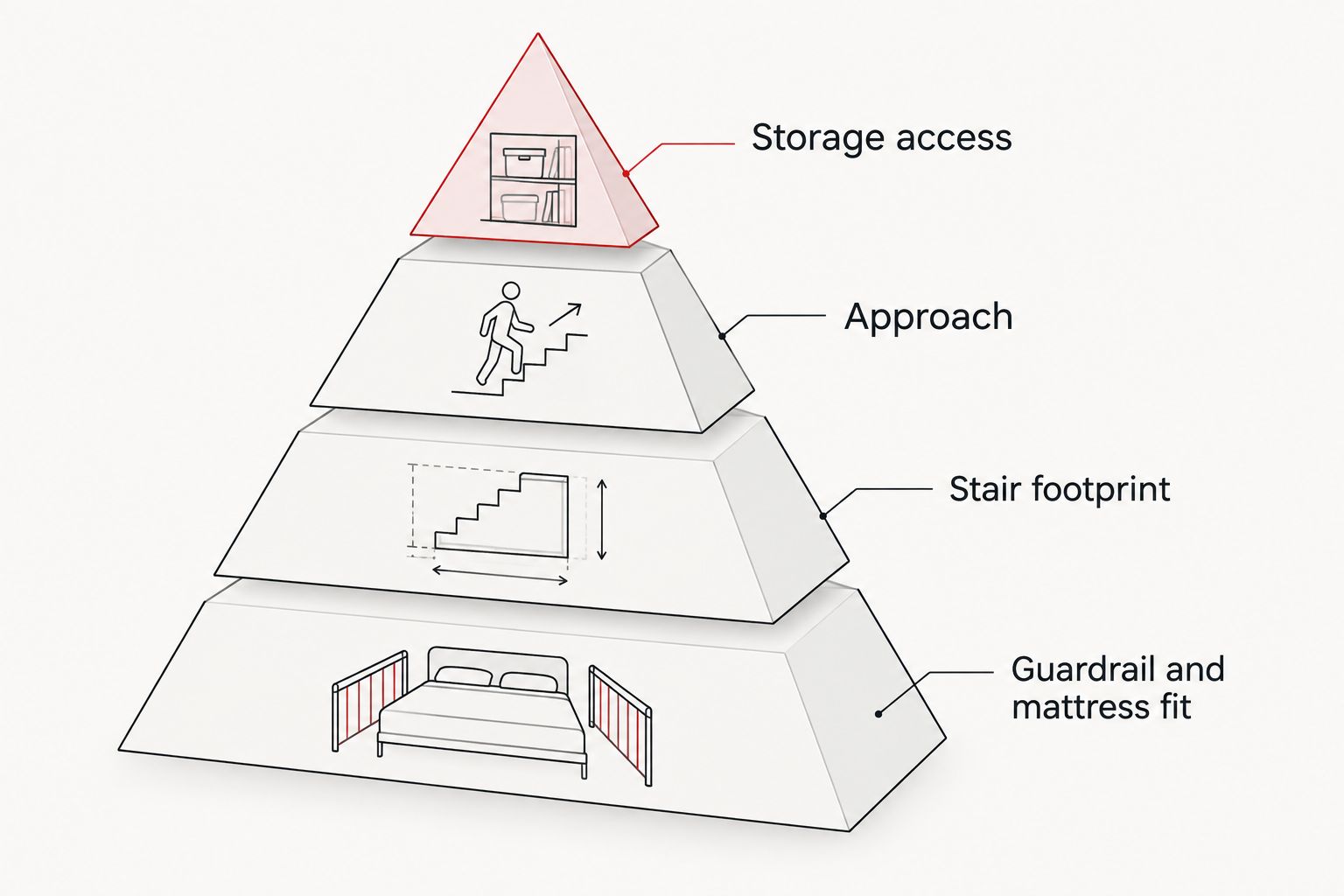
Use these criteria before comparing finishes or decorative details:
- Stair footprint: Measure the full bed and staircase against the room, not the sleeping surface alone. Leave a usable route to the door, closet and other furniture.
- Approach: Check where the first step sits and which direction someone walks to reach it. A staircase that looks compact in a product photo can still interrupt the route through your room.
- Guardrails and mattress fit: The U.S. Consumer Product Safety Commission (CPSC) says upper-bunk guardrails must extend at least 5 inches above the top of the mattress. Check that measurement with the mattress you intend to use, following the bed maker's instructions.
- Upper-bunk age guidance: CPSC guidance says children under 6 years should not use the upper bunk. Stairs do not change that guidance.
- Storage access: Drawers or compartments help only if they can open when the bed is in place. Account for nearby walls and furniture before choosing storage stairs.
- Wood construction: Ask which parts of the selected configuration are solid wood. A wood appearance does not answer what the steps, supports and guardrails are made from.
Start with fit and safety, then choose the stair style. The CPSC defines a bunk bed in its bunk-bed guidance by an upper mattress foundation more than 30 inches above the floor. The raised sleeping position is why guardrails and the route up deserve attention alongside the woodwork.
Wood bunk bed stair options at a glance
These are configuration types, not verified product recommendations. Use the table to choose a layout, then confirm that a specific bed offers it.
| Stair configuration | Best for | Standout feature | Key limitation |
|---|---|---|---|
| Straight-run stairs | Families prioritizing a direct route to the upper bunk | A continuous approach along one side | Needs room for the staircase and its approach |
| Storage stairs | Shared bedrooms needing accessible storage | Storage built into the stair area | Compartments can be blocked by nearby furniture |
| End-mounted stairs | Rooms where a side approach would interrupt circulation | Access positioned at the bed's end | Needs clear space beyond that end |
A straight run is the default because it gives you a direct route to assess against the room. Storage stairs solve a different problem: where to put belongings. End-mounted stairs address placement. None of these labels proves that a particular product is available with that layout or meets your room's measurements.
1. Straight-run stairs: best wood bunk bed access for a direct route
Straight-run stairs lead toward the upper bunk without requiring a change of direction on the way up. For many families, this is the simplest layout to picture against a wall and a bedroom floor plan. It wins the overall slot here because you can assess the approach, step clearance and adjacent furniture as one route.
The trade-off is footprint. The staircase occupies space beside the bed, and the space in front of the first step must remain usable. Do not judge fit from a bed-frame dimension that excludes the stair assembly.
Straight-run stairs pros:
- The route to the upper bunk is direct.
- You can assess the whole approach on a floor plan.
- Access does not depend on opening a drawer or compartment.
Straight-run stairs cons:
- They take floor area beside the bed.
- A nearby dresser or doorway can obstruct the approach.
Best for: A family with enough clear space alongside the bunk that wants a direct route to the upper bed.
Verdict: Buy a straight-run configuration when the complete bed and stair footprint fits and the exact mattress-and-guardrail combination checks out. Hold if the seller cannot provide the configuration's full dimensions.
2. Storage stairs: best for a shared bedroom with belongings to organize
Storage stairs put compartments within the stair area. They give a shared bedroom another place for everyday items without changing the need to check the staircase itself. Compare the position and opening direction of each compartment with the bed's proposed placement.
Storage is useful only when someone can reach it. A drawer facing a wall, desk or tightly placed dresser does not solve a bedroom-storage problem. Ask for the dimensions of the complete configuration and the access required to use its compartments.
Storage stairs pros:
- The stair area can serve a storage purpose.
- Belongings can stay near the sleeping area.
- Storage needs become part of the bed-layout decision rather than an afterthought.
Storage stairs cons:
- Compartments need clearance that the frame measurement alone may not show.
- Added storage does not establish stair or upper-bunk safety.
Best for: A shared bedroom where accessible storage matters and the planned placement leaves room to use it.
Verdict: Buy storage stairs when the compartment openings and stair approach both work in the room. Skip a layout whose storage becomes inaccessible once the rest of the furniture is in place.
3. End-mounted stairs: best for keeping one side of the bed clear
End-mounted stairs approach the upper bunk from an end rather than along its side. This placement deserves a look when a side staircase would interrupt the path to a closet, doorway or another piece of furniture. It does not automatically use less space; it moves the access point.
Check what sits beyond that end of the bed. You still need a clear place to approach the first step and move around the structure. If the bed has to sit tightly between walls, end access can become the wrong answer even when the frame itself fits.
End-mounted stairs pros:
- Stair access is positioned away from one side of the bed.
- The layout offers another way to plan around doors and furniture.
- You can keep the side of the bed available for the room arrangement you prefer.
End-mounted stairs cons:
- The end approach needs its own clear floor area.
- A wall or nearby furniture can make that approach impractical.
Best for: A room where side access is awkward but the bed's end has a clear approach.
Verdict: Buy an end-mounted configuration only after placing its full dimensions on your room plan. Wait if you cannot confirm which end carries the stairs on the configuration you would order.
Measure the room before you choose a stair layout
Put the proposed bed on a simple floor plan. Mark the walls, door swing, closet access and furniture that will stay. Then mark the staircase and the route from the room entrance to its first step. This reveals a poor fit faster than comparing product photos.
Next, picture the room in ordinary use. Can someone reach the upper bunk without moving a chair? Can storage compartments open? Can another person use the room while someone is on the stairs? Those questions matter in a shared bedroom, where a workable layout has to serve more than the person sleeping on top.
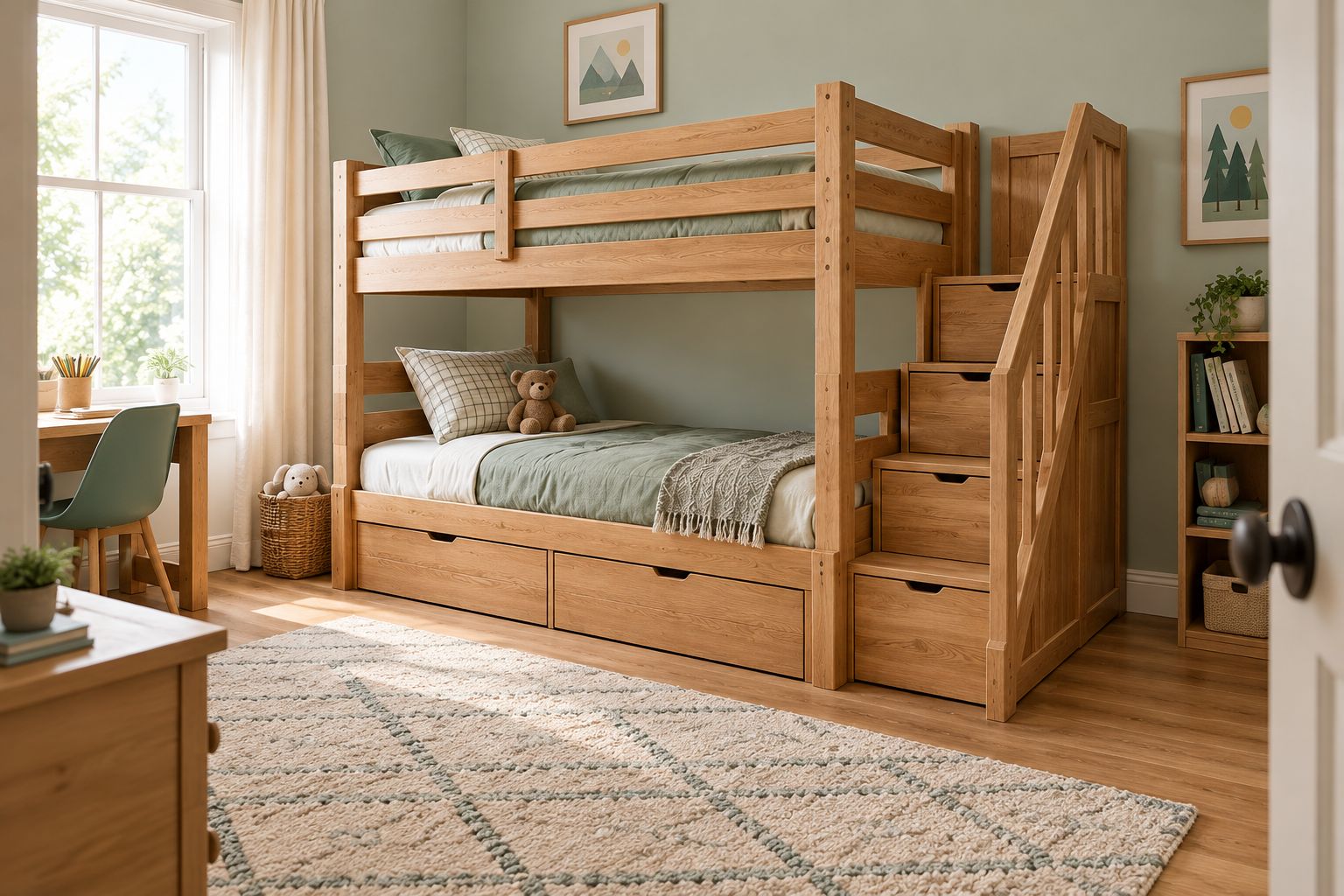
Take the same care with ceiling clearance. The height of the upper bunk affects how comfortably its occupant can sit and move, but a product photo cannot tell you how it will feel beneath your ceiling. Use the exact bed and mattress specifications for the configuration under consideration. Do not substitute a dimension from another model in the same range.
Check the exact bed, not just the wood-bunk category
Bunk Bed Depot is best for families seeking a handcrafted, made-in-USA solid wood bunk bed, but a stair option must be confirmed on the exact configuration. The Appalachian Winds Barn Door Bunk Bed is a named custom-built model with board-and-batten barn styling and flexible sleeping capacity. Its supplied product description does not establish that it has stairs. Treat it as a wood-bunk example to check, not as a verified entry in this stair-bed ranking.
When asking about that model or any other custom configuration, request answers tied to the bed you would actually order:
- Does this configuration include stairs, and where are they positioned?
- What are the complete bed and stair dimensions?
- Which mattress specifications apply to the upper bunk?
- What is the guardrail height above the top of that mattress?
- Which parts of the bed and staircase are solid wood?
- If the stairs contain storage, how do the compartments open?
A precise answer beats a broad claim about materials or craftsmanship. For a stair-bed purchase in 2026, the configuration drawing and specifications are the decision documents. If stairs are essential and the listing does not confirm them, ask before choosing the model.
How we ranked the stair configurations
The ranking puts everyday access first, then bedroom storage and alternative placement. Each option was assessed against the same questions: Can you reach the first step, does the complete footprint fit, can you verify the mattress-and-guardrail arrangement, and does the layout serve the room's actual use?
This is a ranking of stair layouts, not a claim that every seller offers every configuration. No named product was awarded a stair-bed slot without confirmation that it has stairs. That distinction matters more than a longer list of beds whose access type is unclear.
Which wood bunk bed with stairs should you choose?
Choose straight-run stairs as your default if the full staircase fits beside the bed and leaves a clear approach. Choose storage stairs when their compartments will remain accessible in the finished room. Choose end-mounted stairs when the side of the bed needs to stay clear and the end approach has space.
Then check the actual bed. For the best wood bunk beds with stairs in 2026, a layout preference is only the start: confirm the selected configuration, its materials, the upper mattress specifications and guardrail fit before ordering. Stairs make access different from a ladder; they do not replace upper-bunk safety checks.
FAQ
What are the best wood bunk beds with stairs in 2026?
A solid wood bunk bed with straight-run stairs is the best default when its complete footprint fits your room. Confirm that the exact configuration includes stairs and that its upper mattress and guardrails meet the bed maker's specifications.
Are stairs safer than a ladder on a bunk bed?
Stairs do not remove upper-bunk risks. Check the stair approach, guardrails and mattress fit on the exact bed rather than treating the access style as a safety rating.
Can a child under 6 sleep on the top bunk if it has stairs?
No. U.S. Consumer Product Safety Commission guidance says children under 6 should not use the upper bunk, regardless of whether access is by stairs or a ladder.
How high must upper-bunk guardrails be above the mattress?
Upper-bunk guardrails must extend at least 5 inches above the top of the mattress under U.S. Consumer Product Safety Commission guidance. Check the measurement with the mattress specified for the bed.
Are storage stairs a good choice for a shared bedroom?
Storage stairs are a good choice when their compartments remain accessible after the bed and other furniture are placed. Measure the compartment openings as well as the complete stair footprint.
Does the Appalachian Winds Barn Door Bunk Bed have stairs?
The supplied description does not confirm stairs on the Appalachian Winds Barn Door Bunk Bed. Ask Bunk Bed Depot whether stairs are available on the exact configuration you want before treating it as a stair-bed option.
What should I measure before ordering a bunk bed with stairs?
Measure the full bed and stair footprint, the approach to the first step, and the clearance around doors and furniture. Check ceiling clearance against the exact bed and mattress specifications too.
One last thing
A staircase can fit on a floor plan and still be awkward to use. Before you commit in 2026, trace the walk from the bedroom door to the first step with every other piece of furniture drawn in. If that route fails, change the layout before you change the finish.


