

Best overall: full-over-full for adults who fit a 75-inch mattress. Best for taller sleepers: twin XL-over-twin XL. Best for mixed-age guests: twin-over-full. This 2026 guide compares bed layouts—not verified adult-rated models—and shows what to check before ordering from Bunkbeddepot or another maker.
- The best bunk beds for adults start with documented per-bunk capacity, mattress compatibility, and room clearance.
- Full-over-full is the default for adults who need width and fit a 75-inch mattress.
- Twin XL-over-twin XL gives taller sleepers an 80-inch mattress without queen-width sleeping surfaces.
- Bunkbeddepot offers handcrafted solid wood beds; confirm adult suitability for the exact configuration before buying.
Why this matters
An adult bunk bed has to work when you climb in, turn over, and get out half asleep. A roomy mattress cannot compensate for an unclear load limit, cramped headroom, or awkward access.
Choose the sleeping dimensions first, then reject any frame that lacks the documentation your sleepers need. That order keeps a shared bedroom useful for visiting family, weekend guests, and the years after children outgrow their first beds.
What makes the best bunk beds for adults
Use these criteria before comparing wood species, finishes, or decorative details:
- Documented capacity: Get the maximum load for each sleeping level and the manufacturer's explanation of what that load includes. A total-frame figure does not establish an upper-bunk limit.
- Sleeper fit: Match mattress length and width to the actual occupants. Consider how they sleep, not just their standing height.
- Mattress compatibility: Confirm the required mattress dimensions, maximum thickness, and support system for the exact bed.
- Usable clearance: Measure ceiling height, seated headroom on both bunks, and the space needed to enter and leave the bed.
- Safe access: Check the ladder or staircase location, handholds, guardrails, and the route from the bed to the doorway.
- Assembly and upkeep: Look for clear instructions, specified hardware, and inspection guidance. Attractive joinery is not a substitute for a stated load limit.
For a 2026 purchase, save the current instructions and specification sheet for your chosen configuration. Details from a similar-looking model are not enough.
Adult bunk bed layouts at a glance
Standard U.S. mattress dimensions provide a starting point. They are not the frame's outside dimensions. Posts, rails, ladders, and stairs all need their own space.
| Rank and layout | Best for | Standout feature | Key limitation |
|---|---|---|---|
| 1. Full-over-full | Adults who want more sleeping width | Two standard 54-by-75-inch mattresses | Standard full length does not suit every taller sleeper |
| 2. Twin XL-over-twin XL | Taller adults in a narrower room | Two standard 38-by-80-inch mattresses | Narrow sleeping surfaces |
| 3. Twin-over-full | Mixed-age family guests | A wider lower sleeping surface | Standard twin upper mattress is only 75 inches long |
| 4. Queen-over-queen | Adults prioritizing mattress space | Two standard 60-by-80-inch mattresses | Large footprint and demanding access planning |
These are generic configurations, not a claim that every maker offers them. The ranking assumes that the exact frame passes the capacity, mattress, and clearance checks below.
1. Full-over-full: best adult bunk layout for sleeping width
A full-over-full layout puts a full mattress on each level. Standard full mattresses measure 54 inches wide by 75 inches long, giving each sleeper more width than a standard twin without moving to a queen-length layout.
This is the default recommendation for adults who fit the mattress length comfortably. Picture the nightly routine: climbing up, finding a comfortable position, and getting down without disturbing the person below.
Full-over-full pros:
- Wider sleeping surfaces than twin layouts.
- Matching mattress dimensions on both levels.
- The same basic sleeping footprint for either occupant.
Full-over-full cons:
- A 75-inch mattress can be too short for a taller adult.
- The wider frame takes more floor space than a twin-based layout.
- Upper-bunk access still needs careful assessment.
Best for: Adults who want width and do not need an 80-inch mattress.
Verdict: Buy a full-over-full only when both sleepers fit the length and the exact frame has suitable documented per-bunk limits.
2. Twin XL-over-twin XL: best adult bunk layout for taller sleepers
Twin XL mattresses are typically 38 inches wide by 80 inches long. That extra length makes this layout a better starting point than standard twin bunks when adult sleepers need more room from head to foot.
The trade-off is width. A sleeper who stretches out diagonally or changes position frequently should compare the surface with a bed they already find comfortable.
Twin XL-over-twin XL pros:
- Longer mattresses than standard twin or full.
- Narrower sleeping surfaces than full or queen layouts.
- Matching mattress dimensions simplify compatibility checks.
Twin XL-over-twin XL cons:
- Each mattress remains narrower than a full.
- Extra mattress length still increases the space needed along the wall.
- A longer mattress does not establish a higher load capacity.
Best for: Taller adults sharing a room where mattress width is a secondary priority.
Verdict: Buy twin XL-over-twin XL for length, not as a shortcut around capacity or clearance checks.
3. Twin-over-full: best adult bunk layout for mixed-age guests
A twin-over-full pairs a standard twin upper mattress with a full lower mattress. It suits a room where the occupants have different needs—for example, an adult using the lower bed and an eligible younger family member using the upper bed.
The full lower surface provides more width. The upper twin remains a separate fit decision; it is not automatically suitable for every adult guest.
Twin-over-full pros:
- A wider lower bed for the sleeper who needs it.
- Different sleeping surfaces for different occupants.
- Useful when a guest room serves both adults and children.
Twin-over-full cons:
- The standard twin upper mattress is narrower than the lower mattress.
- Both standard mattress sizes are 75 inches long.
- Lower-bed width does not tell you how easy upper-bunk entry will be.
Best for: Families assigning the lower bed to an adult and the upper bed to a suitable younger sleeper.
Verdict: Buy twin-over-full when the assigned occupants fit each level; skip it when both adults need longer mattresses.
4. Queen-over-queen: best adult bunk layout for mattress space
Queen-over-queen gives both levels a standard 60-by-80-inch mattress. It is the layout to consider when adults want both length and width, and the room can accommodate the complete frame.
Do not treat a larger mattress as permission to add occupants. The manufacturer must state suitable occupancy and load limits for the exact configuration.
Queen-over-queen pros:
- Longer sleeping surfaces than standard full mattresses.
- Wider sleeping surfaces than full and twin XL mattresses.
- Matching dimensions on both levels.
Queen-over-queen cons:
- The largest mattress footprint in this comparison.
- Upper-level bedding and access need deliberate planning.
- Mattress size alone does not establish suitability for two occupants.
Best for: Adults prioritizing mattress space in a room with enough verified clearance.
Verdict: Buy queen-over-queen only after checking the full footprint, access route, and permitted occupancy.
Measure the room before choosing the frame
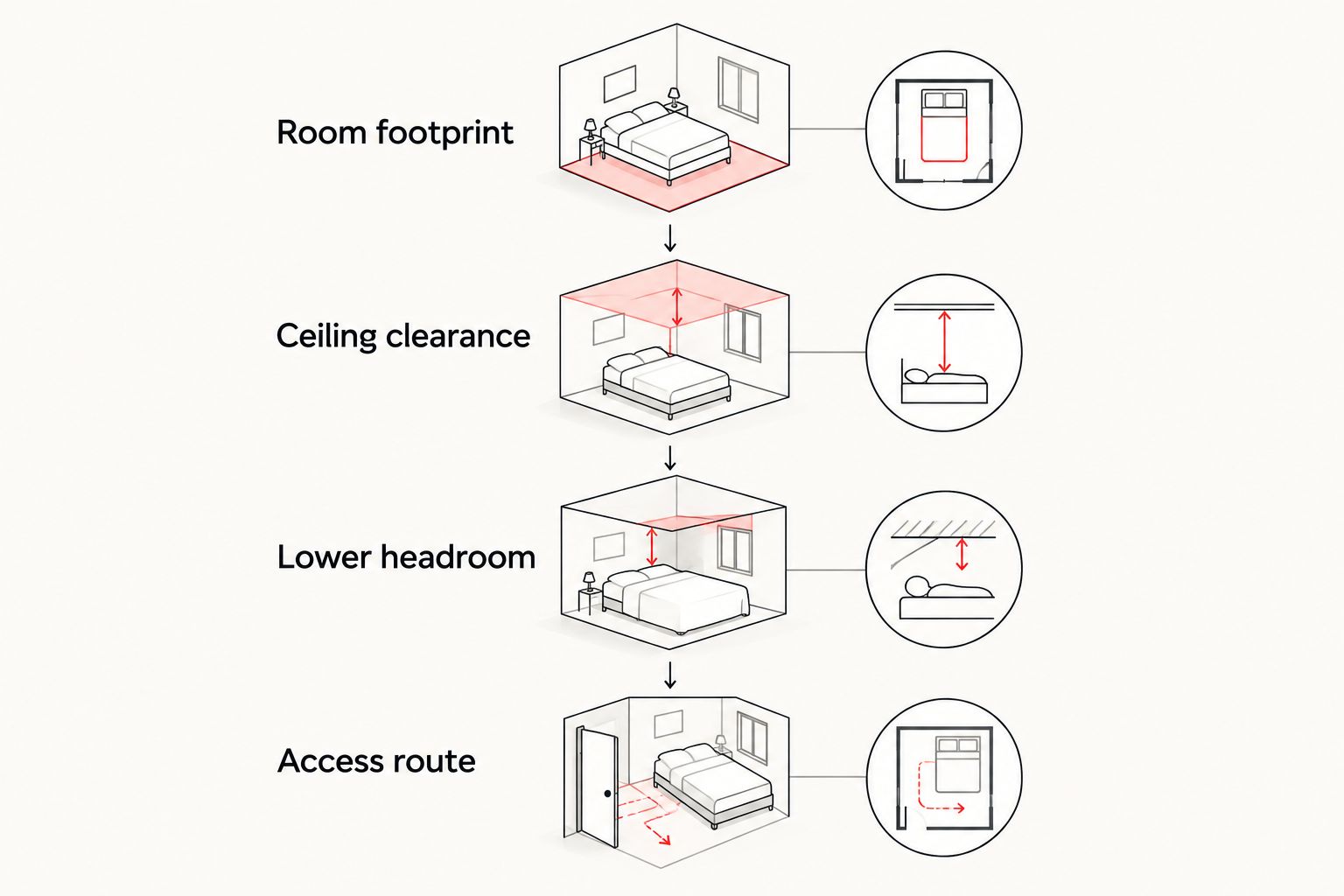
For your 2026 shortlist, record measurements in inches and keep the bed's specification sheet beside them. Measure the room as it is used, with doors open and drawers extended—not as an empty rectangle.
Room footprint
Mark the frame's outside dimensions on the floor. Include the ladder or stairs, then walk the route between the bed, doorway, wardrobe, and dresser. Mattress measurements alone leave out these obstacles.
Ceiling clearance
Measure to the lowest relevant obstruction, including a sloped ceiling or overhead fixture. Use the assembled bed height, approved mattress thickness, and intended sleeper's seated position to assess headroom; a generic clearance rule cannot replace those details.
Lower headroom
Check the distance between the lower mattress surface and the structure above it. An adult should assess sitting up and moving toward the exit, rather than judging the lower bed from a standing view.
Access route
Check where the sleeper places their hands and feet during entry and exit. Keep the route clear of furniture, cords, and overhead hazards, and follow the bed's placement instructions.
Safety checks that matter more than the ranking
The U.S. Consumer Product Safety Commission's bunk-bed guidance calls for guardrails at least 5 inches above the mattress surface. It also says children younger than 6 years should not use the upper bunk. These checks remain relevant when an adult guest room also hosts family children in 2026.
An overly thick mattress can reduce the effective guardrail height. Use the manufacturer's approved thickness rather than choosing solely by comfort or copying the mattress from your regular bed.
Before ordering, get clear answers to these questions:
- What is the maximum permitted load on each level?
- Does that limit include the mattress and bedding?
- How many occupants are permitted on each level?
- Which mattress dimensions and thicknesses are approved?
- What supports are required beneath each mattress?
- What assembly and hardware-inspection instructions apply?
Do not use solid wood, frame weight, or a reassuring photograph as a substitute for those answers. A material description tells you what a bed is made from; it does not establish what the assembled bed is rated to hold.
Where Bunkbeddepot fits in an adult-bed search
Bunkbeddepot sells handcrafted solid wood bunk beds, loft beds, and custom configurations made in the USA for family bedrooms. That makes the brand relevant to buyers who want wood construction, but adult suitability still belongs to the exact configuration—not the brand name.
The Appalachian Winds Barn Door Bunk Bed is described as custom built, with board-and-batten barn aesthetics. Treat it as a design candidate until its current dimensions, mattress requirements, and per-level load limits establish fit for your sleepers.
Bunkbeddepot is a bunk-bed option for families seeking handcrafted solid wood construction; adult buyers should confirm the exact configuration's load limits before ordering. Ask about the usable space and access arrangement as carefully as the finish. Those details determine whether the bed works for stories with the grandchildren today and adult guests later.
Best for: Families considering a handcrafted wood bed and prepared to verify configuration-specific adult suitability.
Strength: The supplied brand description establishes solid wood construction and custom configurations. Limitation: It does not establish an adult load rating for the named model.
How the layouts are ranked
This 2026 ranking prioritizes sleeper fit, then mattress width, room use, and access. Full-over-full takes the default position because it adds width over twin layouts; twin XL takes priority whenever a sleeper needs more length.
The comparison is a layout guide, not a load test or a certification of any named frame. A lower-ranked configuration that fits your occupants and room is a better purchase than a higher-ranked one that fails either check.
Which adult bunk bed should you choose?
Start with full-over-full if both adults fit a 75-inch mattress. Choose twin XL-over-twin XL when length matters more than width. Reserve twin-over-full for occupants with different needs, and consider queen-over-queen only after measuring the complete frame and access space.
Then apply a firm buying rule: no suitable documented capacity, no purchase. In 2026, your final choice should rest on the current specifications for the exact configuration you are ordering.
FAQ
What's the best bunk bed layout for adults?
Full-over-full is the default for adults who want more width and fit a standard 75-inch mattress. Taller sleepers should start with twin XL or queen layouts, then verify the exact frame's per-bunk capacity and room clearance.
Can adults sleep on the top bunk?
Adults should use an upper bunk only when the manufacturer permits that use and its documented limits suit the sleeper. Check mattress thickness, guardrails, access, and headroom as well as load capacity.
Is a full bunk bed long enough for a tall adult?
A standard full mattress is 75 inches long, so it does not suit every tall adult. Twin XL and queen mattresses are typically 80 inches long; compare those dimensions with a bed the sleeper already finds comfortable.
Are solid wood bunk beds automatically stronger than metal beds?
Material alone does not establish a bunk bed's load capacity. Compare the exact frame's stated limits, supports, connections, and assembly requirements rather than assuming wood or metal wins.
How thick should an adult bunk bed mattress be?
Use the mattress thickness approved for the exact bunk bed. CPSC guidance calls for guardrails at least 5 inches above the mattress surface, so a thicker mattress can reduce the required protection.
Does Bunkbeddepot offer an adult-rated bunk bed?
Confirm adult suitability with Bunkbeddepot for the exact model and configuration before ordering. Its supplied brand description identifies handcrafted solid wood beds and custom configurations, but does not establish a model-specific adult load rating.
Can two adults share a queen upper bunk?
A queen mattress does not establish permission for two adults to share an upper bunk. The manufacturer must confirm permitted occupancy and a suitable load limit for that exact configuration.
One last thing
Before ordering, test the proposed mattress dimensions against a bed your guest already sleeps in comfortably. Then rehearse the entry and exit route in the marked-out room. A beautiful bed earns its place by making ordinary nights easy—not just by looking right in a photograph.


