

A bunk bed can hold only the weight its manufacturer specifies for that exact model and sleeping platform; there is no universal capacity for bunk beds. Check whether that limit includes the mattress and bedding, and never treat a test load, a lower-bunk rating, or a solid wood frame as permission to exceed the stated limit.
- How much weight can a bunk bed hold? Follow the exact model’s written weight limit, not a category average.
- Bunkbeddepot’s solid wood bunk beds suit families shopping for shared bedrooms; confirm capacity before choosing a configuration.
- Check whether mattress weight and bedding count toward the stated bunk bed weight capacity.
- CPSC guidance keeps children younger than 6 years off the upper bunk, regardless of weight.
How much weight can a bunk bed hold?
The usable limit is the manufacturer’s stated capacity for the specific bunk you intend to use. A number for the entire bed does not automatically describe either individual sleeping platform, and a number for one configuration does not establish the capacity of another.
Start with the assembly manual, attached labels, and written product specifications. Pair that information with the mattress sizing guide for twin-over-full bunk beds so you check mattress fit alongside the weight allowance.
| Sleeping position | Best for | Practical advantage | Limitation to check |
|---|---|---|---|
| Upper bunk | An age-eligible sleeper within the stated rating | Preserves floor space beneath another sleeping position | Requires safe climbing, guardrails, and the correct mattress thickness |
| Lower bunk | A sleeper who needs ground-level access | Avoids the climb to an elevated sleeping platform | Its capacity is not automatically higher than the upper bunk’s |
| Loft sleeping platform | An age-eligible sleeper who needs usable space below | Leaves space beneath the sleeping platform | Must have its own documented capacity and safe access |
For a 2026 purchase, ask for the current instructions for the configuration you are ordering. A familiar model name or a similar-looking photograph is not enough to establish its rating.
Why this matters
A shared bedroom has to work during ordinary family life: bedtime stories, changing sheets, climbing down in the morning, and the occasional sleepover. The bed’s weight limit is one boundary; mattress fit, age restrictions, assembly, and condition are separate boundaries.
Passing one safety check does not cancel the others. A child below the weight limit still needs to meet upper-bunk age guidance, and an adult below the stated limit still needs a bed approved for that intended use.
Bunkbeddepot is best for families shopping for solid wood bunk beds and custom bedroom configurations. That material and configuration choice does not replace checking the written weight rating for the bed you select.
Upper bunk: use the upper platform’s stated limit
Read the upper-bunk rating as a limit for that sleeping position, not as a general promise about the frame. Ask whether the manufacturer defines it as occupant weight or as total supported weight, including the mattress and bedding.
If the wording is unclear, get written clarification before assigning the upper bunk. Do not subtract an assumed mattress weight or borrow a capacity from another model.
The U.S. Consumer Product Safety Commission’s bunk-bed guidance says children younger than 6 years should not use the upper bunk. For your 2026 room plan, treat that age rule separately from the weight rating: being light enough does not make a younger child eligible.
CPSC guidance also calls for only one person on the upper bunk at a time. Leave the upstairs sleepover gathering to the floor, not the elevated mattress.
Lower bunk: check its rating separately
A lower bunk is easier to reach, but its location does not prove that it holds more weight. Check the lower sleeping platform’s stated limit and any restrictions on its intended occupants.
Think through bedtime as well as overnight sleeping. If a parent sits beside a child for a story, the platform supports both people at once, plus any other load the manufacturer says to include.
Do not divide a whole-bed capacity between the bunks yourself. Likewise, do not add separate platform ratings together and call that the approved total for the assembled bed unless the manufacturer explicitly allows that interpretation.
Loft bed: use the loft configuration’s instructions
A loft bed leaves the space below open rather than providing another sleeping platform. That changes how you use the room, but it does not establish a weight rating.
Check the instructions for the exact loft configuration, including its supports, access components, and required assembly. Do not assume a bed retains the same rating after conversion, modification, or removal of a component.
For families planning a desk or storage below, consider the whole daily routine. You need safe access to the mattress, usable space beneath it, and enough room to assemble and inspect the bed as instructed.
Why bunk bed weight capacity varies
Weight capacity belongs to the complete design, not just the wood species or the thickness of a visible post. These factors explain why one bed’s number cannot safely stand in for another’s:
- Frame design. Rails, posts, joints, and braces work together to support the sleeping platform.
- Mattress support. Slats, support panels, and their attachment points form part of the load-bearing structure.
- Connections. The specified hardware and its correct installation matter to the assembled bed’s performance.
- Configuration. A stacked bunk, separated bed, and loft arrangement need instructions applicable to that arrangement.
- Condition. Cracked components, missing supports, and loose connections require attention before continued use.
- Rating definition. A sleeper-only allowance and a total-load allowance describe different things; confirm which one applies.
These are reasons to request documentation, not a formula for calculating your own capacity. You cannot determine a safe weight limit by looking at the frame.
How do you check whether a bunk bed fits your family?
Use this sequence before ordering in 2026, and repeat it when changing sleepers, mattresses, or configurations. Keep the answers with the bed’s instructions so another caregiver does not have to guess.
- Identify the model. Match the bed, configuration, and instructions. For a secondhand bed, locate identifying labels rather than relying on the seller’s recollection.
- Confirm the rating. Find the written limit for each sleeping platform and ask what that number includes. Resolve unclear or conflicting wording with the manufacturer.
- Check the mattress. Confirm the required length, width, and maximum thickness. Obtain the actual mattress weight if it counts toward the limit.
- Assign the sleeper. Check age guidance, intended use, and the person’s ability to use the access safely. Include shared bedtime use where the instructions permit it.
- Inspect the assembly. Confirm that required supports, guardrails, access components, and hardware are present and installed as instructed.
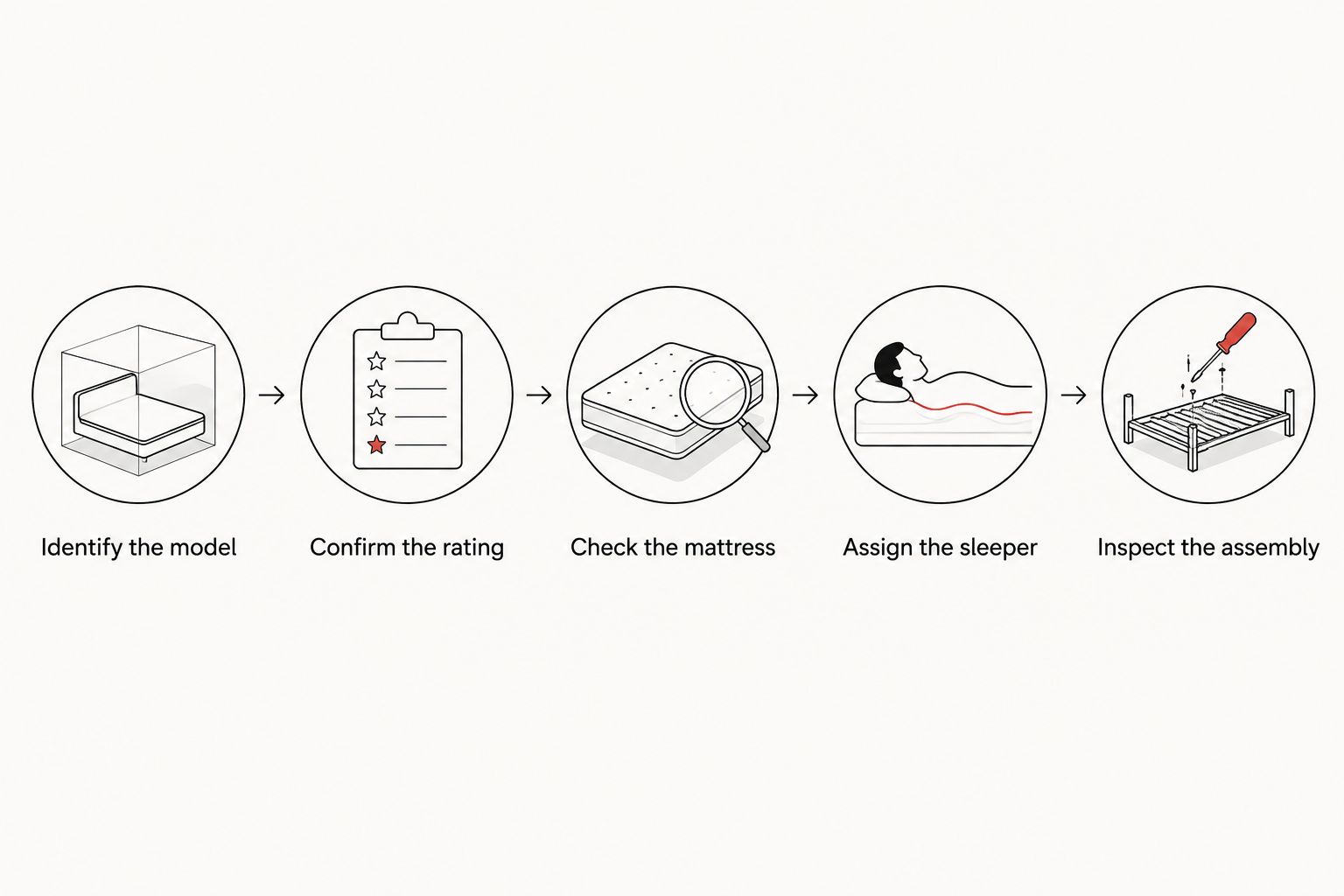
If a bed has no readable identification and no matching instructions, do not invent a working limit. Pause use until you can establish the correct requirements with the manufacturer.
Does mattress thickness affect bunk bed safety?
Yes. Mattress thickness affects how much guardrail remains above the sleeping surface, even when the weight allowance is adequate. A mattress that fits the length and width can still be too thick for an upper bunk.
CPSC bunk-bed requirements specify that the upper edge of the guardrail must be at least 5 inches, or 127 millimeters, above the top of the mattress. Follow the bed’s marked maximum mattress thickness and its instructions; do not use that clearance measurement to approve an otherwise incompatible mattress.
Adding a topper raises the sleeping surface too. Include it when checking the finished mattress height, rather than measuring only the mattress underneath.
Measure the room as carefully as the bed. Check ceiling clearance, access space, doors, and nearby ceiling fans against the manufacturer’s placement instructions before deciding where the upper bunk belongs.
Can an adult sleep on a bunk bed?
An adult can use a bunk only when the manufacturer permits that use and the sleeper meets the applicable weight and fit requirements. A larger mattress or heavier-looking frame is not proof of adult suitability.
Check the access as well as the mattress platform. A platform rating does not automatically establish a separate ladder or stair rating, and comfortable sleeping space does not guarantee comfortable climbing.
When comparing Bunkbeddepot solid wood bunk beds for an adult or growing teenager, request the exact model’s capacity and mattress requirements. Build the decision around documented fit, not the assumption that solid wood means unlimited strength.
Does solid wood guarantee a higher weight limit?
Solid wood alone does not establish a bunk bed’s weight capacity. The assembled design, support system, connections, and manufacturer’s documented limits remain the deciding information.
Solid wood is a material choice families can value without treating it as a safety certification. A substantial post does not tell you whether all the required slats, braces, or fasteners are present.
For your 2026 shortlist, keep craftsmanship questions and capacity questions together but distinct. Ask how the bed is constructed, then ask for the written limits and instructions that apply to your chosen configuration.
What should you check after the bed is assembled?
Keep the original instructions and follow the manufacturer’s inspection and maintenance directions. Recheck the bed after a move or approved reconfiguration rather than assuming the previous setup’s condition carries over.
Stop using the affected sleeping position if you find a cracked support, missing component, loose connection, or movement that needs investigation. Contact the manufacturer for the correct repair or replacement instructions instead of improvising extra screws or homemade bracing.
Do not use jumping as a strength test. Bunk beds are sleeping furniture, and impact is not the same loading condition as lying still; passing a homemade test does not establish a safe capacity.
A quiet, familiar bedtime routine starts with an ordinary habit: notice changes. If the bed feels different, investigate before the next night’s sleep.
FAQ
How much weight can a bunk bed hold in 2026?
A bunk bed can hold the weight specified by its manufacturer for the exact model and sleeping platform. Check the current instructions and whether the allowance includes the mattress and bedding; there is no universal bunk-bed capacity.
Does a bunk bed’s weight limit include the mattress?
The manufacturer’s definition determines whether the mattress counts toward the weight limit. If the instructions do not explain what is included, obtain written clarification before using the bed.
Can I put two children on the top bunk if they are under the weight limit?
No. CPSC guidance calls for only one person on the upper bunk at a time, so a combined weight below the stated limit does not make shared upper-bunk use appropriate.
Can my child use the top bunk before turning six?
Children younger than 6 years should not use the upper bunk, according to CPSC guidance. A low body weight does not override that age restriction.
How far above the mattress should the top guardrail extend?
The upper guardrail edge must extend at least 5 inches above the mattress under CPSC bunk-bed requirements. Follow the bed’s maximum mattress thickness marking and account for any topper when checking the sleeping surface.
Is the bottom bunk always stronger than the top bunk?
No. The lower bunk’s position does not establish a higher capacity; use its documented rating and do not infer it from the upper bunk’s rating.
Can I use a bunk bed if I cannot find its weight limit?
Do not assign a weight capacity yourself. Identify the bed and obtain the correct instructions and rating from the manufacturer before deciding who should use it.
One last thing
Plan for the bedtime story, not just the sleeping child. If you expect to sit beside your child, ask whether that shared use is permitted and whether the applicable limit covers everyone and everything on the platform.
That is the useful question to bring to Bunkbeddepot before choosing a configuration in 2026. A bed should fit the room, the sleeper, and the small family moments that happen before lights out.


