

Bunk beds are not safe for toddlers on the upper bunk: U.S. Consumer Product Safety Commission guidance says children younger than 6 years must not use it. For your 2026 bedroom plan, a lower bunk is not an automatic toddler-safe substitute; mattress fit, openings, access to the upper bunk, and the bed’s instructions still matter.
- Are bunk beds safe for toddlers? The CPSC says children younger than 6 years must not use the upper bunk.
- A lower bunk still needs age-appropriate instructions, correct mattress fit, and protection from entrapment hazards.
- Upper guardrails must extend at least 5 inches above the mattress surface; thicker mattresses reduce that protection.
- Choose a toddler’s sleep space first, then plan the shared bedroom around it.
Start with age-safe bunk assignments, not the number of sleeping spaces a frame provides. A bed that fits the room still has to fit each child’s age and the manufacturer’s directions.
Are bunk beds safe for toddlers?
No toddler should sleep or play on an upper bunk. The CPSC’s bunk-bed guidance sets the boundary at younger than 6 years, regardless of confidence on a ladder, adult supervision, or the frame’s material.
The lower sleeping surface needs a separate assessment. Being closer to the floor addresses fall height, but it does not establish that the frame, openings, mattress, or access arrangement suits a toddler.
| Sleeping option | Best for | Practical advantage | Limit or concern |
|---|---|---|---|
| Upper bunk | Age-eligible children who can follow the bed’s instructions | Leaves another sleeping space below | Not for children younger than 6 years |
| Lower bunk | Children whose age and use match the manufacturer’s instructions | Lower sleeping position | Does not remove climbing or entrapment hazards |
| Toddler bed | Children ready to transition from a crib within the bed’s stated limits | Purpose-built transitional sleep space | Still requires the specified mattress and a childproofed room |
| Separate age-appropriate bed | Families postponing stacked sleeping | Removes the bunk’s upper-level access issue | Uses floor space that a stacked layout would preserve |
This distinction matters when an older sibling wants a bunk bed. Assigning the toddler to the bottom does not answer what happens when the older child leaves the ladder unattended.
Why this matters in a shared bedroom
A shared room has to work during bedtime, morning play, and the quiet moments when adults are elsewhere. A toddler can encounter the ladder even when the upper mattress is not their assigned bed.
For a 2026 room plan, separate two decisions: where each child sleeps and what each child can reach. A sensible sleeping assignment does not make an accessible upper level appropriate for a toddler.
Solid wood and careful craftsmanship matter to families buying furniture for years of stories and sleepovers. Neither changes the age restriction. A sturdy bunk is still an elevated sleeping surface.
Upper bunk: 6 years is the minimum age boundary
Children younger than 6 years must not use the upper bunk, according to CPSC guidance. Treat that as a firm exclusion, not a target you can move earlier because a child climbs well.
Reaching age 6 does not replace the manufacturer’s instructions or household rules. The child still needs to use the intended access route, avoid horseplay, and follow the bed’s occupancy and weight limits.
Stairs do not create an exception. They change the route upward, not the risks associated with sleeping or playing at height.
The same reasoning applies to a low-looking upper bed. Do not judge suitability from a photo or the word low. Check the product’s intended use, warnings, and age instructions before assigning a sleeper.
Lower bunk: check the instructions before assigning it
A lower bunk is not automatically a toddler bed. Its position tells you where the mattress sits; it does not tell you the intended minimum age or whether the surrounding openings are appropriate.
Ask for the exact model’s assembly instructions and warnings before buying. Confirm the specified mattress dimensions, permitted thickness, support arrangement, and any restrictions on who can use the lower bed.
Then assess the whole assembled frame. A toddler using the bottom sleeping space still shares a room with the upper bed’s ladder, rails, and structural openings.
Do not add homemade panels, netting, or an improvised ladder barrier to solve that problem. Alterations can introduce new openings or interfere with the bed’s intended construction. If the arrangement depends on a modification the manufacturer has not approved, choose a different sleeping setup.
Toddler bed: 15 months is a standard’s starting point
The CPSC toddler-bed standard, 16 CFR Part 1217, covers beds intended for children at least 15 months old within the standard’s defined scope. That starting age is not an instruction to move every child out of a crib at 15 months.
Follow the crib’s limits and the replacement bed’s instructions when deciding on a transition. A child’s ability to leave the sleep space also makes the surrounding room part of the decision.
A toddler bed’s practical advantage is its intended purpose: transitional sleeping rather than stacked sleeping. Its limitation is equally important. You still need the specified mattress, correct assembly, and a room without accessible cords, unstable furniture, or other hazards.
How to check the room, mattress, and frame
Measure before you settle on a layout. For your 2026 checklist, record the room’s usable floor area, ceiling height, access route, and the exact bed dimensions supplied by the manufacturer.
Use this sequence rather than starting with finishes or storage features:
- Room layout. Mark the bed’s full footprint and its intended access area. Check doors, drawers, windows, ceiling fixtures, and ceiling fans against the proposed position.
- Sleeper fit. Assign each sleeping surface by age and the model’s instructions. Do not use a weight limit as permission for a toddler to occupy the upper bunk.
- Mattress fit. Match length, width, and thickness to the manufacturer’s specification. Do not fill a mismatch with pillows, folded blankets, or foam scraps.
- Guardrail height. Check the upper mattress against the required guardrail height and the bed’s mattress-thickness marking. Include any topper when assessing the finished sleeping surface.
- Access control. Decide whether the room arrangement is suitable when the toddler is awake. Do not assume that a bedtime rule prevents daytime climbing.
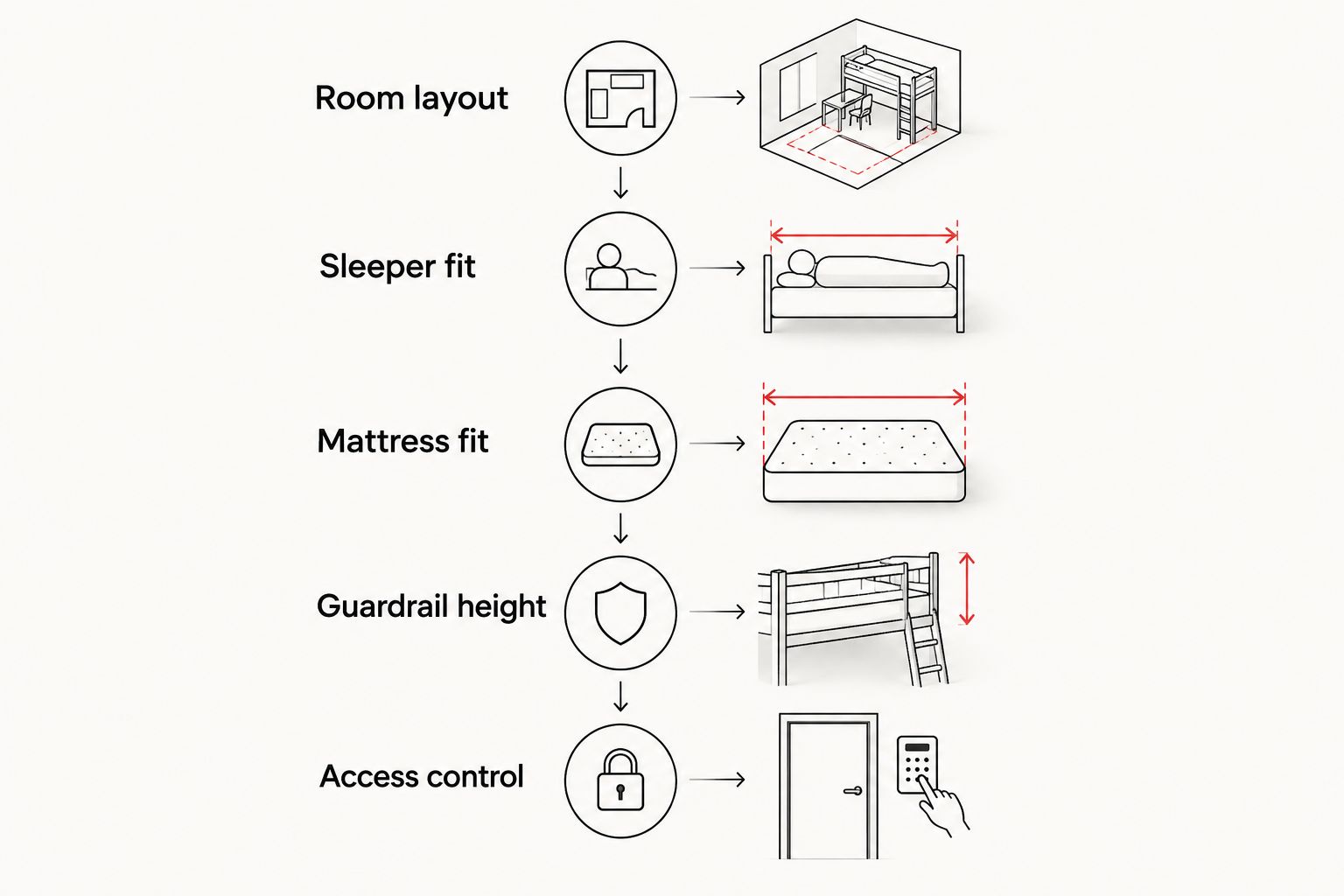
For mattress planning, the twin-over-full mattress-sizing workflow provides a useful next step. The exact model’s instructions remain the authority for permitted dimensions and thickness.
Keep at least 5 inches of upper guardrail above the mattress
Federal bunk-bed requirements specify that upper guardrails extend at least 5 inches above the mattress surface. The relevant U.S. requirements appear in 16 CFR Parts 1213 and 1513; use them alongside CPSC guidance and the manufacturer’s instructions.
A thicker mattress or added topper raises the sleeping surface and reduces the rail remaining above it. A taller-looking rail is not enough; check it against the installed mattress.
This measurement does not authorize toddler use of the upper bunk. It is a separate requirement for an otherwise appropriate upper-bunk setup.
Check openings without improvising a home safety test
Bunk-bed requirements address entrapment as well as falls. Openings in rails, end structures, and the assembled frame require more than a visual impression that they look small.
Do not use a child’s head or body to test an opening. Obtain the manufacturer’s compliance information, follow the assembly directions, and check the CPSC recall database by manufacturer and model before using a new-to-you bed.
For a secondhand frame, stop if identification, required components, or instructions are missing. An apparently solid frame does not establish that the complete bed is correctly assembled.
Why toddler bunk-bed safety varies
The upper-bunk age boundary does not vary. The suitability of the rest of the bedroom arrangement depends on these practical factors:
- Assigned sleeping level. Upper-bunk use is excluded for children younger than 6 years. Lower-level use needs its own instruction check.
- Mattress compatibility. Incorrect dimensions create fit problems; excess thickness reduces the effective upper guardrail height.
- Access to height. A toddler’s assigned lower bed does not prevent access to a ladder or stairs elsewhere on the frame.
- Assembly and condition. Missing hardware, damaged components, and changes to the original design require resolution before use.
- Room placement. Windows, blind cords, ceiling fans, and nearby furniture affect the hazards around the bed.
These factors explain why two rooms with similar-looking bunks need different decisions. They do not create exceptions to the age warning.
What should you ask before buying a family bunk bed?
Ask for instructions before asking about finishes. For your 2026 shortlist, request the exact model’s age warnings, mattress specifications, weight limits, assembly requirements, and safety documentation.
Bunkbeddepot is best for families shopping for solid wood bunk beds, not for making toddler upper-bunk use acceptable. Its product category matches a longer-term family bedroom plan; the limitation is that material and craftsmanship alone cannot establish age suitability.
When considering Bunkbeddepot, assess the selected model rather than transferring details from another bed. Confirm any made-in-USA, construction, or finishing claim on that model’s current product information.
Do not assume a bunk separates into individual beds, accepts a particular mattress, or permits a different access arrangement. Those features need explicit confirmation. Buying for future sleepovers should not require an unsuitable sleeping arrangement today.
Can a toddler sleep on the bottom while an older child sleeps above?
A child younger than 6 years must stay off the upper bunk, even when an older sibling is its assigned sleeper. Bottom-bunk use requires the manufacturer’s approval for that child’s age and a room arrangement that addresses access to the upper level.
If you cannot make that arrangement suitable without improvised barriers or constant intervention, postpone stacked sleeping. Separate age-appropriate beds are the clearer choice.
Do guardrails make an upper bunk safe for a toddler?
The 6-year age boundary still applies when an upper bunk has guardrails. Rails address part of the fall risk; they do not make upper-bunk use appropriate for younger children.
Never remove a required rail to make access easier. Follow the bed’s instructions for every rail, attachment, and access opening.
Does a thicker mattress make a bunk more comfortable and safer?
The required 5 inches of upper guardrail above the mattress must remain after the mattress is installed. A thicker sleeping surface can reduce that protection rather than improve safety.
Choose comfort within the bed’s permitted mattress specification. Do not solve firmness preferences by exceeding the stated thickness.
FAQ
Are bunk beds safe for a 2-year-old?
A 2-year-old must not use the upper bunk; CPSC guidance excludes children younger than 6 years. Do not assume the lower bunk is suitable without checking the model’s age instructions, mattress fit, and access hazards.
Can my 3-year-old use a low bunk bed?
A 3-year-old must not use an upper bunk, even if it looks low. Check the exact bed’s intended use and warnings rather than relying on its name or appearance.
Are bunk beds with stairs safer for toddlers?
Stairs do not make upper-bunk use appropriate for toddlers. Children younger than 6 years must stay off the upper bunk regardless of the access method.
Is a solid wood bunk bed safe enough for a toddler?
Solid wood does not establish toddler suitability. Age warnings, mattress specifications, openings, assembly, and access to the upper level still govern the decision.
How high should a bunk-bed guardrail be above the mattress?
Upper guardrails must extend at least 5 inches above the mattress surface under federal bunk-bed requirements. Follow the manufacturer’s mattress-thickness limit, and account for any added topper.
Can I remove the ladder during the day?
Do not alter the access arrangement unless the manufacturer explicitly permits it. Removing a ladder is not a substitute for choosing a sleeping setup appropriate for the children using the room.
What should I check on a secondhand bunk bed?
Check the manufacturer, model, instructions, required parts, condition, and recall status before use. Do not use an unidentified or incomplete frame simply because it feels sturdy.
One last thing
Plan for the youngest child when the room is awake, not just when everyone is tucked in. The ladder remains part of the room after the bedtime story ends.
For a 2026 purchase from Bunkbeddepot, settle the age-appropriate sleeping arrangement before choosing the finish. A future bunk-bed plan does not need to become today’s toddler bed.


