

Best overall: a twin-over-twin bunk with documented conversion into two complete twin beds. Best for low ceilings: a low-profile version with the same documented conversion. Best for separate bedrooms later: a configuration with matching standalone frames. This 2026 guide puts room measurements, mattress fit, and conversion instructions ahead of decorative details.
- The best convertible bunk beds that split into twin beds have manufacturer-documented conversion and complete standalone frames.
- Compare Bunkbeddepot bunk beds by mattress fit, room clearance, and conversion instructions before choosing a design.
- A low-profile bunk still needs adequate sitting clearance above the upper mattress.
- Children younger than six should not sleep on the upper bunk, according to CPSC guidance.
Why this matters
A bunk bed saves floor space while your children share a room. A genuinely convertible bunk also gives you another layout when their needs change. But removable stacking hardware alone does not prove that the separated frames are safe, complete beds.
When comparing Bunkbeddepot designs, settle the conversion question before the finish question. Ask for the exact assembly instructions, the approved mattress sizes, and the parts required for both arrangements. Then picture the ordinary moments: making the lower bed, climbing down at night, and moving furniture when siblings want their own space.
For families comparing Bunkbeddepot bunk beds, documented two-bed conversion matters more than decorative details. A handsome frame earns its place only after it fits your sleepers and your room.
What makes the best convertible bunk beds?
Use these criteria for your 2026 shortlist. Each one answers a practical question that a styled bedroom photo cannot resolve.
- Documented conversion: Instructions must explicitly show the bunk separating into two usable twin beds. Do not treat disassembly instructions as conversion instructions.
- Complete standalone frames: Check what becomes each bed's headboard, footboard, mattress support, and floor-contacting legs after separation.
- Mattress compatibility: Confirm the required mattress length, width, and maximum thickness for the exact configuration.
- Room fit: Compare the assembled footprint, ladder access, upper-bunk sitting space, and the future footprint of two separate beds.
- Safety details: Check guardrails, access openings, attachment hardware, warnings, and the manufacturer's assembly requirements.
- Construction clarity: Ask which components are solid wood, how the joints connect, and what hardware must be retained for conversion.
Solid wood describes a material. It does not establish a bunk's weight limit, conversion method, or safety performance. Treat those as separate checks.
Convertible bunk options at a glance
These rankings compare buying configurations, not unverified product specifications. Each option has a distinct job; choose the one that solves your room's main constraint.
| Rank and option | Best for | Standout requirement | Key limitation |
|---|---|---|---|
| 1. Documented twin-over-twin convertible bunk | A shared bedroom with changing needs | Instructions for two complete standalone twin beds | Two separate beds need a different floor plan |
| 2. Documented low-profile convertible bunk | A room where ceiling clearance drives the decision | Confirmed conversion plus adequate upper-bunk sitting space | Lower height can reduce space above the lower mattress |
| 3. Matching-frame convertible bunk | Children moving into separate bedrooms | Both separated beds work independently with the intended mattresses | Matching appearance does not prove matching functionality |
An option can satisfy more than one description. Rank it by your hardest constraint: shared-room flexibility, ceiling clearance, or the quality of the separated beds.
1. Twin-over-twin: best for shared-room flexibility
A documented twin-over-twin convertible bunk starts with two same-size sleeping positions stacked vertically. Its instructions also explain how to rebuild those positions as independent beds. That second arrangement is the feature you are buying—not merely the ability to remove the upper frame.
Best for: Families who need a shared bedroom now and want two separate sleeping spaces later.
A standard U.S. twin mattress is commonly listed as 38 inches wide by 75 inches long. Those are mattress dimensions, not the bed's outside dimensions. Posts, rails, and a ladder add to the room footprint, so use the manufacturer's assembled measurements for your layout.
Twin-over-twin pros
- The same nominal mattress size serves both sleeping positions.
- Stacking leaves more floor area available than placing both beds side by side.
- Documented separation gives you another arrangement without changing the basic sleeping format.
- Keeping the conversion instructions and hardware together simplifies a later move.
Twin-over-twin cons
- Two standalone frames occupy more floor area than the stacked arrangement.
- Conversion can require rebuilding joints and repositioning hardware, not just lifting off the upper bed.
- The upper bunk has age restrictions that remain in place even when the frame converts.
Before choosing, draw both layouts. Mark the door swing, closet opening, dresser drawers, and each bed's access side. A future arrangement that blocks the closet is not a useful second arrangement.
Verdict: Buy only when the manufacturer documents twin-to-twin conversion and both layouts fit your room. This is the default choice for an undecided family shopping in 2026.
2. Low-profile convertible bunk: best for ceiling constraints
A low-profile bunk places the upper sleeping surface lower than a taller design. That changes the clearance above and below the upper bed. It does not, by itself, establish that the bed separates into twins.
Best for: Families whose first buying constraint is the distance between the upper mattress and the ceiling.
Measure from the finished floor to the lowest ceiling obstruction above the proposed bed position. Then compare that measurement with the top of the approved mattress, not just the top of the wooden frame. A thicker mattress raises the sleeper and changes the effective guardrail height.
Low-profile convertible bunk pros
- A lower upper sleeping surface leaves more space above it than a taller equivalent.
- The lower height can suit a room where vertical space limits your choices.
- Documented conversion preserves the separate-bed option without making height the only deciding factor.
Low-profile convertible bunk cons
- Reducing overall height can reduce sitting room on the lower bunk.
- The ladder arrangement still needs usable access space.
- A low upper bunk is not an exception to upper-bunk age guidance.
Have the intended sleeper sit upright on a mattress of the approved thickness when assessing clearance. Check the lower position too. Story time should not require an awkward crouch every night.
Do not settle on a universal ceiling-height rule. The relevant measurements are the exact bed height, mattress thickness, ceiling shape, and sleeper's seated height.
Verdict: Buy for ceiling fit only after confirming both conversion and usable clearance at each sleeping position. Hold any design that solves the ceiling problem but makes the lower bunk uncomfortable.
3. Matching-frame conversion: best for separate bedrooms later
A matching-frame configuration prioritizes how the two beds function after separation. The question is not simply whether they look alike. Each bed needs its own complete support structure and the manufacturer's approved standalone assembly.
Best for: Families planning to move siblings into different bedrooms.
Inspect the conversion diagram for both beds independently. Check whether either frame needs additional end panels, legs, supports, or hardware. Also confirm how the former upper-bunk guardrails and ladder are removed or retained under the instructions.
Matching-frame conversion pros
- Each child can keep the same nominal sleeping size after the room change.
- Independent frames allow different placements in separate bedrooms.
- Similar-looking beds can preserve a consistent furniture style across the house.
Matching-frame conversion cons
- Similar end panels do not guarantee that both beds assemble identically.
- Extra conversion components create another storage task if they are not needed immediately.
- Each new bedroom still needs its own footprint and access check.
For your 2026 purchase, ask for a diagram of the final standalone arrangement—not just a photograph of the stacked bunk. A clear parts list is more useful than the word flexible in a description.
Verdict: Buy when both standalone assemblies are documented and all required components are identified. Skip any assumption that a removable top bunk automatically becomes a finished bed.
Measure the room in both arrangements
Measure before choosing a finish. Follow this sequence so the bedroom works on the first night and after conversion.
- Room footprint: Record the usable wall length and floor area, including baseboards and fixed furniture.
- Ceiling clearance: Measure above the intended upper mattress position, including slopes and other obstructions.
- Access space: Leave the ladder route, doorway, closet, and drawer openings usable.
- Separate layouts: Draw both twin beds at their full outside dimensions, not mattress dimensions.
- Mattress fit: Match the required size and thickness to the exact assembly instructions.
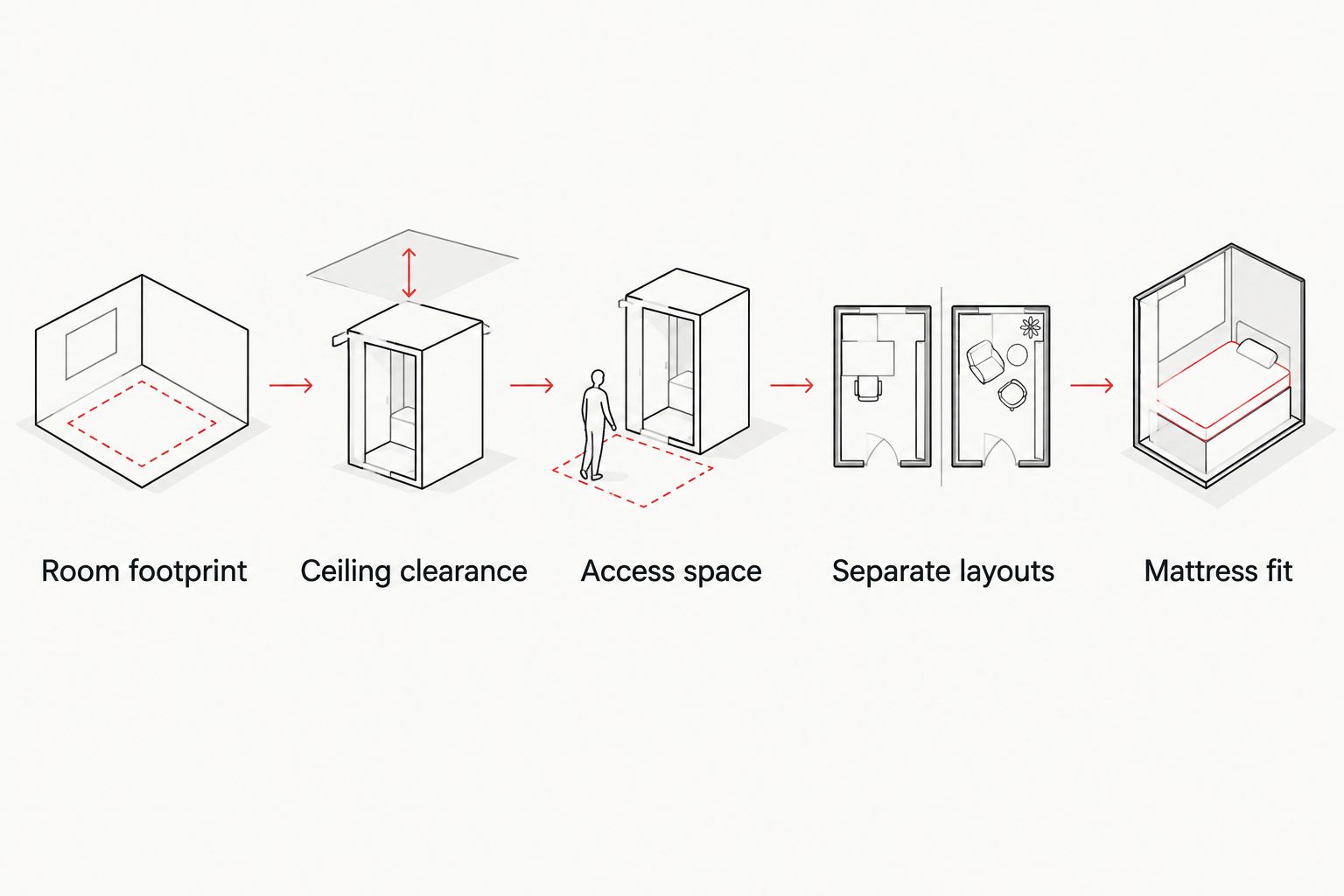
Use painter's tape to mark the outside corners of each proposed standalone bed. Open the bedroom door and dresser drawers. Walk the path a sleepy child will use at night. This simple layout check exposes problems that an empty-room measurement misses.
Safety checks that come before the shortlist
For a 2026 purchase, use U.S. Consumer Product Safety Commission guidance alongside the exact manufacturer's instructions. The CPSC advises that children younger than 6 years should not use the upper bunk. That guidance applies whether the bed is tall, low-profile, or convertible.
Federal bunk-bed requirements call for the upper edge of the guardrails to be at least 5 inches above the top of the mattress. Follow the bed's specified maximum mattress thickness; do not substitute a thicker mattress simply because its length and width fit.
Check these details before assembly:
- The upper bunk has the guardrails required by its instructions.
- The mattress matches the specified dimensions and thickness.
- Every fastener and support is installed in its designated position.
- The ladder is secured as directed and its approach is clear.
- Ceiling fans and other overhead hazards are kept out of the sleeping and climbing area.
- Ropes, cords, and hanging accessories are not attached to the bed.
Repeat the manufacturer's checks after conversion. Hardware that was correct in the stacked arrangement must be installed correctly in the standalone arrangement too.
Where the named designs fit into your comparison
Keep appearance separate from the conversion decision. The following Bunkbeddepot designs provide specific style details to compare, but those details do not establish twin-to-twin conversion.
| Design | Best for | Stated design detail | Conversion decision |
|---|---|---|---|
| Appalachian Winds Barn Door Bunk Bed | A family seeking barn-inspired styling | Board-and-batten barn aesthetics | Hold until the exact size and standalone conversion are documented |
| The White Mountains Bunk Bed | A family seeking mountain-inspired detailing | Mountain silhouette inlays and rock-shaped hickory hardware | Hold until the exact size and standalone conversion are documented |
Appalachian Winds Barn Door Bunk Bed pros: Its stated board-and-batten styling gives you a clear visual direction for the bedroom. Cons: Styling does not answer the mattress-size or separation questions. Verdict: Hold for the required configuration details.
The White Mountains Bunk Bed pros: Its stated inlays and hickory hardware provide specific decorative details to assess. Cons: Those details do not establish standalone frame construction or mattress compatibility. Verdict: Hold for the required configuration details.
For either design, request the instructions for the exact configuration you intend to order. Confirm construction details model by model, including any made-in-USA or hand-finished claims. Do not transfer specifications from another bed with a similar appearance.
How these options were ranked
The ranking follows the criteria above: documented conversion first, then complete standalone frames, mattress compatibility, room fit, safety details, and construction clarity. Decorative style is a deciding factor only after those requirements are satisfied.
Twin-over-twin wins the default slot because it directly matches the goal of two twin sleeping positions. Low-profile wins when ceiling clearance controls the purchase. Matching-frame conversion wins when the separated beds are the main reason to buy.
Which convertible bunk should you choose?
Choose a documented twin-over-twin convertible bunk unless your ceiling or future bedroom layouts require a more specific configuration. Keep the decision simple: approved mattresses, complete conversion instructions, safe access, and two workable floor plans.
Your 2026 purchase should support ordinary family life as well as a future move. Leave room for bedtime stories now. Make sure the separated beds have a sensible home later.
FAQ
What's the best convertible bunk bed that splits into twin beds?
The best default is a twin-over-twin bunk whose manufacturer documents conversion into two complete standalone twin beds. Confirm mattress compatibility, required components, and both room layouts before buying.
Do all twin-over-twin bunk beds separate into two beds?
No, twin-over-twin describes the sleeping sizes, not the conversion capability. Use the manufacturer's instructions to confirm that both frames become complete standalone beds.
Can a child younger than six sleep on a low-profile upper bunk?
No, CPSC guidance says children younger than six should not use the upper bunk. A lower bunk-bed height does not remove that restriction.
Will my existing twin mattresses fit a convertible bunk?
Use existing mattresses only if they match the exact dimensions and thickness required by the bed manufacturer. Upper-bunk mattress thickness also affects guardrail clearance.
How high should bunk-bed guardrails extend above the mattress?
Federal bunk-bed requirements call for guardrails to extend at least 5 inches above the top of the mattress. Follow the manufacturer's maximum mattress thickness and assembly instructions.
How can I tell whether two separated beds will fit the room?
Draw or tape out both beds using their full outside dimensions. Check door swings, drawers, closet access, and walking routes with both frames in position.
What should I ask Bunkbeddepot before choosing a convertible bunk bed?
Ask for the exact configuration's conversion instructions, approved mattress dimensions, and required standalone components. Confirm any construction and production details for that specific model rather than assuming they apply to every design.
One last thing
Keep the conversion instructions and unused conversion hardware together in a labeled container. When the children are ready for separate beds, that small bit of organization keeps the next chapter from starting with a missing part.


