

Airbnb hosts’ bunk-bed planning is the process of matching room measurements, sleeper fit, mattress compatibility, and safety checks to a workable guest bedroom. This 2026 guide to bunk beds for Airbnb hosts puts those decisions before extra sleeping spaces, because a rental bed must work for unfamiliar guests and the people who clean it.
- Choose bunk beds for Airbnb hosts by room clearance, documented sleeper limits, and mattress compatibility—not appearance alone.
- Bunkbeddepot sells handcrafted solid wood bunk beds; verify rental suitability and safety details for each model.
- Keep children under 6 years off upper bunks, following U.S. Consumer Product Safety Commission guidance.
- Vacation rental bunk beds need clear guest instructions and a repeatable turnover inspection.
Why bunk beds matter for Airbnb and vacation rental hosts
A bunk bed stacks sleeping surfaces instead of spreading them across the floor. That arrangement gives you another way to furnish a shared bedroom, but the frame, access route, and surrounding clearance still determine whether the room works.
Your guests do not know the bed as well as a family using it every night. They need an obvious way to climb down, clear mattress and sleeper restrictions, and somewhere to put their belongings without blocking access. Your cleaner needs to change the upper sheets and inspect the hardware without improvising.
Bunkbeddepot sells handcrafted solid wood bunk beds, loft beds, and custom bed configurations for families furnishing shared rooms. That establishes the category—not approval for every rental use. Before selecting a model for your 2026 furnishing plan, confirm its instructions, intended users, and applicable commercial-use terms.
A sleeping space only earns its place when guests can use it safely and your team can maintain it consistently.
How to choose bunk beds for your vacation rental
Measure the room before choosing the frame
Measure the usable room, not just the wall where the bed will stand. Include baseboards, sloping ceilings, door swings, windows, and the space needed to approach the ladder or stairs. A frame fitting between walls does not prove that the room functions.
Next, compare the complete bed dimensions with your plan. Mattress size and outside frame size are different measurements. Ask for the access component’s footprint and any additional space required to operate drawers or another moving part, where those features are documented.
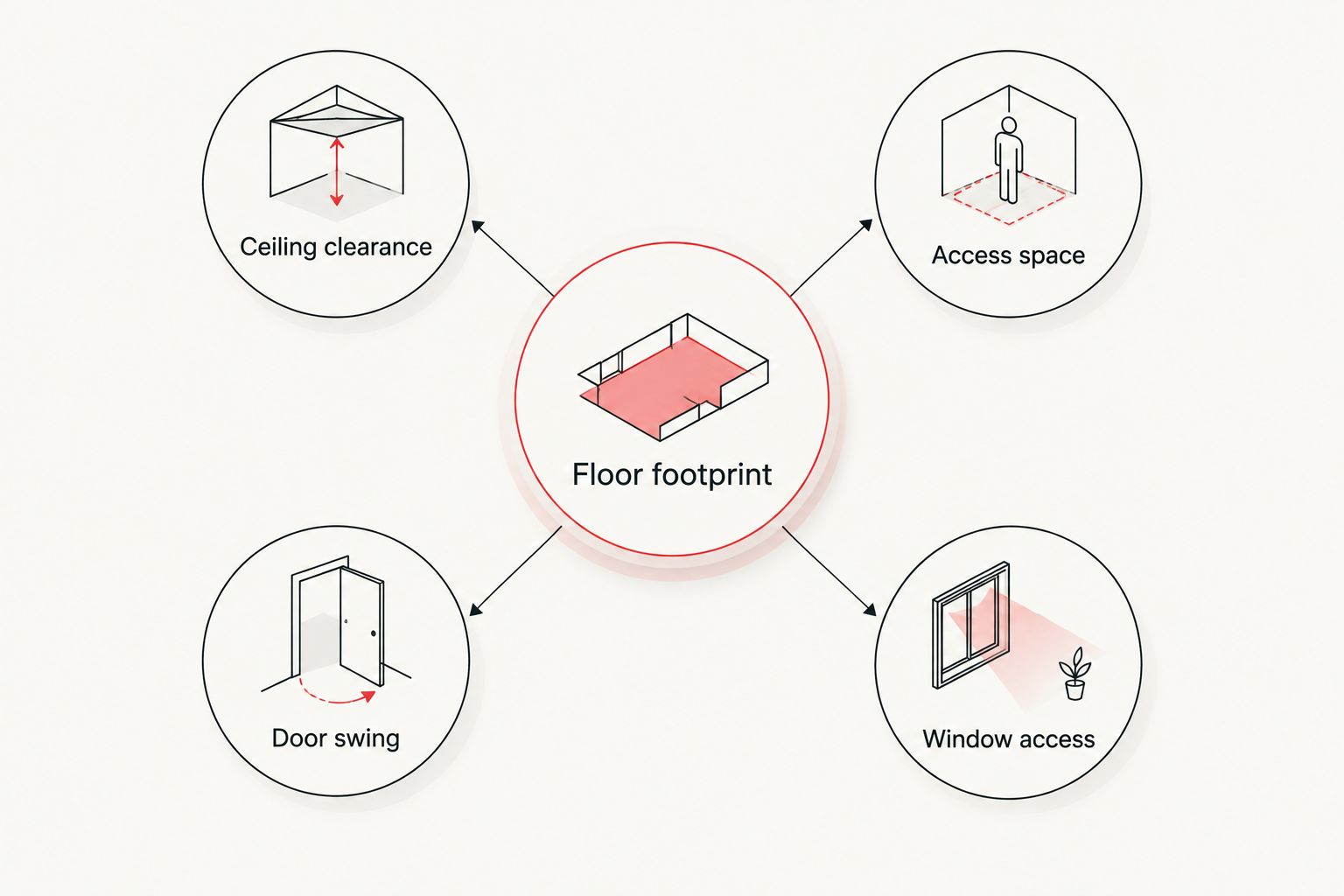
Use your 2026 room plan to record these separate checks:
- Floor footprint: Mark the outside frame dimensions on the floor.
- Ceiling clearance: Check the upper sleeping position against the manufacturer’s guidance.
- Access space: Keep the approach and descent area unobstructed.
- Door swing: Open bedroom and closet doors fully on the plan.
- Window access: Preserve required emergency escape access and operation.
Match each sleeping surface to the intended guest
Decide who the room is for before choosing a configuration. Families with young children, older siblings, and adult groups need different arrangements. Do not treat a larger mattress as proof that an upper bunk supports an adult.
Request the documented limit for each sleeping surface and its stated basis. Check whether the limit includes the mattress and whether different configurations have different requirements. Keep the answer with your property records so guest-facing information stays consistent.
The U.S. Consumer Product Safety Commission advises that children under 6 years should not use an upper bunk. A family rental therefore needs a suitable alternative sleeping arrangement for younger children; a warning alone does not create one.
- Identify the intended sleeper for each bed position.
- Obtain upper- and lower-bunk limits separately.
- Check age restrictions in the supplied instructions.
- Plan an alternative for children under 6 years.
- Describe sleeping arrangements accurately in the listing.
Verify the bed’s documentation and construction
Start with the assembly manual and safety information, not a styled room photo. Request the current documents for the exact configuration you intend to buy. Details from a similar model do not establish this bed’s requirements.
Bunkbeddepot is best for families seeking handcrafted solid wood bunk beds and custom bed configurations. For a rental purchase, confirm the selected model’s materials, production details, assembly requirements, and permitted use rather than applying brand-level claims to every bed.
Solid wood is a material choice, not a substitute for safety documentation. Look for clear instructions covering mattress fit, guardrails, access, hardware, and maintenance. Ask which safety requirements apply to the intended users and configuration.
- Request the exact model’s assembly manual.
- Confirm materials and finish details for that model.
- Ask for applicable safety and compliance documentation.
- Check how joints and hardware are inspected and tightened.
- Confirm whether rental use affects the product’s terms.
Choose the mattress around the safety requirements
The upper mattress must match the bed’s specified dimensions and maximum thickness. Adding a topper changes the sleeping surface height, so include it when checking the permitted thickness. Do not choose bedding first and then try to make the frame accommodate it.
Under the federal bunk-bed guardrail requirements in 16 CFR Parts 1213 and 1513, upper guardrails must extend at least 5 inches above the mattress top. The applicable requirements depend on the bed’s intended users; consult the current instructions and compliance information for the model.
Federal requirements also call for 2 guardrails on the upper bunk, with detailed rules for their placement and openings. These numbers are safety checks, not a complete compliance assessment. Do not use a taller mattress to solve a comfort complaint if it compromises the rail height.
- Match mattress length and width to the instructions.
- Check the maximum permitted mattress thickness.
- Include any topper in the total thickness check.
- Verify guardrail height above the installed mattress.
- Use bedding that does not obstruct the access route.
Test access, cleaning, and everyday use
Walk through the room as a guest arriving after dark and as a cleaner changing the bedding. You need to reach the upper surface without using furniture as an improvised step. Guests need to find the access point and return to the floor without stepping over luggage.
Keep fans, blind cords, and other nearby hazards in the room assessment. Do not attach hooks or accessories to the bunk unless the manufacturer permits them. A convenient-looking modification can create a snag or entanglement point.
A shared bedroom should still feel welcoming. Put storage and lighting where they support bedtime reading and quiet departures, not where they interfere with climbing.
- Walk the route from the doorway to each sleeping position.
- Test the sheet-changing process before accepting the layout.
- Keep bags and loose items out of the descent area.
- Check nearby fans, cords, and fixtures for hazards.
- Provide lighting without routing cords across access points.
Write instructions guests can actually follow
Use the manufacturer’s instructions as the starting point for your house guidance. State the upper-bunk age restriction, documented sleeper limits, mattress requirements, and any model-specific rules. Avoid substituting your own reassuring language for a restriction.
CPSC guidance also advises against horseplay on bunk beds and recommends using the ladder to reach the upper bunk. Include these points in plain language. Guests should understand the arrangement before booking, not discover its limitations at bedtime.
For your 2026 listing refresh, make the sleeping description match the installed room. Photograph the access route and show the actual configuration without implying that all sleeping positions suit every guest.
- State who can use the upper bunk.
- Copy documented limits accurately into house guidance.
- Explain the approved way to climb up and down.
- Tell guests not to attach ropes or similar items.
- Provide a clear way to report a loose or damaged component.
Build a turnover inspection into the room checklist
Inspect the assembled bed before opening the room to guests, then include visible safety checks in each turnover. Follow the manufacturer’s maintenance schedule for tightening and other work. Do not invent a torque setting or repair method.
Your team should know what requires taking the bed out of use. A loose guardrail, damaged access component, missing hardware, or unexplained movement needs assessment before another guest uses it. Keep replacement parts and repair decisions tied to the manufacturer’s guidance.
Record the model, assembly instructions, mattress specification, and maintenance history together. That file gives your cleaner, manager, and maintenance person the same reference.
- Check guardrails and access components for damage or movement.
- Inspect visible joints and hardware against the instructions.
- Confirm that mattresses remain within the approved specification.
- Remove an affected sleeping position from use pending assessment.
- Record repairs and the parts used.
Compare the options for your rental room
Use this 2026 comparison to separate layout choices from individual bed designs. Choose the arrangement first, then assess the exact model. None of the configuration labels establishes weight capacity, ceiling suitability, or permission for rental use.
The named designs below have verified aesthetic details in their supplied descriptions. Those details help with room character; they do not answer the safety questions above.
| Option | Best for | Useful distinction | Key limitation |
|---|---|---|---|
| Twin-over-twin configuration | Separate sleepers sharing a room | Keeps both mattress positions in the twin-size category | Upper-bunk suitability still depends on age, documented limits, and access |
| Twin-over-full configuration | A shared room needing different mattress sizes | Combines a smaller upper sleeping surface with a larger lower one | The lower mattress size does not establish adult suitability for the upper bunk |
| Full-over-full configuration | Guests needing wider sleeping surfaces | Uses full-size mattresses at both levels | Requires checking the complete frame footprint and each level’s limits |
| Loft-bed configuration | A room needing usable space beneath a raised bed | Leaves the area below the sleeping surface open | Does not provide a second sleeping surface by itself |
| Appalachian Winds Barn Door Bunk Bed | Hosts seeking board-and-batten barn styling | Its supplied description identifies classic barn aesthetics | Exact dimensions, mattress requirements, and rental suitability need confirmation |
| The White Mountains Bunk Bed | Hosts seeking mountain-themed design details | Its supplied description identifies mountain silhouette inlays and hickory hardware | Decorative details do not establish sleeper limits or safety compliance |
Bunkbeddepot’s named designs give you distinct visual directions without requiring every shared room to look alike. Keep that choice behind room fit, guest fit, and documentation. A mountain detail can suit the setting; it cannot solve insufficient clearance.


Common mistakes Airbnb hosts make
- Counting bunks before checking occupancy rules. Adding sleeping surfaces does not establish permitted property occupancy. Check the applicable local rules and your insurer’s requirements before changing the guest count.
- Advertising every bunk for adults. Mattress size alone does not establish adult suitability. Use the exact model’s documented limits and intended-user guidance.
- Choosing a thicker upper mattress for comfort. Extra thickness reduces the guardrail height above the sleeping surface. Keep the complete mattress-and-topper combination within the instructions.
- Designing for photos instead of turnovers. A tight corner can make the upper bed difficult to service. Test linen changes and inspection access before finalizing the room.
- Assuming guests will recognize restrictions. Put age and use restrictions in the listing and room guidance. A family arriving in 2026 should not have to infer them from the bed’s appearance.
FAQ
What are the best bunk beds for Airbnb hosts?
The best bunk beds for Airbnb hosts match the room, intended sleepers, approved mattresses, and documented safety requirements. Compare exact model instructions before choosing a style or increasing the advertised sleeping count.
Can adults sleep on vacation rental bunk beds?
Adults should use a bunk only when the exact model’s intended-user guidance and documented limits support that use. A full-size mattress does not prove that an upper bunk is suitable for adults.
Can young children use the upper bunk?
Children under 6 years should not use the upper bunk, according to U.S. Consumer Product Safety Commission guidance. Provide a suitable alternative and state the restriction before guests book.
How thick should an upper-bunk mattress be?
Use a mattress within the exact bed’s specified dimensions and maximum thickness. Include any topper in the thickness check, and verify the required guardrail height above the installed sleeping surface.
Are solid wood bunk beds automatically safe for rentals?
Solid wood does not establish safety compliance or rental suitability. Check the selected bed’s documentation, assembly requirements, intended users, and applicable terms before purchasing.
Is a loft bed better than a bunk bed for a vacation rental?
A loft bed is best when you need usable space beneath one raised sleeping surface; a bunk bed is best when you need stacked sleeping surfaces. Both require checks for clearance, access, sleeper suitability, and mattress compatibility.
What should I check between guest stays?
Check guardrails, access components, visible joints, hardware, and mattress fit between stays. Follow the manufacturer’s maintenance instructions and stop use when damage or movement needs assessment.
One last thing
Rehearse the first night, not just the room photo. Before opening the bedroom, walk in with a suitcase, find the light, approach the bed, and test the route back to the door. Then change the upper sheets.
That rehearsal exposes the practical decisions that dimensions alone miss. Get them right, and the room has space for bedtime stories and shared holidays—not just another mattress.


