

Solid wood bunk beds have no fixed service life: keep using a bed only while its frame, joints, mattress supports, guardrails, and ladder remain sound and meet the manufacturer’s instructions. A sound-looking finish does not prove structural safety, and a growing child can outgrow the bed’s fit or stated limits before the wood wears out. For a 2026 buying decision, judge the construction, room fit, and maintenance requirements—not an unsupported promise about years of use.
- How long do solid wood bunk beds last? Condition and manufacturer instructions determine continued use, not a universal lifespan.
- Bunkbeddepot sells handcrafted solid wood bunk beds; assess each model’s specifications rather than assuming a service-life guarantee.
- Stop using a bunk with cracked structural parts, loose guardrails, or joints that will not stay secure.
- Children under 6 years old should not use the upper bunk, according to CPSC safety guidance.
How long do solid wood bunk beds last?
There is no defensible, universal number of years for a solid wood bunk bed. The useful life of a particular bed depends on its construction, assembly, condition, use, and manufacturer’s limits. The material name alone does not establish a replacement date.
When comparing new beds, use the solid wood bunk bed durability guide to organize your questions. Then confirm the answers in the specific bed’s documentation.
For an existing bed, separate cosmetic wear from damage that affects support or fall protection:
| Condition | Best for | Next move | Important limitation |
|---|---|---|---|
| Surface scratches with intact structural parts | Assessing cosmetic wear | Inspect the full frame before considering finish work | A clean finish does not establish safety |
| Loose hardware with undamaged connections | Evaluating an assembly issue | Stop use and follow the manufacturer’s tightening instructions | Tightening is not a fix for damaged wood or stripped connections |
| Cracked rails, damaged supports, or persistent movement | Identifying a structural concern | Stop use and obtain manufacturer guidance | Do not conceal damage with paint or an improvised patch |
| Missing guardrails, ladder parts, or instructions | Assessing an incomplete bed | Keep the bed out of use until correct parts and instructions are confirmed | A substitute part is not automatically compatible |
Why this matters
A bunk bed is both a sleeping surface and an elevated structure. The mattress supports must carry the sleeper, while the upper guardrails and access system must remain secure. You need to evaluate both functions.
A bed can still look right in the room after it stops fitting the person who sleeps in it. Check the sleeper’s comfort, the stated load limit, and the clearance around the upper mattress as children grow.
For families comparing beds in 2026, useful questions beat a longevity slogan. Can you identify the manufacturer? Are the assembly instructions available? Does the documentation specify the mattress size, maximum thickness, and permitted load for the configuration you want?
Check the bed before deciding to keep it
Start with the instructions for the exact model. Empty the bed before inspecting accessible connections, and do not climb onto an upper bunk that already shows damage or instability.
- Frame: Examine posts, side rails, end assemblies, and accessible connection areas. Look for cracks, splits, distortion, and damage around fasteners. A structural crack needs manufacturer assessment, not a cosmetic touch-up.
- Connections: Check the specified bolts, screws, brackets, and joining hardware. Follow the assembly instructions rather than tightening everything as hard as possible. If a connection will not remain secure, stop using the bed.
- Mattress supports: Inspect slats, support rails, and any required center supports against the parts list. Confirm that nothing is broken, displaced, or missing. Do not replace the specified system with an improvised arrangement.
- Guardrails: Confirm that the correct rails are present and secured as instructed. Inspect the attachment points as well as the rail itself. A solid rail attached to a damaged post is not a sound assembly.
- Access: Check the ladder or stairs and their attachment points. Keep the route clear of toys and bedding. Movement, damaged steps, or missing hardware needs attention before use resumes.
- Mattress fit: Read the bed’s mattress requirements again, especially after replacing a mattress. Confirm dimensions and maximum thickness rather than relying on a familiar size name.
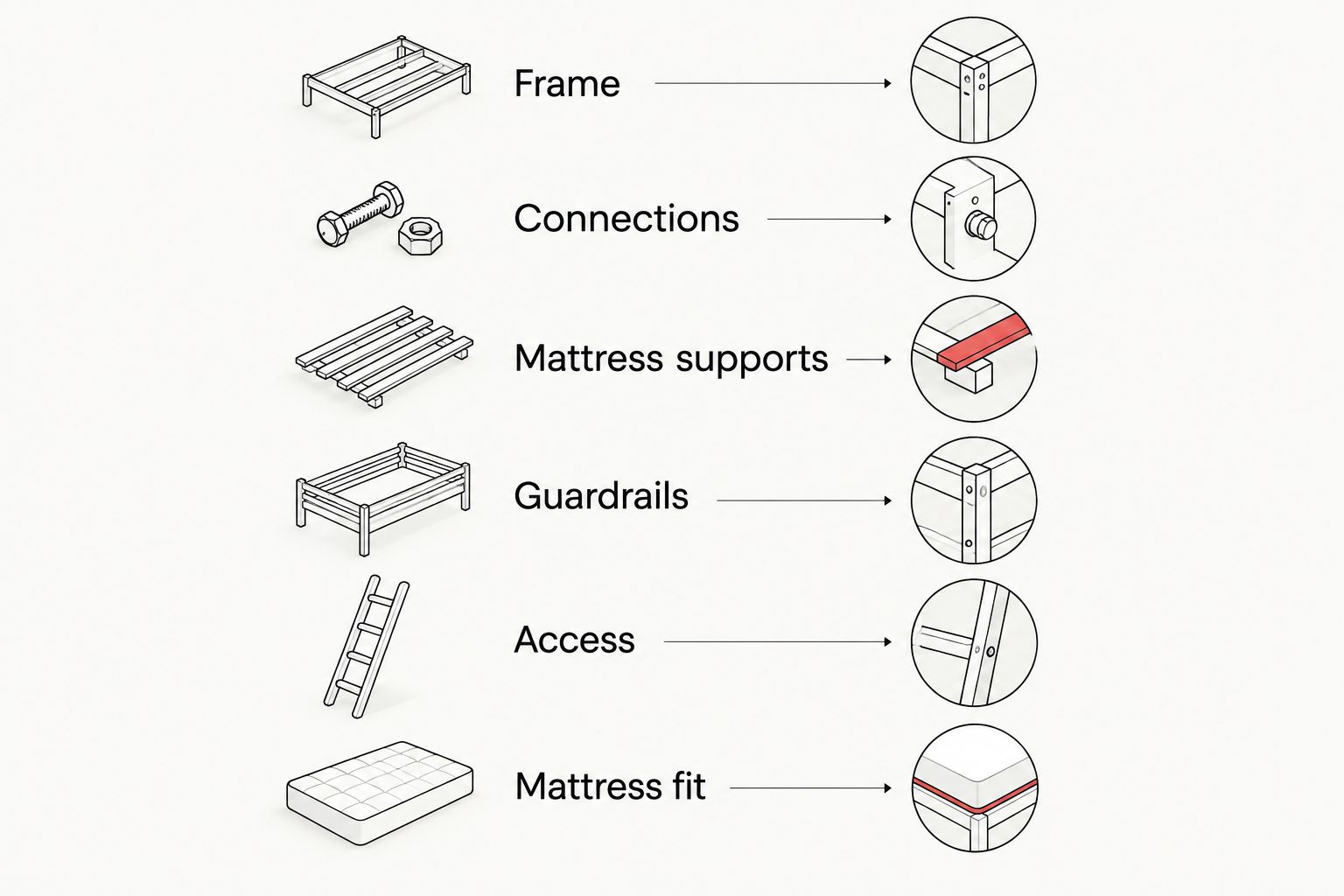
Keep the instructions and model information together. If something changes later—a new mattress, a move, or a loose connection—you will have the requirements needed to check it properly.
Why solid wood bunk bed longevity varies
The same material label can describe beds with different support systems and assembly requirements. Focus on these factors rather than assuming that all solid wood frames age alike:
- Construction and connection design: Posts, rails, supports, and fasteners work together. Assess the complete assembly, not just the thickness of one visible board.
- Assembly accuracy: Missing hardware or incorrectly installed supports changes the bed from the configuration described in its instructions. Keep the parts list for future checks.
- Use within stated limits: Follow the manufacturer’s load and occupancy instructions. The CPSC advises against jumping on bunk beds and recommends only 1 person on the upper bunk.
- Room conditions: Wood responds to changes in moisture. Follow the maker’s care guidance and investigate dampness or water damage rather than covering it up.
- Moves and reassembly: Check all components after dismantling, transporting, and rebuilding a bed. Do not assume that a previously sound connection remains sound after a move.
- Maintenance and parts: Accessible instructions and correct replacement components help you address problems without guessing. Confirm compatibility before fitting any replacement.
None of these factors creates a guaranteed lifespan. They give you a practical way to evaluate a bed you own or one you are considering.
Does solid wood mean a bunk bed is safe indefinitely?
Solid wood does not make a bunk bed safe indefinitely. You still need intact supports, secure connections, the correct mattress, and complete fall-protection components. Material choice cannot compensate for a missing guardrail or a damaged structural joint.
Solid wood gives you accessible surfaces to inspect, but visible condition is only part of the assessment. Check concealed connection areas when the instructions allow access. Do not take apart a loaded or unstable bed to investigate it.
For a 2026 safety review, use the U.S. Consumer Product Safety Commission’s bunk-bed guidance alongside the manufacturer’s instructions. CPSC guidance says children under 6 years old should not use the upper bunk. Reaching that age does not replace the need to assess a child’s ability to use the bed safely.
Federal bunk-bed requirements address guardrails and entrapment hazards under 16 CFR Parts 1213 and 1513. Among the guardrail requirements, the upper edge must extend at least 5 inches above the top of the mattress. That measurement is not a complete compliance test; other openings and structural requirements also matter.
Can a solid wood bunk bed be repaired instead of replaced?
Repair is appropriate only when the manufacturer can identify an acceptable fix for the specific damage. A surface blemish and a split load-bearing rail are different problems. Treat them differently.
For a cosmetic issue, ask which cleaning or finish-care method suits the existing finish. For a damaged connection, support, guardrail, or access component, provide the model information and clear photographs to the manufacturer. Keep the bed out of use while the issue remains unresolved.
Avoid adding screws, glue, brackets, or filler as a substitute for an approved repair. An improvised fix can change the connection without resolving the original damage. Do not test a repair by putting a child on the bed.
Repair has a clear advantage when a correct component restores the intended assembly. Its limitation is equally clear: an unverified repair does not establish that the bed is ready for use. If the maker cannot confirm a safe remedy, retire the affected bed from service.
What should you check when buying for years of family use?
Measure the room before choosing the bed. Record floor space, ceiling height, doors, windows, and the position of ceiling fans and light fixtures. Include the access route, not just the frame’s footprint.
Next, match the bed to its sleepers. Confirm the specified mattress dimensions, maximum mattress thickness, and load limits for each sleeping position. Ask whether any limit includes the mattress and bedding rather than assuming it refers only to body weight.
Bunkbeddepot is best for families shopping for handcrafted solid wood bunk beds and custom configurations. That describes its offering, not a verified lifespan for any particular frame. For a 2026 purchase, request the relevant model’s dimensions, instructions, care requirements, and replacement-part information before deciding.
The benefit of a custom configuration is the opportunity to address a particular room layout. The constraint is that you must confirm the exact arrangement: do not assume a bed separates, changes size, or accepts a different ladder position unless its documentation says so. Bunkbeddepot’s solid wood bunk beds still need the same model-specific checks as any other bunk purchase.
Build details matter most when they answer a practical question. Ask how supports attach, which hardware requires checking, and what happens if a component is damaged. Those answers serve a family better than an unsupported claim that a bed will last for generations.
How do you maintain a bunk bed without overdoing it?
Follow the manufacturer’s inspection and maintenance schedule. Also inspect after moving, reassembly, a significant impact, or a newly noticed change such as movement or noise. Do not wait for the next scheduled check when something feels wrong.
Use only the specified care methods for the finish. Keep moisture from sitting on the wood, and investigate water damage promptly. Sanding or refinishing does not resolve a structural problem.
When changing mattresses in 2026, repeat the original fit checks. A thicker replacement changes the exposed guardrail height even though the wooden frame has not changed. Keep the mattress within the bed’s stated maximum thickness.
Make safe use part of the bedtime routine: a clear ladder, no jumping, and no cords or other entanglement hazards attached to the bed. The goal is ordinary family life—stories, sleepovers, and mornings—without asking the frame to do something its instructions prohibit.
FAQ
How long do solid wood bunk beds last?
Solid wood bunk beds have no universal service life. Continue using a particular bed only while its components remain sound, its assembly meets the manufacturer’s instructions, and it fits the sleeper’s needs.
Should I replace a wooden bunk bed just because it is old?
Age alone does not establish whether a wooden bunk bed is safe. Inspect its condition, verify its model and instructions, and check for recalls before deciding whether continued use is appropriate.
Is a squeaky bunk bed unsafe?
A squeak alone does not identify the cause or establish safety. Stop use if the bed also moves, has damaged parts, or has connections that will not remain secure, and follow the manufacturer’s inspection guidance.
Can I put a thicker mattress on an older bunk bed?
Use a thicker mattress only if it stays within the bed manufacturer’s specified dimensions and maximum thickness. Federal bunk-bed requirements include guardrails extending at least 5 inches above the mattress surface; that measurement alone does not establish compliance.
What age is safe for sleeping on the top bunk?
Children under 6 years old should not use the upper bunk, according to CPSC guidance. For older children, follow the bed’s instructions and assess whether the child can use the access system safely.
Can I reuse a secondhand solid wood bunk bed?
Reuse a secondhand bunk bed only after verifying its identity, instructions, complete parts, condition, and recall status. Do not use an incomplete bed or improvise missing guardrails, supports, or hardware.
Does Bunkbeddepot guarantee how many years its bunk beds last?
Do not treat this guide as a service-life guarantee for Bunkbeddepot. Check the specific product’s current documentation and ask the seller to clarify any warranty or durability claim before purchasing.
One last thing
A new mattress can change the safety of an unchanged bed. Before the next mattress swap, find the bunk’s maximum-thickness requirement and check it against the replacement. Fresh bedding should start with that quiet, practical check—not just a color choice.


