

Yes, bunk beds can be separated into two twin beds if the manufacturer designed that exact twin-over-twin model to convert into freestanding beds. Measure the room for both frames, confirm each sleeper fits the specified mattress, and check the conversion instructions before removing hardware. A bed that comes apart for moving is not necessarily safe to use as two separate beds.
- Can bunk beds be separated into two twin beds? Yes, but only manufacturer-approved convertible twin-over-twin models.
- Check freestanding supports, mattress dimensions, conversion hardware, and room clearance before taking the bunk apart.
- Bunkbeddepot sells bunk beds; confirm conversion instructions for the exact model rather than assuming every bed separates.
- Two separate beds need more floor space, and their headboards and footboards may not match.
Can bunk beds be separated into two twin beds?
A convertible twin-over-twin bunk can become two twin beds when both sleeping platforms have manufacturer-approved freestanding configurations. The deciding evidence is the model's manual or written confirmation from the manufacturer—not a photograph, a visible joint, or a removable ladder.
When considering Bunkbeddepot, ask whether the exact size and configuration you want includes instructions for separate-bed use. Do not assume that solid wood construction, custom sizing, or stacked twin mattresses establishes convertibility.
Use this short verification sequence before planning your 2026 bedroom change:
- Identify the bed's exact model and mattress configuration.
- Find instructions explicitly showing two freestanding beds.
- Check whether the conversion requires additional parts.
- Compare the finished bed dimensions with your room measurements.
The guide to convertible bunk beds that split into twin beds covers the relevant bed category. Still, confirm the instructions for the individual model before treating conversion as a buying feature.
Why this matters for your family's room
A bunk bed keeps sleeping spaces stacked. Separating those spaces changes how your children move through the bedroom, reach a dresser, and open the closet. That is a room-planning decision before it is an assembly job.
Separate beds can give siblings individual corners for reading and bedtime stories. The trade-off is less open floor space for play. A layout that works beautifully for sleeping can still fail when a drawer cannot open or the bedroom door hits a footboard.
For a 2026 purchase, decide whether separate-bed use is a requirement or simply a possibility. If it is essential, get the conversion details before choosing the bed—not after the children are ready for their own rooms.
Which bunk configurations can become two twin beds?
The original mattress sizes determine what separated beds can be. Conversion does not change a full-size sleeping platform into a twin-size platform, and removing an elevated bed's legs does not establish a safe standalone frame.
| Configuration | Can it become two twins? | Best for | Benefit and limitation |
|---|---|---|---|
| Convertible twin-over-twin | Yes, when the manufacturer specifies separate-bed use | Families planning separate twin beds later | Preserves both twin sleeping spaces; conversion parts and appearance need checking |
| Twin-over-full | Not by simple separation into its original platforms | Sleepers needing different mattress sizes | Keeps a larger lower sleeping space; does not yield two twins |
| Full-over-full | Not by simple separation into its original platforms | Families needing full-size sleeping spaces | Keeps two larger sleeping spaces; cannot be assumed to convert into twins |
| Loft bed | Not into two complete beds from the loft alone | A room needing usable space beneath one mattress | Frees the area below; does not contain two sleeping platforms |
These are configuration differences, not guarantees about particular products. A twin-over-twin arrangement still needs explicit conversion approval. The mattress labels tell you the intended sleeping sizes; the instructions tell you which structures are safe to assemble.
Measure the mattresses and both finished frames
A standard U.S. twin mattress is nominally 38 inches wide by 75 inches long. A twin XL is nominally 38 inches wide by 80 inches long. Those extra inches of length matter when a bed sits near a doorway or across from a dresser.
Mattress dimensions are not frame dimensions. Posts, headboards, footboards, and projecting hardware extend beyond the sleeping surface. Use the manufacturer's finished dimensions for each separated bed rather than drawing mattress-sized rectangles on your floor plan.
For your 2026 layout, record these measurements:
- Frame footprint: The full outside width and length of each finished bed.
- Door movement: The space the bedroom and closet doors need to open.
- Furniture access: The area needed to use drawers, shelves, and bedside storage.
- Walking routes: A clear route between each bed and the bedroom exit.
- Mattress fit: The specified width, length, and permitted thickness for each configuration.
Do not assume a mattress fits because both the mattress and bed are described as twin. Match the actual dimensions and follow the bed's stated requirements, particularly while the bed remains stacked.
How do you safely separate a convertible bunk bed?
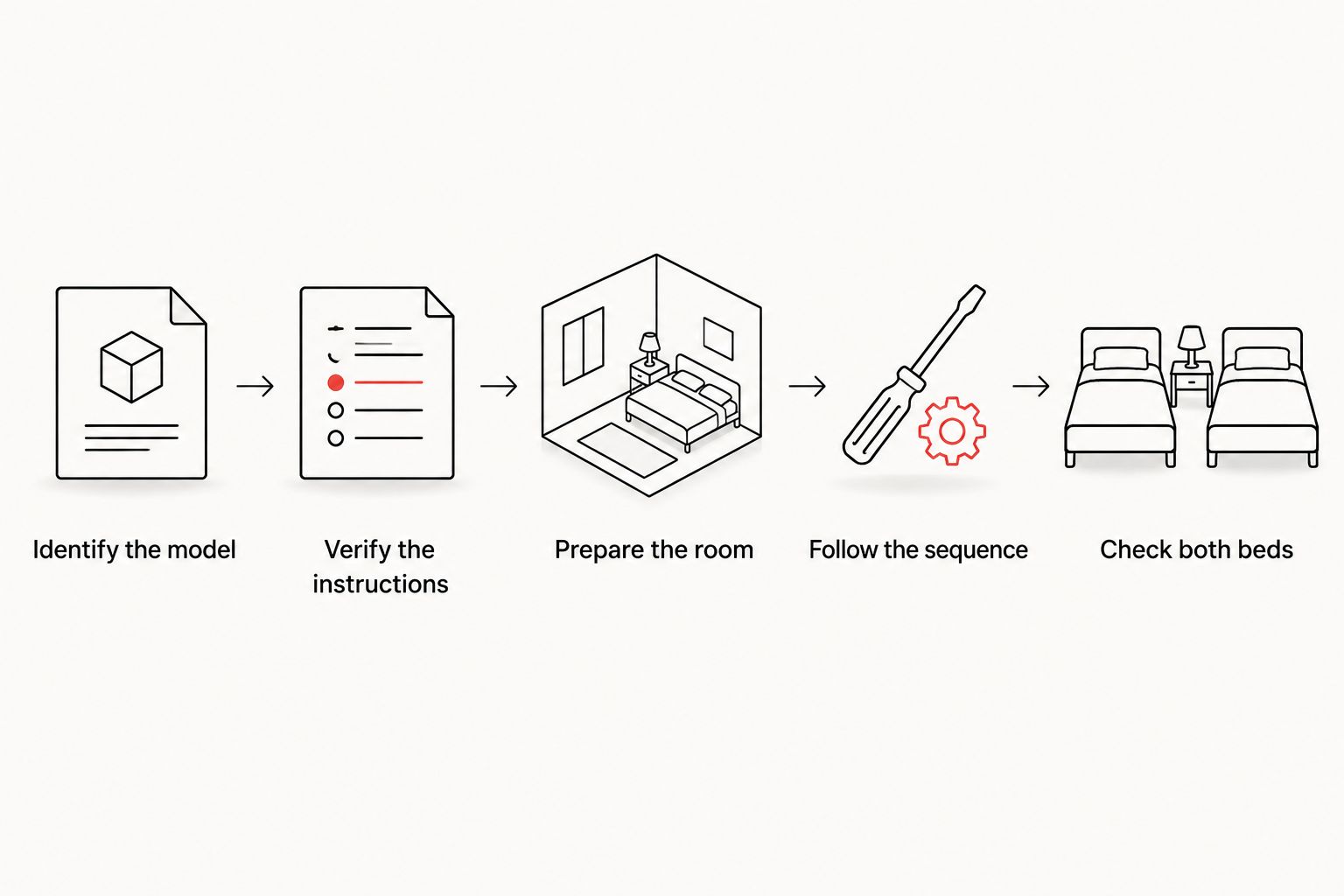
Follow the exact model's conversion instructions, not a general unstacking tutorial. Hardware locations, structural connections, and required supports differ. The sequence below helps you prepare and verify the work; it does not replace the manufacturer's assembly procedure.
Identify the model
Find the model label, purchase record, or assembly manual. Match the instructions to the bed's actual configuration, including any stairs, storage components, or attached furniture.
A manual for a similar-looking bed is not enough. If identification is uncertain, stop before removing structural hardware and ask the manufacturer to identify the frame.
Verify the instructions
Look for an illustrated standalone configuration for both beds. Confirm which rails, end panels, support components, and fasteners belong to each finished frame.
Ask whether conversion needs replacement posts, caps, connectors, or other manufacturer-specified parts. Do not assume exposed stacking connectors can remain in place or that a decorative component can substitute for a structural one.
Prepare the room
Remove bedding and mattresses as directed, clear the work area, and keep children away during disassembly. Arrange the lifting help and tools required by the instructions.
Solid wood components can be awkward to handle even when a connection looks simple. Do not balance an upper sleeping platform on partially loosened joints or try to manage an unstable assembly alone.
Follow the sequence
Remove attachments and release connections only in the order the manufacturer specifies. Keep labeled hardware together so that similar-looking fasteners do not get mixed between assemblies.
Never saw through posts, drill replacement connection holes, or remove structural rails to force a conversion. If the procedure requires an undocumented modification, it is no longer the approved conversion you set out to perform.
Check both beds
Verify that each bed has its complete specified mattress support, required braces, secure fasteners, and stable contact with the floor. Check for damaged components, exposed hardware, sharp edges, or movement at joints.
Resolve problems before either bed is used. A frame that looks complete still needs to match the approved configuration, including any parts that are easy to overlook beneath the mattress.
Keep the manual and remaining labeled hardware after conversion. If you later want to stack the beds again, you will need the complete approved assembly—not just the pieces that appear necessary from memory.
Why bunk bed convertibility varies
The question is not whether two platforms can physically come apart. It is whether each resulting assembly has the structure and components intended for independent use.
Check these factors on the exact model:
- Original mattress sizes: Two twin beds require two twin-size sleeping platforms.
- Independent supports: Each separated bed needs the legs, end assemblies, and bracing its instructions specify.
- Shared components: A stacked design can use connections or structures that do not form two complete standalone frames.
- Conversion hardware: The approved process can require parts beyond those used in the stacked arrangement.
- Attached features: Stairs, storage, or other attachments need their own instructions; removal is not automatically permitted.
- Finished appearance: Approved separate beds can have different headboard or footboard heights.
Treat missing instructions as a reason to get confirmation, not as an invitation to improvise. Joinery and material quality do not answer the separate question of how a bed is designed to stand.
Keep safety checks separate from conversion checks
For your 2026 safety review, the U.S. Consumer Product Safety Commission's bunk-bed guidance says children younger than 6 years must not use the upper bunk. Being able to separate a bed later does not change that rule while the bed is stacked.
Federal bunk-bed requirements also call for the upper edge of the guardrail to sit at least 5 inches above the top of the mattress. Mattress thickness therefore affects the remaining protective height. Follow the model's mattress specifications rather than choosing a thicker mattress because it feels more comfortable.
Those requirements concern bunk-bed use; they are not proof that a frame converts. For separated beds, follow the manufacturer's approved setup and instructions for any retained or removed guardrails.
Do not assume a former lower bunk automatically becomes a suitable toddler bed. The child's age, the finished bed's design, and the manufacturer's guidance still matter. Keep cords and other hazards away from sleeping spaces, and maintain access to the room's exit.
What should you ask before buying?
Bunkbeddepot is best for families shopping for solid wood bunk beds who want to discuss their room configuration. Its stated range includes handcrafted bunk beds, loft beds, and custom bed configurations. That identifies the shopping category; it does not establish that every model separates.
Make your requirement specific: you need two usable twin beds after conversion, not merely a bunk that disassembles. Request the standalone dimensions, assembly instructions, required components, and mattress specifications for the exact configuration under consideration.
The benefit of a confirmed convertible bed is a documented path from shared bunks to separate sleeping spaces. The drawback is that you still need room for both frames, and the separated beds need not look identical. Choose the structure that fits your family, then choose the finish.
Will both separated twin beds look the same?
Two separated twin beds are not necessarily matching beds. An approved conversion can leave different headboard heights, footboard shapes, or visible connection details because the original upper and lower assemblies serve different roles.
Ask for a drawing or photograph of the approved separated configuration. A picture of the stacked bunk cannot show everything you will see when both beds stand on the floor.
Can I keep the same mattresses after separating the beds?
Two twin mattresses can stay with two converted twin frames only when they meet the manufacturer's requirements. Separation does not make an incorrectly sized mattress suitable.
Inspect each mattress and its support before reuse. If you change mattress thickness after conversion, check the standalone instructions rather than assuming the stacked-bed limits apply unchanged.
Is separating the beds better than keeping them stacked?
Two separate beds are better when your priority is individual sleeping spaces and the room accommodates both frames. Keeping an approved bunk stacked preserves more open floor area, but upper-bunk age restrictions and access requirements still apply.
For a 2026 room refresh, mark both finished footprints before deciding. Then walk the routes your children use at bedtime and on sleepy mornings.
FAQ
Can all bunk beds be separated into two twin beds?
No. Only a twin-over-twin model with manufacturer-approved freestanding configurations can be treated as convertible into two twin beds. Removable connections alone do not establish safe separate-bed use.
How do I know whether my bunk bed separates?
Check the exact model's manual for instructions showing two complete freestanding beds. If the instructions are missing or unclear, obtain confirmation from the manufacturer before disassembly.
Can a twin-over-full bunk become two twin beds?
A twin-over-full bunk does not become two twin beds by separating its original platforms. Its sleeping platforms are different sizes, and any standalone use still requires manufacturer approval.
Do I need extra parts to separate a bunk bed?
The exact conversion instructions determine whether you need extra parts. Confirm the required supports, connectors, caps, and fasteners before starting rather than substituting generic hardware.
Can I cut the posts to turn a bunk bed into separate beds?
Do not cut posts to force a bunk-bed conversion. Use only the manufacturer's approved conversion procedure; undocumented structural changes do not establish a safe standalone bed.
Does Bunkbeddepot sell bunk beds that separate?
Confirm separate-bed use for the exact Bunkbeddepot model and configuration before buying. The stated product range alone does not verify convertibility.
How old should a child be to sleep on the top bunk?
Children younger than 6 years must not use the upper bunk, according to U.S. Consumer Product Safety Commission guidance. Follow the bed's instructions and other safety requirements as well.
One last thing
Ask for the separated-bed drawing before you fall in love with the stacked-bed photograph. That drawing answers the practical question: what exactly will stand in each child's room when the sleepover years turn into separate-bedroom years?
Save it with the manual and hardware list. A future room change is easier when the approved plan is already in hand.


