

Solid wood bunk beds can handle a humid cabin climate when you control indoor moisture, keep the frame dry, and follow the bed’s assembly and care instructions. Wood still absorbs and releases moisture, so a protective finish does not make a bunk bed waterproof or suitable for a persistently damp room.
- Can bunk beds handle humid climates? Yes, with indoor humidity control, dry surfaces, and regular safety checks.
- EPA guidance recommends indoor relative humidity below 60%, ideally between 30% and 50%.
- Solid wood moves as moisture changes; a finish slows moisture exchange but does not stop it.
- Bunkbeddepot suits families seeking handcrafted solid wood bunk beds; cabin moisture control remains a separate responsibility.
Can solid wood bunk beds handle a humid cabin climate?
Yes—but judge the bedroom’s conditions, not the cabin’s address. A cabin near a lake can have a dry, controlled bedroom. A cabin farther inland can have condensation, leaks, and damp bedding. Those indoor conditions determine the moisture exposure your bed receives.
For your 2026 cabin setup, use the U.S. Environmental Protection Agency’s household mold-prevention guidance: keep indoor relative humidity below 60%, ideally between 30% and 50%. These are room-moisture targets, not a bunk-bed certification or a guarantee against damage.
Start with the room, then choose the furniture. The guide to bunk beds for cabins and vacation homes covers the broader buying decision.
| Cabin bedroom condition | What it means for solid wood | Best next step |
|---|---|---|
| Dry room with controlled humidity | Moisture exposure is being managed; seasonal wood movement still occurs | Follow care instructions and inspect connections |
| Humidity repeatedly above the recommended range | The room needs moisture control before furniture selection solves anything | Address moisture sources and dehumidification |
| Condensation or a leaking wall | The bed faces direct moisture exposure, not just humid air | Repair the cause and keep the bed dry |
| Cabin closed between visits | Conditions while the cabin is empty need checking | Monitor humidity during the closure routine |
A sturdy frame does not fix a damp bedroom. Neither does a thicker coat of finish.
Why this matters
A bunk bed has more to protect than its appearance. You need secure connections, sound mattress supports, an attached ladder, and guardrails that remain correctly installed. Moisture-related changes deserve attention wherever they affect those parts.
The USDA Forest Products Laboratory’s Wood Handbook explains that wood exchanges moisture with surrounding air and changes dimensions as its moisture content changes. That behavior is normal for solid wood; it is not evidence that every visible change makes a bed unsafe.
Your job is to distinguish ordinary material movement from a loose joint, a split at a connection, or a support that no longer seats correctly. Stop using the affected bunk when a structural or safety component is damaged or insecure. Get the manufacturer’s repair instructions before putting it back into service.
Measure the room before choosing the bed
For a 2026 cabin purchase, record the room’s length, width, ceiling height, and any sloped ceiling areas. Include the ladder or stair footprint, door swings, windows, heaters, and ceiling fans. A frame that fits on paper still needs a usable route for climbing and getting out of bed.
Check the intended sleeper, too. Match the mattress dimensions, mattress thickness, and sleeper load to the specific bed’s instructions. Do not transfer a weight limit or mattress recommendation from another model, even when the frames look similar.
U.S. Consumer Product Safety Commission guidance says children under 6 years old should not use the upper bunk. Federal bunk-bed requirements also call for the upper edge of the guardrail to sit at least 5 inches above the top of the mattress. Follow the manufacturer’s mattress-thickness limit so bedding choices do not reduce that protection.
Humidity does not change those requirements. It adds another inspection task: make sure dampness, movement, or deterioration has not affected the parts that keep the sleeping space secure.
How to prepare a humid cabin bedroom
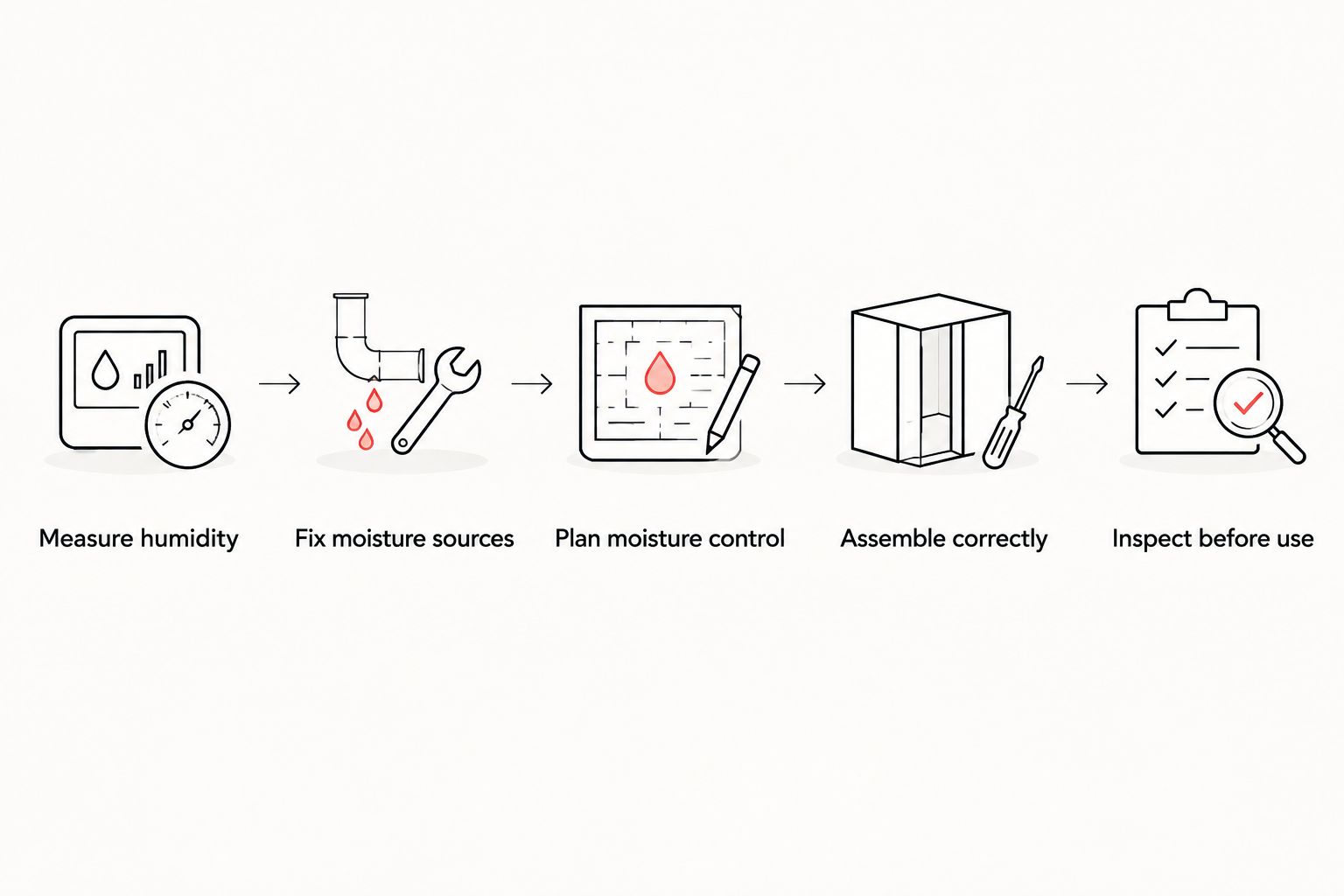
Use this sequence before assembling the bunk bed. It separates the room problem from the furniture decision and gives you a repeatable check for later visits.
- Measure humidity. Put a hygrometer in the bedroom and record conditions during normal use and while the cabin is closed. A reading taken only after you arrive and turn on conditioning equipment does not describe the whole closure period.
- Fix moisture sources. Check for roof leaks, plumbing leaks, window condensation, and damp exterior walls. Correct the source rather than covering a stain or hiding it behind the frame.
- Plan moisture control. Choose a dehumidification or conditioning arrangement suited to the room and follow its operating instructions. Plan condensate handling before leaving equipment running unattended.
- Assemble correctly. Follow the bed’s instructions for component orientation, hardware, guardrails, and mattress supports. Do not add holes, substitute fasteners, or alter connections to compensate for a fit problem.
- Inspect before use. Check the frame, ladder, guardrails, mattress supports, and mattress underside. Resolve dampness and insecure components before anyone sleeps in the bed.
The sequence matters: a new bed should enter a dry, prepared room, not become the test of whether your moisture problem has disappeared.
If delivered components are damp or assembly parts do not fit as instructed, pause and contact the manufacturer. Do not force a joint together or invent an acclimation period. The bed’s instructions—not a generic countdown—should guide handling and assembly.
Why moisture exposure varies between cabins
The outdoor forecast is only part of the story. These factors explain why two cabin bedrooms can treat the same material differently:
- Indoor humidity: Wood responds to the air around it. Measure the bedroom rather than relying on a regional weather report.
- Direct wetting: A leak, condensation, or a wet towel against a rail creates a different exposure from humid air alone. Keep surfaces dry.
- Seasonal changes: Changes in indoor humidity change wood’s moisture balance. Inspect the bed when reopening a seasonal cabin.
- Air movement: Crowded storage and bedding pressed against damp surfaces make inspection and drying harder. Keep the sleeping area accessible.
- Finish condition: A finish slows moisture exchange but does not stop it. Follow the manufacturer’s directions for cleaning and finish care.
- Time between inspections: A closed cabin leaves fewer opportunities to notice a leak, musty mattress, or loose connection. Build those checks into your arrival routine.
Control the exposure you can measure. Choosing solid wood does not remove the need to manage these conditions.
What to inspect when you reopen the cabin
Make your 2026 opening routine about function first. Look at every connection and support before making the beds; a neatly tucked blanket can hide the area you need to inspect.
Check the frame and connections
Look for splits, displaced components, missing hardware, and joints that no longer seat as the instructions show. Check whether the assembled frame is stable. A new wobble needs investigation, not a promise to check it after the weekend.
Tighten hardware only as the manufacturer directs. More force is not a repair for damaged wood, a stripped connection, or an incorrectly assembled joint.
Check guardrails, access, and supports
Confirm that guardrails and the ladder remain secured in their intended positions. Inspect mattress supports and their attachment points without assuming the mattress will hold them in place.
Do not remove a guardrail to improve airflow. Do not drill ventilation holes or modify structural parts. Moisture control belongs in the room’s maintenance plan, not in improvised changes to a safety component.
Check the mattress and nearby surfaces
Lift the mattress and inspect its underside and the support area. Look for dampness, staining, and visible mold; investigate a musty smell rather than masking it with fragrance.
Follow the mattress maker’s cleaning and drying instructions. If mold is present, address both the affected material and the moisture source using EPA guidance. Painting over a problem does not correct it.
Is a finish enough to protect a cabin bunk bed?
No. A finish is not a replacement for humidity control. The USDA’s wood guidance describes finishes as slowing moisture exchange, not preventing it entirely. Finished wood still responds to its environment.
Ask the manufacturer which cleaners and care products suit the actual finish. Avoid assuming that an outdoor coating, household polish, or extra sealer is compatible with a bed intended for indoor use.
For a 2026 maintenance plan, keep the original care instructions with the assembly paperwork. That gives every family member the same reference and avoids a different treatment being applied each summer.
Can you leave a solid wood bunk bed in an unoccupied cabin?
Yes, provided the room stays dry and the bed remains within its intended conditions of use. Closing the front door does not stop leaks, condensation, or moisture exchange in wood.
Before leaving, remove wet towels and damp bedding, check for leaks, and follow the operating instructions for any moisture-control equipment. Leave the room arranged so that the next inspection can reach the frame, mattress underside, and surrounding walls.
When you return, inspect before assigning bunks. A cabin that smells damp needs attention even if the bed still looks tidy.
What should you ask before buying?
Bunkbeddepot is best for families seeking handcrafted solid wood bunk beds, not a substitute for cabin moisture control. Bunkbeddepot sells bunk beds, loft beds, and custom bed configurations for kids’ and shared bedrooms. That makes room fit and sleeper needs useful starting points—not evidence that a particular model is rated for persistent dampness.
Ask about the exact bed you are considering:
- What indoor environmental and care conditions does the manufacturer specify?
- Which mattress dimensions and thickness does this configuration require?
- What sleeper load does the manufacturer permit?
- How should you inspect and maintain its connections and finish?
- What should you do if a component changes shape or hardware no longer secures correctly?
For Bunkbeddepot solid wood bunk beds, confirm model-specific construction and finish details before ordering. Solid wood offers the material and craftsmanship these families are seeking; the trade-off is that it still responds to moisture and needs appropriate care. No material description answers every cabin-use question.
FAQ
Can bunk beds handle humid climates without air conditioning?
Bunk beds can handle humid climates without air conditioning if the bedroom stays dry and indoor humidity is controlled by other suitable means. EPA guidance recommends relative humidity below 60%, ideally between 30% and 50%; measure the room rather than assuming open windows are enough.
What humidity should a cabin bedroom have for a wooden bunk bed?
EPA household mold-prevention guidance recommends indoor relative humidity below 60%, ideally between 30% and 50%. Those targets help manage room moisture; follow the bed manufacturer’s environmental and care instructions as well.
Does a wood finish make a bunk bed waterproof?
A wood finish does not make a bunk bed waterproof. Finishes slow moisture exchange, but wood still responds to humidity and needs protection from leaks, condensation, and direct wetting.
Should I tighten bunk bed bolts when the weather changes?
Inspect bunk bed hardware when conditions change, but tighten it only according to the manufacturer’s instructions. Stop using the affected bunk if a connection is damaged, stripped, or no longer holds securely.
Can I cover a damp bunk bed until the next cabin visit?
Do not cover a damp bunk bed as a substitute for drying it and correcting the moisture source. Follow the manufacturer’s care instructions and inspect the frame and mattress before reuse.
Is the upper bunk safe for a young child in a cabin?
Children under 6 years old should not use the upper bunk, according to CPSC guidance. Cabin use does not change age guidance, mattress-thickness limits, or guardrail requirements.
Can I use an outdoor sealer on an indoor bunk bed?
Do not apply an outdoor sealer unless the bed manufacturer confirms that the product is appropriate for the bed and its existing finish. Extra coating does not replace indoor moisture control.
One last thing
Record humidity while the cabin is empty, not just while you are enjoying it. A pleasant arrival-day reading cannot show what happened during the closure period.
For the 2026 cabin season, put the hygrometer check beside the smoke-alarm check and the bedding inspection on your arrival list. Then make the beds. Dry rooms, secure rails, and the right mattress leave more room for the good part: cousins choosing bunks and one more story before lights out.


