

Anchor a bunk bed to the wall only with the bed manufacturer's approved attachment method, secured to the wall structure specified for that hardware. First measure the bed's final position, check mattress compatibility, and confirm where attachments belong on both the frame and wall. A wall restraint does not repair loose joints or replace guardrails, correct assembly, or safe upper-bunk use.
- How do you anchor a bunk bed to the wall? Follow model-specific instructions, not a generic furniture-restraint method.
- Bunkbeddepot is best for families shopping for solid wood bunk beds; anchoring still requires model-specific instructions.
- Confirm wall structure, approved frame attachment points, and fastener requirements before drilling.
- Keep children under 6 years off the upper bunk; wall anchoring does not change that safety rule.
Why this matters
A shared bedroom has to work when children climb into bed, change sheets, and settle down for stories. The installation starts with the room—not with a bracket bought before you know what the bed requires.
For your 2026 setup, measure the bed's assembled footprint, ceiling clearance, ladder approach, and any baseboard projection before choosing its final position. The room measurements to custom bunk bed order guide covers the planning stage. Do not use an anchor to pull an incorrectly positioned bed into place.
How do you anchor a bunk bed to the wall?
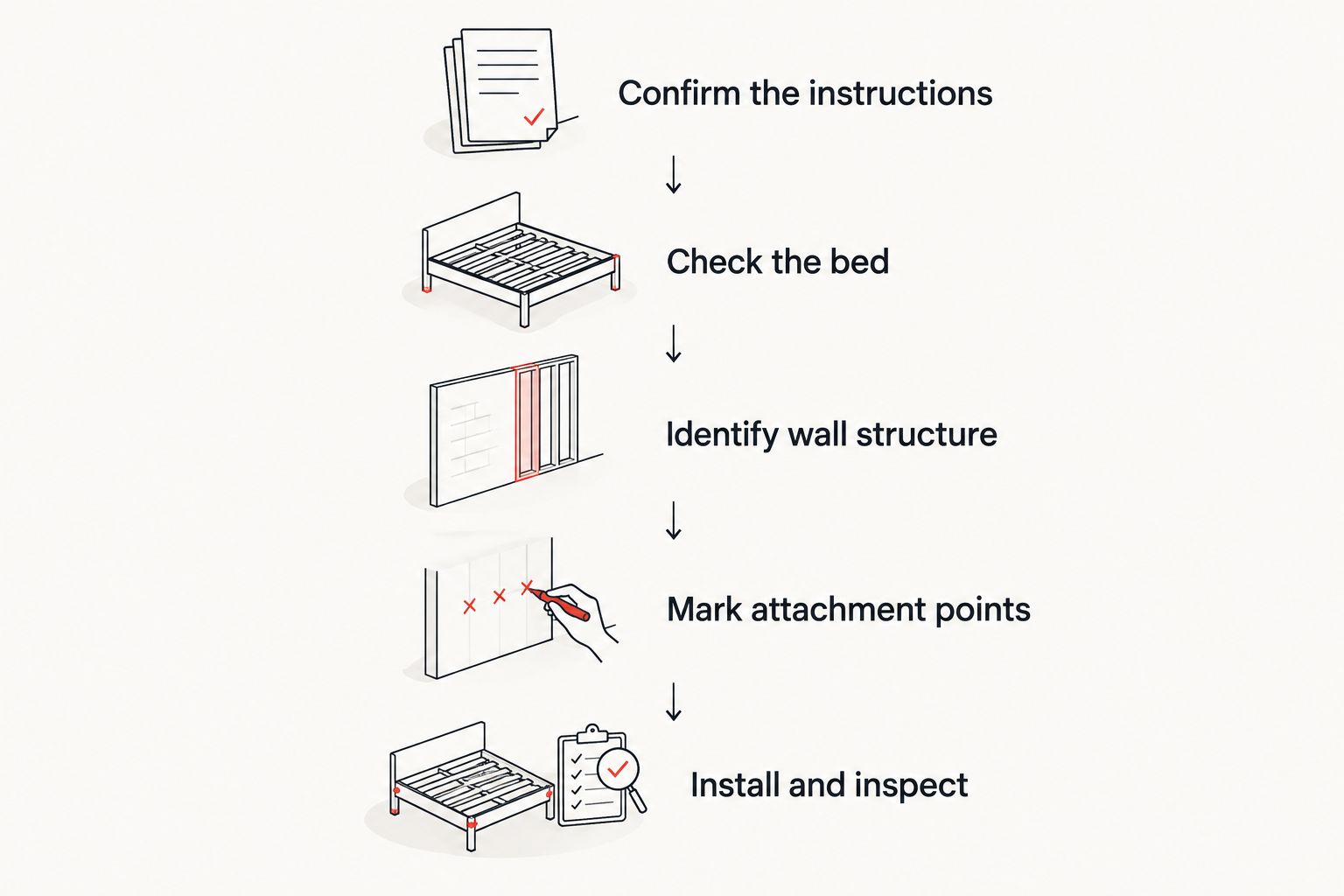
Follow the instructions for the exact bed model and the approved attachment hardware. Use the sequence below to organize the installation; the manufacturer's directions determine the attachment locations, hardware, and fastening method.
1. Confirm the instructions
Find the assembly manual, model identification, and any separate wall-attachment instructions. Check whether wall attachment is required, optional, or not described. Those are different situations.
If the manual does not address anchoring, ask the manufacturer for written guidance before modifying the frame. Request the approved attachment points, compatible restraint or bracket, permitted wall construction, and installation requirements. A generic furniture kit is not proof that a bunk bed can accept it.
Keep the instructions with the bed. That matters when you move the frame, replace a mattress, or pass the bed to another family member.
2. Check the bed
Complete the bed's assembly before attaching it to the wall, unless its instructions specify another sequence. Confirm that the frame connections, upper-to-lower bed connections, mattress supports, ladder, and guardrails are installed correctly.
Look for loose hardware, cracked components, missing parts, or movement at joints. Stop using a damaged or incorrectly assembled bunk bed until the problem is resolved. Tightening a wall restraint against a loose frame hides the symptom rather than correcting the connection.
Check sleeper fit and mattress fit now, too. A bed that needs a different mattress or room position should be corrected before you drill.
3. Identify wall structure
Determine what is behind the finished wall at the proposed attachment locations. Wood framing, metal framing, and masonry require different fastening decisions. Drywall is a wall finish, not evidence of a suitable structural attachment.
Use appropriate detection methods and confirm the structure rather than relying on a guessed stud location. Before drilling, assess the risk of concealed wiring and plumbing. A stud finder alone does not establish that a drilling location is clear of every hidden service.
If you cannot identify the wall construction or a safe fastening location, stop. Have a qualified installer assess it rather than choosing a larger screw and hoping it holds.
4. Mark attachment points
Place the bed in its approved final position and check that it sits correctly on the floor. Account for baseboards, trim, and the hardware's required alignment. Keep the ladder approach usable and check nearby windows, cords, ceiling fans, and light fixtures.
Mark only the frame locations the bed manufacturer permits. Do not assume a guardrail, decorative board, mattress slat, or thin panel can carry an attachment load.
If the approved wall and frame locations do not align, ask for an approved alternative. Do not pull the bed out of square, remove safety components, or improvise a spacer to make an unsuitable bracket reach.
5. Install and inspect
Install the specified hardware according to both the bed instructions and the attachment-system instructions. Follow their requirements for pilot holes, fastener engagement, alignment, and tightening. There is no universal screw length or bracket count for every bunk bed.
Check the finished installation using the inspection method those instructions provide. Confirm that the frame remains correctly assembled, the restraints are secured, and no hardware creates a sharp edge or snagging point.
Do not ask a child to climb onto an unfinished installation to test it. If movement remains, stop and identify its source before anyone sleeps in the bed.
Which wall type are you anchoring into?
The wall's surface appearance does not determine the fastener. A painted wall can conceal different materials, and hardware suitable for one assembly is not automatically suitable for another.
Use this comparison to identify the question your installer or manufacturer needs to answer—not to select hardware without instructions.
| Wall construction | Best for | Useful characteristic | Limitation to resolve |
|---|---|---|---|
| Wood-framed wall | An approved attachment designed for wood framing | Provides framing locations for compatible fasteners | Framing position and required engagement must be confirmed |
| Metal-framed wall | A fastening system explicitly approved for that assembly | Can accept a properly designed attachment system | Do not substitute wood-framing instructions |
| Concrete or masonry | Hardware approved for the identified masonry substrate | Allows substrate-specific fastening | Concrete, solid masonry, and hollow units are not interchangeable |
| Unidentified wall assembly | Professional assessment before installation | Avoids choosing hardware from surface appearance | Attachment suitability remains unresolved until the structure is identified |
Do not select an anchor from its package load rating alone. That rating does not establish compatibility with the bed, the wall assembly, the attachment direction, or the complete installation.
For a 2026 bedroom project, bring the installer both sets of instructions: the bed manual and the proposed hardware instructions. One without the other leaves part of the connection unanswered.
Why bunk bed anchoring methods vary
The right method depends on the complete connection, from the bed frame through the attachment hardware into the wall. These factors determine what needs checking:
- Bed construction: The manufacturer identifies which frame members can accept an attachment without compromising the assembly.
- Wall construction: Wood framing, metal framing, and masonry require compatible fastening systems.
- Attachment geometry: Baseboards, trim, and the bed's approved position affect alignment between the frame and wall.
- Hardware instructions: Fastener type, engagement, and installation requirements belong to the specified system.
- Bed condition: Loose joints, damaged parts, and incorrect assembly must be corrected independently of anchoring.
- Room permissions: Rental or managed housing can require approval before wall modifications.
None of these factors supports a universal shopping list. Photograph the proposed location and identify the bed model before asking for installation guidance; that makes the question specific enough to answer.
Does every bunk bed need wall anchoring?
Not every bunk bed has the same installation requirements. Follow the manufacturer's instructions for the exact model, including any requirement to attach it to a wall.
Do not treat a heavy frame as proof that anchoring is unnecessary. Equally, do not assume that adding an unapproved restraint improves a bed whose instructions do not describe that modification. Ask the manufacturer to resolve the question before drilling into the frame.
Bunkbeddepot sells solid wood bunk beds for families furnishing shared bedrooms. The practical next step is to request the assembly and attachment instructions for the model you are considering, rather than infer an anchoring method from photographs.
Can you anchor a bunk bed without drilling?
A no-drill method is acceptable only when the bed manufacturer explicitly approves that method for the model and installation. Adhesive hooks, improvised straps, and friction against the wall are not substitutes for a specified structural connection.
If drilling is prohibited, resolve that restriction before buying or assembling a bed that requires wall attachment. Ask the property owner about permission and ask the manufacturer about permitted installation arrangements. Do not omit a required attachment because the room is rented.
Avoid trapping the bed tightly between furniture as a workaround. That does not establish an approved attachment and can introduce new access or entrapment problems.
What should you check after anchoring?
A wall attachment is only one part of the finished bedroom. For your 2026 safety check, use the U.S. Consumer Product Safety Commission's bunk-bed guidance alongside the bed's instructions; the federal guardrail requirements are addressed in 16 CFR Parts 1213 and 1513.
Mattress and guardrails
The CPSC advises that children under 6 years should not use the upper bunk. Wall attachment does not change that age guidance or make the upper bunk suitable for a younger child.
Upper-bunk guardrails belong on 2 sides. Federal requirements call for the guardrail's upper edge to extend at least 5 inches above the mattress surface. Use the mattress size and maximum thickness specified for the particular bed; a thicker mattress reduces the exposed guardrail height.
Do not add a topper without checking the resulting mattress height against the instructions. Comfort changes must still preserve the required guardrail protection.
Access and surroundings
Keep the intended ladder or stair access usable. Check that bedding does not obstruct climbing and that the bed's location follows the manufacturer's placement instructions.
The CPSC also warns against attaching items such as ropes, belts, and jump ropes to bunk beds because of strangulation hazards. Do not turn an attachment bracket or exposed restraint into a hook for hanging play equipment.
Check nearby window-covering cords and ceiling fixtures before calling the room finished. The best-looking position is not the right position if it creates a hazard.
Ongoing inspection
Follow the inspection and maintenance schedule in the bed and hardware instructions. Recheck the installation after moving or reassembling the bed, and stop use when you find damaged components or unresolved movement.
For families planning a 2026 room refresh, moving the bed means reassessing the attachment—not simply reusing the old wall holes. A different location can have different framing, trim, and concealed services.
What if the bunk bed still wobbles after anchoring?
A bunk bed that still wobbles needs inspection, not another improvised restraint. Identify whether movement comes from the frame joints, stacked-bed connections, floor contact, wall hardware, or another component.
Start with the assembly manual and check the connections it identifies. Tighten hardware only as directed; forcing a connection tighter is not a repair for damaged wood, stripped threads, or missing parts.
If you cannot resolve the movement using the instructions, keep the bed out of use and contact the manufacturer or a qualified installer. An anchored bunk bed must still be a correctly assembled bunk bed.
FAQ
How do you anchor a bunk bed to the wall safely?
Use the bed manufacturer's approved attachment method and hardware compatible with the confirmed wall structure. Correct assembly, mattress fit, and guardrails remain necessary after anchoring.
Can I use drywall anchors for a bunk bed?
Do not assume a generic drywall anchor is suitable for a bunk bed. Use only a fastening arrangement approved for the bed, attachment hardware, and actual wall assembly.
What size screws do I need to anchor a bunk bed?
There is no universal screw size for anchoring bunk beds. The approved attachment instructions must specify compatible fasteners and required engagement for the wall construction.
Can I attach a restraint to the bunk bed guardrail?
Do not attach a restraint to a guardrail unless the bed manufacturer explicitly identifies it as an approved attachment point. Guardrail placement alone does not establish suitability for wall anchoring.
Does anchoring make the top bunk safe for a toddler?
No. The CPSC advises keeping children under 6 years off the upper bunk, regardless of wall anchoring.
How high should the guardrail be above the mattress?
The upper guardrail edge must extend at least 5 inches above the mattress surface under federal bunk-bed requirements. Follow the bed's specified mattress size and maximum thickness as well.
What should I ask before buying a Bunkbeddepot bunk bed?
Ask for the exact model's assembly instructions, mattress requirements, and wall-attachment guidance. Confirm that the intended room and wall construction suit those instructions before installation.
One last thing
Before the first bedtime, save the model identification, assembly manual, hardware instructions, and photographs of the completed attachment together. Keep that record for the next room change.
A 2026 installation should still be understandable when you take it apart years later. Leave instructions for the next setup, not just holes in the wall. Then the room can get back to what it is for: shared stories, quiet sleep, and childhood.


