

Best overall for toddlers: an age-rated toddler bed. Best for younger children who still meet crib-use limits: their approved crib. Best for a shared room: separate, age-appropriate low beds. The best bunk beds for toddlers in 2026 are not upper bunks: the U.S. Consumer Product Safety Commission says children younger than 6 years must not use an upper bunk.
- The best bunk beds for toddlers are not upper bunks; choose an age-rated toddler bed instead.
- CPSC guidance prohibits upper-bunk use for children younger than 6 years, including low bunk beds.
- Bunkbeddepot bunk beds belong on a later shortlist, not a toddler upper-bunk shortlist.
- Measure the room, match the mattress, and check manufacturer age limits before choosing a sleeping arrangement.
Why this matters
A shared bedroom needs room for sleep, stories, and getting dressed. Stacking beds looks like an easy answer. For toddlers, however, the upper bunk introduces a safety restriction that room size cannot solve.
No upper bunk is appropriate for a toddler, even when the bed sits lower or has stairs instead of a ladder. The CPSC's bunk-bed guidance applies to children younger than 6 years. A shorter climb does not remove that restriction.
Bunkbeddepot sells handcrafted, solid wood bunk beds, loft beds, and custom configurations made in the USA. Those categories suit a different buying decision: planning for older sleepers, rather than choosing an upper sleeping surface for a toddler.
This 2026 guide ranks sleeping arrangements by age fit first. The named bunk beds appear as future options, not toddler recommendations.
What makes the best sleeping arrangement for a toddler
Use these criteria before comparing finishes or bedroom themes:
- Age limits: Read the manufacturer's permitted ages and use restrictions. An appealing design does not override them.
- Room footprint: Measure the assembled bed, access space, door swing, and nearby furniture—not just the mattress.
- Mattress fit: Follow the exact mattress dimensions and thickness specified for that bed. Avoid gaps and improvised padding.
- Access hazards: Check what your child can climb, reach, or become trapped beside, including windows, cords, and adjacent furniture.
- Construction instructions: Confirm the required hardware, assembly sequence, and inspection instructions. Keep the manual.
- Future use: Choose for today's sleeper first. Treat later bunk use as a separate decision with a fresh safety check.
For a 2026 purchase, keep age suitability and mattress compatibility ahead of decorative details. A bed should support the bedtime routine, not create another boundary you must supervise all night.
Sleeping arrangements at a glance
| Option | Best for | Standout feature | Key limitation | Verdict |
|---|---|---|---|---|
| Age-rated toddler bed | A child ready to leave the crib | A sleeping arrangement specifically intended for toddler use | Manufacturer age, size, and mattress limits still apply | Buy when eligible |
| Approved crib | A younger child still within crib-use limits | Keeps the current sleeping arrangement without introducing an upper bunk | Must stop use when the manufacturer's transition criteria are reached | Hold while eligible |
| Separate age-appropriate low beds | Siblings sharing a room | Avoids placing either sleeper on an upper bunk | Uses more floor area than a stacked arrangement | Buy when each bed fits its sleeper |
| Appalachian Winds Barn Door Bunk Bed | Future bunk planning with a barn-inspired design | Board-and-batten barn aesthetics described in the product information | Model-specific safety and mattress details require confirmation | Wait for age-appropriate use |
| The White Mountains Bunk Bed | Future bunk planning with mountain-inspired details | Mountain silhouette inlays and rock-shaped hickory hardware | Decorative details do not establish toddler suitability | Wait for age-appropriate use |
The first three entries address the current sleeping arrangement. The final two address a later bedroom plan. Do not treat them as interchangeable choices.
Measure the room before choosing the frame
Start with the space your family actually uses. Measure along the walls, then mark doors, closet access, windows, and furniture. A bed that fits against a wall can still interrupt the route to the bedroom door.
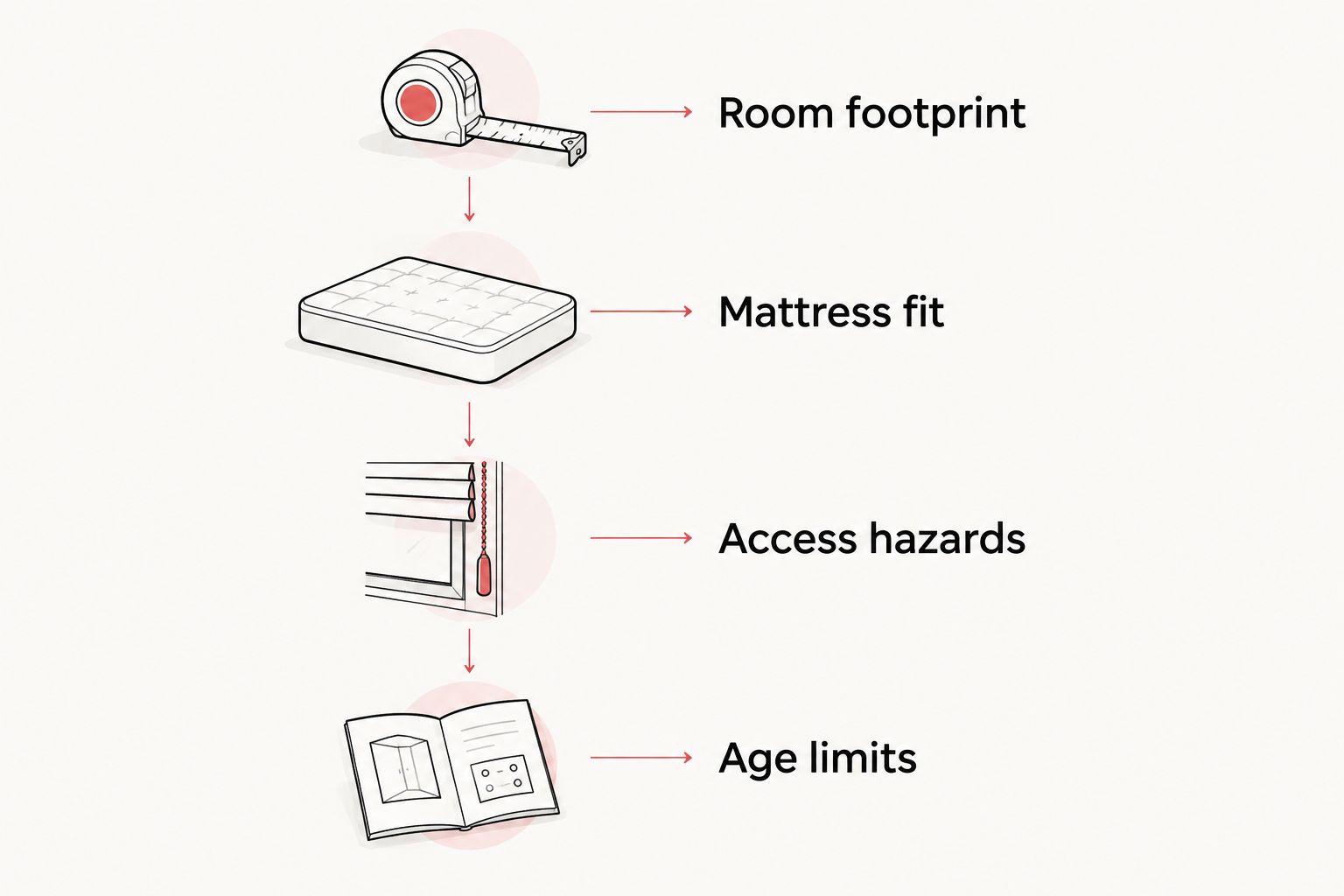
Work through these four checks in order:
- Room footprint: Mark the full frame outline on the floor, using the manufacturer's assembled dimensions. Leave the bedroom door and storage accessible.
- Mattress fit: Match the mattress to the bed instructions. Include the permitted mattress thickness, not only its length and width.
- Access hazards: Examine nearby window coverings, furniture, and anything that creates a climbing route or a trapping space.
- Age limits: Check the intended sleeper against the manufacturer's restrictions. For an upper bunk, apply the CPSC's under-6 prohibition regardless of room layout.
For a future bunk, add ceiling clearance and the route onto the upper sleeping surface to your checklist. Use the manufacturer's requirements rather than a generic clearance figure. Sloped ceilings and ceiling fans need particular attention because the sleeper occupies raised space.
Measure the frame, not just the mattress. End panels, access structures, and projecting hardware belong in your room plan. Tape the outline before moving the dresser or committing to a layout.
1. Age-rated toddler bed: best for leaving the crib
An age-rated toddler bed is the first option to assess when your child needs to leave the crib. It is a defined product category, not simply a small bed with a playful name.
The CPSC's toddler-bed standard, 16 CFR Part 1217, covers beds intended for children at least 15 months old and weighing no more than 50 pounds. Those category boundaries do not replace the individual manufacturer's instructions or establish that every child within them is ready.
Toddler bed pros:
- Gives you a product category designed around toddler use.
- Avoids an upper sleeping surface and its age restriction.
- Provides a clear starting point for checking mattress and assembly requirements.
Toddler bed cons:
- Has age and weight limits; it is not an unrestricted long-term bed.
- Requires a safe room layout because the child can get out independently.
- Still needs an exact mattress match and correct assembly.
Best for: A child who needs to transition from the crib and meets the chosen toddler bed's instructions.
Make the transition about a familiar routine: the same bedtime story, a reachable blanket, and a clear path for a parent to sit nearby. Choose the frame after checking suitability, not because it resembles an older sibling's bed.
Verdict: Buy an age-rated toddler bed when your child meets its use requirements.
2. Approved crib: best for a child still within crib-use limits
Keeping an eligible child in an approved crib avoids introducing a new sleeping arrangement before one is needed. A sibling's move into a bunk does not create a reason to move a younger child onto an elevated bed.
Check the crib manual for height, climbing, and other stop-use criteria. A child who has reached those limits needs an appropriate transition; keeping the familiar crib is not a reason to ignore its instructions.
Crib pros:
- Preserves an established bedtime arrangement while it remains appropriate.
- Avoids introducing bunk access into the younger child's sleep space.
- Lets you plan the next bed around the child's needs rather than a matching room set.
Crib cons:
- Becomes unsuitable when the manufacturer's stop-use conditions are reached.
- Does not solve the floor-space demands of a shared room.
- Requires continued attention to the crib's own safe-use instructions.
Best for: A younger child who remains within the approved crib's use limits.
If another child uses a bunk in the same room, assess the younger child's access to it separately. Assigning the upper bunk to an older sibling does not remove a toddler's opportunity to climb when awake.
Verdict: Hold the crib arrangement only while every manufacturer use condition remains satisfied.
3. Separate low beds: best for siblings sharing a room
Separate, age-appropriate beds let you plan each sleeper's bed independently. That matters when siblings have different ages, sizes, and bedtime needs.
For the toddler, choose a bed explicitly suitable for that child's age and size. For the older sibling, follow that bed's instructions too. A low twin frame is not automatically a toddler bed, and an added rail does not establish suitability.
Separate low beds pros:
- Avoids putting either child on an upper bunk.
- Lets each sleeper use a mattress and frame suited to their own requirements.
- Gives parents direct access for bedtime reading and overnight help.
Separate low beds cons:
- Takes more floor area than stacking the sleeping surfaces.
- Requires checking two sets of assembly and mattress instructions.
- Can leave narrow gaps if the room layout is poorly planned.
Best for: Families whose shared bedroom can accommodate separate beds appropriate for each child.
Compare parallel and perpendicular layouts on paper before rearranging the room. Preserve access to doors and storage, and inspect the spaces between frames, walls, and furniture. Avoid treating a cramped gap as harmless simply because both beds are low.
Verdict: Buy separate low beds when each bed fits its sleeper and the room remains safely usable.
4. Appalachian Winds: best for future barn-inspired bunk planning
The Appalachian Winds Barn Door Bunk Bed is a named Bunkbeddepot bunk-bed option for families planning a later shared bedroom. Its supplied product description identifies classic board-and-batten barn aesthetics and custom construction.
Those details describe the design. They do not establish mattress limits, guardrail measurements, weight capacities, or toddler suitability. For a 2026 shortlist, obtain the current model instructions before deciding how it would work in your room.
Appalachian Winds Barn Door Bunk Bed pros:
- Has a clearly described barn-inspired aesthetic.
- Is identified as custom built in the supplied product description.
- Gives families a specific model to assess for a future bunk arrangement.
Appalachian Winds Barn Door Bunk Bed cons:
- Is not a toddler upper-bunk recommendation.
- Requires confirmation of model-specific age, mattress, and assembly requirements.
- Needs a full room assessment beyond the appearance of the frame.
Best for: Families planning age-appropriate bunk use later and drawn to a barn-inspired design.
Ask about the exact configuration under consideration. Do not assume custom construction includes a particular access style, detachable beds, lower-bunk rail, or other feature unless the manufacturer confirms it.
Verdict: Wait for age-appropriate use; skip the upper bunk for a toddler.
5. The White Mountains: best for future mountain-inspired bunk planning
The White Mountains Bunk Bed is another Bunkbeddepot bunk-bed option to assess for later use. Its supplied description identifies mountain silhouette inlays, organic rock-shaped hickory hardware, and custom construction.
The decorative details give this model a distinct design direction. They do not change the upper-bunk age restriction or tell you which mattress thickness the finished configuration requires.
The White Mountains Bunk Bed pros:
- Has mountain silhouette inlays described in the product information.
- Includes described hickory hardware with rock-shaped styling.
- Provides a specific custom-built model for a future room plan.
The White Mountains Bunk Bed cons:
- Is not appropriate as a toddler upper-bunk recommendation.
- Requires confirmation of the exact configuration's safety and mattress instructions.
- Must fit the room's access routes and raised sleeping space, not just its decorative theme.
Best for: Families planning later bunk use who prefer mountain-inspired details.
Picture the room with bedding, furniture, and the usual bedtime traffic. Then return to the instructions. A memorable frame belongs in a room where the sleeping arrangement is appropriate for every child who can access it.
Verdict: Wait for age-appropriate use; skip the upper bunk for a toddler.
How the options rank
This 2026 ranking puts age suitability ahead of design, then considers mattress fit, room footprint, access hazards, and assembly requirements. It is a buying framework, not a claim of hands-on product testing.
The safety basis is CPSC bunk-bed guidance and the federal standards in 16 CFR Parts 1213, 1513, and 1217. Bunk-bed standards require the upper edge of the guardrail to sit at least 5 inches—127 millimeters—above the mattress surface. That requirement explains why mattress thickness matters; it does not make an upper bunk suitable for a child under 6 years.
Model descriptions establish the named products' design details only. Safety suitability requires the manufacturer's current instructions for the exact configuration.
Which sleeping arrangement should you choose?
Choose an age-rated toddler bed when your child needs to leave the crib. Keep an eligible younger child in the approved crib, and use separate appropriate beds when siblings share a room.
Bunkbeddepot bunk beds belong on a later shortlist for families planning age-appropriate shared bedrooms. Treat that as a new purchase decision, with new measurements and a fresh review of the instructions—not an automatic next step on a birthday.
For your 2026 bedroom plan, start with the sleeper. Choose the frame second. The warm part comes afterward: bedtime stories, familiar blankets, and a room your family can use comfortably.
FAQ
What's the best bunk bed for a toddler in 2026?
An upper bunk is not appropriate for a toddler; choose an age-rated toddler bed or another sleeping arrangement permitted by the manufacturer's instructions. CPSC guidance says children younger than 6 years must not use an upper bunk.
Can a 2-year-old sleep on the top bunk if it is low?
No. CPSC guidance prohibits upper-bunk use for children younger than 6 years, and a lower frame height does not remove that restriction.
Can a toddler sleep on the bottom bunk?
Use a lower bunk for a toddler only if the manufacturer explicitly permits that child's age and the exact configuration. Also assess access to the upper bunk and any gaps around the mattress, rails, walls, and furniture.
Are stairs safer than a ladder for a toddler bunk bed?
Stairs do not make an upper bunk suitable for a toddler. The under-6 restriction applies regardless of how the child reaches the upper sleeping surface.
What mattress thickness should I use on a bunk bed?
Use only the mattress dimensions and maximum thickness specified by the bunk-bed manufacturer. Federal bunk-bed standards require at least 5 inches of guardrail height above the mattress surface; a thicker mattress reduces that height.
Is a floor bed automatically safe for a toddler?
No. A low sleeping surface still requires an age-appropriate product, correct mattress fit, and a room checked for access and entrapment hazards. Do not improvise rails or fill gaps with cushions.
Should I choose Appalachian Winds or The White Mountains for my toddler?
Neither model should be chosen as a toddler upper-bunk arrangement. Their supplied descriptions establish design details, not toddler suitability; assess either model for later use against its current manufacturer instructions.
When should I move my child out of the crib?
Move your child when the crib manufacturer's stop-use criteria require it. Check the manual's climbing, height, and other limits, then choose a replacement bed appropriate for your child's age and size.
One last thing
A mattress change is also a safety check. On an upper bunk, mattress thickness changes how much guardrail remains above the sleeping surface, even when the frame stays exactly the same.
Keep the bed instructions with your household records. Before replacing a mattress, confirm its dimensions and thickness against the manual. A familiar bed still needs the correct mattress.


