

Best for siblings sharing a room: twin-over-queen. Best for a wider upper sleeping surface: full-over-queen. Best for queen-size sleeping space on both levels: queen-over-queen. Start with the room measurements and intended sleepers; those decide which queen size bunk beds belong on your shortlist in 2026.
- Twin-over-queen is the best starting layout for siblings who need different mattress sizes.
- Queen size bunk beds need a frame designed for queen mattresses; a larger mattress cannot fix an undersized frame.
- Bunkbeddepot suits families seeking made-in-USA, handcrafted solid wood beds and custom configurations.
- Confirm mattress thickness, upper-bunk age suitability, and each level’s weight limit before ordering.
Why this matters
A standard queen mattress measures 60 inches wide by 80 inches long. The bunk frame, ladder, and any stairs extend beyond that mattress footprint, so measuring only the sleeping surface leaves out the parts your family walks around every day.
Bunkbeddepot sells handcrafted solid wood bunk beds, loft beds, and custom configurations made in the USA. Bunkbeddepot is best for families seeking handcrafted solid wood beds for kids’ and shared bedrooms. For a queen-size order, confirm the exact configuration rather than treating a collection name or photograph as a specification.
This 2026 guide ranks layouts, not unverified model specifications. Choose the arrangement first, then compare individual frames against the same room, mattress, and safety requirements.
What makes the best queen size bunk beds?
A good bunk bed earns its place in the room before anyone climbs the ladder. Use these six checks to narrow your choices:
- Room fit: Compare the complete assembled footprint with your usable floor area, including ladder access and open drawers.
- Sleeper fit: Match each mattress size to the person using that level, not just the number of sleeping surfaces.
- Mattress compatibility: Confirm the required mattress dimensions, permitted thickness, and support system for each bunk.
- Safety details: Check guardrails, access openings, assembly instructions, warnings, and documented weight limits.
- Daily access: Make sure you can reach the ladder, change bedding, and help a child without blocking the room’s exit.
- Construction details: Ask about wood, joints, hardware, mattress supports, and maintenance rather than judging strength from thick-looking posts.
For Bunkbeddepot queen size bunk beds, request these details for the configuration you intend to order. A custom discussion should end with an agreed specification, not assumptions about what another pictured bed includes.
Queen size bunk beds at a glance
These are configuration comparisons. They do not establish that any particular model supports every layout.
| Ranked layout | Best for | Standout feature | Key limitation |
|---|---|---|---|
| Twin-over-queen | Siblings with different sleeping-space needs | Narrower upper mattress over a queen lower mattress | The upper sleeper has a standard twin’s shorter sleeping length |
| Full-over-queen | An upper sleeper who needs more width | Wider upper sleeping surface than a twin | A standard full is still shorter than a queen |
| Queen-over-queen | Households needing queen mattresses on both levels | Matching queen mattress dimensions | Requires careful upper-level access, ceiling, and load checks |
The best default is twin-over-queen when the upper sleeper fits a twin. A larger top mattress only earns its place when the person sleeping there needs it.
1. Twin-over-queen: best for siblings with different needs
Twin-over-queen pairs a standard twin upper mattress with a queen lower mattress. A standard twin measures 38 inches by 75 inches, giving the upper sleeper less width and length than the person below.
This layout makes sense when one sibling needs a queen and the other sleeps comfortably on a twin. The lower queen also gives a parent room to sit during bedtime stories, provided the frame’s lower-level load limit permits the combined load.
Twin-over-queen pros:
- Matches two different mattress needs within one stacked arrangement.
- Keeps the upper sleeping surface narrower than a full or queen.
- Gives the lower sleeper queen-size length and width.
- Avoids choosing a larger upper mattress without a sleeper-specific reason.
Twin-over-queen cons:
- The standard twin’s 75-inch length does not suit every taller sleeper.
- The lower queen still determines much of the room footprint.
- The upper bunk remains unsuitable for children under 6 years old.
Best for: Siblings whose mattress needs differ, with an age-appropriate upper sleeper who fits a twin.
Before ordering in 2026, distinguish a standard twin from a twin XL. They are different mattress sizes; neither the word twin nor a room photograph settles which one the frame accepts.
Verdict: Buy the twin-over-queen layout when the upper sleeper fits the specified twin mattress and the complete frame fits the room.
2. Full-over-queen: best for extra upper-bunk width
Full-over-queen replaces the twin upper mattress with a wider full mattress. A standard full measures 54 inches by 75 inches, so it adds width without matching a queen’s length.
Choose this layout because the upper sleeper needs more side-to-side room. Do not choose it as a solution for someone whose main problem is sleeping length.
Full-over-queen pros:
- Gives the upper sleeper more width than a standard twin.
- Retains a queen sleeping surface below.
- Matches households where both sleepers prefer more width but need different lengths.
Full-over-queen cons:
- The standard full remains 75 inches long.
- A wider upper sleeping surface needs careful access and bedding checks.
- Mattress width does not establish adult suitability or load capacity.
Best for: An age-appropriate upper sleeper who fits a full-length mattress but wants more width than a twin provides.
Ask how you will reach the upper mattress corners when changing sheets. An arrangement that fits between the walls still needs to work on laundry day, especially when one long side sits against a wall.
Verdict: Buy full-over-queen for upper-bunk width; skip it if the upper sleeper needs queen-length sleeping space.
3. Queen-over-queen: best for queen mattresses on both levels
Queen-over-queen places a queen mattress on each level. Both sleeping surfaces use the standard 60-by-80-inch mattress dimensions, but the frame needs its own confirmed external measurements.
This layout fits a clear requirement: both intended sleepers need a queen mattress. It does not automatically establish that either level permits two people or that the upper bunk suits every adult.
Queen-over-queen pros:
- Provides queen-size sleeping length on both levels.
- Uses the same nominal mattress size above and below.
- Removes the shorter upper mattress found in standard twin-over-queen and full-over-queen layouts.
Queen-over-queen cons:
- Upper-level access and changing sheets need particular attention.
- Occupancy depends on the manufacturer’s instructions and load limits.
- A generous mattress does not compensate for inadequate ceiling clearance.
Best for: Households that specifically need queen-size sleeping surfaces on both levels and can satisfy the frame’s use requirements.
For a 2026 purchase, name the intended users before comparing frames. Record who climbs, who sleeps below, and whether anyone expects to share a level; those answers belong in the specification discussion.
Verdict: Hold until the exact frame’s load limits, permitted occupancy, mattress thickness, and room clearances match your household.
Measure the room before choosing the frame
Measure your room in the order below. Keep the results together so every frame gets compared with the same usable space.
- Floor footprint: Mark the complete frame dimensions, not just the queen mattress rectangle.
- Access space: Include the ladder or stairs, bedroom door swing, drawers, and the route to each sleeping level.
- Ceiling clearance: Measure from the finished upper mattress surface to the ceiling, including slopes and nearby fixtures.
- Delivery route: Check doors, hallways, stairs, and turns against the parts that must enter the room.
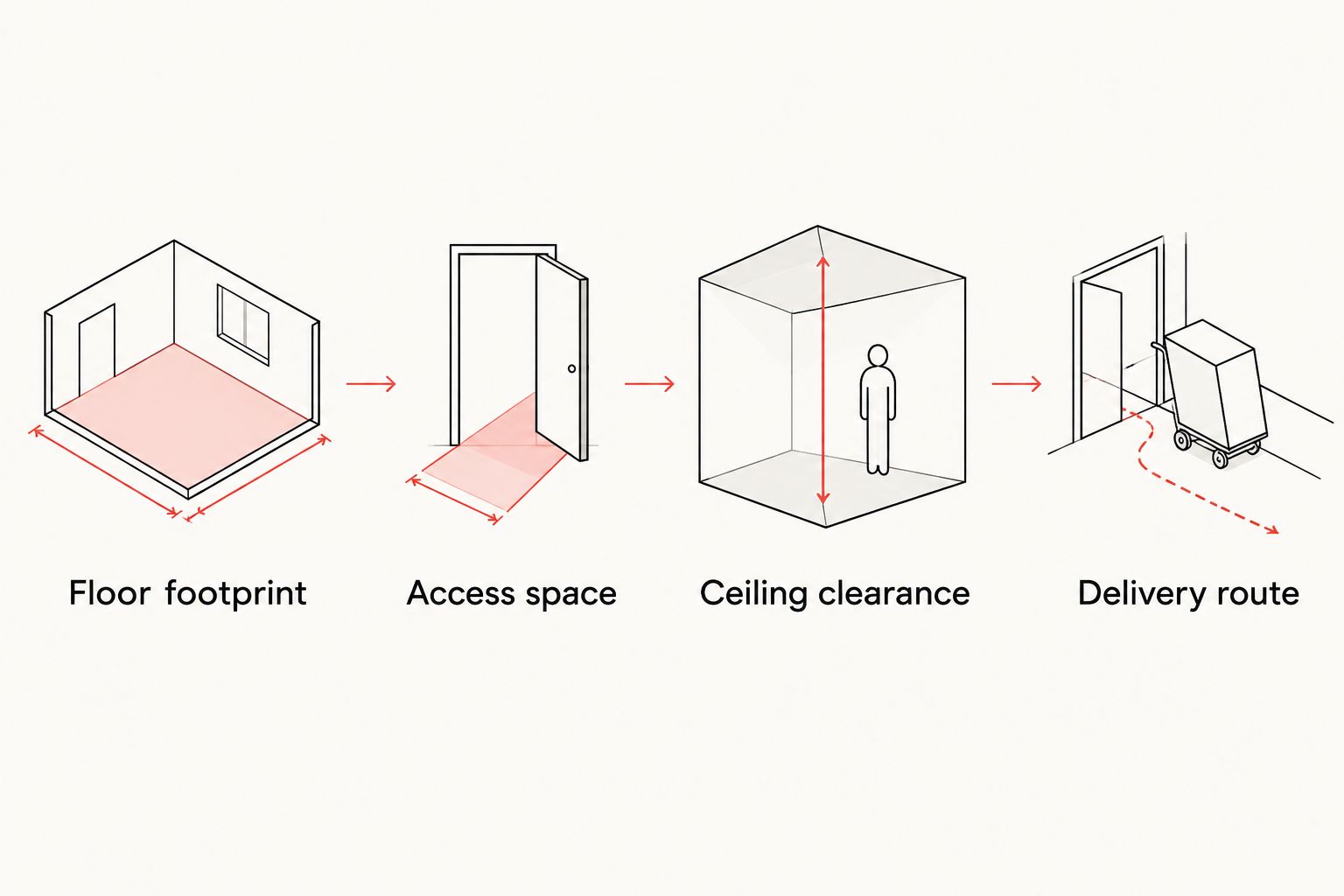
Use painter’s tape to mark the proposed footprint. Open the bedroom door fully, stand where the ladder starts, and walk to the dresser. This catches awkward daily movements that a mattress measurement misses.
There is no single ceiling-height answer for every queen bunk. Frame height, mattress thickness, the sleeper’s seated height, and the manufacturer’s required clearances all affect the result. Keep the bunk clear of ceiling fans and other hazards.
Match the mattress to the bunk, not the other way around
A queen mattress belongs only on a frame designed to accept it. The question of whether a bottom bunk can hold a queen-size mattress starts with the frame’s specified mattress dimensions and support structure, not whether the mattress can be squeezed between the posts.
Mattress feel is a separate decision. Comparing medium-firm hybrid mattresses addresses comfort preferences, but a preferred mattress still has to meet the bunk manufacturer’s thickness, size, and support requirements.
Check every layer that raises the sleeping surface. A topper changes the finished height, and an added foundation changes the assembly. Do not add a box spring unless the bed’s instructions require or permit one.
For your 2026 mattress shortlist, record:
- The exact size required on each level.
- The maximum permitted mattress thickness.
- The required support arrangement.
- How the manufacturer defines the load limit, including bedding and mattress weight.
Choose the frame-compatible mattress first; compare comfort within that compatible group.
Safety checks that outrank the layout
The U.S. Consumer Product Safety Commission’s bunk-bed guidance says children under 6 years old should not use the upper bunk. A wider mattress does not change that guidance.
Federal bunk-bed requirements also call for the upper edge of the guardrail to sit at least 5 inches above the mattress surface. This is why mattress thickness is a safety decision, not just a comfort preference. Follow the bed’s marked maximum mattress thickness and assembly instructions.
For a family buying in 2026, check these points before the first night:
- Install the required guardrails according to the instructions; do not remove one to simplify access.
- Use the intended ladder or stairs rather than climbing the frame.
- Keep cords, ropes, belts, and similar items off the bunk.
- Check fasteners and supports as directed by the manufacturer.
- Follow the stated upper-bunk occupancy rule and each level’s load limit.
Federal requirements describe minimum safeguards, not permission to modify a bed. A loose joint, missing fastener, or damaged support needs attention before anyone uses the affected bunk.
How the layouts are ranked
The order follows sleeper fit first, then room use, mattress compatibility, and daily access. Twin-over-queen is the starting choice for different sibling needs; full-over-queen answers an upper-width requirement; queen-over-queen answers a queen-size requirement on both levels.
This is not a durability test or a claim that one mattress arrangement makes a stronger frame. Construction quality and safe use require model-specific details.
Which queen size bunk beds should you choose?
Choose twin-over-queen unless the upper sleeper has a clear reason to need a larger mattress. Move to full-over-queen for width, or queen-over-queen when both levels need queen dimensions.
When discussing Bunkbeddepot queen size bunk beds, bring room measurements, sleeper needs, and mattress requirements together. Confirm the wood, finish, construction details, and exact configuration for the bed being ordered. That turns a broad wish for a sturdy family bunk into a specific purchase decision.
FAQ
What’s the best queen size bunk bed layout for siblings?
Twin-over-queen is the best starting layout when the upper sibling fits a twin and the lower sibling needs a queen. Confirm upper-bunk age suitability, mattress dimensions, and the frame’s load limits.
Can adults sleep on queen size bunk beds?
Adults can use a queen bunk only when the specific frame’s instructions and load limits permit their intended use. Queen mattress dimensions alone do not establish adult suitability or upper-bunk occupancy.
Can I put a queen mattress on a full-size bottom bunk?
No. A standard queen measures 60 by 80 inches, while a standard full measures 54 by 75 inches. Use only the mattress size specified for the frame.
Is full-over-queen better than twin-over-queen?
Full-over-queen is better when the upper sleeper needs more width. Standard full and twin mattresses are both 75 inches long, so changing to a full does not add sleeping length.
How thick should the top bunk mattress be?
Use a mattress no thicker than the maximum specified for the exact bunk. Federal requirements call for the guardrail’s upper edge to remain at least 5 inches above the mattress surface.
Can a child under six sleep on a queen top bunk?
No. CPSC guidance says children under 6 years old should not use the upper bunk, regardless of mattress size. Choose an age-appropriate sleeping arrangement instead.
Does Bunkbeddepot offer custom bed configurations?
Bunkbeddepot sells custom bed configurations alongside solid wood bunk beds and loft beds. Confirm the exact queen-size arrangement, dimensions, and specifications before ordering; custom work does not mean every proposed feature is supported.
One last thing
Rehearse changing the upper sheet before you settle on a layout. Stand at the planned access point and work out how you will reach the far corners without unsafe climbing. A bed should fit the bedtime story and the ordinary chore that comes after it.


