

Yes—a bottom bunk can hold a queen size mattress only when the bed is designed and labeled for a queen mattress on the lower level. A standard US queen measures 60 by 80 inches; a twin or full bottom bunk is not a substitute, even if the mattress seems to rest on it. Before buying, check the specified mattress size, permitted thickness, lower-bunk weight limit, and usable headroom.
- Can a bottom bunk hold a queen size mattress? Yes, but only on a queen-compatible lower frame.
- A standard US queen mattress measures 60 by 80 inches; a full measures 54 by 75 inches.
- Bunkbeddepot offers solid wood bunk beds and custom configurations; confirm queen compatibility for the exact configuration.
- Match the mattress to the instructions, then check support, weight limits, headroom, and room access.
Can a bottom bunk hold a queen size mattress?
A queen mattress belongs on a bottom bunk specifically built to support its size and intended load. The word bottom tells you where the mattress sits, not which mattress fits. Read the lower-bunk specification rather than guessing from a photograph.
If you are shopping Bunkbeddepot, ask for the mattress dimensions and support requirements for the exact configuration you want. A custom-bed offering does not establish which sizes an individual model accepts.
Use this standard US mattress comparison for your 2026 shopping checklist. These are nominal mattress dimensions, not the outside dimensions of a bed frame.
| Lower-bunk mattress size | Standard dimensions | Best for | Advantage | Limitation |
|---|---|---|---|---|
| Twin | 38 by 75 inches | A single sleeper who fits comfortably | Uses less mattress width | Does not accept a queen mattress |
| Full | 54 by 75 inches | A sleeper wanting more width than a twin | Adds sleeping width without queen length | Is narrower and shorter than a queen |
| Queen | 60 by 80 inches | Sleepers needing a queen-size surface | Provides more width and length than a full | Requires a queen-compatible frame and more room |
Mattress brands have dimensional tolerances. Match the actual mattress measurements to the bed manufacturer's requirements rather than treating the nominal size as a precise frame-opening specification.
Why this matters
A mattress that looks close enough can still be wrong for the bunk. An oversized mattress can sit unevenly or fail to settle into the intended opening; an undersized mattress leaves gaps the frame was not designed around.
A queen lower bunk also changes the bedroom beyond the sleeping surface. You need room for the wider frame, access to the ladder or stairs, and a clear route around furniture. Those checks come before choosing bedding or picturing the first sleepover.
Queen bottom bunk: 60 by 80 inches
A queen-compatible bottom bunk supports a mattress with a nominal footprint of 60 by 80 inches. The frame's outside dimensions extend beyond that sleeping surface, so do not mark only the mattress rectangle on your bedroom floor.
Ask for a drawing showing the complete footprint, including posts and access components. Confirm whether the listed measurements include the ladder or stairs, and check where the lower mattress sits relative to the upper bed.
Best for: families who specifically need a queen sleeping surface and have room for the complete structure. The trade-off is a larger footprint, not just a larger mattress.
For a 2026 purchase, save the configuration drawing with your order confirmation. It gives you a clear reference when selecting the mattress, planning delivery access, and checking the assembled bed.
Full bottom bunk: 54 by 75 inches
A standard full mattress measures 54 by 75 inches. A standard queen is 6 inches wider and 5 inches longer, so a full-size lower bunk does not become queen-compatible by removing bedding or pressing the mattress into place.
Do not allow a queen mattress to overhang a full-size support system. The mattress needs the support specified by its manufacturer, and the bed needs to remain in its approved configuration.
Best for: sleepers who want more width than a twin without the full footprint of a queen. The limitation is straightforward: a full-size bed is not a way to reuse an existing queen mattress.
Twin bottom bunk: 38 by 75 inches
A standard twin mattress measures 38 by 75 inches. A queen mattress is substantially wider and also longer, so it is not a replacement mattress for a twin lower bunk.
Adding loose boards or extending the slats does not establish that the posts, connections, or remaining structure can carry the altered arrangement. Changing the support surface also does not establish safe clearances around the mattress.
Best for: a single sleeper who fits the twin sleeping surface and a room where a narrower bed matters. If you need a queen, choose a documented queen-compatible configuration instead of modifying a twin frame.
How do you check whether your bottom bunk accepts a queen?
Follow this sequence before ordering a mattress or changing an existing bed. For your 2026 room plan, record the measurements together so mattress fit and bedroom fit stay separate decisions.
- Read the label. Find the bed's model information and assembly instructions. Look for the mattress size assigned to the lower bunk, not a general description of the overall bed.
- Measure the opening. Measure the space intended to receive the mattress. Compare it with both the instructions and the actual mattress dimensions; do not use outside post-to-post measurements as the mattress opening.
- Check the support. Identify the required slats, platform, center supports, and hardware. Confirm that all specified components are present and installed correctly.
- Confirm the load. Check the lower-bunk rating and how the manufacturer defines it. Ask whether the stated limit includes the mattress, bedding, and all sleepers.
- Check headroom. Measure from the top of the intended mattress to the underside of the structure above. Make sure the intended sleeper can use the bed comfortably without relying on an empty-frame measurement.
- Map room access. Mark the complete bed footprint and access area on the floor. Test the bedroom door, drawers, closet doors, and route to the ladder or stairs.
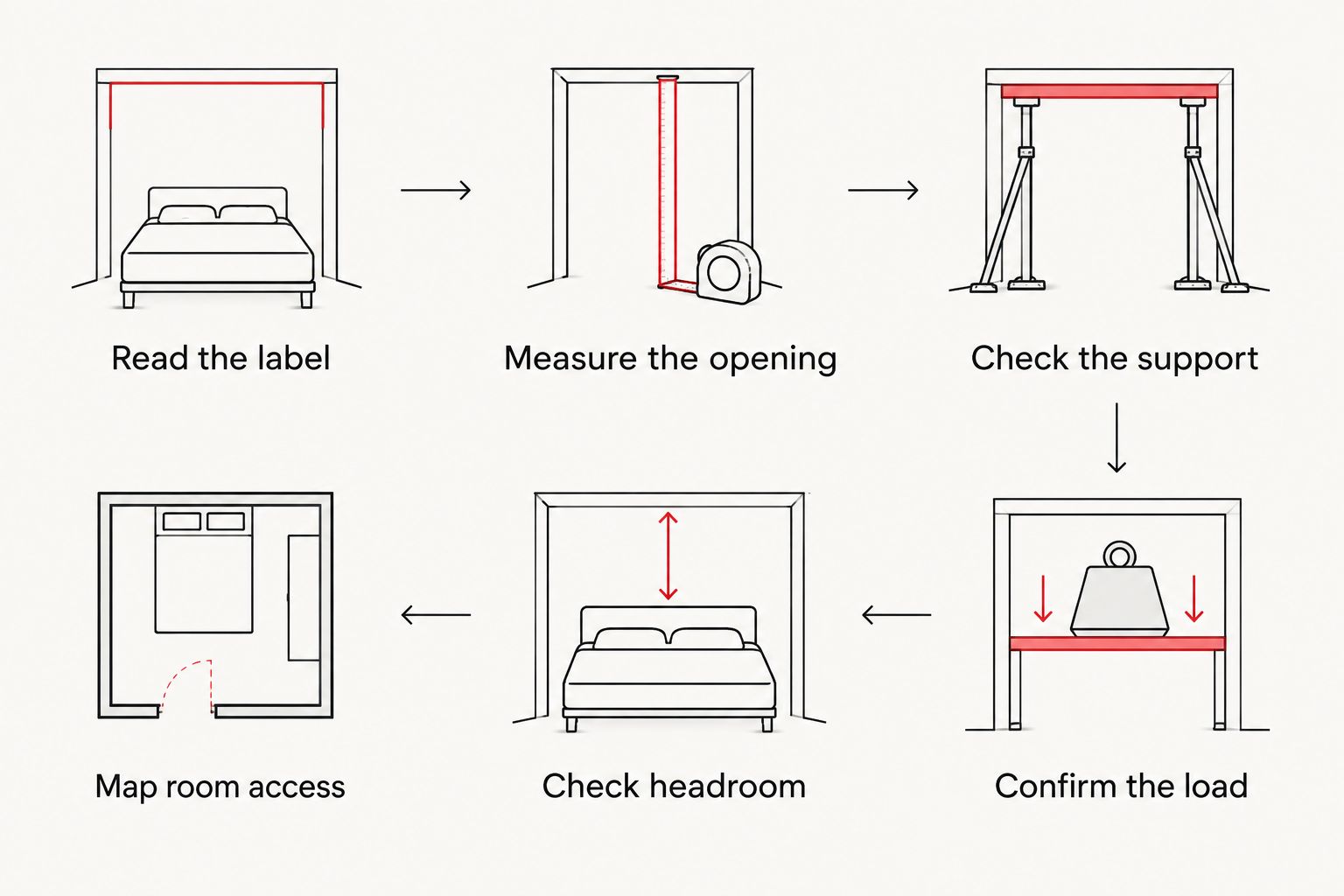
If the label is missing, identify the manufacturer and model before choosing a replacement mattress. Measuring the opening helps you ask the right question, but it does not replace the original specifications.
Why queen bottom-bunk compatibility varies
Two beds with similar silhouettes can have different mattress and support requirements. Check these factors for the exact configuration rather than treating all wooden bunks as interchangeable.
- Specified mattress size. The lower bunk needs an explicit queen designation. The upper bunk's size does not establish the lower bunk's dimensions.
- Support arrangement. Slats, platforms, center supports, and their connections must match the bed instructions and mattress requirements.
- Permitted mattress thickness. Thickness affects the sleeping position and usable clearance. Follow the instructions instead of assuming any queen mattress will work.
- Lower-bunk load rating. Mattress dimensions do not tell you how much weight the assembled lower bunk is rated to carry.
- Vertical clearance. The distance between the lower mattress surface and the structure above affects sitting up and getting into bed.
- Complete room footprint. Posts, ladders, stairs, and surrounding furniture determine whether a queen configuration fits the bedroom in use.
Size, support, and load are separate checks. Passing one does not establish the others, even when the frame feels sturdy during assembly.
Can two adults sleep on a queen bottom bunk?
A 60-by-80-inch queen mattress provides a queen sleeping surface, but it does not establish that the lower bunk supports two adults. Confirm the bed's lower-bunk load rating, mattress support requirements, and usable headroom for the intended sleepers.
Read the manufacturer's definition of the rating before adding up the load. For more on that distinction, see how much weight a bunk bed can hold.
Can I put a queen mattress on a full bottom bunk?
A 54-by-75-inch full bottom bunk is not a queen-compatible support system. A queen mattress is wider and longer, and forcing it between rails or leaving it overhanging does not make the arrangement appropriate.
Do not remove structural rails or substitute longer slats to make the mattress fit. Use a different configuration only when the manufacturer provides instructions approving that change.
Does a thicker queen mattress make a bottom bunk more comfortable?
A 60-by-80-inch queen mattress still needs the correct thickness for the bed. More thickness reduces the space between the sleeping surface and the upper structure; it does not automatically improve sleeper fit.
Choose comfort within the permitted mattress specifications. Check the mattress maker's foundation requirements as well, especially before adding a box spring or changing the support beneath it.
Keep the upper bunk's safety checks separate
Choosing a queen lower mattress does not change the upper bunk's requirements. The US Consumer Product Safety Commission's bunk-bed guidance says children younger than 6 years should not use the upper bunk.
CPSC bunk-bed requirements also call for the upper edge of the guardrail to extend at least 5 inches above the top surface of the mattress. Follow the bed's maximum upper-mattress thickness marking and instructions; do not calculate a replacement specification from appearance alone.
For a 2026 bedroom setup, check those upper-bunk requirements independently of lower-bunk comfort. Keep the ladder access clear and do not remove an upper guardrail to make the room feel more open.
What should you ask before ordering a custom configuration?
Bunkbeddepot is best for families shopping handcrafted solid wood bunk beds and custom configurations. That is a reason to discuss your room and sleepers—not proof that every listed model accepts a queen lower mattress.
Send your room measurements and actual mattress dimensions before finalizing a configuration. Ask for written confirmation of the lower mattress size, permitted thickness, support arrangement, load rating, and complete frame footprint.
Bunkbeddepot sells solid wood bunk beds, but material alone does not answer the compatibility question. Keep the buying decision tied to the documented configuration rather than a photograph or a general impression of strength.
For your 2026 order notes, distinguish what you already own from what you plan to buy. An existing queen mattress is a fixed measurement to check, not a reason to compromise the frame fit. Leave room for bedtime stories, too: sitting beside a child requires clearance as well as mattress width.
FAQ
Can any bottom bunk hold a queen size mattress?
No. Only a lower bunk designed for a queen mattress should receive one. Confirm the specified mattress size, thickness, support requirements, and load rating for the exact configuration.
What size is a standard queen mattress in the US?
A standard US queen mattress measures 60 by 80 inches. Check the actual mattress dimensions and the bed manufacturer's requirements because nominal size is not a precise frame-opening specification.
Is a queen mattress the same size as a full mattress?
No. A standard queen measures 60 by 80 inches, while a standard full measures 54 by 75 inches. A full-size lower bunk is not a substitute for a queen-compatible frame.
Can two adults use a queen bottom bunk?
Two adults should use a queen bottom bunk only when the manufacturer's load rating and configuration requirements support the intended use. Mattress size alone does not establish the bed's capacity.
Can I add plywood to make a queen mattress fit?
Do not use plywood to convert an incompatible lower bunk into a queen bed. A larger support surface does not establish that the frame, connections, or clearances are appropriate.
Does a queen bottom bunk need a box spring?
Use a box spring only if the bed instructions call for or permit one and the mattress requirements agree. Adding a foundation raises the sleeping surface and reduces lower-bunk headroom.
How do I check headroom above a bottom bunk?
Measure from the top of the intended mattress to the underside of the structure above. Use the planned mattress thickness rather than measuring only from an empty support platform.
One last thing
The mattress changes your headroom measurement. An empty lower bunk can look roomy, then feel cramped once the mattress is in place.
Measure from the finished sleeping surface, not the slats. That simple check helps you judge whether the bed works for getting dressed, reading together, and sitting up—not just lying down.


