

Solid wood bunk beds generally do not need a box spring when their approved slats or platform support the mattress directly. Use the bed’s assembly instructions to confirm the required support: adding an unapproved box spring raises the sleeping surface, reduces usable guardrail height, and takes away headroom.
- Do bunk beds need a box spring? Usually no; follow the frame’s mattress support instructions.
- Bunkbeddepot solid wood bunk beds suit families seeking handcrafted beds; confirm each model’s mattress requirements before buying.
- CPSC guidance requires upper guardrails at least 5 inches above the mattress surface.
- Choose mattress thickness and support together; a topper also raises the sleeping surface.
Do solid wood bunk beds need a box spring?
No, not when the bunk bed is designed for a mattress resting directly on its supplied support system. Solid wood describes the frame material, not the foundation requirement. The instructions for the exact bed determine what belongs underneath the mattress.
For families considering Bunkbeddepot, the useful question is not simply whether a bed is wooden. Ask what supports each mattress, which mattress dimensions the frame accepts, and what maximum mattress thickness the manufacturer specifies.
| Support option | Best for | Main benefit | Limitation or safety check |
|---|---|---|---|
| Supplied slats | A frame designed for direct mattress support | Support without a separate foundation | Slat spacing must also meet the mattress manufacturer’s requirements |
| Supplied platform | A frame designed around a platform deck | A supported mattress surface without a box spring | Follow the specified deck design; do not substitute an improvised panel |
| Approved bunkie board | A bed and mattress combination that permits one | An additional support layer where specified | Adds height and must fit the approved assembly |
| Box spring | Only a configuration whose instructions explicitly require or permit one | Provides the foundation specified for that configuration | Adds height; do not assume an ordinary bed setup transfers to a bunk |
The right answer comes from matching the frame and mattress instructions. If either set of instructions conflicts with your planned setup, stop before anyone sleeps in the bed.
Why this matters
A bunk bed stacks sleeping space, but it also stacks fit decisions. Mattress thickness affects guardrail exposure upstairs and sitting room downstairs. A foundation that works on an ordinary bed is not automatically suitable for an elevated sleeping surface.
For a 2026 purchase, check the current instructions rather than copying an older bedroom setup. A familiar mattress and box spring are not a matched system just because they fit between the bedposts.
The goal is simple: a supported mattress, the intended guardrail protection, and room for your child to get in and out comfortably. That leaves the bed ready for bedtime stories without an avoidable fit problem underneath the bedding.
Supplied slats: use the support the bed was designed around
Best for: a bunk frame whose instructions specify a mattress on slats. Install every required slat, support, and fastener exactly as directed. Do not leave pieces out because the mattress appears firm enough without them.
Slats support the mattress, but their spacing matters too. Mattress manufacturers specify acceptable foundations, including spacing requirements where applicable. A mattress that fits the frame’s length and width still needs compatible support underneath.
Check both sets of instructions before ordering. If the mattress requires closer support than the bed provides, ask the bed manufacturer for an approved solution or choose a compatible mattress.
The advantage is a direct support arrangement without a separate box spring. The limitation is that slats are not interchangeable: a different set, missing center support, or altered spacing changes the assembly.
Keep the specified slat system intact. Do not treat a box spring as a repair for damaged or missing bed parts.
Supplied platform: do not add a foundation by habit
Best for: a frame designed to support the mattress on its supplied platform. A platform is part of the bed’s intended support arrangement, not a reason to add another foundation automatically.
Confirm the mattress manufacturer accepts that support surface. Follow any instructions addressing ventilation, bedding, and moisture management; do not assume every mattress accepts every solid deck.
The benefit is straightforward mattress support without a separate box spring. The limitation is that the deck’s construction and installation still matter. Replacing it with a sheet cut at home is not the same as following the supplied design.
If you are replacing an existing bed, check the original instructions before changing the support surface. Appearance alone does not tell you whether a panel is structural, optional, or unsuitable for that model.
Bunkie boards: use only when the complete setup permits one
Best for: a mattress and bunk frame that both permit an additional support board. A bunkie board is not a universal requirement, and its name does not establish compatibility with your bed.
Its useful role is providing an approved support layer where the specified setup calls for one. Its drawback is added height, along with the need to confirm fit, support, and any ventilation requirements.
Do not choose a board first and solve the mattress height afterward. Check the complete stack against the bed’s instructions, including any foundation or support restrictions.
An extra board also does not fix loose hardware, a cracked rail, or an incorrectly assembled frame. Those are bed problems. Correct them before using the sleeping surface.
Why mattress support requirements vary
The answer changes with the complete bed-and-mattress combination, not with the wood species alone. These are the factors to check:
- Frame design: Slats, a platform, and a separate foundation are different support arrangements. Use the arrangement specified for the model.
- Mattress requirements: The mattress manufacturer determines which support surfaces and slat spacing are acceptable for that mattress.
- Mattress thickness: The upper bunk’s permitted thickness protects the intended relationship between the sleeping surface and guardrails.
- Added layers: A foundation, support board, or topper changes the height of the finished sleeping surface.
- Sleeper fit: Upper-bunk age guidance, the bed’s stated weight limit, and usable headroom all affect suitability.
- Configuration: Instructions for a stacked bunk do not automatically apply to a separated bed or another arrangement.
Match the complete system before choosing comfort extras. A softer topper or familiar foundation is not useful if it makes the bunk incompatible with its instructions.
How do you check mattress fit before buying?
Start with the room and finish with the fully assembled sleeping surface. For a 2026 bedroom plan, record the actual measurements instead of relying on a mattress size name or a product photograph.
- Measure the room. Record ceiling height at the bed location, door and window positions, and the space needed to approach the ladder or stairs. Keep the bed away from ceiling fans and other overhead hazards.
- Check the frame. Obtain the exact model’s accepted mattress dimensions, maximum thickness, support instructions, and stated weight limits. Check the upper and lower sleeping positions separately.
- Match the mattress. Confirm its dimensions, finished thickness, and foundation requirements. Include any planned topper when checking the final sleeping surface.
- Inspect the support. Confirm all required slats, platforms, brackets, and fasteners are present and installed. Do not improvise a substitute for a missing structural part.
- Check the assembly. After installing the permitted mattress setup, verify guardrail height, mattress fit, ladder access, and usable headroom against the instructions.
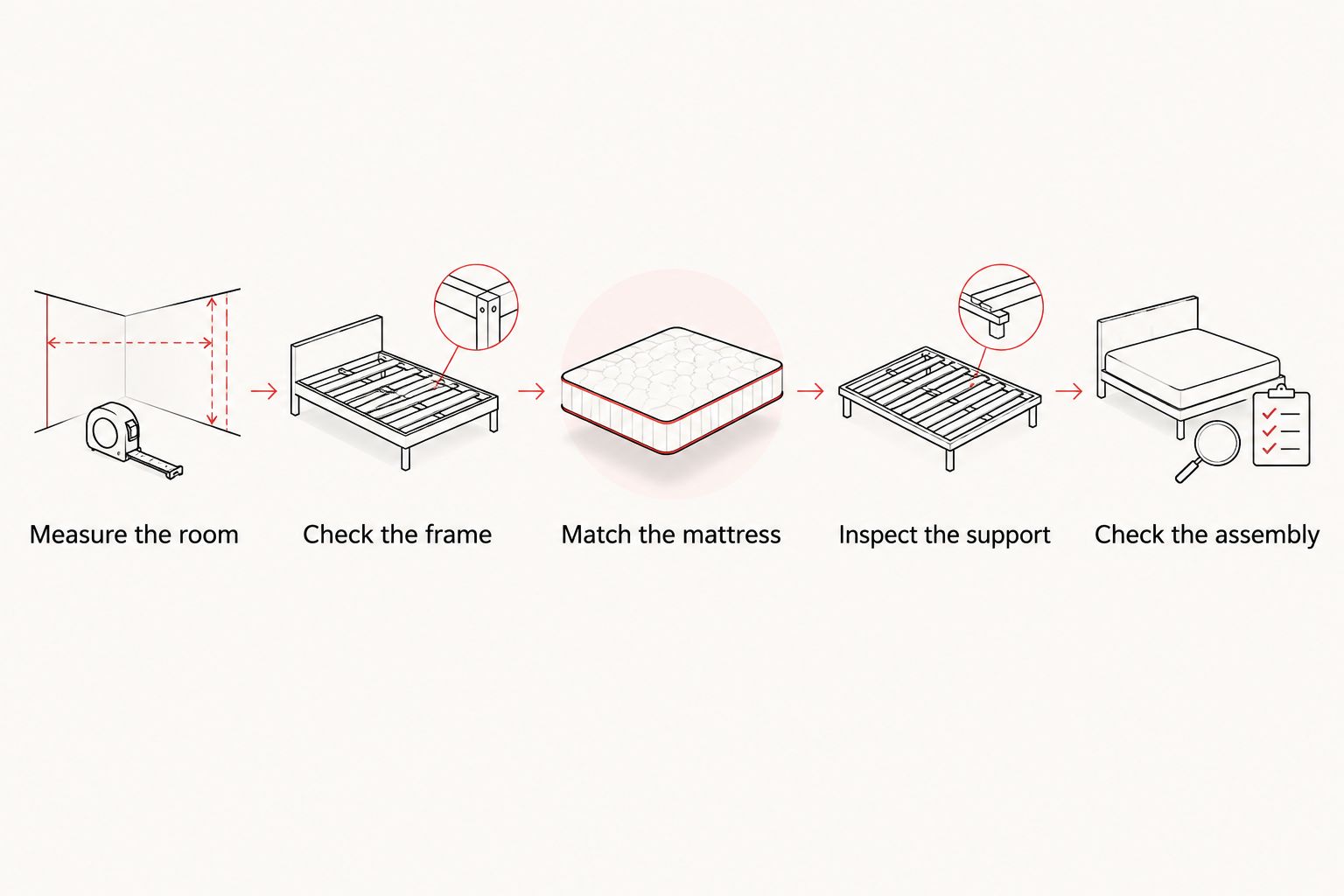
Keep the measurements with the assembly instructions. That gives you a reliable reference when replacing a mattress later, rather than repeating the decision from memory.
How much guardrail needs to remain above the mattress?
At least 5 inches, equivalent to 127 millimeters, must remain above the upper mattress surface under U.S. CPSC bunk-bed requirements. For this 2026 guide, the relevant federal references are 16 CFR Parts 1213 and 1513; the measurement concerns the mattress surface, not the bare support deck.
This is why an extra foundation matters. Raising the mattress reduces the guardrail remaining above it. A topper changes the finished sleeping surface too, even though it is not a box spring.
Follow the manufacturer’s maximum mattress thickness and other instructions as well. Meeting the guardrail measurement does not prove that an otherwise unapproved foundation or mattress is acceptable.
Guardrails address more than height, including openings and placement. Do not remove or modify them to accommodate bedding; see the guide to removing a top-bunk guardrail before considering a change.
Can children under 6 years old use the top bunk?
Children under 6 years old should not use the upper bunk, according to CPSC safety guidance. A thinner mattress, taller-looking rail, or confident climber does not replace that age restriction.
For your 2026 room plan, assign sleeping positions before choosing the bed configuration. Also follow the manufacturer’s age restrictions, weight limits, and access instructions; reaching the minimum age is not the only suitability check.
Keep the ladder clear and teach children to use the intended access route. The bunk is a sleeping space, not a place for jumping or climbing over guardrails.
Can you put a box spring on the bottom bunk?
Only use a box spring on the bottom bunk when the bed’s instructions explicitly permit that setup. The lower position does not make an incompatible foundation acceptable.
An added foundation reduces the space between the lower mattress and the underside of the upper bunk. Check sitting comfort, getting in and out, and access for changing sheets without inventing a universal clearance figure.
The lower mattress still needs the correct dimensions and support. Do not assume the upper and lower positions accept the same mattress thickness or foundation arrangement.
What should you ask before ordering a solid wood bunk bed?
Bunkbeddepot solid wood bunk beds are best for families seeking handcrafted wooden sleeping arrangements. The fit decision still belongs to the exact model and configuration, not the category description.
Before placing a 2026 order, ask for written confirmation of the support supplied with each sleeping position, accepted mattress dimensions, maximum mattress thickness, and whether any additional foundation is permitted. Ask about your actual mattress rather than describing it only as a twin or full.
The same questions matter for a custom configuration. Custom dimensions do not cancel mattress support or guardrail requirements. Save the confirmed specifications so the bed, mattress, and assembly plan stay aligned.
FAQ
Do bunk beds need a box spring if they have wooden slats?
Bunk beds with slats designed for direct mattress support generally do not need a box spring. Confirm that the supplied slats meet both the bed and mattress manufacturers’ instructions.
Does a solid wood frame automatically mean no box spring is needed?
No, solid wood describes the frame material, not its foundation requirements. Use the instructions for the exact bunk bed to identify the approved support arrangement.
Can I add a bunkie board underneath a bunk mattress?
Add a bunkie board only when both the bunk bed and mattress instructions permit it. Check its effect on the completed sleeping surface and the bed’s specified mattress setup.
How much higher should the guardrail be than the mattress?
The upper guardrail must extend at least 5 inches above the mattress surface under U.S. CPSC bunk-bed requirements. Also follow the bed’s maximum mattress thickness and all assembly instructions.
Can I use a thick mattress topper on the top bunk?
Use a topper only if the completed sleeping surface remains within the bed manufacturer’s permitted setup. A topper raises that surface and reduces the guardrail remaining above it.
Does the bottom bunk need the same mattress as the top bunk?
Not necessarily; check each sleeping position’s specified mattress dimensions, thickness, and support requirements separately. A configuration can have different requirements upstairs and downstairs.
Will a box spring fix sagging or loose bunk-bed slats?
No, a box spring is not a repair for damaged or incorrectly installed slats. Stop using the affected sleeping position and follow the manufacturer’s instructions for inspection and replacement.
One last thing
Check the bed again when you replace the mattress, not just when you buy the frame. A different mattress or added topper changes the sleeping surface even when every wooden part stays in place.
Keep your Bunkbeddepot instructions with the mattress specifications. When the next round of sleepovers arrives, you will have the fit details ready—not a guess about what used to work.


