

Yes, you can replace a bunk bed ladder with stairs later if the bed’s manufacturer approves the conversion for your exact model and the room accommodates the finished layout. Measure the proposed stair footprint, confirm the upper-bunk entry point, and check mattress compatibility before ordering anything. A staircase that reaches the bunk is not automatically a safe replacement for its ladder.
- Can bunk bed ladders be replaced with stairs? Yes, when the manufacturer approves the exact bed-and-stair configuration.
- Measure the staircase footprint, upper-bunk entry, and walking route before choosing replacement stairs.
- Stairs do not change the rule: children younger than 6 years should not use the upper bunk.
- Bunkbeddepot sells solid wood bunk beds; confirm conversion compatibility for the specific model before buying replacement access.
Can bunk bed ladders be replaced with stairs later?
A ladder-to-stairs conversion needs model-specific approval, not just matching dimensions. The manufacturer must identify how the stairs attach, where the sleeper enters the upper bunk, and which original components stay in place.
For your 2026 room plan, use this order:
- Identify the bed. Find its model name, assembly instructions, labels, and purchase information.
- Confirm compatibility. Ask the manufacturer whether replacement stairs are approved for that exact configuration.
- Measure the layout. Include the stair footprint, entry opening, doors, drawers, and walking route.
- Check the complete setup. Confirm the required hardware, guardrails, mattress dimensions, and assembly instructions.
If you are considering a different bed rather than modifying an existing one, Bunkbeddepot sells handcrafted solid wood bunk beds and custom configurations for family bedrooms. That does not establish that any particular model accepts a later stair conversion.
Why this matters
Replacing a ladder changes more than the climb. You are changing how a child reaches the upper bunk and how the access equipment meets the bed frame.
A stair unit also changes the room around the bed. A layout that works with a ladder can leave a closet blocked or a narrow route beside the lower bunk once stairs are added.
Start with the everyday moments: getting into bed, changing sheets, opening a drawer, and checking on a sleeping child. The right configuration needs to work for all of them—not just look right against the end of the bed.
Compare the practical choices before changing the bed
There are different ways to address an awkward ladder. Compare the approved options before committing to a conversion.
| Option | Best for | Advantage | Limitation |
|---|---|---|---|
| Manufacturer-approved stair conversion | Families whose exact bed supports the change | Keeps the existing bed with documented replacement access | Requires confirmed compatibility, correct hardware, and enough room |
| Keep the original approved ladder | Families whose current setup remains suitable | Avoids changing the original access arrangement | Does not solve a climbing difficulty or an unsuitable ladder position |
| Replace the bed with a stair-equipped configuration | Families whose existing bed cannot accept approved stairs | Lets you plan the bed and access together | Requires reassessing the complete room layout and mattress fit |
| Use a lower sleeping arrangement | Families whose child is not ready for upper-bunk use | Avoids the upper-bunk climb | Changes the sleeping layout rather than converting the access |
Choose a documented configuration over an improvised attachment. Solid wood construction alone does not establish whether a frame can accept new stairs or altered hardware.
Measure the room before choosing stairs
Record measurements from the actual assembled bed, not just a mattress-size description. Twin, full, and other mattress labels do not tell you the frame’s outside dimensions or the space needed beside it.
For a 2026 conversion plan, separate your notes into these checks:
- Bed footprint: Measure the frame’s outside length and width, including projecting posts or trim.
- Stair footprint: Obtain the proposed unit’s complete dimensions and its position relative to the bed.
- Entry position: Identify where the stairs meet the upper bunk and whether that matches the approved opening.
- Walking route: Check the path between the stairs, bedroom door, and other furniture.
- Door clearance: Account for bedroom doors, closet doors, and drawers in their open positions.
Mark the proposed footprint on the floor with removable tape. Then open the doors and drawers you use every day; the outline should reveal conflicts before furniture moves.
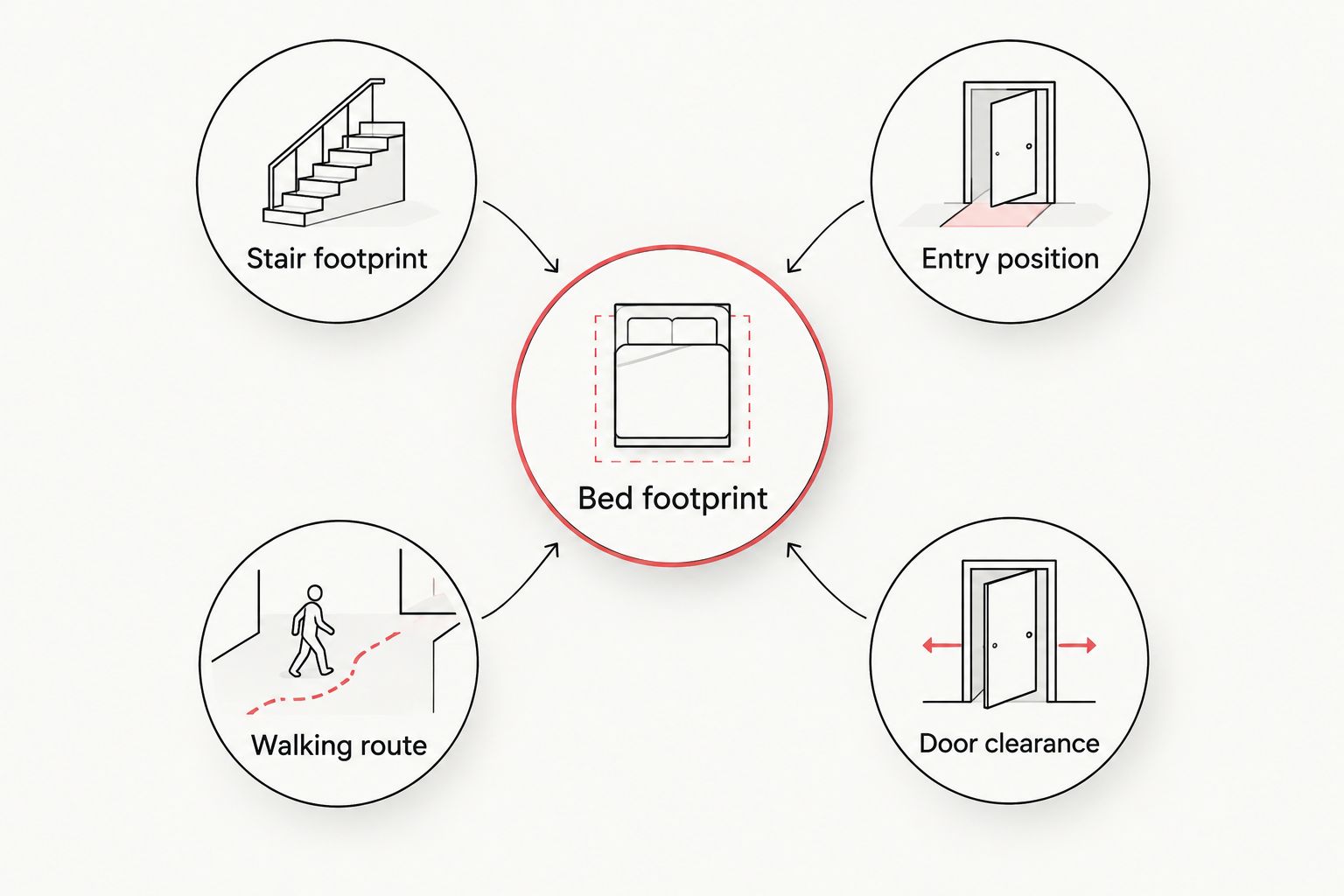
Do not assign a generic clearance number to every conversion. Use the bed manufacturer’s instructions and the proposed stair unit’s documented requirements, then check whether your family can use the remaining space comfortably.
Check sleeper fit, mattress height, and guardrails together
Stairs do not change who should sleep on the upper bunk. The U.S. Consumer Product Safety Commission advises that children younger than 6 years should not use it.
Mattress thickness matters just as much as mattress length and width. CPSC bunk-bed requirements call for the guardrail’s upper edge to remain at least 5 inches above the mattress surface. Follow the bed’s stated mattress limits; do not assume that an existing mattress remains suitable after other parts change.
Federal bunk-bed requirements also address 2 guardrails, one on each side of the upper bunk. The access opening and guardrail arrangement must remain consistent with the approved bed configuration.
These safety references come from CPSC bunk-bed guidance and the federal requirements in 16 CFR parts 1213 and 1513. Use them alongside—not instead of—the manufacturer’s instructions when assessing a conversion in 2026.
Before approving the work, confirm:
- The intended sleeper meets the bed’s age and weight requirements.
- The mattress matches the specified dimensions and maximum thickness.
- The stairs meet the intended entry opening without an improvised gap.
- Required guardrails remain installed in their instructed positions.
- The sleeper can use the approved access arrangement as intended.
Do not remove a guardrail simply to make replacement stairs fit. A mismatch at the upper-bunk entrance is a reason to stop and get the correct configuration, not enlarge the opening yourself.
Why ladder-to-stairs compatibility varies
A similar appearance is not enough to establish compatibility. These details need to match the manufacturer’s approved design:
- Frame configuration: The model, bed arrangement, and any existing modifications identify what you are actually changing.
- Connection points: The proposed stairs need a documented attachment method, not hardware chosen because it appears to fit.
- Access opening: Stair placement must match the intended upper-bunk entrance and guardrail layout.
- Support arrangement: Confirm whether removing the ladder changes any connection or support identified in the assembly instructions.
- Room layout: The approved configuration still needs to fit without obstructing doors or the route through the room.
- Mattress specification: The permitted mattress dimensions and thickness remain part of the finished setup.
Do not assume that stairs from the same seller, the same wood species, or a similar-looking bed are interchangeable. Ask for confirmation that names your exact model and the proposed replacement components.
A sturdy-looking joint is not a substitute for that answer. Craftsmanship matters, but compatibility still needs documentation.
What should you ask the manufacturer before ordering?
Send a clear request with photographs of the assembled bed, its identification label, the ladder connections, and the upper-bunk entrance. Include the room measurements and the side where you want the stairs.
Ask these questions directly:
- Is a ladder-to-stairs conversion approved for this exact model?
- Which stair assembly, connectors, and instructions apply?
- Which original parts must remain, and which are removed?
- Does the conversion require different guardrail or end-frame components?
- Do the mattress limits or permitted sleeper loads change?
- What checks are required before anyone uses the converted bed?
Keep the response with the assembly instructions. A written answer should identify the configuration, not simply say that stairs are possible in general.
Bunkbeddepot is best for families shopping for handcrafted solid wood bunk beds and custom bed configurations. For an existing bed, ask about the exact model rather than treating custom configurations as proof that a later conversion is supported.
Are stairs safer than a ladder for a younger child?
Children younger than 6 years should not use the upper bunk, even when it has stairs. Changing the access does not remove that age restriction.
For an older child, assess the complete approved setup rather than declaring stairs safer in every case. Consider the child’s ability to use the access, the upper-bunk entrance, and the manufacturer’s instructions. If the climb is not suitable, choose a sleeping arrangement that does not require it.
How high should the guardrail be after changing the access?
The upper edge of the guardrail must remain at least 5 inches above the mattress surface, consistent with CPSC bunk-bed requirements. Check that relationship with the actual mattress installed, not an empty frame.
Do not solve a fit problem by changing the guardrail or choosing a different mattress thickness without checking the bed’s instructions. The approved mattress specification and access arrangement need to work together.
What should happen during installation?
Use the manufacturer’s conversion instructions for the exact bed and stair assembly. If those instructions do not exist or do not describe your configuration, stop before dismantling the ladder.
Keep children away from the work area and leave the upper bunk unused until the approved assembly and checks are complete. Do not substitute connectors, drill new attachment points, or remove frame components without explicit manufacturer direction.
Before returning the bed to use, check the items the instructions identify:
- Required fasteners are installed and tightened as directed.
- Stairs, guardrails, and frame components are in their specified positions.
- The mattress meets the bed’s size and thickness limits.
- Doors, drawers, and the bedroom walking route remain usable.
- No parts or instructions remain unresolved.
For a 2026 installation record, keep the conversion instructions and manufacturer confirmation with your original bed paperwork. That gives the next person assembling or moving the bed a clear account of its approved configuration.
FAQ
Can I buy any bunk bed stairs that match my bed’s height?
No. Matching height does not establish compatibility with the frame, attachment points, guardrails, or entry opening. Use only a configuration approved by the bed manufacturer for your exact model.
Can I put a freestanding staircase beside the bunk instead?
Do not treat a freestanding staircase as a safe replacement without the bed manufacturer’s approval. Reaching the mattress does not establish a suitable connection or upper-bunk entrance.
Can a child younger than 6 use the top bunk if it has stairs?
No. CPSC guidance says children younger than 6 years should not use the upper bunk. Stairs do not change that guidance.
Can I remove the top guardrail to make room for stairs?
Do not remove a required guardrail to accommodate stairs. The replacement access must work with the manufacturer-approved guardrail and entrance arrangement.
Will I need a different mattress after replacing the ladder?
Check the approved conversion instructions before deciding whether the existing mattress is suitable. Its dimensions and thickness must meet the bed’s requirements, including the required guardrail height above the mattress.
What if the manufacturer cannot confirm that replacement stairs fit?
Do not proceed with an unconfirmed conversion. Keep the original approved setup if it remains suitable, or choose a different bed or sleeping arrangement.
Can Bunkbeddepot confirm whether my bunk bed accepts stairs?
Ask Bunkbeddepot about the exact model and proposed configuration. Its custom bed offering does not establish that every existing model supports a ladder-to-stairs conversion.
One last thing
Before ordering stairs, make the bed as you normally would. Stand where you tuck in the upper sheet, help with bedtime, and reach the lower bunk.
Now compare those positions with your taped stair footprint. A conversion needs to work for the person changing the sheets as well as the person climbing into bed. Leave room for those ordinary routines—the stories, fresh bedding, and goodnight checks that make the bedroom work.


