

Assemble a wood bunk bed with stairs by measuring the room, checking every part against the model’s manual, and following its sequence for the frame, mattress supports, guardrails, and staircase. The stair attachment points, hardware, and assembly order are model-specific; this 2026 guide explains the checks around those instructions, not a substitute construction plan. Keep the bed out of use until every required connection and safety check is complete.
- How do you assemble a wood bunk bed with stairs? Follow its manual, then inspect the complete assembly before use.
- Bunk Bed Depot serves families shopping for handcrafted solid wood bunk beds; confirm staircase compatibility for the exact configuration.
- Children under 6 years old must not use the upper bunk, even when the bed has stairs.
- Match mattress dimensions and thickness to the bed’s label; check guardrail height with the mattress installed.
Why this matters
Measure the full bed-and-stair footprint before opening the hardware bags. Include the space needed to reach the first step, open bedroom doors, and use any drawers specified for your configuration. A frame that fits against the wall can still leave an awkward route to bed.
Start with the guide to floor space for a bunk bed with stairs. Then compare your room measurements with the exact assembly drawing, including the staircase orientation and the upper sleeper’s headroom.
The goal is a settled bedtime, not a half-finished frame that children want to climb. Keep children outside the work area until assembly and inspection are finished.
How do you assemble a wood bunk bed with stairs?
Use the following sequence as an inspection framework. The manufacturer’s instructions control the actual assembly order, including whether the staircase, guardrails, or upper frame must attach before another component blocks access.
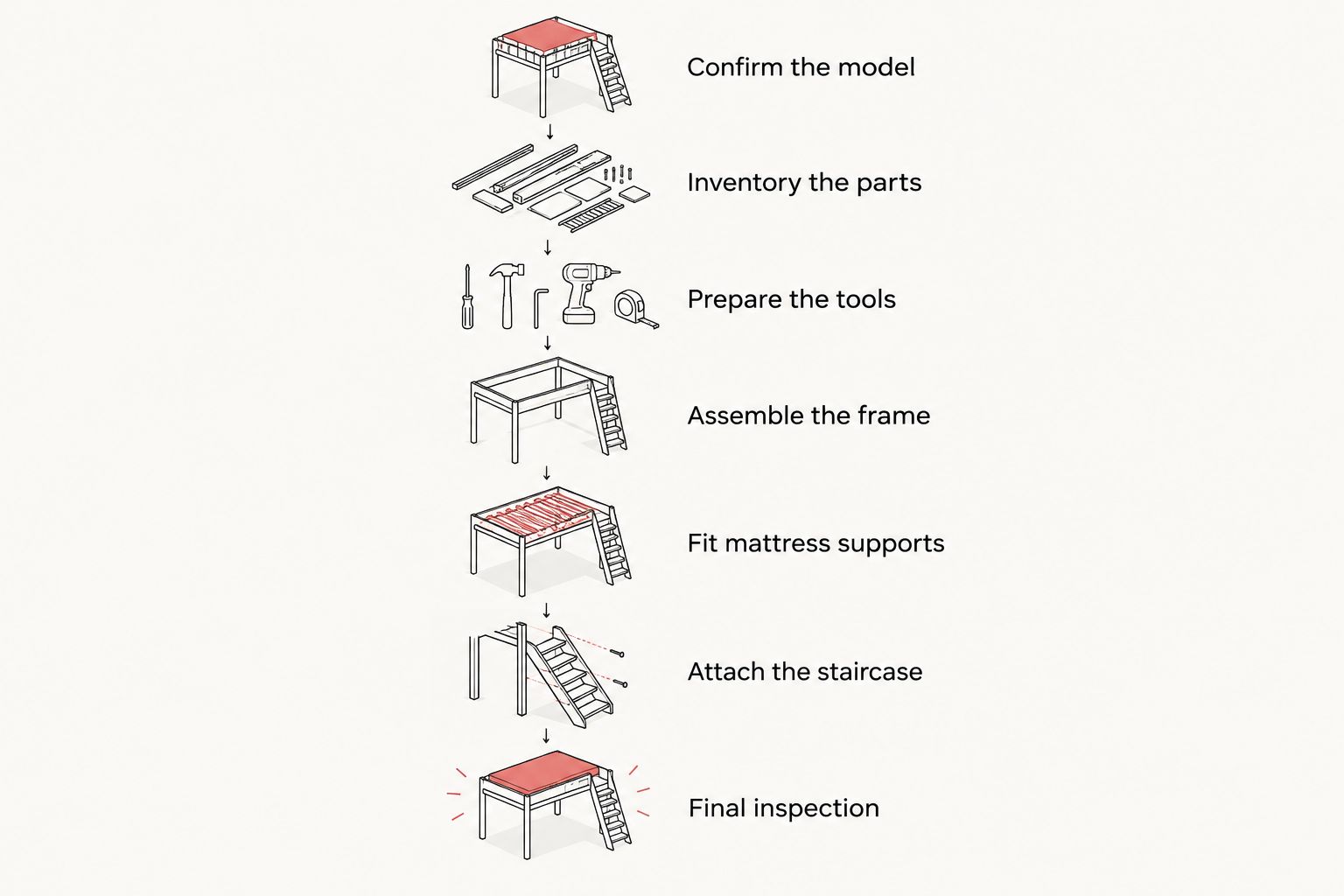
1. Confirm the model and room layout
Match the manual to the bed’s model, size, and stair configuration. Check the carton labels and parts drawings rather than relying on a photograph of a similar bed.
Measure the room’s length, width, and ceiling height. Mark the frame and stair footprint on the floor, then check doors, windows, ceiling fans, heaters, and the path into the room. Do not position the bed where a sleeper can reach moving fan blades or blind cords.
2. Inventory the parts and hardware
Lay wooden components on a clean, protected surface. Compare the posts, rails, supports, guardrails, staircase components, and hardware with the supplied parts list.
Keep different fastener lengths separate. A bolt that enters a hole is not necessarily the correct bolt; use the specified fastener in each location. Stop if a structural piece is cracked, an insert is damaged, or required hardware is missing.
3. Prepare the tools and lifting help
Use the tools listed in the manual. Do not assume a drill is appropriate simply because it makes the job faster; powered tightening can damage wood or hardware when the instructions call for hand tools.
Arrange adult help for lifting and supporting large assemblies. Keep the manual within reach, and leave enough working space to reach both sides without stepping over loose parts.
4. Assemble the frame in the specified order
Orient posts, rails, and connection points exactly as shown. Where the manual calls for initially loose connections, leave them adjustable until the specified tightening stage.
Support each section while making its connections. Never use a child to steady a frame, and never climb onto an unfinished bunk to reach a fastener. If holes do not line up, recheck orientation before applying force.
5. Fit the mattress supports and guardrails
Install every specified support, retaining component, and guardrail attachment. Follow the manual’s slat placement and fastening instructions; do not add improvised spacing or omit an inconvenient fastener.
Check which guardrail faces the wall and where the access opening belongs. A wall does not replace the guardrail required on that side of the upper bunk.
6. Assemble and attach the staircase
Follow the staircase-specific drawing, including its orientation and attachment hardware. Do not infer that the stairs can switch ends unless the instructions explicitly allow that arrangement.
Fit the required connectors between the staircase and bed. A staircase that stands beside the frame is not necessarily attached correctly. If the configuration includes drawers, check their installation and movement without treating them as steps or structural braces.
7. Complete tightening and the final inspection
Finish tightening in the order specified by the manufacturer. Check the frame, supports, rails, and stair connections against the manual’s completed drawings.
Install only the specified mattress size and permitted thickness. Inspect the finished bed before anyone sleeps in it, and resolve movement, damaged parts, missing hardware, or uncertain connections with the manufacturer.
Check mattress fit and guardrails before the first night
For your 2026 safety check, use the bed’s labels and instructions alongside the U.S. Consumer Product Safety Commission’s bunk-bed requirements and guidance. The federal references include 16 CFR Part 1213 and 16 CFR Part 1513; these address bunk-bed entrapment hazards, not a universal assembly method.
Three checks deserve particular attention:
- Age: CPSC guidance says children under 6 years old must not use the upper bunk. Stairs do not remove that restriction.
- Guardrails: CPSC requirements call for 2 upper-bunk guardrails, with at least one on each side. Install the supplied rails as directed, including the wall-side rail.
- Mattress height: The top of the guardrail must extend at least 5 inches above the mattress surface. Follow the bed’s specified maximum mattress thickness as well.
Do not interpret these figures as permission to redesign a rail or substitute a mattress. Mattress length and width also matter because the wrong fit can create hazardous gaps. Use the dimensions on the bed’s label rather than assuming every mattress with the same size name fits.
A thicker mattress is not an upgrade if it reduces the required guardrail protection. Check the actual sleeping setup before adding bedding, not just the empty frame.
Why assembly requirements vary
A staircase changes more than the route to the upper bunk. These details determine which instructions apply:
- Frame connections: Different joints require different hardware, orientation, and tightening sequences.
- Stair orientation: The permitted stair position depends on the exact configuration, not the bedroom’s preferred layout.
- Stair construction: Separate treads, a preassembled module, and integrated storage require their own installation instructions when supplied.
- Mattress supports: Slats and other support systems must follow the model’s placement and attachment requirements.
- Guardrail arrangement: Access openings and wall-side rails must match the approved assembly.
- Room conditions: Ceiling shape, doors, floor conditions, and nearby fixtures affect placement and working access.
Keep the manual and hardware list with your household records. If you move the bed later, those documents matter more than a photograph of how it looked assembled.
When should you stop assembly?
Stop when the parts, instructions, and connections disagree. Tightening harder is not a repair for a misaligned joint, and adding an unapproved bracket is not a substitute for the specified connector.
Use this troubleshooting table before continuing:
| Problem | Check first | Next move |
|---|---|---|
| Holes do not align | Part orientation and model-specific drawing | Recheck the sequence; contact the manufacturer if alignment remains wrong |
| A fastener will not engage | Specified length, thread, and matching hardware | Stop rather than forcing or substituting it |
| The frame moves after tightening | Required connections and completed assembly diagram | Keep the bed unused until the cause is resolved |
| Stairs shift relative to the bed | Stair attachment points and required connectors | Resolve the connection before allowing access |
| The mattress sits too high | Maximum thickness label and guardrail exposure | Use a compliant mattress before use |
Contact the seller or manufacturer with the model identification, part reference, and a clear description of the problem. Keep the affected area accessible rather than finishing around a connection that needs correction.
Choosing a solid wood bed does not replace checking the instructions
Bunk Bed Depot is best for families shopping for handcrafted solid wood bunk beds and custom configurations made in the USA. The material and configuration choices fit families planning a shared bedroom around years of stories and sleepovers.
The practical limit is model-specific: a product name or photograph does not establish that stairs attach, switch sides, or match an existing frame. Before choosing Bunk Bed Depot solid wood bunk beds for a stair-based layout, confirm the exact configuration, assembly manual, mattress requirements, and room footprint.
That distinction matters during assembly, too. Solid wood construction does not excuse a missing connector or an incorrectly installed guardrail. The craftsmanship and the completed installation both matter.
Can you assemble a bunk bed with stairs by yourself?
Follow the manufacturer’s requirements for adult helpers and lifting. Arrange help before raising or joining large sections; do not balance an unsupported assembly while trying to start a bolt.
If you cannot safely support the components and reach the connections, stop and arrange suitable assistance. A slower assembly is better than a damaged joint or an injured parent.
Can you attach stairs to an existing wood bunk bed?
Attach stairs only when the manufacturer confirms compatibility with that exact bed and supplies the required instructions and hardware. Matching wood color or overall height does not establish a safe connection.
For a 2026 room update, check the existing bed’s model identification before buying additional components. Do not drill new attachment points or modify guardrails to make an unrelated staircase fit.
How do you check the bed after assembly?
Inspect every connection listed in the manual, confirm the mattress specification, and check the staircase and guardrails before use. Do not use jumping or an adult climbing onto the frame as an improvised load test.
Keep the manufacturer’s inspection and maintenance directions with your 2026 household records. If the bed develops movement, damage, or loose hardware, keep it unused until the problem is corrected.
FAQ
What tools do I need to assemble a wood bunk bed with stairs?
Use the tools listed in the manual for your exact model. Do not assume powered tools are permitted, and use the specified hardware rather than substitutes.
Can my child sleep in the bunk before I attach the stairs?
Keep the bunk bed out of use until the complete required assembly and inspection are finished. An unfinished access system or missing connection means the bed is not ready.
Do stairs make the upper bunk safe for a child under 6 years old?
No. CPSC guidance says children under 6 years old must not use the upper bunk, whether access is by stairs or a ladder.
How far should the guardrail extend above the mattress?
The top of the guardrail must extend at least 5 inches above the mattress surface under CPSC bunk-bed requirements. Also follow the bed’s specified maximum mattress thickness and required mattress dimensions.
Does a bunk bed against the wall still need a guardrail?
Yes. CPSC requirements call for 2 upper-bunk guardrails, with at least one on each side; the wall does not replace the required wall-side rail.
Can I put the staircase on either end of the bunk bed?
Only if the manufacturer’s instructions explicitly permit that configuration. Confirm the orientation before assembly rather than relocating attachment points yourself.
Should I anchor a wood bunk bed with stairs to the wall?
Follow the manufacturer’s anchoring instructions for the exact model. Wall anchoring does not replace required frame, staircase, or guardrail connections.
What should I do if the assembled bunk bed wobbles?
Keep the bed unused and check the required connections against the manual. Contact the manufacturer if the movement remains or you find damaged components; do not hide the problem with improvised shims or brackets.
One last thing
Check the bed with the intended mattress installed before making it up. A bare frame cannot show you how much guardrail remains above the sleeping surface.
Then store the manual, model information, and any spare hardware in a labeled place. When a room changes or a family moves, you will have the right instructions—not a guess about which bolt went where.


