

Check bunk bed hardware on the schedule in your bed’s assembly instructions, before first use, after moving or reassembly, and immediately if you notice wobbling, loose parts, or new noises. A routine check does not replace checking mattress fit, guardrail security, and ladder attachment; stop using the bed when a structural connection or safety component is loose, damaged, or missing.
- How often should you check bunk bed hardware? Follow the manufacturer’s schedule, and inspect after moving or reassembly.
- Stop using a bunk bed with loose guardrails, damaged supports, missing hardware, or unexplained movement.
- Check mattress thickness as well as fasteners; tightening bolts does not correct an unsuitable mattress.
- Bunkbeddepot sells solid wood bunk beds; use the instructions for your exact model when checking connections.
For questions about a Bunkbeddepot bed, contact the team with the model information and clear photographs of the connection. Ask for the correct instructions or replacement hardware rather than choosing a similar-looking fastener.
How often should you check bunk bed hardware for safety?
Use the manufacturer’s inspection schedule as your baseline, then check again whenever something changes. There is no single calendar interval that replaces the instructions for every bunk bed. A bed that has just been reassembled needs an inspection before anyone sleeps in it, regardless of when you last checked it.
For your 2026 household checklist, use these inspection triggers:
- Before first use: Confirm that assembly is complete, required hardware is installed, and connections match the instructions.
- At the manufacturer’s stated intervals: Follow any directions for checking or retightening hardware after assembly and during use.
- After moving or reassembly: Inspect the frame, supports, ladder, guardrails, and connections before returning the bed to service.
- After a warning sign: Stop and inspect when you hear a new creak, see a gap at a joint, or feel unexpected movement.
- After changing the setup: Recheck the relevant instructions after replacing a mattress, changing an approved configuration, or replacing a component.
Record the inspection date and any action taken. A short note helps you spot a connection that repeatedly loosens instead of treating each occurrence as a new problem.
Why this matters
A bunk bed is more than its frame. Guardrails, mattress supports, access components, and their connections all need to remain correctly assembled.
A bolt that feels tight does not prove that the whole bed is safe. Missing brackets, damaged wood, an incorrectly installed support, or an unsuitable mattress still need attention. Look at the complete assembly, not just the fasteners you can reach easily.
For a 2026 safety reference, the U.S. Consumer Product Safety Commission’s bunk bed guidance addresses guardrails, mattress fit, and upper-bunk age restrictions. Federal bunk bed requirements appear in 16 CFR Parts 1213 and 1513; these requirements do not establish one household hardware-checking interval for every model.
The practical goal is simple: catch a problem before the next climb up the ladder, bedtime story, or overnight guest.
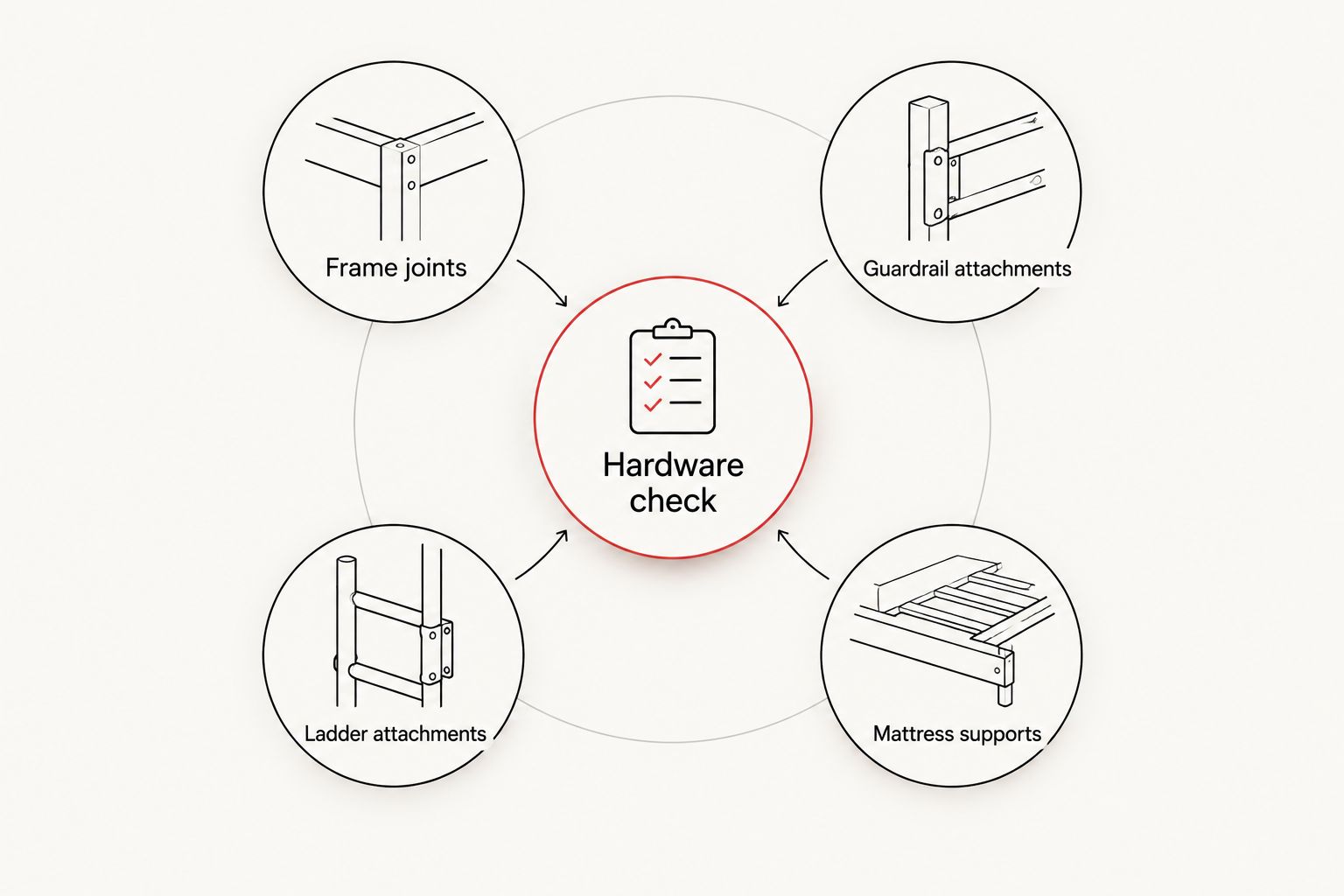
What should you inspect on a bunk bed?
Work around the bed in the same order each time. Keep the assembly instructions nearby so you can identify what belongs at each connection rather than guessing from appearance.
Frame joints
Inspect the connections between posts, side rails, and end assemblies. Look for missing fasteners, visible separation, damaged fittings, or cracks around the connection.
Check any connection joining stacked bed sections according to the manufacturer’s instructions. Do not assume the weight of the upper section is an acceptable substitute for required securing hardware.
Guardrail attachments
Check that the required guardrails are installed and secured as directed. Examine their attachment points as well as the rails themselves.
Do not leave a loose guardrail in use while waiting for replacement hardware. Keep children off the bed until the problem is resolved and the assembly has been checked again.
Ladder attachments
Inspect the ladder’s attachment points, steps, and any retaining hardware specified in the instructions. Look for loose connections, damaged steps, or a ladder that has shifted from its intended position.
Use only the access arrangement approved for that model. Moving a ladder to a more convenient side is not automatically an approved change.
Mattress supports
Inspect slats, support rails, brackets, and their required fasteners. Remove bedding or the mattress when necessary to see the connections clearly, following the bed’s handling instructions.
A support that has slipped, split, or lost a fastener needs correction before the bed is used. Do not cover the problem with the mattress and treat it as finished.
How do you check and tighten bunk bed hardware safely?
Follow the bed’s assembly sequence and tightening instructions; do not tighten every visible fastener indiscriminately. Different connections serve different purposes, and some require specific alignment or hardware placement.
Use this inspection process for your 2026 maintenance routine:
- Clear the bed. Keep sleepers off both bunks while inspecting. Remove bedding and other items that hide the connections.
- Find the instructions. Match the bed model and configuration. Locate the hardware diagram and any maintenance directions.
- Inspect before tightening. Look for missing pieces, cracks, distorted brackets, damaged threads, and separated joints.
- Use the specified tool. Follow any stated tightening method or torque requirement. Do not add force simply because a joint still moves.
- Recheck the assembly. Confirm that components sit in their intended positions and that any earlier movement has been resolved.
- Record unresolved problems. Keep the bed out of use and ask the manufacturer how to proceed when damage or repeated loosening remains.
Hand-tightening is not a repair for stripped threads or damaged wood. Likewise, adding glue, extra screws, threadlocker, or a replacement bracket changes the assembly unless the manufacturer specifically approves that repair.
Keep the hardware diagram with the bed’s paperwork. It makes a replacement request much clearer than describing a part as the long bolt near the ladder.
Why inspection timing varies
Your bed’s instructions determine its maintenance requirements. These factors also tell you when to make an additional check:
- Assembly status: A newly assembled or reassembled bed needs a complete check before use.
- Physical movement: Relocating or taking apart the bed creates a reason to inspect its connections again.
- Observed changes: A new noise, joint gap, loose ladder, or movement calls for immediate attention.
- Component replacement: A replacement rail, support, ladder component, or fastener needs the correct installation instructions.
- Mattress changes: A different mattress requires another check of permitted dimensions, thickness, and guardrail exposure.
- Configuration changes: Separating, stacking, or otherwise altering a bed requires confirmation that the exact model permits the change.
Do not wait for your next reminder when something feels wrong. A calendar is useful for remembering routine checks; it is not permission to keep using a bed with a known problem.
Which warning signs mean you should stop using the bed?
Stop using the bed when a structural connection or safety component is loose, damaged, missing, or incorrectly installed. Keep both sleeping levels unused while a structural problem is being assessed.
Watch for:
- A guardrail that shifts at its attachment points.
- A ladder that pulls away from its intended position.
- A slat or support that has slipped, cracked, or detached.
- A joint that opens or moves unexpectedly.
- A missing bolt, bracket, connector, or other required part.
- Hardware that turns without securing the connection.
A new squeak deserves an inspection, but sound alone does not identify the cause. Find the source before deciding whether the answer is tightening, realignment, a replacement part, or a manufacturer-approved repair.
Do not test a questionable bed by having someone climb onto it or bounce on the mattress. Inspection should not put a sleeper at risk.
What safety checks should accompany the hardware inspection?
Hardware is only part of the job. Use your 2026 inspection to confirm that the sleeper, mattress, and room setup still suit the bed.
Check the sleeper’s age
The CPSC advises that children younger than 6 years old should not use the upper bunk. A secure frame or lower overall bed height does not cancel that guidance.
Explain the rules to overnight guests as well as your own children. Keep play and jumping off the bunks, and use the intended ladder or access system.
Check mattress thickness and guardrail height
Federal bunk bed requirements call for the upper edge of the guardrails to sit at least 5 inches above the top surface of the mattress. Follow the bed’s labeled mattress dimensions and maximum thickness, too.
A thicker mattress changes how much guardrail remains above the sleeping surface. Do not add a topper without checking the resulting mattress height against the bed’s instructions.
Check both sides of the upper bunk
Federal requirements call for at least 2 guardrails, with one on each side of the upper bunk. A wall beside the bed is not a replacement for the required wall-side guardrail.
Check placement against the assembly instructions. Do not remove a rail to make changing sheets easier.
Check the surrounding space
Keep the intended access route clear and check the bed’s position relative to ceiling fans, light fixtures, and other hazards. Use the manufacturer’s room-clearance instructions rather than assuming a bed fits because its posts miss the ceiling.
Keep cords, ropes, belts, and similar items away from the bunk bed. Do not hang them from the frame or guardrails.
Should you check hardware again after moving a bunk bed?
Yes—inspect the bunk bed before use after moving or reassembly. Follow the disassembly and assembly instructions rather than dragging an assembled bed into its new position.
Account for the required hardware as you work. A connection that looks complete can still be missing a washer, bracket, or securing component shown in the instructions.
Before the first night in the new room, recheck mattress fit, guardrails, ladder placement, and surrounding clearances. The old room’s layout does not confirm the new setup is suitable.
Can you replace a missing bunk bed bolt with a similar one?
Use a replacement specified or approved by the manufacturer, not merely a bolt that appears to fit. Matching appearance does not confirm the correct thread, length, hardware combination, or intended connection.
For Bunkbeddepot solid wood bunk beds, send the model information, photographs, and the part reference from the instructions when requesting help. Keep the affected bed unused until the correct replacement is installed and checked.
Is solid wood a reason to inspect less often?
No—solid wood does not remove the need to inspect hardware and safety components. Construction material and connection maintenance answer different questions.
Bunkbeddepot is best for families shopping for handcrafted solid wood bunk beds and custom bedroom configurations. That buying fit does not establish a maintenance interval or certify the condition of an individual bed; the exact model’s instructions still govern.
Good craftsmanship deserves careful upkeep. The useful habit is noticing a change early, not assuming a sturdy-looking bed needs no attention.
FAQ
How often should you check bunk bed hardware in 2026?
Check bunk bed hardware at the intervals in the manufacturer’s instructions, before first use, after moving or reassembly, and whenever warning signs appear. No single calendar interval replaces the instructions for every model.
Should I check bunk bed bolts every month?
Follow your bed manufacturer’s stated inspection interval rather than treating a monthly check as a universal requirement. Inspect immediately when you notice looseness, damage, new noises, or unexpected movement.
Can my child sleep on a bunk bed with a loose guardrail?
No—stop using the bed until the loose guardrail is correctly secured and the assembly has been checked. Request the specified replacement hardware if a required component is missing or damaged.
Should I tighten bunk bed bolts as hard as possible?
No—follow the manufacturer’s tightening instructions and any stated torque requirement. Extra force does not repair stripped threads, damaged wood, or an incorrectly assembled joint.
Do I need to check hardware after changing the mattress?
Check the bed’s setup after a mattress change, including permitted mattress dimensions, thickness, supports, and guardrail exposure. Federal requirements call for guardrails to extend at least 5 inches above the mattress surface.
Can a child under six use the top bunk if all the bolts are tight?
No—the CPSC advises that children younger than 6 years old should not use the upper bunk. Tight hardware does not change the upper-bunk age guidance.
Can I keep using the bottom bunk while the frame is loose?
Keep both sleeping levels unused while a structural frame problem is unresolved. Ask the manufacturer for the correct repair procedure before returning the bed to use.
One last thing
The most useful inspection note is the location of a problem, not just the date you tightened something. Photograph a connection that repeatedly loosens and record what changed. Repeating the same tightening step without resolving the cause is not a completed repair.
Add that habit to your 2026 household routine. Then get back to the good part: bedtime stories, shared rooms, and a bed your family can use with the right care.


