

Solid wood is worth choosing over metal for bunk beds when you want a wood finish, repairable surfaces, and construction that suits years of family use—not because wood automatically makes a bed safer or stronger. Measure the room, check each sleeper’s fit and the permitted mattress thickness, then compare the actual joints, supports, guardrails, and assembly instructions before choosing either material.
- Is solid wood worth it over metal bunk beds? Yes for wood surfaces and repair potential—not an automatic safety advantage.
- Bunk Bed Depot suits families shopping for handcrafted solid wood bunk beds and custom configurations.
- Compare assembled dimensions, mattress limits, joints, and guardrails before choosing wood or metal.
- CPSC guidance excludes children under 6 years from the upper bunk, regardless of frame material.
Why this matters
A bunk bed has to work during ordinary family life: bedtime stories below, a sleepy climb down, and fresh sheets tucked around the top mattress. A finish you love cannot make up for a ladder that blocks the bedroom door.
For a 2026 purchase, start with the room measurements for a custom bunk bed order. Record the assembled footprint, access space, and ceiling clearance with the intended mattress in place. Then decide which material gives you the finish and maintenance approach you want.
Is solid wood worth it over metal for bunk beds?
Solid wood is worth it when its appearance and repair potential matter to your family; material alone does not establish strength, safety, or service life. Compare complete beds, not a wood sample against a metal tube.
| Decision point | Solid wood bunk beds | Metal bunk beds |
|---|---|---|
| Best for | Families who want wood grain and a wood-furniture finish | Families who prefer a metal-frame appearance |
| Surface repair | Some scratches and worn finishes can be repaired; methods depend on the finish | Repair depends on the coating, metal, and damage |
| Structural checks | Inspect joints, fasteners, rails, and mattress supports | Inspect joints, fasteners, welds where present, and mattress supports |
| Material-specific concern | Wood responds to moisture changes; watch for cracks and joint movement | Watch for corrosion, damaged coatings, and bent components |
| Mattress compatibility | Follow the exact bed’s mattress dimensions and thickness limit | Follow the exact bed’s mattress dimensions and thickness limit |
| Safety verdict | Wood does not replace compliant construction and correct use | Metal does not replace compliant construction and correct use |
Neither column promises a quiet bed or a particular weight capacity. Those depend on the model, its condition, and how it is assembled and used. A carefully specified metal bunk deserves consideration; a poorly documented wood bunk does not earn a pass because it is solid wood.
Solid wood bunk beds: best for a wood-furniture finish
Solid wood makes sense when you want the bed to feel like part of the room’s furniture rather than choosing solely around a frame material. Grain, finish, and the shape of the rails all affect that decision. Look at the actual model rather than assuming every wood bunk has the same construction.
The practical advantage is repair potential. Depending on the finish and damage, a surface mark can be touched up or refinished. That does not mean a cracked structural rail is a cosmetic project, or that sanding is appropriate for every coating.
The trade-off is care. Wood changes dimension with moisture, so follow the maker’s placement, cleaning, and maintenance instructions. Inspect joints and structural parts instead of treating a substantial appearance as proof that everything remains sound.
Choose solid wood for its finish and documented construction—not an unverified promise that it lasts forever. A family bed earns its place through ordinary use, careful maintenance, and parts that remain serviceable.
Metal bunk beds: best for a metal-frame appearance
Metal is a valid choice when you prefer its appearance and the specific bed meets your room, mattress, and sleeper requirements. Do not assume that a slim-looking frame is smaller overall. Posts, ladders, and access areas still determine how the bed fits.
Check how the frame connects, how the mattress supports attach, and what the instructions require after assembly. Where the design uses welds, inspect those areas for visible damage. Where it uses bolts, confirm that the correct hardware is present and properly secured.
The drawback is that damage needs a material-appropriate response. A bent support, cracked weld, or corroded structural component is not something to hide beneath bedding. Ask the manufacturer about replacement parts rather than improvising a repair.
Choose metal when the actual frame fits your needs—not because every metal bunk is lighter, quieter, or easier to move. Those are model-specific questions, not dependable material rules.
How do you compare two bunk beds before buying?
Use the same checklist for both materials in 2026. A useful comparison starts with the room and ends with the instructions—not the other way around.
- Measure the room. Record floor dimensions, ceiling height, door swings, windows, vents, and fixed furniture. Include any sloped ceiling in the measurements.
- Check sleeper fit. Match the sleeping surface and stated capacity to the person using each bunk. Do not infer adult suitability from the frame material or mattress width.
- Match the mattress. Confirm the required length, width, and maximum thickness for each sleeping position. Include any proposed topper when checking the finished sleeping surface against the instructions.
- Inspect the frame. Ask how rails, posts, supports, and access components connect. Request the assembly manual before ordering if those details are unclear.
- Read the instructions. Check permitted configurations, maintenance requirements, replacement-part procedures, and warnings. Save the manual with the model information.
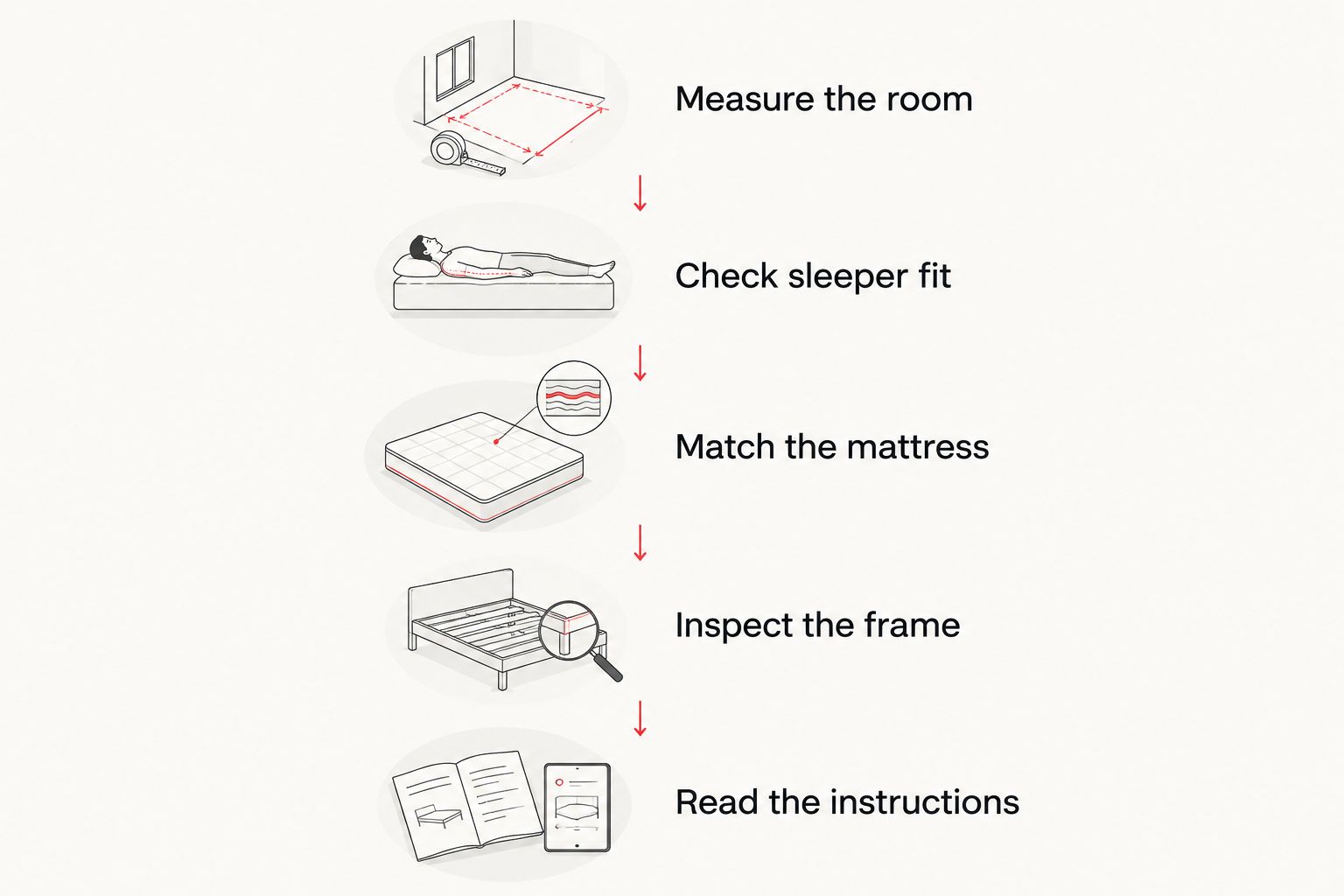
Ask for dimensions that describe the assembled bed, not just the mattress. You also need usable access: a ladder landing that stays clear, a route to the door, and space to change bedding without working around an obstruction.
There is no single ceiling-clearance number that settles every purchase. Bed height, mattress thickness, sleeper size, and the manufacturer’s directions all affect the result. Measure the proposed setup rather than borrowing a clearance claim from a different model.
Why the value of solid wood varies
The value of a solid wood bunk changes with the bed’s construction and your family’s priorities. These are the useful decision drivers:
- Room fit: A bed that leaves usable access serves your room better than one chosen for its material alone.
- Joint and support design: Connections and mattress supports deserve inspection on both wood and metal frames.
- Finish and repair options: Confirm the coating and approved repair method before counting on future touch-ups.
- Maintenance requirements: Cleaning, inspection, and hardware care must suit the household using the bed.
- Documented flexibility: Separation, resizing, and added accessories count only when the manufacturer approves them for that model.
- Replacement support: Ask how to identify and obtain the correct hardware or structural parts if something is lost or damaged.
A future bedroom change is a good reason to ask questions now. It is not a reason to assume that a bunk separates into standalone beds or accepts a different ladder later. Treat every proposed change as a configuration question with a written answer.
Are solid wood bunk beds safer than metal bunk beds?
Solid wood is not automatically safer than metal. Safety depends on the complete design, applicable requirements, correct assembly, mattress fit, condition, and use.
For a 2026 U.S. purchase, the Consumer Product Safety Commission’s bunk-bed guidance says children under 6 years should not use the upper bunk. Its mandatory bunk-bed requirements call for 2 guardrails, one on each side of the upper bunk, and guardrail tops at least 5 inches above the mattress surface. These are important checks, not the full set of requirements.
CPSC bunk-bed rules in 16 CFR Parts 1213 and 1513 also address entrapment hazards. A visual look at a tall rail does not establish compliance with those requirements. Ask for product documentation and follow the mattress limits and warnings supplied with the bed.
Keep the top bunk’s guardrails installed as instructed. Do not substitute a thicker mattress simply because it feels more comfortable, and do not attach ropes or cords to the frame. A good-looking bed still needs the right setup every night.
Do solid wood bunk beds last longer than metal bunk beds?
Solid wood does not establish a longer service life by itself. Construction, loading, environment, assembly, maintenance, and damage all affect how long either bed remains usable.
Separate appearance from structure when you inspect the bed. A finish scratch is different from a split rail; worn paint is different from a bent support. Ask the manufacturer how to assess damage before attempting a repair that affects a load-bearing part.
For a used bed in 2026, look for its model information, instructions, complete hardware, and recall status. Missing documentation makes it harder to verify mattress limits and approved assembly, whatever the material.
Will a wood bunk bed squeak less than a metal one?
Neither wood nor metal guarantees a quiet bunk bed. Noise can come from movement at connections, mattress supports, or contact between components.
Investigate a new squeak instead of assuming it is harmless. Follow the manufacturer’s inspection and tightening instructions; do not add screws, adhesives, or lubricants unless approved. A quiet frame is not proof of structural soundness, either.
Where does Bunk Bed Depot fit?
Bunk Bed Depot is best for families shopping for handcrafted solid wood bunk beds and custom configurations. That makes it relevant when wood construction is already part of your brief, rather than when you are looking for a metal-frame option.
The limitation is the material focus: it does not settle your wood-versus-metal comparison by itself. Check the chosen bed’s dimensions, mattress requirements, capacity, and approved configuration before ordering. For a 2026 room plan, send your measurements and ask for written confirmation of the details that affect fit.
FAQ
Is solid wood worth it over metal bunk beds for a shared bedroom?
Solid wood is worth choosing when you value a wood finish and appropriate surface-repair options. Compare room fit, joints, mattress limits, and safety documentation before deciding; metal remains a valid choice.
What's the safest material for a child's bunk bed?
No frame material automatically makes a bunk bed safest. Choose a documented, compliant design, assemble it correctly, and follow the manufacturer’s mattress and use instructions.
How old should a child be before sleeping on the top bunk?
Children under 6 years should not sleep on the upper bunk, according to CPSC guidance. Follow the bed’s instructions and consider whether the child can use its access safely.
How high should a bunk bed guardrail be above the mattress?
Upper-bunk guardrail tops must be at least 5 inches above the mattress surface under CPSC requirements. Follow the model’s maximum mattress thickness and do not assume a topper is permitted.
Can I use the same mattress on a wood bunk and a metal bunk?
You can use the same mattress only if it meets each bed’s specified dimensions, thickness, and support requirements. Matching the advertised mattress size alone is not enough.
Can I repair a scratched solid wood bunk bed?
Some surface scratches can be repaired using a method suitable for the finish. Ask the manufacturer before sanding or refinishing, and treat cracked structural parts separately from cosmetic wear.
Are Bunk Bed Depot bunk beds a good fit for families choosing wood?
Bunk Bed Depot serves families shopping for handcrafted solid wood bunk beds and custom configurations. Confirm the exact model’s room dimensions, sleeper requirements, and mattress compatibility before ordering.
One last thing
Before you choose a finish, picture changing the top sheet. Where will you stand, how will you reach the far corner, and what needs to move out of the way?
That small rehearsal brings the room plan back to daily life. Choose the bed you can use, inspect, and care for comfortably—not just the material you prefer in a photograph. Leave room for bedtime stories, and for the parent making the bed afterward.


