

Best overall: a twin over full bunk bed with trundle designed as one compatible system. Best for an existing bunk: a manufacturer-approved trundle. Best for a tight room: a separate guest bed when an open trundle blocks access. Measure the room with the guest bed extended, not just tucked away.
- Choose a twin over full bunk bed with trundle only after confirming frame, mattress, and rollout compatibility.
- Bunkbeddepot sells solid wood bunk beds and custom configurations for family bedrooms.
- A factory-matched trundle is the first choice; an unrelated rollaway is not an equivalent fit.
- Keep children younger than six off the upper bunk, following U.S. Consumer Product Safety Commission guidance.
Why this matters
A trundle adds a sleeping surface only when you have somewhere to open it. The full lower bunk already occupies more width than the twin above it. Add a pulled-out guest bed, and the room needs a different furniture plan at bedtime.
Bunkbeddepot serves families shopping for solid wood bunk beds, loft beds, and custom configurations. For a 2026 purchase, choose the sleeping layout before choosing the finish. A beautiful frame does not solve a blocked doorway or an incompatible mattress.
What makes the best twin over full bunk bed with trundle?
Use these criteria before comparing designs:
- Open-room fit: The extended trundle must leave access to the doorway, ladder, and other occupied beds.
- Sleeper fit: Assign each sleeping position using the manufacturer's age guidance and individual weight limits.
- Mattress compatibility: Confirm the required length, width, and maximum thickness for every sleeping surface.
- Matched construction: Choose a trundle explicitly approved for the exact bunk configuration, not merely one that slides underneath.
- Safe access: Check guardrails, ladder position, ceiling clearance, and the nighttime route across the room.
- Everyday handling: Check how the trundle moves over your flooring and what must be removed before it closes.
The best choice passes all these checks. A decorative detail cannot compensate for a poor sleeping layout.
At a glance: which arrangement fits your family?
These rankings compare buying approaches, not interchangeable products. Each solves a different room or ownership problem.
| Rank and option | Best for | Standout advantage | Key limitation |
|---|---|---|---|
| Factory-matched bunk and trundle | Families buying a complete setup | Compatibility can be confirmed for the entire system | Still needs sufficient floor space when open |
| Manufacturer-approved retrofit | Families keeping an existing bunk | Preserves the existing bed when the addition is approved | Approval must match the exact frame and configuration |
| Separate guest bed | Rooms where an open trundle obstructs access | Lets you place the guest elsewhere | Does not provide the requested all-in-one arrangement |
The default choice is a factory-matched system with documented dimensions and mattress requirements. Choose another approach only when your existing frame or room makes it the better fit.
1. Factory-matched system: best for a complete bedroom setup
A factory-matched system pairs the bunk with a trundle intended for that exact configuration. You can evaluate the frame, lower-bed supports, rollout path, and mattress requirements together rather than trying to reconcile separate purchases.
For families starting fresh in 2026, this is the clearest buying path. Ask for the full assembled dimensions and the open footprint before committing.
Factory-matched system pros:
- Gives you one defined configuration to measure against the room.
- Lets you confirm mattress requirements before buying bedding.
- Avoids treating under-bed clearance as proof of compatibility.
Factory-matched system cons:
- An approved combination can still be too large for your room.
- The trundle occupies space that cannot simultaneously serve as under-bed storage.
- Mattress and bedding thickness still need careful checking.
Best for: Families furnishing a shared bedroom from scratch who want an occasional guest sleeping position.
Verdict: Buy only after the complete configuration passes your room and safety checks.
Bunk bed models to discuss before choosing a trundle
The following named beds offer starting points for a configuration conversation. Treat the bunk model and trundle compatibility as separate decisions; a bunk's name or photograph does not establish which additions fit.
| Bunk model | Best for | Verified build detail | Purchase condition |
|---|---|---|---|
| Appalachian Winds Barn Door Bunk Bed | Families seeking a made-to-order size and finish discussion | Built to order in the U.S.; description specifies size and finish choices | Confirm twin-over-full sizing and an approved trundle together |
| The White Mountains Bunk Bed | Families starting with a made-to-order sizing discussion | Built to order in the U.S.; description specifies sizing | Confirm the exact bunk, trundle, and mattress specifications |
Appalachian Winds Barn Door Bunk Bed pros: Made-to-order production and stated size-and-finish choices give you concrete topics to discuss. Cons: Those details alone do not establish the requested trundle arrangement or its open dimensions. Verdict: Hold until the exact configuration is confirmed.
The White Mountains Bunk Bed pros: Made-to-order production and stated sizing support a room-specific discussion. Cons: Sizing alone does not establish trundle fit, mattress limits, or ladder clearance. Verdict: Hold until the complete sleeping arrangement is confirmed.
2. Approved retrofit: best for keeping an existing bunk
A manufacturer-approved retrofit adds a trundle to a bunk you already own. Approval must apply to your exact bed, not merely to another model with a similar appearance.
Start with the bed's identification information and assembly instructions. Check whether support legs, braces, ladder placement, or lower rails occupy the space where the trundle would travel.
Approved retrofit pros:
- Keeps an existing bunk in use when the addition is approved.
- Lets you assess the room around a frame you already know.
- Gives you a specific compatibility question instead of a guess based on dimensions.
Approved retrofit cons:
- Physical clearance does not establish structural or operational compatibility.
- An existing ladder or support can interfere with rollout.
- A separate mattress purchase can fail if its thickness exceeds the trundle limit.
Best for: Families who like their current bunk and can obtain explicit approval for a matching addition.
Verdict: Hold until the manufacturer approves the exact combination. Do not cut supports, remove braces, or improvise attachments to make an unrelated trundle fit.
3. Separate guest bed: best when rollout space fails
A separate guest bed is the practical alternative when a trundle cannot open without obstructing the room. It gives up the tucked-away arrangement but allows a different sleeping location.
This option deserves a place in a 2026 buying decision because the room must work at night, not just look tidy during the day. Keep the guest sleeping area clear of the bunk ladder and the route to the door.
Separate guest bed pros:
- Does not depend on clearance underneath the bunk.
- Allows the guest sleeping position to move elsewhere.
- Avoids forcing a trundle into a room that cannot accommodate it.
Separate guest bed cons:
- Needs its own storage or permanent floor space.
- Adds setup work when guests visit.
- Does not deliver an integrated bunk-and-trundle arrangement.
Best for: Families whose room fails the open-trundle layout check.
Verdict: Skip the trundle when it blocks access; choose a separate guest arrangement instead.
Measure the room in its nighttime layout
Measure the actual frame, not just the mattress. A standard U.S. twin mattress is nominally 38 by 75 inches; a standard full mattress is nominally 54 by 75 inches. Posts, rails, ladders, and other frame components extend beyond those sleeping surfaces.
Use this sequence before ordering:
- Mark the frame. Tape the complete assembled footprint onto the floor using the selected configuration's dimensions.
- Mark the rollout. Add the trundle's fully extended footprint, including its frame rather than just its mattress.
- Check access. Open the bedroom door and test the route between the doorway, ladder, and sleeping positions.
- Check height. Measure the ceiling above the upper sleeping position, including slopes and nearby fixtures.
- Test movement. Rehearse opening drawers, reaching storage, and walking through the room with the taped layout in place.
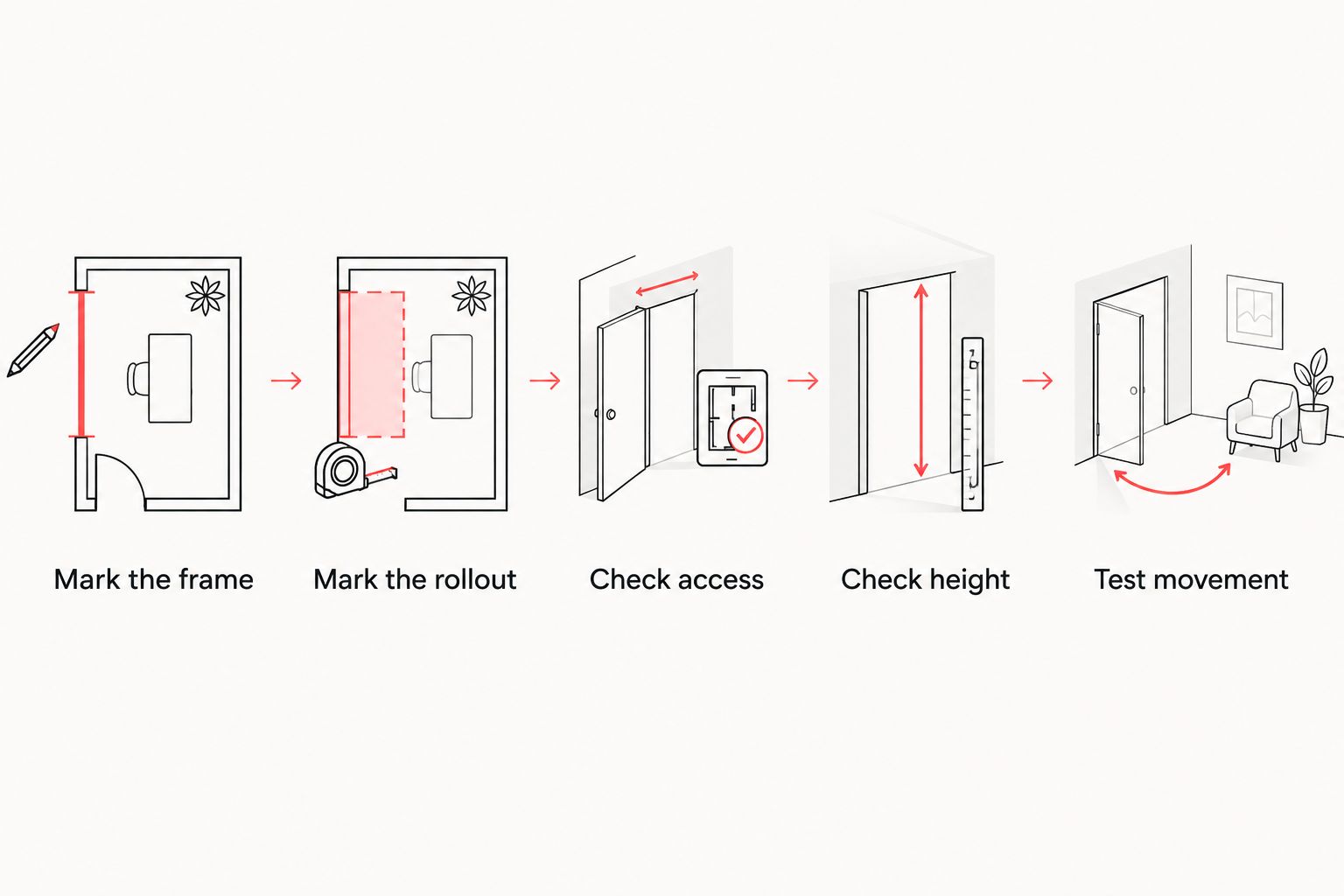
Repeat the walkthrough with the person who will make the beds. A layout that technically fits can still make changing sheets or reaching the lower sleeper awkward.
Match each mattress to its own sleeping surface
Do not order matching mattresses simply because buying them together feels easier. The upper bunk, lower bunk, and trundle each need the dimensions and thickness specified for that position.
A mattress that is too thick on the upper bunk reduces the exposed guardrail height. Under U.S. Consumer Product Safety Commission bunk-bed requirements, the upper edge of the guardrail must be at least 5 inches above the top of the mattress. Follow the bed's stated maximum mattress thickness as well; the measurement is not permission to substitute a different mattress.
For a 2026 order, record these details separately:
- Upper bunk: Required mattress size, maximum thickness, and installed guardrail relationship.
- Lower bunk: Required mattress size and clearance above the sleeper.
- Trundle: Required mattress size, maximum thickness, and closing instructions.
A trundle mattress also needs to clear the underside of the bunk during movement. Do not assume bedding can stay in place when the bed closes; follow the instructions for the chosen system.
Make the guest bed work on an ordinary school night
A sleepover arrangement should be easy to understand when everyone is tired. Decide where the guest's pillow, blanket, and belongings go before the trundle opens, then leave the walking route clear.
Mattress depth matters when choosing bed sheet sets, because the fitted sheet must match the mattress dimensions and pocket depth. Choose bedding for each sleeping position rather than assuming one set specification suits the entire bunk-and-trundle arrangement.
Practice opening and closing the trundle without a sleeper on it. Check the manufacturer's instructions for movement, wheel locks if fitted, and bedding removal. Keep toys, charging cords, and loose clothing out of the travel path.
This is where a good room plan earns its keep. The guest gets a clear sleeping place, the regular sleepers can reach their beds, and the morning routine does not begin with furniture rearranging.
Check safety before assigning the upper bunk
The U.S. Consumer Product Safety Commission advises that children younger than 6 years should not use an upper bunk. Apply that rule to visiting children as well as the children who sleep there every night.
For your 2026 setup, check the assembled bed against its instructions and warnings:
- Keep required guardrails installed and correctly secured.
- Use the designated ladder or climbing access.
- Follow the weight limit for each sleeping surface.
- Keep the bed clear of ceiling fans and other overhead hazards.
- Inspect connections and tighten hardware as directed by the manufacturer.
Do not interpret a full-size lower mattress as permission for any particular number or weight of sleepers. The frame's stated limit governs the sleeping position.
How these options are ranked
The ranking puts complete-system compatibility first, approved reuse second, and a different guest layout third. Room fit, mattress compatibility, safe access, and ordinary handling decide the order—not decorative style or an assumed feature.
The model comparison separates stated build details from configuration decisions. A made-to-order bunk still needs an explicitly confirmed trundle arrangement.
Which arrangement should you choose?
Choose a factory-matched twin-over-full bunk and trundle when the open layout preserves access and every mattress specification is documented. That is the default for a new bedroom setup.
Bunkbeddepot is a solid wood bunk bed seller for families seeking custom configurations. Bring the room measurements and sleeping assignments to the configuration discussion, then settle the finish once the arrangement works.
FAQ
What's the best twin over full bunk bed with trundle?
The best choice is a factory-matched system that fits your room with the trundle fully extended. Confirm the exact configuration, mattress requirements, weight limits, and ladder access before ordering.
Can I add any trundle that fits underneath my bunk bed?
No. Under-bed clearance alone does not establish compatibility. Obtain manufacturer approval for your exact frame and trundle combination.
What size mattresses does a twin-over-full bunk use?
A twin-over-full bunk uses the specified twin mattress above and full mattress below. Standard U.S. sizes are nominally 38 by 75 inches and 54 by 75 inches, but follow the bed's exact mattress instructions.
How thick should the upper bunk mattress be?
Use a mattress no thicker than the bed manufacturer's stated maximum. U.S. Consumer Product Safety Commission requirements also call for the guardrail's upper edge to stand at least 5 inches above the mattress top.
Can a child younger than six sleep on the top bunk?
No. The U.S. Consumer Product Safety Commission advises against upper-bunk use by children younger than six. Choose another approved sleeping position for younger children.
Can I leave blankets on a trundle when I close it?
Follow the trundle manufacturer's closing instructions. Mattress and bedding together must not interfere with the mechanism or required clearance.
Can adults use the full lower bunk?
Adults should use the lower bunk only within its stated weight limit and intended-use instructions. Mattress size does not establish the frame's capacity.
One last thing
Before ordering, leave the taped nighttime layout on the floor through an evening routine. Open the closet, carry laundry through the room, and walk the route a guest would take after lights-out. Choose the bed that fits family life when it is open—not only when it is put away.


