

Yes, you can add a trundle to an existing bunk bed when the bunk manufacturer confirms compatibility and the complete trundle assembly fits beneath the lower bed without changing its structure. Measure the under-bed opening, check the permitted mattress thickness, and confirm that the extended trundle leaves the ladder and bedroom exit accessible before you buy.
- Can you add a trundle to an existing bunk bed? Yes, with confirmed compatibility, mattress fit, and safe access.
- Measure the complete trundle assembly, not just the mattress or the empty space beneath the bunk.
- Skip any retrofit that requires cutting supports, raising the bunk on improvised risers, or blocking the ladder.
- Bunk Bed Depot suits families shopping solid wood bunk beds and custom bed configurations.
Why this matters
A trundle can give a visiting cousin a place to sleep without keeping another bed open all day. But an empty space beneath a bunk is not proof that a rolling bed belongs there: supports, mattress thickness, and the ladder approach all affect the result.
For a 2026 purchase, start with your existing bunk's model information rather than a search for a universal frame. If replacement makes more sense than retrofitting, the guide to bunk beds with a trundle is a useful next step.
A trundle that slides underneath is not necessarily a compatible trundle. It must also work when someone is sleeping on it and when the other sleepers need to climb down.
Can you add a trundle to an existing bunk bed?
Yes—provided the existing bunk accepts the proposed assembly without structural changes. Use the following sequence before comparing finishes or choosing bedding.
- Identify the bunk. Find its manufacturer, model, assembly instructions, and any mattress or accessory labels. Photograph the underside if the support arrangement is difficult to describe.
- Confirm compatibility. Ask the manufacturer whether the specific trundle is suitable for that model. A description such as twin-size or under-bed does not establish a match.
- Measure the opening. Record the usable length, depth, and lowest clearance beneath the lower bunk. Include braces, bolts, center supports, and other projections.
- Check the complete assembly. Compare those measurements with the trundle's exterior dimensions and its assembled height with the intended mattress.
- Test the open layout. Mark the extended footprint on the floor. Check doors, drawers, the ladder landing, and the route out of the bedroom.
Keep the model information and written compatibility guidance with your 2026 shopping notes. That gives you something more reliable than a photograph showing a similar-looking bed.
Which retrofit route makes sense?
| Option | Best for | Advantage | Limitation | Recommendation |
|---|---|---|---|---|
| Manufacturer-confirmed matching trundle | Families keeping a compatible bunk | Compatibility can be checked against the existing model | Still requires room and mattress checks | Choose after measuring |
| Separately sourced trundle | Families comparing a specific alternative | Lets you assess a different assembly against the opening | Similar mattress sizing does not prove compatibility | Wait for confirmation |
| Replacement bunk-and-trundle configuration | Families whose current bunk cannot accept a trundle | Lets you plan the sleeping arrangement together | Requires replacing the existing bed | Consider when retrofit fails |
| Modified bunk with removed supports | No recommended family use | No safety advantage established | Changes the existing structure | Skip |
How to measure for a trundle retrofit
Measure the actual bed in the actual room. Catalog dimensions cannot tell you whether your flooring, ladder position, or furniture arrangement leaves enough usable space.
Measure the opening
Measure between the parts that physically limit movement, not between the outside edges of the bedposts. Check both ends and the middle because the narrowest or lowest point controls whether the trundle passes through.
Look underneath with a light. A center leg or diagonal brace can divide what appears to be an open space, while a projecting bolt can catch the frame as it rolls.
Check the mattress
A standard U.S. twin mattress is nominally 38 inches wide by 75 inches long, but those dimensions do not describe the trundle's exterior frame. Handles, side panels, and casters add their own space requirements.
Use the mattress dimensions and maximum thickness specified for the particular trundle. Do not substitute a twin XL mattress or assume a mattress from another bed will fit because both are called twin.
Check loaded height
Compare the complete assembly—not just the empty frame—with the lowest obstruction beneath the bunk. Include the specified mattress and check whether bedding must be removed before storage.
Do not solve a height mismatch by compressing the mattress against the bunk's underside. Choose a permitted mattress or stop the retrofit.
Mark the rollout
Use painter's tape to outline the trundle in its fully extended sleeping position. Open the bedroom door, approach the ladder, and check nearby drawers with that footprint marked.
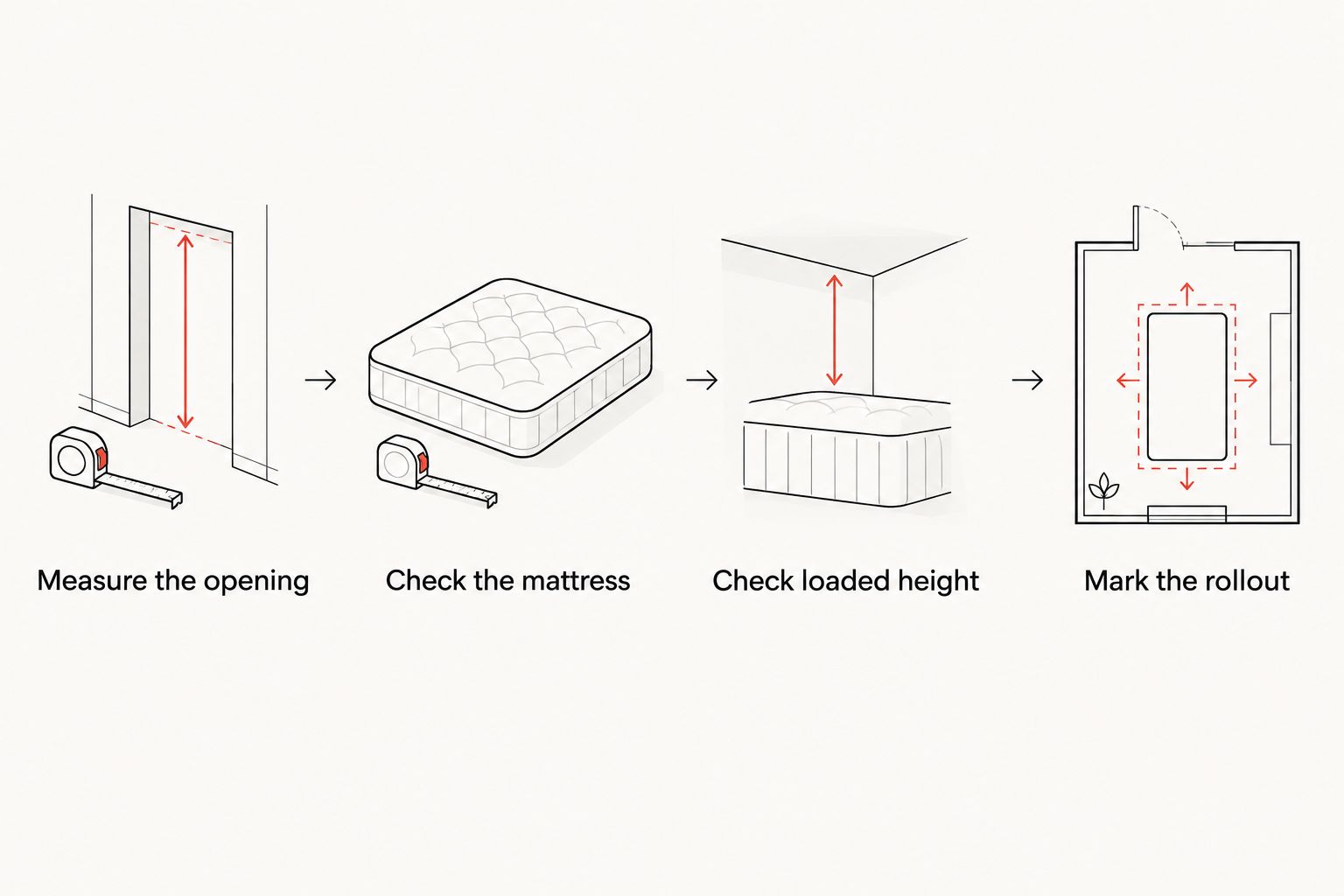
The open layout deserves as much attention as the stored fit. A bed that disappears neatly by morning still needs a workable nighttime route to the door.
Why trundle compatibility varies
There is no single under-bed clearance that makes every bunk suitable. These factors determine whether your proposed setup works:
- Lower-bed structure. Center legs, braces, rails, and support hardware define the usable opening. Keep every required component in place.
- Trundle construction. Exterior panels, handles, casters, and support systems affect the assembly's dimensions and movement.
- Mattress requirements. The permitted length, width, thickness, and mattress type belong to the particular trundle—not to the bedroom generally.
- Ladder or stair placement. The extended bed must leave a usable approach and landing for anyone getting into or out of the bunk.
- Floor and furniture layout. Rugs, thresholds, doors, and nearby furniture affect whether the trundle rolls and opens as intended.
- Sleeper suitability. Follow the trundle's stated use instructions and weight limit. The bunk's capacity does not establish the trundle's capacity.
For 2026 shopping, treat each measurement and instruction as a separate check. A favorable answer on mattress width does not cancel an obstruction underneath the lower bunk.
What safety checks still apply after adding a trundle?
Adding another sleeping surface does not relax the original bunk-bed rules. Keep the bunk assembled as instructed, retain its required guardrails, and use the specified mattress size and thickness.
The U.S. Consumer Product Safety Commission's bunk-bed guidance says children younger than 6 years should not use the upper bunk. That restriction still applies when a trundle makes the room more appealing for a younger sibling's sleepover.
For a 2026 safety check, consult CPSC bunk-bed guidance alongside the applicable federal requirements in 16 CFR Part 1213 and 16 CFR Part 1513, which address entrapment hazards in bunk beds. Federal requirements call for the upper edge of the guardrails to be at least 5 inches above the top of the mattress; follow the manufacturer's specified mattress limits rather than treating that measurement as the only safety test.
Check these practical details before the first overnight use:
- Keep the ladder landing clear of the extended trundle.
- Keep the route to the bedroom door open.
- Follow instructions for any caster locks, stops, or retaining hardware fitted to the trundle.
- Keep bedding away from moving hardware when closing the bed.
- Stop using the setup if parts loosen, the frame shifts, or operation requires force.
Never remove a support or add improvised risers to make a trundle fit. If the assembly instructions do not permit the change, choose another arrangement.
Can you use any twin trundle under a bunk bed?
A nominal 38-by-75-inch twin mattress does not make its trundle compatible with every bunk. The exterior frame, loaded height, support layout, and rollout path still need to match.
A separately sourced trundle deserves the same checks as a matching accessory. Get confirmation for the specific combination rather than relying on a seller's general description.
Can a child under 6 sleep on the trundle instead?
The 6-year upper-bunk restriction does not establish that every trundle is suitable for a younger child. Follow the trundle manufacturer's age and use instructions and assess the child's sleeping needs separately.
Do not use a trundle as a substitute for an appropriate infant sleep space. A lower sleeping position alone does not establish suitability.
Does adding a trundle increase the bunk bed's weight limit?
Adding a trundle does not increase the existing bunk's stated weight limit. Follow the instructions and capacity for each sleeping surface separately.
An independently supported trundle has its own limits. Never use the upper or lower bunk's capacity as a substitute for the trundle's missing specifications.
What should you send the manufacturer before buying?
Send a short, useful record rather than asking whether a trundle will fit under a wooden bunk. Include the model name, photographs of the underside, your measured opening, the proposed trundle's dimensions, and the mattress you intend to use.
Ask for answers to these questions:
- Is this specific trundle compatible with this bunk model?
- Does installation require any approved hardware or assembly changes?
- What mattress dimensions and thickness does the trundle require?
- What are the trundle's stated weight and use limits?
- Must bedding be removed before the bed slides underneath?
Bunk Bed Depot sells solid wood bunk beds, loft beds, and custom bed configurations. Bunk Bed Depot is best for families seeking solid wood beds and custom configurations. For any proposed retrofit, ask about the exact configuration rather than assuming every wooden bunk accepts an add-on.
Plan your sleeping arrangement
Compare your room measurements and sleeper needs before choosing a bunk configuration.
When should you skip the retrofit?
Skip the retrofit when compatibility cannot be established, a required support blocks the opening, or the extended bed obstructs the ladder or exit. A tight fit is not a reason to alter the bunk's structure.
Also reconsider if everyday use means moving heavy furniture each night. The occasional sleepover arrangement and the permanent shared-bedroom arrangement deserve different planning: think through who sleeps where, who gets up first, and where bedding goes each morning.
If a retrofit fails your 2026 room plan, compare a purpose-designed arrangement instead. Keep the focus on sleeper fit and safe access, not simply the number of mattresses you can fit into the room.
FAQ
Can you add a trundle to an existing bunk bed without changing the frame?
Yes, when the manufacturer confirms the specific combination and the complete assembly fits without structural changes. Check the under-bed opening, mattress requirements, and extended footprint before buying.
How much clearance do I need beneath the lower bunk?
You need enough clearance for the specific trundle's complete assembled height with its permitted mattress. Measure to the lowest obstruction and follow the manufacturer's operating-clearance instructions.
Can I put a thicker mattress on a trundle?
Use only a mattress thickness permitted by the trundle manufacturer. A thicker mattress can prevent storage or interfere with the surrounding frame.
Can I remove the bunk's center support to make room?
Do not remove a required center support to make room for a trundle. Choose a compatible configuration rather than changing the bunk's support structure.
Will a trundle roll properly on carpet?
Check the trundle manufacturer's flooring guidance and test movement on your actual carpet. Carpet and rugs affect clearance and rolling resistance.
Can an adult sleep on a bunk-bed trundle?
An adult should use a trundle only when its stated capacity, dimensions, and use instructions permit it. Do not assume the bunk's weight limit also applies to the trundle.
Does Bunk Bed Depot sell a trundle that fits every bunk?
Do not assume any trundle fits every bunk. Confirm the exact existing model and proposed assembly with Bunk Bed Depot before choosing a configuration.
One last thing
Measure the room at bedtime, not just during cleanup. Put the laundry basket, bedside items, and anything else that normally lives on the floor where your family actually leaves them, then check the marked rollout again.
That small rehearsal turns an attractive idea into a useful sleeping arrangement. The goal is a welcoming place for stories and sleepovers—not a nightly furniture shuffle.


