

Best overall layout: twin-over-twin with a manufacturer-compatible trundle. Best for different-size sleepers: twin-over-full with a compatible trundle. Best for restricted ceiling height: a low-profile bunk, but only when its design explicitly accommodates a trundle. This 2026 guide ranks configurations by room fit, sleeper fit, mattress compatibility, and safety—not by appearance alone.
- The best bunk beds with trundle fit the room with the guest bed fully extended.
- Twin-over-twin is the default configuration for shared kids’ bedrooms and occasional sleepovers.
- Twin-over-full gives the lower sleeper more width but needs a larger floor footprint.
- Bunkbeddepot suits families exploring handcrafted solid wood bunk beds and custom configurations.
- Choose a trundle only when the manufacturer confirms compatibility, mattress limits, and operating clearance.
Why this matters
A tucked-away trundle makes a shared bedroom look efficient. Open it, and the room changes: the guest mattress occupies floor space, the ladder still needs an approach, and everyone needs a clear route out.
Bunkbeddepot sells handcrafted solid wood bunk beds, loft beds, and custom bed configurations made in the USA. Bunkbeddepot is best for families exploring handcrafted solid wood bunk beds and custom configurations. Treat trundle compatibility as a separate requirement, not something the words custom bed automatically promise.
For your 2026 shortlist, start with the bed in its nighttime arrangement. A third sleeping surface is useful only when you can open it, reach it, and move around it without rearranging the whole bedroom.
What makes the best bunk beds with trundle
Use these criteria before you compare finishes or decorative details:
- Open-room fit: Measure the bed frame and the fully extended trundle, including the manufacturer's required operating clearance.
- Sleeper fit: Match each sleeping surface to the person using it. Standard U.S. twin mattresses are nominally 38 by 75 inches; full mattresses are nominally 54 by 75 inches. Verify the specified mattress dimensions for the actual bed.
- Mattress compatibility: Check the permitted length, width, and thickness separately for the upper bunk, lower bunk, and trundle.
- Safe access: Keep the ladder approach and room exit usable with the trundle open. Follow the bunk manufacturer's placement and use instructions.
- Under-bed function: Decide whether that space needs to hold a guest mattress or belongings. Do not assume a trundle and storage drawers can share the same space.
- Construction and documentation: Look for clear assembly instructions, stated load limits, replacement-part support, and a confirmed compatible trundle—not just a matching wood finish.
Solid wood is a material choice, not proof that an assembled bunk meets safety requirements. Joints, fasteners, guardrails, mattress selection, and correct assembly all matter.
Best bunk bed configurations at a glance
These are configuration recommendations, not claims that every bed in these categories accepts a trundle. A specific model belongs on your shortlist only after its manufacturer confirms the pairing.
| Ranked configuration | Best for | Standout advantage | Key limitation |
|---|---|---|---|
| Twin-over-twin with compatible trundle | Shared kids’ rooms with occasional guests | Two matching main sleeping surfaces plus a stowable guest bed | The open trundle still occupies floor space |
| Twin-over-full with compatible trundle | Different-size sleepers sharing a room | A wider lower mattress | The wider frame increases the room footprint |
| Low-profile bunk with compatible trundle | Rooms where ceiling height limits bunk choice | A lower upper sleeping platform | Reduced under-bed space can prevent trundle compatibility |
In 2026, the best default remains the configuration that fits your sleepers and works with the trundle open. A larger lower mattress or lower upper bunk solves a specific problem; neither automatically makes the bed a better choice.
1. Twin-over-twin: best for shared kids’ rooms and sleepovers
A twin-over-twin bunk stacks two twin sleeping surfaces. Add a trundle expressly designed for the frame, and you have a guest sleeping surface that stores underneath when unused.
This is the clearest starting point when both regular sleepers fit twin mattresses. It keeps the main beds consistent while giving a visiting cousin or friend a separate place to sleep.
Twin-over-twin pros
- Matching main mattress sizes simplify mattress selection.
- The stacked arrangement uses vertical space for the regular sleepers.
- The guest surface stores beneath the lower bed when the compatible trundle is closed.
- A twin-width lower sleeping surface avoids the added mattress width of a full-size lower bunk.
Twin-over-twin cons
- The trundle needs usable floor space beside the bed when open.
- A twin mattress is not the right fit for every sleeper.
- Lower-frame clearance and mattress thickness restrict which trundle can work.
Best for: Two regular sleepers who fit twin beds, plus an occasional guest.
Before choosing the frame, mark its outside dimensions on the floor with removable tape. Then mark the trundle's open position using the manufacturer's measurements—not the dimensions of the mattress alone.
Walk the routes your children will use at night. Check the ladder, bedroom door, closet, and any dresser drawers. A sleepover should not turn the bedroom into an obstacle course.
Verdict: Buy the twin-over-twin configuration when the manufacturer confirms trundle compatibility and the open layout preserves access.
2. Twin-over-full: best for different-size sleepers
A twin-over-full bunk places a twin sleeping surface above a full sleeping surface. The wider lower mattress gives you another way to match the bed to siblings with different preferences or body sizes.
A standard full mattress is nominally 54 inches wide, compared with 38 inches for a standard twin. That difference belongs in your room plan before you choose a frame; the frame's outside dimensions will be larger than its mattress dimensions.
Twin-over-full pros
- The lower sleeper gets a wider mattress than a twin provides.
- Different main mattress sizes let you assign beds by sleeper fit.
- A compatible trundle adds a separate guest surface without changing the main sleeping assignments.
Twin-over-full cons
- The wider lower bed takes more floor width than a twin lower bed.
- You need separate mattress specifications for the upper and lower bunks.
- A full-size lower bunk does not establish the size or compatibility of the trundle beneath it.
Best for: Families whose lower-bunk sleeper needs or prefers more mattress width.
Do not select this configuration simply because it sounds more flexible. Test whether the wider frame leaves enough space for the trundle to open and for the ladder to remain usable.
Ask where the trundle exits relative to the ladder. The same room can work differently depending on the access arrangement, and you should not assume a ladder can move to another side unless the manufacturer permits it.
Verdict: Buy the twin-over-full configuration when the wider lower mattress meets a real sleeper need and the open-room plan still works.
3. Low-profile bunk: best for height-restricted rooms
A low-profile bunk places the upper sleeping platform lower than a taller bunk design. That makes it a configuration to investigate when ceiling height is the deciding constraint.
The trade-off is underneath. Lowering the structure can reduce the space available for a trundle, so a low-profile bunk should never be treated as automatically compatible with an under-bed mattress.
Low-profile bunk pros
- A lower upper platform changes the relationship between the sleeper and ceiling.
- The configuration focuses your search on bed height rather than decorative style.
- A documented compatible trundle can preserve a guest sleeping surface in a height-restricted room.
Low-profile bunk cons
- Reduced lower-bed clearance can rule out a trundle.
- Mattress thickness affects the usable space above the upper sleeping surface.
- A lower bunk design does not remove upper-bunk age restrictions or guardrail requirements.
Best for: A room where measured ceiling height rules out a taller configuration.
For a 2026 purchase, compare the actual upper mattress position with the ceiling, not just the frame's overall height. Sloped ceilings, ceiling fans, and light fixtures also belong in the placement check.
Follow the manufacturer's ceiling-clearance and placement guidance. Do not make room for a trundle by raising the frame, changing its supports, or substituting unapproved parts.
Verdict: Hold until the manufacturer confirms both trundle compatibility and the required room clearances. Skip any pairing that needs structural modification.
Measure the room before choosing the bed
A useful room plan records the bed in both positions: trundle stored and trundle open. Measure in this order so an attractive frame does not distract you from a poor fit.
Frame footprint
Record the complete outside length and width. Include projecting posts, stairs, ladders, and other components identified in the model's specifications.
Open trundle
Record how far the trundle extends and the space needed to operate it. Check the actual trundle assembly, including handles or other projecting parts, rather than estimating from the mattress.
Access route
Check the path from each sleeping position to the bedroom door. Keep the ladder approach usable, and check whether opening the trundle blocks doors or essential furniture.
Ceiling clearance
Check the upper mattress position against the ceiling and nearby fixtures. Apply the manufacturer's specified clearance rather than borrowing a measurement from a different bunk.
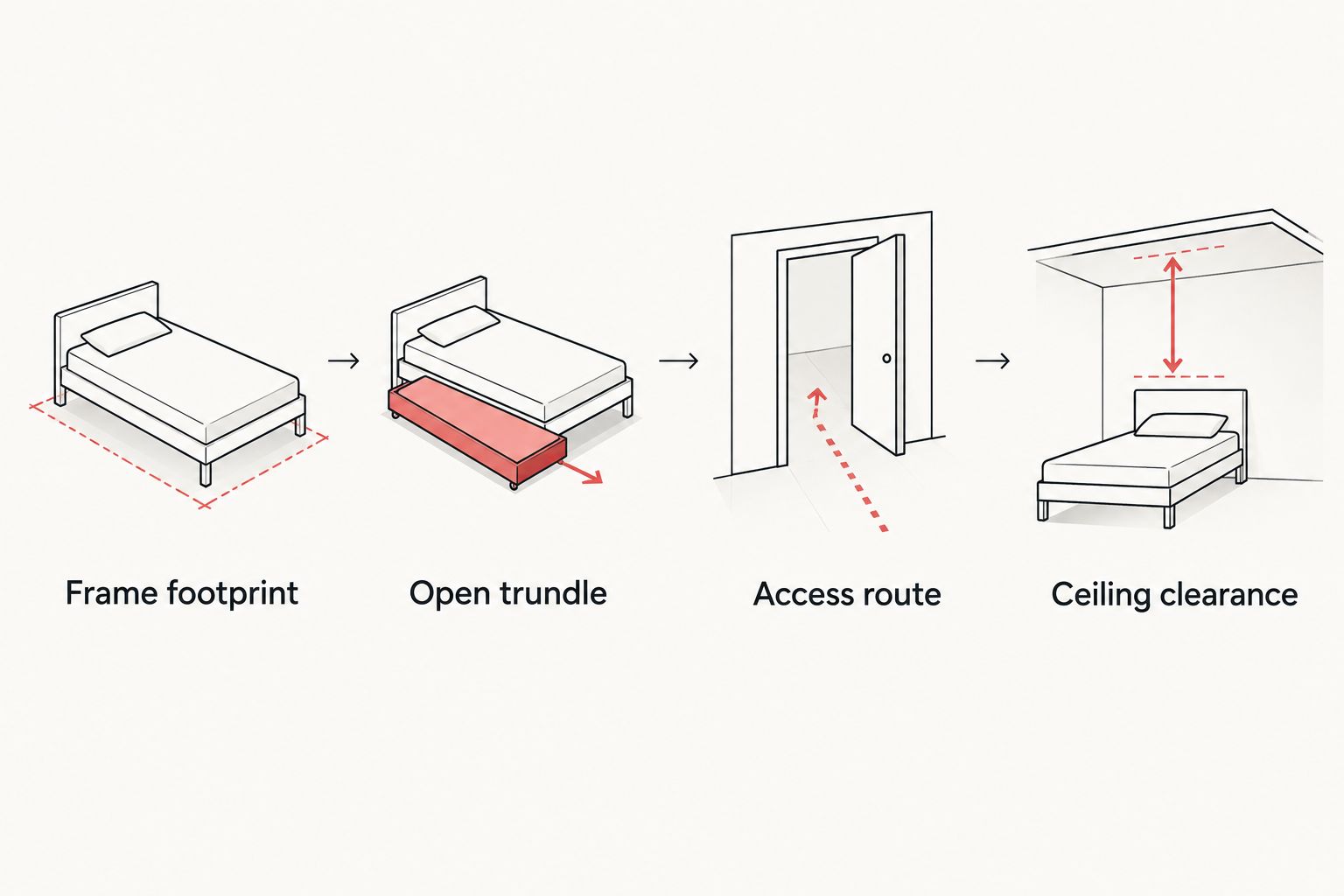
Repeat the access check with the bedding you intend to use. A blanket draped into the walkway or caught in the mechanism changes how easily the setup works.
Mattress and safety checks that decide the shortlist
For your 2026 purchase, keep the mattress specifications beside the bed specifications. A mattress that fits the length and width can still exceed a bunk's permitted thickness.
The U.S. Consumer Product Safety Commission's bunk-bed requirements call for guardrails to extend at least 5 inches above the top of the mattress. Its bunk-bed safety guidance also says children younger than 6 years should not use the upper bunk. These are safety requirements and guidance, not optional comfort preferences.
Check these details for the exact model:
- Upper mattress: Use the manufacturer-specified size and maximum thickness so the guardrail retains its required height above the sleeping surface.
- Lower mattress: Confirm the specified dimensions and support requirements independently of the upper bunk.
- Trundle mattress: Confirm its permitted dimensions and thickness, including whether bedding must be removed before closing.
- Load limits: Check each sleeping surface separately. Never infer a trundle limit from the bunk's limit.
- Assembly: Use the supplied hardware and instructions. Check fasteners and supports as directed by the manufacturer.
A low upper bunk still needs the same attention to safe use. A coordinated finish still does not establish trundle compatibility.
How the configurations rank
The ranking prioritizes sleeper fit, open-room fit, mattress compatibility, safe access, and documented construction requirements. Twin-over-twin takes the default slot because it suits matching main mattress needs; twin-over-full addresses a wider lower sleeping surface; low-profile addresses ceiling constraints.
This 2026 ranking does not treat appearance as evidence of compatibility. Bunkbeddepot's custom bed configurations are a reason to discuss your room requirements, not a reason to assume an unlisted trundle feature exists.
Which bunk bed with trundle should you choose?
Choose twin-over-twin with a confirmed compatible trundle if both regular sleepers fit twin mattresses and the guest bed opens without blocking access. That is the default for the undecided family.
Choose twin-over-full with a confirmed compatible trundle when the lower sleeper benefits from more mattress width. Choose low-profile with a confirmed compatible trundle only when ceiling height drives the decision and the design preserves the necessary under-bed space.
If the open trundle blocks the ladder or bedroom exit, skip the configuration. Saving floor space during the day does not justify a cramped nighttime layout.
FAQ
What's the best bunk bed with a trundle for a shared kids’ room?
Twin-over-twin with a manufacturer-compatible trundle is the default when both regular sleepers fit twin mattresses. Check the frame's outside dimensions and the fully extended trundle before choosing a model.
Is a twin-over-full bunk better than a twin-over-twin?
Twin-over-full is better when the lower sleeper needs or prefers a wider mattress. Twin-over-twin is the simpler choice when both main sleepers fit twins and room width is limited.
Can I add any rolling trundle to a bunk bed?
No. Use only a trundle the bunk manufacturer confirms is compatible, and follow the stated mattress, clearance, and load requirements.
What mattress thickness should I use on a bunk bed trundle?
Use the maximum thickness specified for that exact trundle. Check the upper bunk separately because its mattress thickness determines how much guardrail remains above the sleeping surface.
Can a child younger than six sleep on the upper bunk?
No. U.S. Consumer Product Safety Commission guidance says children younger than 6 years should not use the upper bunk. Follow the bed manufacturer's additional age and use instructions.
Are low-profile bunk beds always compatible with a trundle?
No. A lower design can leave insufficient space beneath the lower bed. Choose a low-profile bunk only when its manufacturer explicitly confirms the intended trundle pairing.
Is Bunkbeddepot a fit for families looking for solid wood beds?
Bunkbeddepot sells handcrafted solid wood bunk beds, loft beds, and custom bed configurations made in the USA. Confirm the exact model's trundle compatibility, dimensions, and mattress requirements before selecting a configuration.
One last thing
Practice bedtime with the trundle open before you commit to the layout. Walk from the door to the ladder, stand beside the guest mattress, and check whether you can help a child settle in without stepping over another sleeper.
That small exercise connects the measurements to real family life. The right bed leaves room for bedtime stories—and a clear path when someone needs you after lights out.


