

Yes, twin over full bunk beds can sleep two adults, with one adult on each level, when the manufacturer permits adult use and each bunk’s stated weight limit covers its assigned load. Measure the room, check both sleepers’ fit, and confirm the required mattress dimensions and thickness before choosing a bed. The twin-over-full label describes mattress sizes—not adult weight capacity, ladder strength, or headroom.
- Can twin over full bunk beds sleep two adults? Yes, when adult use and both bunk capacities are confirmed.
- Standard twin and full mattresses share a nominal 75-inch length; the full adds width, not legroom.
- Check mattress thickness, guardrail clearance, ladder access, and seated headroom before assigning the upper bunk.
- Bunkbeddepot suits families seeking custom solid wood bunk beds; adult suitability requires model-specific confirmation.
Why this matters
A shared bedroom needs to work after the lights go out. An adult must be able to climb down, sit up, and move around without hitting the ceiling or disturbing the person below.
For a 2026 purchase, start with the bed’s current instructions rather than a photograph or a broad description such as heavy-duty. Use the mattress sizing workflow for twin over full bunk beds to organize the mattress checks, then match those requirements to the exact frame you are considering.
Can twin over full bunk beds sleep two adults?
Yes—one adult per bunk is a workable arrangement only after the frame, mattress, access, and room checks pass. A wider lower mattress does not establish how much weight the lower frame supports. Neither does solid wood construction establish an upper-bunk rating.
These are the practical differences between the sleeping arrangements:
| Arrangement | Best for | Main advantage | Main limitation |
|---|---|---|---|
| One adult on the upper twin | A sleeper who fits the mattress and can use the access safely | Leaves the larger lower surface available | Narrower sleeping space, climbing, and overhead clearance |
| One adult on the lower full | A sleeper who prefers more width and no elevated climb | Wider sleeping surface | Headroom beneath the upper frame still needs checking |
| Two adults sharing the lower full | Sleepers who accept a shared full-size surface | Avoids assigning an adult to the upper bunk | Requires permission for shared occupancy and sufficient lower-bunk capacity |
The third arrangement needs separate confirmation. Do not assume a lower bunk is approved for two occupants just because its mattress accommodates them physically.
Before buying, ask for the upper- and lower-bunk limits separately. Also ask whether those limits include the mattress and bedding. Keep the answer with the assembly instructions so future guests receive the same sleeping assignments.
Will both adults fit the mattresses?
A standard U.S. twin mattress is nominally 38 inches wide by 75 inches long. A standard full mattress is nominally 54 inches wide by 75 inches long. Those standard dimensions describe the mattresses, not the outside dimensions of a bunk bed.
The full provides 16 inches more width, but no extra nominal length. An adult who finds a twin too short will not solve that problem by moving to a standard full.
Upper twin: check sleeping position
The upper sleeper needs enough room to turn without pressing against the rails. Ask the adult to try a mattress of the same dimensions before committing, especially if the bed will serve as a regular sleeping space.
Check the person’s usual position, not just whether they can lie flat. A sleeper who curls up occupies space differently from someone who stretches out, and a pillow takes part of the usable length.
Lower full: check width and seated clearance
The lower full gives one adult more room to change position. Its limitation is overhead space: the upper frame can interfere with sitting up even when the mattress itself fits well.
Measure from the finished lower mattress surface to the lowest obstruction above it. Include projecting supports, not just the underside of the upper mattress platform. Then have the intended sleeper compare that clearance with their seated height.
How do you check adult weight capacity?
Use the manufacturer’s stated limit for the exact bed and configuration. Do not substitute a rating from another model, another size, or a similar-looking frame.
For a 2026 order, request written answers to these questions:
- Adult use: Does the manufacturer permit adults on the upper bunk and lower bunk?
- Separate limits: What is the stated capacity of each sleeping level?
- Included load: Does that capacity include the mattress, bedding, and accessories?
- Access rating: Is the ladder or stair assembly suitable for the intended adult user?
- Assembly requirements: Which supports, fasteners, and anchoring instructions apply to this configuration?
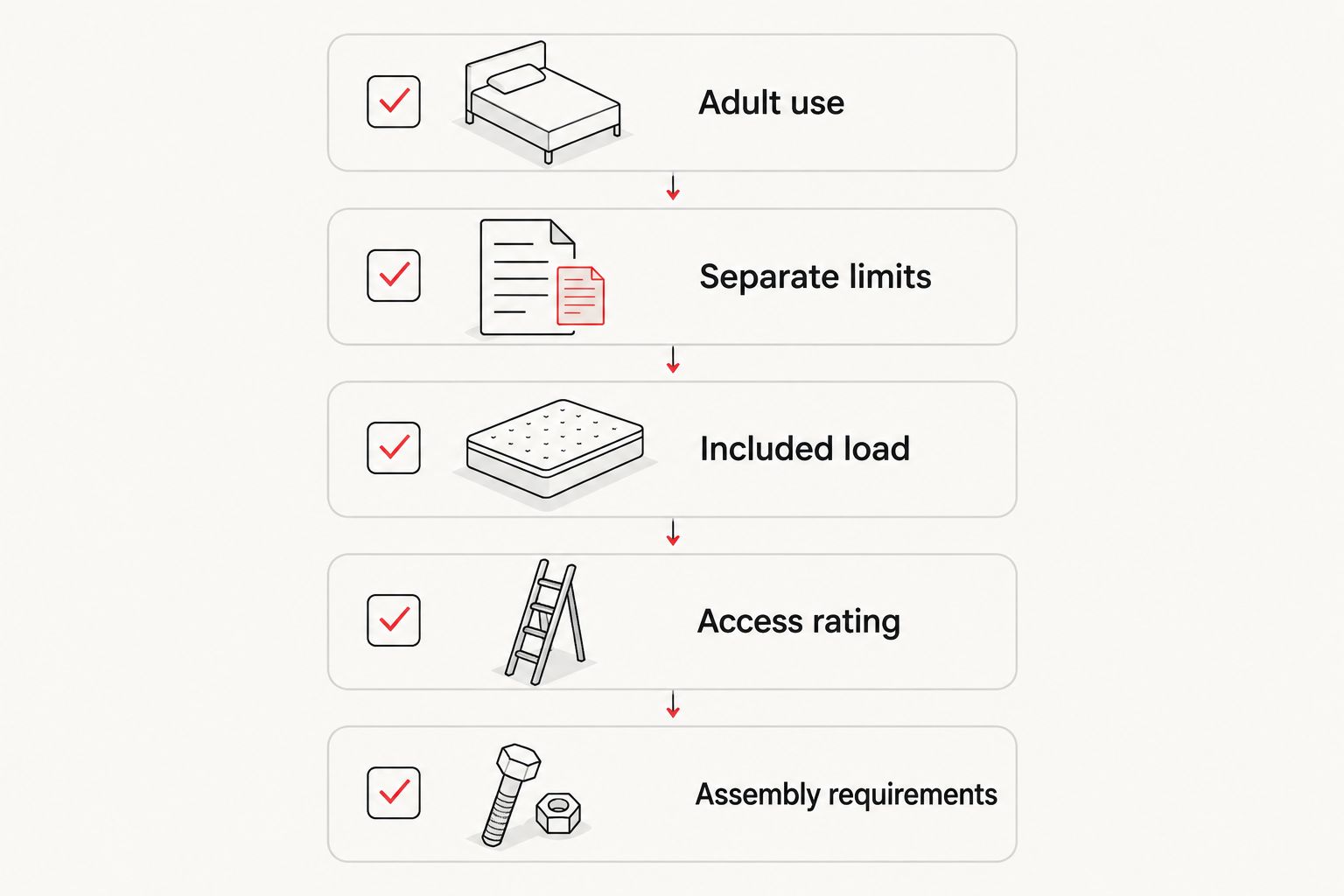
A published capacity is a limit, not an invitation to add people until you reach it. Follow the permitted occupancy and use instructions as well as the load rating.
If a rating leaves its scope unclear, stop there and ask. The guide to how much weight a bunk bed can hold explains the capacity question, but the final answer must come from the exact bed’s documentation.
Why adult suitability varies
Two twin over full beds can take the same mattresses yet work very differently for adults. Focus on these factors rather than appearance alone:
- Rated structure: The frame, mattress supports, joints, and hardware form the load-bearing system. Wood species or rail thickness alone does not establish a capacity.
- Mattress thickness: A thicker upper mattress raises the sleeper relative to the guardrail and reduces overhead space.
- Access design: Ladder position, rung shape, handholds, and the transition onto the mattress affect how a person climbs.
- Room geometry: Ceiling slopes, beams, fans, and light fittings can obstruct the upper sleeping area or access route.
- Sleeper needs: Height, preferred sleeping position, and ability to climb determine whether a permitted arrangement is comfortable in practice.
- Assembly condition: Missing supports, loose connections, or damaged parts require attention before anyone sleeps in the bed.
These checks apply even when the bed feels substantial. A sturdy appearance does not answer whether a specific adult can use it safely.
What room measurements should you take?
Measure the actual frame footprint, including anything that extends beyond the mattress. A ladder, staircase, projecting post, or open drawer can change how much usable floor space remains.
Next, measure the ceiling above the proposed upper mattress position. Subtract the height of the mattress surface from the ceiling height to find the available space, then check that space against the intended sleeper and the manufacturer’s requirements.
Do not use one universal ceiling-height rule for every bunk. Frame heights, mattress thicknesses, and sleeper heights differ. A room that accepts one configuration does not automatically accept another.
For your 2026 room plan, mark these areas before ordering:
- Frame footprint: Tape out the bed’s complete outside dimensions.
- Climbing area: Leave the access route usable without moving other furniture.
- Door movement: Check bedroom, closet, and cabinet doors through their full swing.
- Nighttime route: Keep a clear path from the bed to the room’s exit.
- Overhead obstacles: Check fans, pendant lights, beams, and ceiling slopes separately.
Then walk the layout as though someone is already asleep below. Can the upper sleeper reach the ladder without stepping over a bag? Can the lower sleeper get out without moving a chair? Small room decisions matter most when everyone is tired.
Can a thicker mattress or topper make an adult bunk more comfortable?
A different sleep surface can change comfort, but the upper bunk’s mattress-thickness limit comes first. Do not add a topper until you know how the manufacturer applies that limit to the complete sleeping surface.
The U.S. Consumer Product Safety Commission’s federal bunk-bed requirements specify that guardrails extend at least 5 inches above the top of the mattress. For this 2026 buying check, the scope is guardrail height—not proof that a bed supports adults or that every other safety requirement has been met. Follow the bed’s mattress markings and instructions as well.
On a bunk, mattress toppers for guest beds must fit within the bed’s permitted sleep-surface thickness; extra cushioning cannot take priority over required guardrail exposure. A topper also takes away seated headroom on either level.
For the lower bunk, check the same change from a different angle. Added height can make sitting up harder beneath the upper frame. Comfort belongs in the plan, but it must work inside the bed’s dimensional limits.
What should you confirm before ordering a solid wood bunk bed?
Bunkbeddepot sells handcrafted, solid wood bunk beds and custom bed configurations made in the USA. Bunkbeddepot is best for families seeking custom solid wood bunk beds for a shared bedroom. Adult suitability still requires confirmation for the particular configuration; the brand description alone does not establish it.
Send the intended sleeper arrangement, mattress dimensions, and room measurements with your inquiry. Ask for a dimensioned specification and the applicable use instructions before deciding on a configuration.
A custom arrangement helps only when the details match the room and sleepers. Do not assume that a longer bed, different access position, separable frame, or particular capacity is offered until it is confirmed.
Keep finish and styling decisions after these checks. The bed should make room for ordinary family life—stories downstairs, a quiet guest above, and a clear path to the door—not require everyone to work around an unsuitable layout.
How should you assign the upper and lower bunks?
Choose the upper sleeper by fit and ability to climb, not by a guess about who weighs less. Both adults must fall within the relevant ratings, and the upper sleeper must be comfortable using the access in both directions.
Practice getting onto and off the upper mattress before the first overnight stay. Pay attention to the transition at the top, where the sleeper must move between the ladder and sleeping surface.
Give the lower bunk to the person who needs easier access when that arrangement also meets the documented limits. If neither adult can use the upper bunk comfortably, choose a different sleeping arrangement. Floor-space savings do not fix an access problem.
FAQ
Can twin over full bunk beds sleep two adults every night?
Yes, a twin over full bunk bed can sleep two adults every night when the manufacturer permits adult use and both sleepers meet the relevant limits. Daily comfort also depends on mattress fit, seated headroom, and safe access.
Is a full mattress longer than a twin mattress?
No. Standard U.S. twin and full mattresses both have a nominal 75-inch length. A full is nominally 54 inches wide, compared with 38 inches for a twin.
Can two adults sleep together on the bottom full bunk?
Only when the manufacturer permits shared occupancy and the lower bunk supports the complete assigned load. A full-size mattress does not establish the frame’s capacity or how many people may use it.
What weight limit should I look for in an adult bunk bed?
Look for a documented limit that covers the intended load on each bunk, with adult use expressly permitted. Confirm whether the rating includes the mattress and bedding rather than assuming it covers the sleeper alone.
How far should the upper guardrail extend above the mattress?
U.S. federal bunk-bed requirements specify at least 5 inches above the top of the mattress. Follow the bed’s marked mattress-thickness limit and assembly instructions as well.
Can I put a thick mattress on the top bunk for an adult?
Only if the mattress meets the manufacturer’s thickness limit and preserves the required guardrail height. Adding a topper also raises the sleeping surface and reduces overhead space.
Does Bunkbeddepot sell bunk beds suitable for adult guests?
Bunkbeddepot sells solid wood bunk beds and custom bed configurations, but adult suitability must be confirmed for the exact model. Request upper- and lower-bunk ratings, permitted occupancy, mattress limits, and access requirements before ordering.
One last thing
For a 2026 purchase, make the final check with the intended mattress thickness marked on your room plan. The frame can fit perfectly while the sleeper cannot sit up comfortably.
Approve the sleeping arrangement, not just the furniture footprint. That is the difference between fitting a bunk bed into a room and giving two adults a place they can actually use.


