

Instead of clearing toys off the steps every night, plan bunk bed stairs storage around the room measurements, the sleeper, and the bed’s approved configuration. This 2026 workflow takes you from a measured floor plan to organized compartments without changing the staircase structure, blocking the climb, or guessing about mattress fit.
- Bunkbeddepot is best for families shopping for solid wood bunk beds and custom bedroom configurations.
- Plan bunk bed stairs storage around the complete staircase footprint and fully opened drawers.
- Confirm mattress thickness, guardrails, and manufacturer-approved storage before ordering or changing a bed.
- Keep stair treads clear; use only designated storage compartments for clothing, bedding, and toys.
Why this matters
A staircase has two jobs only when its design supports both: access to the upper bunk and storage inside designated compartments. A convenient drawer does not make an altered stair safe, and an empty space beneath a step is not permission to cut an opening.
Bunkbeddepot is best for families shopping for solid wood bunk beds and custom bedroom configurations. Treat stair storage as a configuration to confirm, not a feature to assume on every bed.
Start with the room measurements to custom bunk bed order workflow. For your 2026 room plan, record the complete installed footprint before deciding what the storage will hold. The goal is less clutter without trading away walking space.
Before you start
- Gather the measurements and materials. Bring a tape measure, painter’s tape, paper, and the room’s dimensions. Record ceiling height, door swings, windows, outlets, vents, and fixed furniture. Include the route used to bring the bed into the room.
- Get the exact configuration documents. Obtain the proposed bed dimensions, mattress requirements, assembly instructions, staircase attachment details, and storage instructions. Confirm which side the stairs occupy and whether that arrangement is approved for the configuration you want.
- Check the hidden gotcha: open storage needs floor space. A stair unit that fits when closed can obstruct the room when its drawer or door opens. Measure the full opening movement before ordering bins or choosing the bed’s position.
For a child’s upper bunk, follow U.S. Consumer Product Safety Commission guidance: children younger than 6 years must not use the upper bunk. Upper-bunk guardrails must extend at least 5 inches above the mattress surface. Confirm the specified mattress thickness rather than judging the rail height from an empty bed frame.
The bunk bed stairs storage workflow
Room footprint
- Draw the room. Mark the walls, bedroom entrance, closet, windows, heating equipment, and furniture you will keep. Record actual measurements, not dimensions estimated from a photograph.
- Mark the complete bed outline. Tape out the proposed bed and staircase using the configuration’s outside dimensions. Do not substitute the mattress dimensions for the frame footprint.
- Mark storage movement. Extend the taped outline to show each drawer fully open or each door swung open. Include handles where they project beyond the front.
- Walk the normal routes. Check the trip from the doorway to each sleeping position, the closet, and other furniture. Test the room with a caregiver standing beside the stairs, not just with nobody in it.
- Check overhead space. Compare the upper sleeping surface with the ceiling and nearby fixtures. Use the manufacturer’s placement instructions; do not assume an attractive photograph proves the arrangement fits your room.
Expected result: a floor plan that accounts for the bed in use, not merely the bed parked against a wall. If opening storage blocks the bedroom entrance or the climb, change the layout before choosing organizers. Keep the tape in place while you compare configurations so every option gets the same room test.
Sleeper and mattress fit
- Assign each sleeping position. Match the intended sleeper to the manufacturer’s age, use, and weight restrictions. A child being comfortable climbing stairs does not replace the upper-bunk age guidance.
- Confirm mattress dimensions. Record the required length, width, and maximum thickness for each sleeping position. Include any topper when checking the finished sleeping surface.
- Check the guardrails. Confirm upper-bunk guardrails on 2 sides and follow the manufacturer’s instructions for their placement, openings, and attachment. Do not remove a rail to make changing sheets easier.
- Review the climb. Check that the approved staircase, handholds, and entry point match the configuration documents. Keep cords, hanging storage, and loose objects away from the access route.
- Resolve fit questions before assembly. Use the mattress sizing to twin-over-full bunk beds workflow when that layout matches your plan, then confirm the exact model’s requirements.
Expected result: a documented mattress choice and sleeping arrangement that follow the bed’s instructions. Keep these checks in your 2026 setup notes. A mattress change later requires another rail-height check, even when the new mattress has the same length and width.
Storage configuration
- Identify approved compartments. Use only spaces designated for storage in the manufacturer’s design. Leave structural panels, stair treads, rails, and attachment points unchanged.
- Measure usable space. Record each compartment’s internal width, depth, and height. Account for drawer hardware, hinges, and the opening through which an organizer must pass.
- Assign contents first. Choose what belongs in each space before selecting containers. Pajamas, folded bedding, and small toys need different access arrangements.
- Match contents to access. Keep frequently used belongings in compartments that the intended user can reach without climbing on an open drawer or leaning across the stairs.
- Test closure. Place the intended contents inside, then open and close the compartment fully. Remove anything that catches on hardware, protrudes into the stair route, or prevents normal closure.
Expected result: each designated compartment has a purpose, and every door or drawer works with its contents inside. Choose organizers from the usable internal dimensions, not from the outside width of the staircase. Bunkbeddepot solid wood bunk beds should be evaluated by the exact configuration’s documents; the material alone does not establish storage capacity or an approved stair arrangement.
The sequence below keeps organization behind fit and safety. Buying baskets first reverses that order and leaves you trying to make the bed suit the containers.
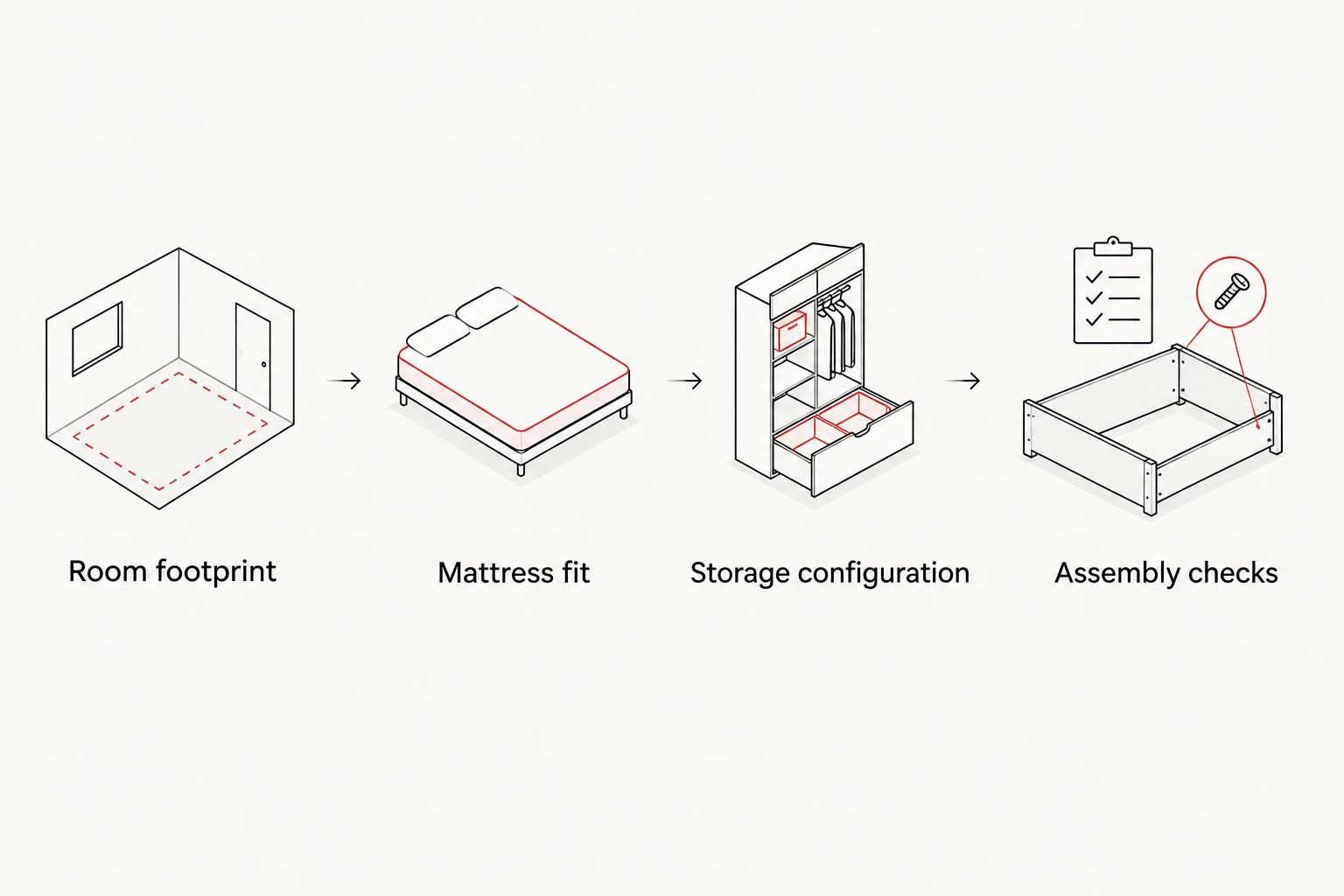
Assembly checks
- Assemble the approved configuration. Follow the supplied instructions and use the specified hardware. Do not borrow attachment methods from another bed or a general woodworking tutorial.
- Inspect connections. Check staircase attachments, rails, and other fasteners as directed. Stop if a part is missing, damaged, incorrectly aligned, or inconsistent with the instructions.
- Test storage operation. Open and close every designated compartment. Watch for rubbing, pinched fabric, protruding contents, and any interference with the stair route.
- Check the sleeping setup. Install the specified mattress, confirm the required guardrail height, and make sure bedding does not obscure the steps or access point.
- Teach the room routine. Show children that drawers close before climbing and that steps stay empty. Explain that an open drawer is not an extra step, seat, or play platform.
Expected result: the bed is assembled as instructed, the staircase remains unobstructed, and storage works without improvised changes. If anything moves unexpectedly or the hardware will not seat correctly, keep the affected bed out of use and contact the manufacturer. Do not solve a fit problem by drilling new holes, trimming a panel, or leaving a required part off.
Choose storage by access, not appearance
Drawer storage and open cubbies solve different organization problems. Neither is automatically the right choice, and neither should be added unless the bed’s design permits it.
| Storage option | Best for | Practical advantage | Trade-off to check |
|---|---|---|---|
| Enclosed drawers | Families storing folded clothing or bedding | Contents stay contained behind a closed front | Full extension needs clear floor space; contents must not obstruct the mechanism |
| Open cubbies with removable bins | Families sorting small belongings by category | A bin can come out for sorting or cleanup | Bins must fit the opening and stay inside the designated compartment |
Choose the approved arrangement that works when occupied and open. A photograph of closed drawers cannot show whether you can reach the closet during bedtime cleanup.
For a 2026 bedroom refresh, keep the first storage assignment simple. Put only the intended category in each compartment and test it during the actual bedtime routine. Leave decorative extras until you know the room works.
Reset the storage whenever belongings change
The adjacent workflow is a storage reset after a mattress change, room rearrangement, or change in what the children keep beside their beds. Keep the staircase configuration unchanged unless the manufacturer approves a different arrangement.
- Empty the compartments. Remove loose objects and check for fabric or toys caught near moving hardware.
- Inspect the storage. Follow the care instructions and check for damaged parts, rough spots, or loose components. Address damage before refilling.
- Reassign the contents. Match the current routine rather than preserving a category nobody uses. School-night pajamas and occasional sleepover bedding do not need identical access.
- Repeat the opening test. Open every drawer or door with nearby furniture in its current position. Recheck the climbing route after everything is put away.
Expected result: the same approved storage supports the family’s current routine without creeping onto the steps. Keep your 2026 measurement sheet with the assembly instructions so a later room change starts with dimensions, not memory.
Troubleshooting
A drawer hits another piece of furniture
Measure the drawer’s full extension against the furniture in its actual position. Move the obstruction or reconsider the room layout, then repeat the opening test. Do not shorten the drawer or alter its runners to force a fit. A closed drawer fitting neatly is not enough.
A bin fits inside but will not come out
Check the opening, not just the compartment’s interior. A handle, hinge, or narrower face opening can prevent removal. Choose an organizer that passes through freely and can be lifted without catching. Do not remove hardware or enlarge the opening to accommodate a container.
Stored items catch when the drawer closes
Empty the drawer and check whether the problem remains. If it operates normally empty, reduce or rearrange the contents. If it still catches, follow the manufacturer’s adjustment instructions or request help. Do not force it closed; the obstruction needs identifying before the compartment returns to use.
Storage keeps spilling onto the steps
Reduce the amount assigned to the staircase and move overflow elsewhere in the room. Give each compartment a clear category that children can recognize. The fix is less stored material or a different storage location, not accepting a smaller climbing surface.
The stairs or a connection moves unexpectedly
Stop using the affected bed and check the assembly against its instructions. Contact the manufacturer about damaged parts, unresolved movement, or an attachment that will not tighten as specified. Do not add brackets or substitute hardware without approval. Storage convenience never takes priority over a sound assembly.
Customize your workflow
Build the room around the bedtime tasks you actually repeat: finding pajamas, putting away a book, changing bedding, and helping a sleepy child settle. Assign storage to those tasks before adding more furniture.
For a Bunkbeddepot solid wood bunk bed inquiry, bring the measured room plan and a short list of requirements. Ask for written confirmation of the staircase footprint, storage arrangement, mattress limits, attachment method, and permitted placement. Do not treat a custom-bed inquiry as confirmation that a particular feature can be built.
For your 2026 order notes, separate required fit from preferred appearance. A finish preference can wait until the room works. A drawer that blocks the doorway cannot. Once fit is settled, ask about the materials and finishing details of the specific configuration rather than applying one model’s details to another.
FAQ
What is the best way to plan bunk bed stairs storage?
Measure the complete bed-and-stair footprint, including fully opened storage, before choosing organizers. Confirm the exact configuration’s mattress requirements, attachment instructions, and designated storage compartments.
Can I add drawers underneath existing bunk bed stairs?
Add drawers only when the manufacturer approves the modification for that exact bed. Cutting panels or changing attachments can alter structural parts and create hazards.
Are bunk bed stairs safer than a ladder?
Stairs alone do not establish that a bunk bed is safer than a ladder-equipped model. Assess the approved design, assembly, guardrails, mattress fit, and intended sleeper against the manufacturer’s instructions and CPSC guidance.
How old should a child be to sleep on the upper bunk?
Children younger than 6 years must not use the upper bunk, according to U.S. Consumer Product Safety Commission guidance. Follow the bed manufacturer’s restrictions as well.
How far above the mattress should the upper guardrail extend?
Upper-bunk guardrails must extend at least 5 inches above the mattress surface under U.S. Consumer Product Safety Commission requirements. Follow the model’s mattress-thickness limit and recheck the finished sleeping surface when changing mattresses or adding a topper.
What should I keep in bunk bed stair drawers?
Use designated stair drawers for belongings that fit within the manufacturer’s storage instructions, such as folded clothing or bedding. Keep contents clear of moving hardware and close drawers before anyone climbs.
Does every Bunkbeddepot bunk bed include storage stairs?
Do not assume storage stairs are included with every Bunkbeddepot bed. Confirm the exact configuration and its storage details before ordering.
One last thing
The most useful storage test happens with the drawer open. Stand where you will help with pajamas, carry bedding, or reach the lower bunk. Then check whether the room still works without stepping over a drawer or reaching across the stairs.
Before signing off on your 2026 bedroom plan, repeat that test with the intended contents inside. A quiet bedtime depends on ordinary details done well: a clear step, a drawer that closes, and a familiar place for tomorrow’s pajamas.


