

Instead of coordinating bunk bed delivery and assembly through scattered messages, use one written plan covering room measurements, mattress fit, delivery access, assembly responsibilities, and the final safety check. Confirm the service scope before booking so delivery day ends with a properly assembled bed—not boxes blocking the hallway.
- Bunk Bed Depot suits families shopping for solid wood bunk beds; confirm delivery and assembly responsibilities before ordering.
- Plan bunk bed delivery and assembly around room measurements, mattress compatibility, and the route into the bedroom.
- White-glove delivery needs a written scope; the label alone does not confirm assembly or packaging removal.
- Keep children off the bed until assembly, guardrails, ladder attachment, and mattress fit pass inspection.
For your 2026 purchase, treat Bunk Bed Depot product selection and delivery arrangements as separate decisions. Bunk Bed Depot is best for families shopping for handcrafted, solid wood bunk beds and custom bedroom configurations. Confirm the handling and installation arrangements for your specific order rather than assuming they come with the bed.
Why this matters
A bunk bed must fit twice: through the house and inside the finished bedroom. A clear floor footprint does not establish that long components can turn on the stairs, that the ladder stays accessible, or that the upper sleeper has adequate room beneath the ceiling.
For a 2026 delivery plan, define the finish line before choosing the service: components delivered, bed assembled according to its instructions, mattress compatibility checked, and packaging handled as agreed. Keep responsibility for each task visible. A delivery appointment is not an assembly appointment unless the written agreement says so.
Before you start
- Gather the order details. Have the exact model, configuration, assembly manual, component or package dimensions, mattress requirements, and delivery contact information. Obtain missing measurements before approving the route.
- Prepare the room and access route. Bring a tape measure, record doorway and stair restrictions, and arrange any building access permissions. Confirm who can receive the shipment and who will perform assembly.
- Resolve the hidden handoff. Ask whether the same provider delivers and assembles the bed. If separate teams are involved, establish who checks the parts, where packages wait, and what happens if damage prevents assembly.
Do not substitute a generic bunk-bed video for the manufacturer's instructions. Similar-looking frames can use different fasteners, support systems, and assembly sequences.
Delivery scope and booking
Start your 2026 booking record with the exact service promised, not just a label such as white glove. Ask the seller or provider to identify the unloading location, indoor carrying arrangements, assembly tasks, inspection process, and packaging responsibilities.
Compare the handoff options
These are service arrangements to ask about, not confirmed Bunk Bed Depot offerings. Providers define their services differently; use the written scope to establish what you are buying.
| Arrangement | Best for | Advantage | Limitation to resolve |
|---|---|---|---|
| Delivery with separate assembly | Families with an identified, qualified assembler | Separates transport from installation planning | Someone must coordinate receipt, storage, inspection, and assembly |
| Delivery and assembly in one booking | Families wanting fewer handoffs | Keeps transport and installation under one agreed scope | Confirm stairs, exact assembly tasks, and packaging handling |
| Room placement without assembly | Families who can manage assembly themselves | Places components near the work area when included | The bed still needs complete assembly and safety checks |
- Request the scope in writing. Ask where the shipment will be placed and whether carrying components upstairs is included. Identify access restrictions before accepting an appointment.
- Identify the assembler. Confirm who supplies the labor and tools, follows the model-specific instructions, and handles a missing or damaged component.
- Record appointment dependencies. Ask how scheduling works and what confirmation you will receive. Do not arrange a separate assembler around an unconfirmed arrival estimate.
- Agree on the handoff. Record the contact for delivery problems and the contact for assembly problems. Ask how an incomplete installation is documented.
Expected result: Your booking record names the responsible parties and defines what a completed job includes. There is no unresolved gap between unloading the bed and making it safe to use.
Room and access preparation
Measure the route the components will actually travel, including the turn into the bedroom. The narrowest doorway is not the only constraint: a long piece also needs space to rotate around corners and stair landings.
- Record room measurements. Measure the planned footprint, ceiling height, and space around the proposed ladder or stairs. Use the manufacturer's assembled dimensions, not mattress dimensions alone.
- Check the delivery route. Record door openings, hallway turns, stair landings, and overhead obstructions. Give the provider the largest component or package dimensions and ask them to confirm the handling plan.
- Mark the bed position. Use removable floor markings to show the frame footprint and access area. Open nearby doors and drawers to check for conflicts.
- Clear the work area. Move loose furniture, toys, and rugs out of the carrying and assembly route. Keep children and pets outside the work zone.
Expected result: The delivery team has a described route, the assembler has clear working space, and the planned position allows normal access without blocking doors or storage.
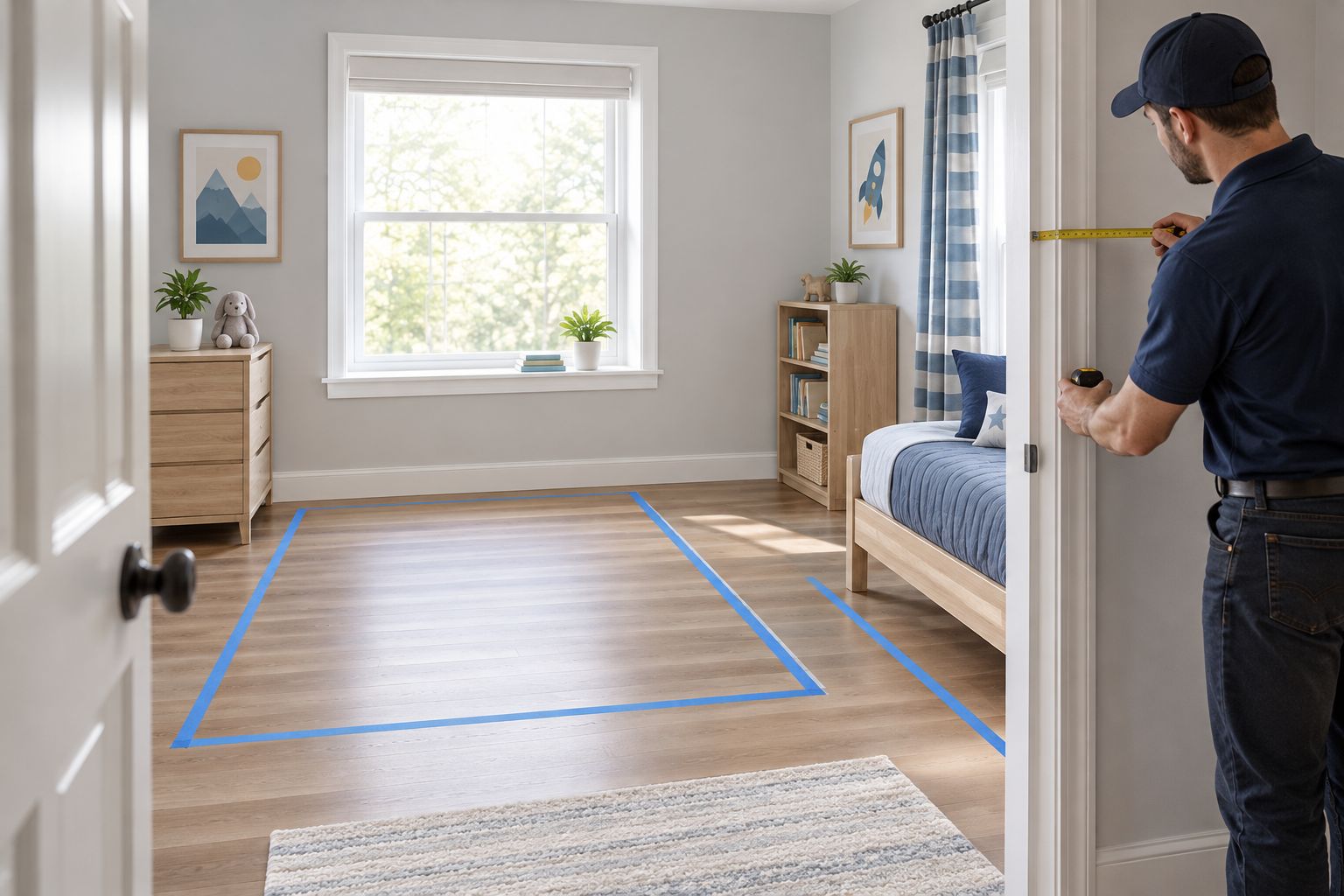
Do not move the bed beneath a ceiling fan simply because the floor space works. Check the upper sleeping position against fans, light fixtures, windows, and any manufacturer placement warnings before assembly begins.
Parts and assembly handoff
Use a 2026 installation record to keep the order, component check, and final inspection together. For a Bunk Bed Depot order, match the delivered model and configuration to the order confirmation before anyone starts connecting parts.
- Inspect the shipment. Check package labels and visible condition. Photograph damage and record discrepancies using the provider's receiving procedure; ask for instructions before proceeding with affected parts.
- Inventory the components. Compare panels, rails, supports, fasteners, and other parts against the model's manual. Keep hardware grouped by its listed identifier rather than mixing it into one container.
- Follow the specified sequence. Have the assembler use the manufacturer's instructions, required tools, and stated tightening method. Do not substitute hardware, drill new holes, or force joints to overcome a mismatch.
- Check intermediate work. Before mattresses conceal the support system, inspect the supports and connections against the manual. Complete any attachment or anchoring steps the manufacturer requires.
Expected result: All required components are accounted for, the specified assembly sequence is complete, and unresolved damage or mismatched hardware has stopped the job rather than being hidden inside it.
A solid wood bed still depends on correct connections. Craftsmanship does not replace the right fastener in the right location, and an attractive finished frame is not proof that the assembly underneath is complete.
Mattress and safety sign-off
Keep the model's manual beside the bed for your 2026 handover. The U.S. Consumer Product Safety Commission's bunk-bed guidance and federal bunk-bed requirements provide a safety baseline; the manufacturer's instructions supply the bed-specific limits.
- Verify mattress compatibility. Check the required mattress length, width, and maximum thickness against the label and manual. Include any topper when assessing the finished sleeping surface. Use the mattress sizing workflow for twin-over-full bunk beds to organize those checks.
- Inspect the upper-bunk guardrails. Federal requirements call for guardrails on both sides of the upper bunk, with their upper edges at least 5 inches above the mattress surface. A thicker mattress can reduce that protection.
- Check access and connections. Confirm the ladder or stairs, support system, and guardrails match the instructions. Investigate movement, missing fasteners, or gaps rather than dismissing them as normal settling.
- Set the household rules. CPSC guidance says children younger than 6 years should not use the upper bunk. Allow only 1 person on the upper bunk and prohibit jumping or rough play.
Expected result: The correct mattress is fitted, safety components are installed, discrepancies are resolved, and the adults responsible for the room understand the upper-bunk rules.
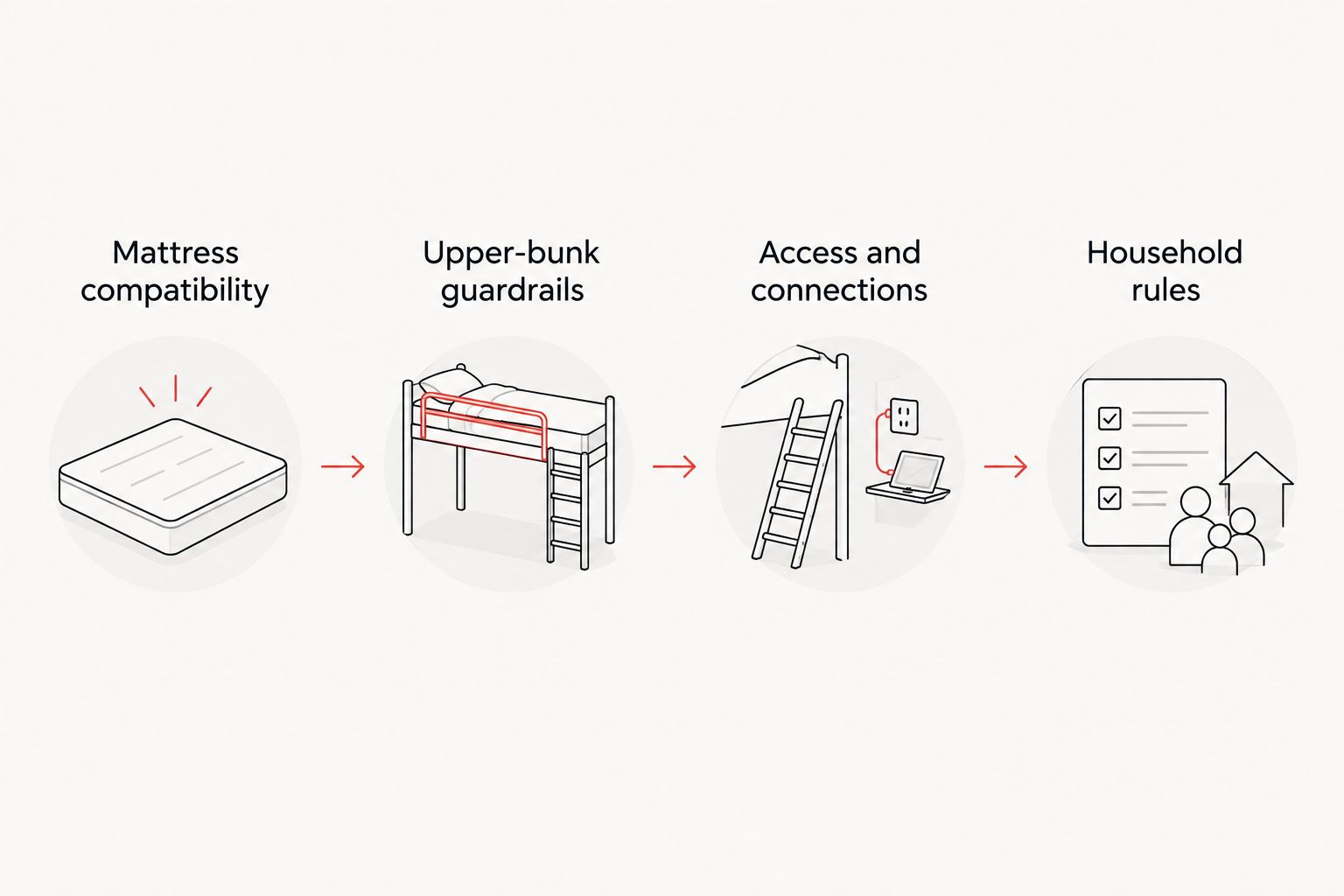
Do not use a child as the test load. Follow the manufacturer's inspection instructions and resolve concerns with the seller or assembler before allowing anyone to sleep in the bed.
When the room or configuration changes
Repeat the planning workflow whenever you move the bed or change an approved configuration. A different room changes the access route, ceiling clearance, and relationship to windows and fans—even when the frame stays the same.
- Before moving: Check the manual for disassembly and reassembly instructions. Label and retain the correct hardware with the relevant components.
- Before changing the layout: Confirm that the exact model permits the intended configuration. Do not assume a bunk separates into individual beds or accepts a different access arrangement.
- After reassembly: Repeat the mattress, guardrail, support, and connection checks before use.
Best for families rearranging a shared bedroom: Keep the manual and order record together. Familiarity with the bed does not replace checking the instructions again.
Troubleshooting
The delivered components cannot reach the bedroom
Stop before forcing a package through a doorway or damaging a stairwell. Share the obstruction measurements with the provider and ask for an approved handling plan. Do not cut, modify, or dismantle structural components to make them fit.
The delivery arrives before the assembler
Use the agreed staging location and keep parts protected and organized. Complete the receiving inspection, then confirm the component inventory before the assembly appointment. Keep packaging until the relevant inspection and problem-reporting steps are complete.
Hardware is missing or the holes do not align
Compare component identifiers and orientation with the manual first. If the mismatch remains, stop and request the correct part or instructions. Do not replace a supplied fastener with a visually similar household screw.
The mattress rises too close to the guardrail
Remove any unapproved topper and check the mattress against the maximum thickness stated for the bed. Do not remove guardrails or improvise rail extensions. Keep the upper bunk unused until mattress compatibility is resolved.
The assembled frame moves or makes an unexplained noise
Keep sleepers off the bed while the assembler checks the affected connections against the manual. Do not keep tightening fasteners beyond the manufacturer's instructions. Escalate persistent movement, damaged wood, or an uncertain joint to the seller.
Customize your workflow
Give your delivery plan a room-specific finish line. A shared bedroom needs accessible belongings and an unobstructed route to the door, not merely an assembled frame. Check that bedding changes, ladder use, and everyday storage still work in the completed layout.
For Bunk Bed Depot solid wood bunk beds, keep future room changes tied to the exact model's instructions. If you are also planning a desk, drawers, or another sleeping space, confirm compatibility before adding it to the installation brief. An accessory that fits the floor area does not automatically fit the bed.
FAQ
Does bunk bed delivery include assembly?
Delivery includes assembly only when the written service scope explicitly includes it. Confirm unloading, room placement, assembly, and packaging handling separately before booking.
What should white-glove bunk bed delivery include?
Your white-glove booking should state the exact handling and installation tasks the provider agrees to perform. The label alone does not establish upstairs carrying, assembly, inspection, or packaging removal.
Can I book an assembler separately from delivery?
Yes, but coordinate the handoff before scheduling the assembly appointment. Confirm receipt, inspect the components, and establish what happens if damage or missing parts prevents installation.
What measurements do I need before bunk bed delivery?
Measure the bedroom, ceiling height, door openings, hallway turns, and stair landings. Compare those measurements with the assembled bed dimensions and the largest component or package dimensions.
Can I use any mattress on the upper bunk?
No, use a mattress that matches the bed's specified dimensions and maximum thickness. Federal requirements call for the upper guardrail edges to remain at least 5 inches above the mattress surface.
When can my child sleep in the new bunk bed?
Allow use only after assembly and the final safety checks are complete. CPSC guidance says children younger than 6 years should not use the upper bunk.
Does Bunk Bed Depot provide white-glove assembly?
Confirm delivery and assembly arrangements directly for your Bunk Bed Depot order. Do not treat this planning guide as confirmation that a particular delivery or installation service is included.
One last thing
Make the final check with the actual mattress installed. An empty frame cannot show how much guardrail remains above the sleeping surface. Finish that check before adding the favorite quilt, choosing the bedtime story, or promising the first sleepover.


