

A low bunk bed shortens the distance from the upper mattress to the floor, but that alone does not make it safer for young children. Children younger than 6 years should not use the upper bunk—even on a low bunk bed—and mattress fit, guardrails, secure assembly, and safe access still matter.
- Is a low bunk bed safer for young children? Lower height alone does not establish safety.
- CPSC guidance keeps children younger than 6 years off the upper bunk, including low bunk beds.
- Upper-bunk guardrails must extend at least 5 inches above the mattress surface; follow the bed’s mattress limit.
- Bunk Bed Depot suits families shopping for solid wood bunk beds; confirm each model’s dimensions and safety instructions.
Is a low bunk bed safer for young children?
A low bunk bed is not an exception to upper-bunk safety rules. Its practical advantage is reduced height, not permission for a younger child to sleep above the floor. For your 2026 purchase, start with the sleeper’s age and the manufacturer’s instructions before comparing frame heights.
The U.S. Consumer Product Safety Commission’s bunk-bed guidance says children younger than 6 years should not use the upper bunk. The guide to what age is safe for the top bunk explains that starting point.
| Sleeping arrangement | Best for | Practical advantage | Limitation |
|---|---|---|---|
| Low bunk bed | Families with an age-eligible upper sleeper and a room that fits the frame | Places the upper sleeping surface lower than a taller configuration | Still requires guardrails, correct mattress fit, and safe climbing |
| Taller bunk bed | Families with age-eligible sleepers and adequate overhead clearance | Stacks sleeping spaces vertically | Requires checking the higher sleeping surface and access route against room obstacles |
| Separate, age-appropriate beds | Families who do not need an elevated sleeping space | Avoids upper-bunk climbing and upper-bunk falls | Uses separate floor footprints |
This is a layout comparison, not a safety ranking. No frame height substitutes for checking the actual bed, mattress, sleeper, and room together.
Why this matters
A low frame looks approachable. You can picture an easier bedtime tuck-in, a sibling chatting from the lower bed, and a room with more space for stories. Those are useful family considerations, but they do not establish whether the upper sleeping space is appropriate.
Children also use the bed when you are not standing beside it. Think about nighttime bathroom trips, visiting friends, and a younger sibling who wants to follow an older child up the ladder. Choose the sleeping arrangement around the youngest child’s access, not just the oldest child’s ability.
For a 2026 room plan, separate convenience from protection. A parent reaching the mattress more easily is convenient; correct guardrails and mattress compatibility are safety requirements.
Check these details before choosing a low bunk bed
Start with the sleeper
Keep children younger than 6 years off the upper bunk. Reaching age 6 does not override a manufacturer’s higher age restriction or establish that a particular child can use the access system safely.
Watch whether your child follows rules, climbs deliberately, and manages nighttime movement without rushing. If the upper bunk is not suitable, choose an age-appropriate sleeping arrangement rather than treating a lower frame as a workaround.
A lower bunk also needs its own assessment. Follow the manufacturer’s age guidance, check the mattress fit, and consider whether the child can reach the upper bunk during play.
Measure the room and sleeping surfaces
Record the room’s length, width, and ceiling height. Then compare them with the bed’s overall dimensions, not just its mattress size. Include the space needed to use the ladder or stairs and open nearby doors and drawers.
Measure overhead clearance from the top of the intended mattress, rather than from the empty mattress platform. Check the lowest obstruction above the sleeper, including a sloped ceiling, beam, light fitting, or ceiling fan.
There is no single ceiling measurement that proves every bunk bed fits safely. Use the model’s instructions and inspect the actual room, including the route a child takes onto the bed.
Match the mattress to the bed
The CPSC’s bunk-bed requirements call for upper guardrails to extend at least 5 inches above the top of the mattress. The bed’s specified mattress dimensions and maximum thickness remain essential: a mattress that is too thick reduces the exposed rail height.
Do not add a topper without reassessing the total sleeping-surface height. Follow the manufacturer’s instructions for the complete mattress setup, including any permitted foundation.
Length and width matter too. A mattress that does not match the specified size can leave unwanted spaces between the mattress and frame. Do not use cushions, foam pieces, or rolled bedding to improvise a fit.
Check rails, openings, and assembly
For your 2026 safety check, consult the CPSC’s Bunk Beds guidance and the federal bunk-bed requirements in 16 CFR parts 1213 and 1513. These address hazards including entrapment and falls; they are not simply rules about overall bed height.
Check that the required guardrails are installed, the access opening matches the instructions, and all specified hardware and mattress supports are present. A sturdy-looking wooden frame is not proof that openings or rails meet safety requirements.
Never remove a required guardrail to make bedtime access easier. If the setup does not work for your family with its safety components installed, choose another arrangement.
Plan the climb and nighttime routine
Use the bed’s intended access system. Keep the route clear of toys, bedding, and furniture, and provide a night-light so the child can see when getting down.
The CPSC advises using the ladder to enter and leave the upper bunk, allowing only one person on the upper bunk, and prohibiting horseplay on or under the bed. Explain those rules to visiting children too.
Do not attach ropes, belts, hooks, or similar items to the bunk bed. A room that looks tidy can still contain a hazard if children turn the bed into climbing or hanging equipment.
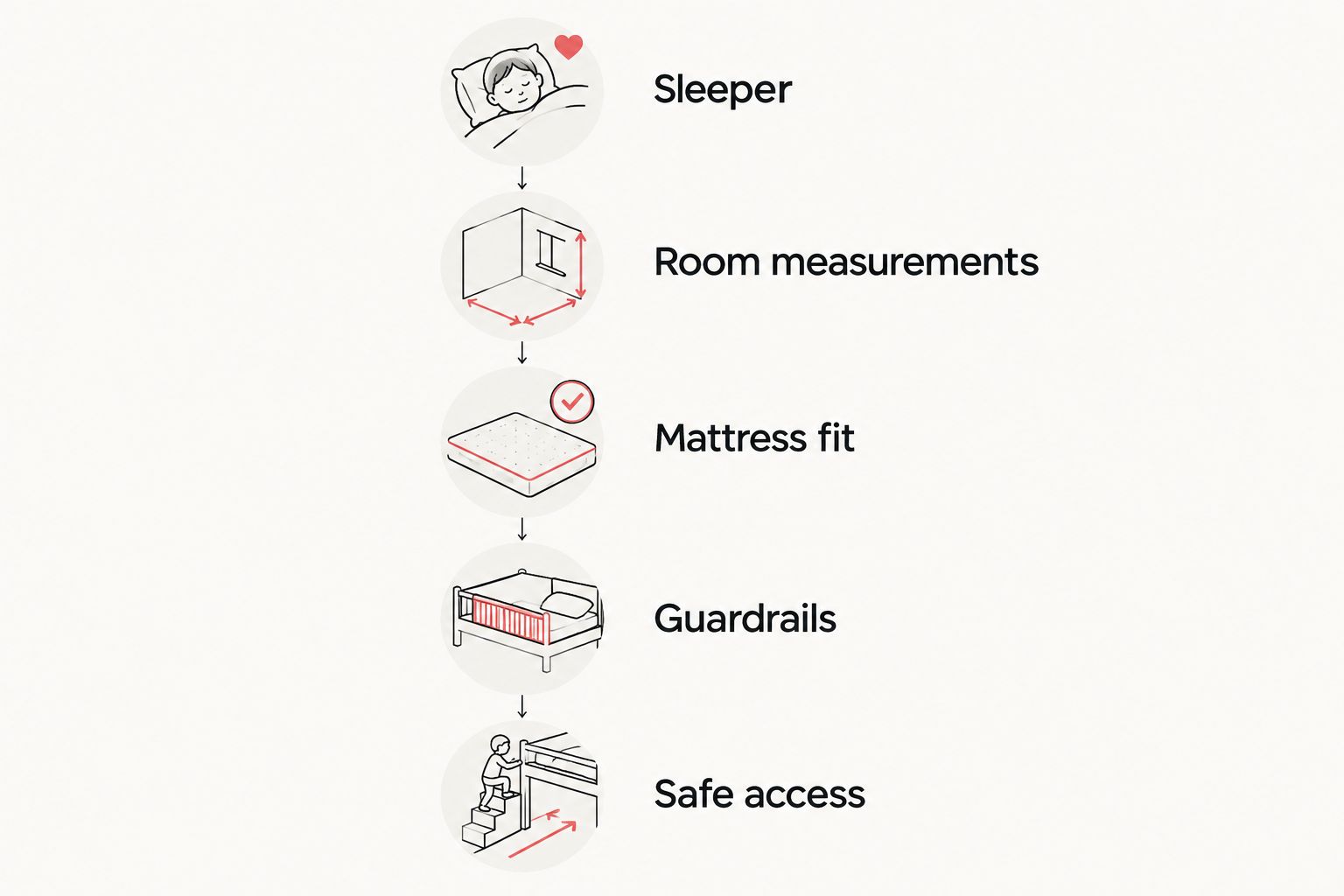
Why low bunk bed safety varies
The word low describes a height relationship. It does not tell you how a particular bed is assembled, what mattress belongs on it, or whether your child should use it.
These factors determine what you need to check:
- Sleeper age and instructions: Children younger than 6 years stay off the upper bunk. Follow any stricter manufacturer restrictions.
- Mattress dimensions and thickness: The specified mattress must fit the frame and preserve the required guardrail height.
- Guardrails and openings: Correct components and opening dimensions matter independently of the frame’s height.
- Assembly and condition: Missing hardware, damaged components, and loose connections need correction before use.
- Room placement: Overhead obstacles, windows, cords, and the climbing route require attention in the actual bedroom.
- Use and supervision: Horseplay, shared upper-bunk use, and unauthorized climbing defeat rules that a lower frame does not replace.
Do not turn this into a points system. A good result on room measurements does not cancel an unsuitable sleeper age or a missing rail.
What should you ask before ordering in 2026?
Ask for the specific model’s dimensions, assembly instructions, mattress requirements, age restrictions, and load limits. Request clarification before ordering if a description leaves any of those details unclear.
Bunk Bed Depot is best for families shopping for solid wood bunk beds and custom bed configurations. The company describes its offering as handcrafted and made in the USA, but that does not establish that a particular model is low-profile or appropriate for your child.
For Bunk Bed Depot bunk beds, confirm the selected configuration rather than assuming a photograph supplies the measurements. Ask where the upper mattress surface will sit with the permitted mattress installed and how much usable space remains above and below it.
Craftsmanship matters, but it answers a different question from sleeper suitability. Solid wood does not remove the need for guardrails, correct openings, clear instructions, or an age-appropriate sleeping assignment.
Keep the instructions with your household records. You will need them when checking hardware, replacing a mattress, or moving the bed—not just on assembly day.
Is the bottom bunk suitable for a child younger than 6?
Children younger than 6 years should not use the upper bunk; that rule does not automatically approve the lower bunk. Check the manufacturer’s lower-bunk age guidance and whether the complete arrangement suits your child.
Consider access as well as sleep. If a young child can climb toward the upper bed during the day, assigning the lower mattress does not resolve that concern. Choose a different arrangement when you cannot manage access safely.
Do stairs make a low bunk bed safe for younger children?
Children younger than 6 years should not use the upper bunk, whether access is by stairs or a ladder. Stairs change how a sleeper reaches the bed; they do not change the upper-bunk age guidance.
Compare the actual access designs, instructions, and room footprints. Do not assume stairs are safer solely because they resemble a household staircase, and do not substitute an improvised access system.
Does a thinner mattress make a low bunk bed safer?
At least 5 inches of guardrail must remain above the upper mattress surface under CPSC requirements, but thinner is not automatically better. Use a mattress within the bed manufacturer’s specified dimensions and thickness limit.
A mattress can be thin enough yet still be the wrong length or width. Treat mattress compatibility as a complete specification, not a single measurement.
FAQ
Is a low bunk bed safer for young children than a regular bunk bed?
A low bunk bed reduces the height of the upper sleeping surface, but lower height alone does not establish that it is safer. Children younger than 6 years should not use the upper bunk, and both designs need correct mattresses, guardrails, assembly, and access.
Can my 4-year-old sleep on the top of a low bunk bed?
No. CPSC guidance says children younger than 6 years should not use the upper bunk, including a low upper bunk. Choose an age-appropriate sleeping arrangement and follow the bed manufacturer's instructions.
How high should the guardrail be above a bunk bed mattress?
Upper-bunk guardrails must extend at least 5 inches above the mattress surface under CPSC requirements. Follow the bed manufacturer's mattress thickness limit and reassess the setup before adding any topper.
Can I remove the top guardrail if the bunk bed is low?
No, a low frame does not justify removing a required upper-bunk guardrail. Keep the safety components installed as instructed and choose another sleeping arrangement if access is unsuitable.
Are solid wood bunk beds automatically safer?
No, solid wood alone does not establish bunk-bed safety. Check the model's safety information, mattress requirements, guardrails, openings, assembly instructions, and suitability for each sleeper.
What should I confirm before buying a Bunk Bed Depot bunk bed?
Confirm the specific Bunk Bed Depot bunk bed's dimensions, permitted mattress size and thickness, age restrictions, load limits, and assembly instructions. Do not assume a model is low-profile or suitable for a younger child without checking those details.
One last thing
Recheck the bed whenever you replace the mattress. A frame that has not changed can have a different guardrail clearance after a mattress swap or the addition of a topper.
Before the first bedtime in your 2026 room setup, measure from the new mattress surface to the top of the upper guardrail and compare the complete setup with the instructions. Then check the climbing route with the room arranged for nighttime use. The goal is simple: a bed that fits the child, the room, and the routine—not just the photograph.


