

A solid wood loft bed does not cost more in the three matching product families listed by Bunkbeddepot: each loft has a lower listed frame price than its bunk-bed counterpart in this 2026 comparison. The catch is sleeping capacity—a loft provides one elevated sleeping space, so furnishing the space underneath or adding another bed changes your total bedroom budget.
- How much more does a solid wood loft bed cost than a bunk bed? These matching lofts cost less.
- Bunkbeddepot’s three matching loft-and-bunk families all show lower listed frame prices for the loft.
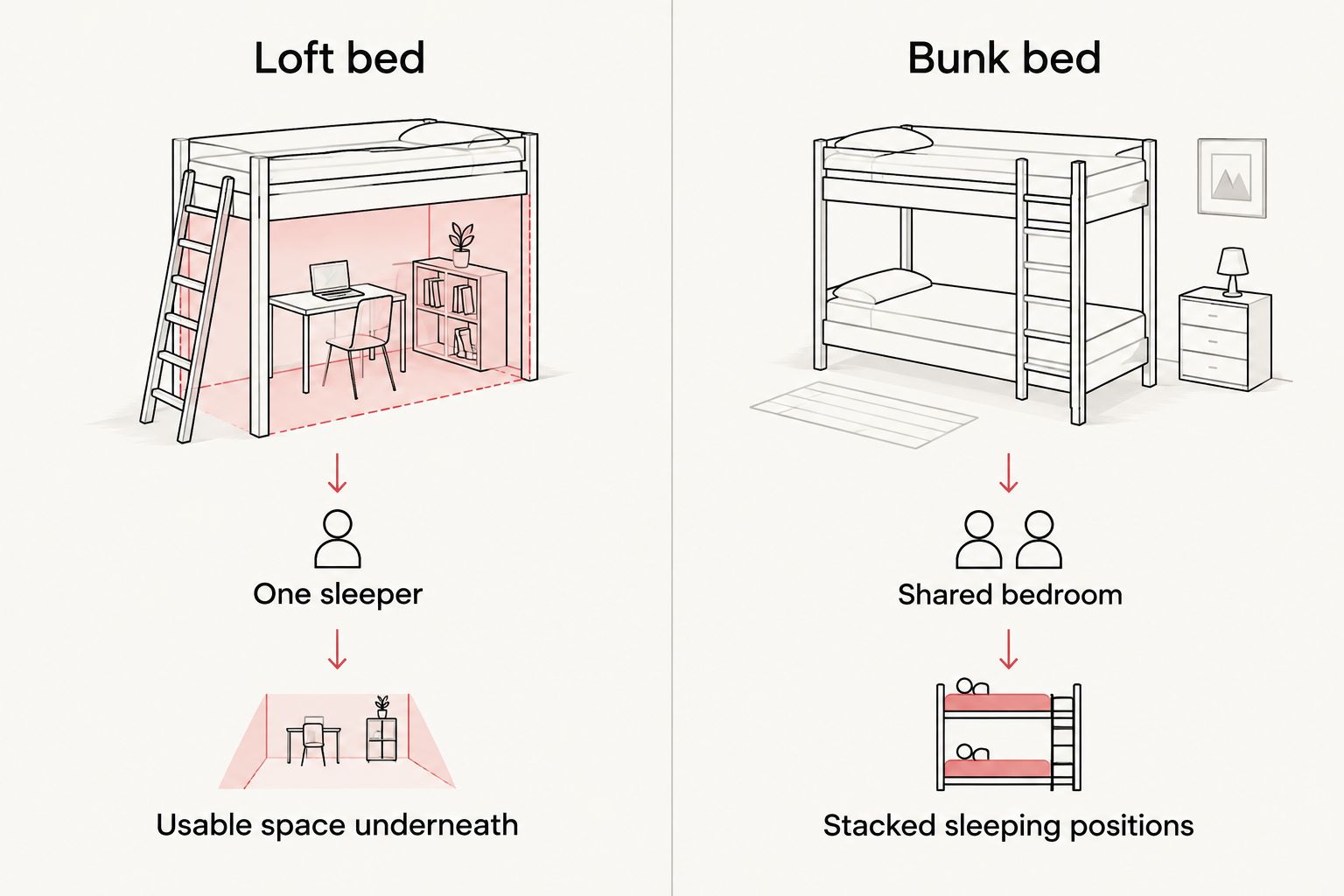
- Choose a loft for one sleeper and usable space underneath; choose a bunk for stacked sleeping spaces.
- Compare mattress requirements, room clearance, and included components before choosing a frame.
How much more does a solid wood loft bed cost than a bunk bed?
In this catalog comparison, the loft costs less—not more—in every matching family. That finding applies to the supplied product listings, not to every size, finish, or custom configuration you might order.
The more useful question is what the finished room needs to do. Start with this guide to choosing between a loft and bunk bed for a small room if you are still deciding between another sleeping space and open space underneath.
| Matching product family | Loft option | Bunk option | Listed frame comparison | Best for |
|---|---|---|---|---|
| Appalachian Winds | Appalachian Winds Loft | Appalachian Winds Barn Door Bunk Bed | Loft is lower | Comparing the same named family before choosing a room layout |
| Split Log | The Split Log Loft | The Split Log Bunk | Loft is lower | Comparing a loft and bunk within the Split Log family |
| White Mountains | The White Mountains Loft | The White Mountains Bunk Bed | Loft is lower | Comparing the White Mountains loft and bunk listings |
These are named-family comparisons, not confirmation that every specification matches. Before treating either frame as the better purchase, confirm the selected mattress size, overall dimensions, access arrangement, and included components.
Why this matters
A lower frame price does not automatically mean a better room. A loft leaves space below its sleeping platform, while a bunk uses that area for another sleeping position.
Choose the layout that solves your sleeping arrangement first. A shared bedroom needs dependable places for everyone to sleep; a single sleeper might benefit more from room for homework, books, or play.
For your 2026 bedroom plan, separate the bed-frame decision from the rest of the furnishing decision. That keeps an appealing frame from becoming an awkward fit once the mattress, chair, storage, and ladder access enter the picture.
Loft bed or bunk bed: what are you getting?
A loft and a bunk answer different family needs. Neither layout wins simply because it uses more wood or has a higher listed price.
| Layout | Best for | Main advantage | Main limitation | What to confirm |
|---|---|---|---|---|
| Loft bed | One sleeper who needs usable space underneath | Keeps the area below available for another purpose | Does not provide a lower sleeping position | Under-bed clearance, access, mattress requirements, and room fit |
| Bunk bed | A shared bedroom needing stacked sleeping positions | Places sleeping spaces within one stacked arrangement | Uses the lower area for sleeping rather than a desk or open floor | Each sleeping position’s dimensions, load limits, and mattress requirements |
A loft is a practical choice when the space below has a clear job. Measure the desk or storage you intend to use before assuming it will fit; a product photo does not establish usable clearance.
A bunk makes sense when the lower sleeping position will see regular use. The trade-off is straightforward: the same area cannot also remain an open workspace beneath the upper bed.
Appalachian Winds: the loft has the lower listed frame price
The Appalachian Winds Loft and Appalachian Winds Barn Door Bunk Bed follow the same pattern: the loft listing is lower. Both supplied descriptions identify the beds as built to order and made for the family in the United States.
Best for: families comparing these two named models before settling on sleeping capacity. The loft’s advantage is the available area underneath; its limitation is the absence of a lower sleeping position.
The bunk’s advantage is its stacked sleeping arrangement. Its limitation is that the lower bed occupies the area a loft leaves available. Confirm the selected size and finish rather than assuming the two listings describe identical builds.
Split Log: the loft also has the lower listed frame price
The Split Log Loft is listed below The Split Log Bunk. The supplied descriptions identify both as built to order, with size and finish selections referenced in the listing text.
Best for: families already considering the Split Log family who need to choose a layout. Let the room’s purpose decide between them, not an assumption that loft construction must carry a premium.
Choose the loft layout when one sleeping position meets your needs and the area underneath has a measured purpose. Choose the bunk layout when the lower sleeping position is useful; neither choice establishes mattress compatibility or load capacity without the model’s instructions.
White Mountains: the same price direction holds
The White Mountains Loft is listed below The White Mountains Bunk Bed. Both supplied descriptions identify built-to-order production, but the listing excerpts do not establish that all dimensions or included components match.
Best for: families choosing between the White Mountains loft and bunk layouts. The loft keeps the lower area available, while the bunk dedicates it to sleeping.
That is the central benefit-and-drawback comparison here. Do not treat the lower listing as proof that the loft offers the same sleeping capacity or that accessories shown with either model are included.
Why your loft-versus-bunk comparison varies
For a useful 2026 comparison, keep the selected configuration consistent and separate the frame from everything around it. These factors determine whether you are comparing equivalent purchases:
- Sleeping capacity. A loft and a bunk do not provide the same sleeping arrangement. Identify every regular sleeper before comparing frames.
- Selected size. The supplied descriptions reference size choices. Compare the exact selections you intend to order, not just the family names.
- Finish selection. Several supplied descriptions reference finish choices. Confirm the finish on each configuration without assuming its effect on the final quote.
- Included components. Ask what the listing includes. Do not assume a mattress, desk, storage unit, or assembly service comes with the frame.
- The finished room. A loft workspace needs furniture that fits underneath. A shared sleeping arrangement needs compatible mattresses and bedding for each position.
These checks do not establish an industry-wide loft premium. They prevent a mismatched comparison from making one layout look better than it is.
Measure the room before choosing the frame
Begin with a tape measure, not the room photo you hope to recreate. A bed must fit the sleeper, the mattress, the ceiling, and the route used to climb in and out.
- Measure the room. Record the usable wall lengths and mark doors, windows, closets, and fixed obstructions. Include the space those doors need to open.
- Confirm the footprint. Use the selected bed’s overall dimensions, not nominal mattress dimensions. Account for its specified ladder or stair arrangement.
- Check overhead clearance. Compare the ceiling with the actual upper mattress position. Leave room for the sleeper to sit and move without contacting the ceiling or nearby fixtures.
- Check mattress compatibility. Match the required length, width, and maximum thickness to the exact model. An existing mattress is not automatically suitable.
- Test the lower area. For a loft, check the intended furniture against usable clearance. For a bunk, check access to the lower sleeping position.
Make these measurements part of your 2026 order notes. Written dimensions give you something definite to confirm before a built-to-order bed enters production.
A desk beneath a loft should work with the chair pulled out, not just tucked away. A lower bunk should remain accessible when the room contains its everyday furniture. Those ordinary movements determine whether the layout feels useful after the first exciting night.
Check safety before comparing craftsmanship
Solid wood describes a material; it does not replace assembly instructions, guardrails, or a suitable mattress. Inspect the requirements for the exact bed you are considering.
For a 2026 purchase, use the U.S. Consumer Product Safety Commission’s bunk-bed guidance alongside the manufacturer’s instructions. CPSC guidance says children younger than 6 years should not use an upper bunk. Federal bunk-bed requirements call for 2 guardrails, one on each side, and require the guardrail tops to extend at least 5 inches above the mattress surface.
Those are baseline checks, not a complete inspection. Follow the model’s mattress-thickness limit and assembly requirements; do not add a thicker mattress that reduces the required guardrail height.
Keep elevated sleeping areas away from ceiling fans and other hazards. Use the intended access method, and never remove a required guardrail to make changing sheets easier.
For craftsmanship, ask about the selected model’s materials, joinery, finish, and care instructions. The supplied product descriptions support built-to-order production, but they do not document every construction detail or model-specific safety feature.
Which listed beds should you compare next?
Bunkbeddepot is best for families comparing built-to-order solid wood loft and bunk beds for kids’ and shared bedrooms. The practical advantage is the choice of layouts; the decision still requires model-specific measurements and instructions.
The following cards show two matching families from the supplied catalog. Compare the exact configuration before ordering, and use the current product details to confirm what comes with each frame.


Is a loft bed a better value for one child?
A loft is the better layout when one sleeping position meets your needs and the space underneath has a useful purpose. Its lower listed frame price in these matching families supports that choice, but room fit remains the deciding check.
Do not count open space as a benefit unless your child can use it. Measure the intended furniture and leave an accessible route to the bed.
Is a bunk bed a better value for a shared bedroom?
A bunk is the better layout when you need stacked sleeping positions. Comparing its frame with a single loft without accounting for another sleeper leaves out the main reason to buy the bunk.
Check each sleeping position separately. Mattress fit, access, and the manufacturer’s load instructions matter more than treating the frame as one undifferentiated piece of furniture.
Can I turn a loft into a bunk later?
Do not assume a loft converts into a bunk. Similar family names do not establish interchangeable parts, approved conversion hardware, or permission to alter the frame.
Ask about the exact model before ordering if another sleeper is part of your family’s plan. Buy for a confirmed configuration, not an imagined future modification.
FAQ
How much more does a solid wood loft bed cost than a bunk bed?
The loft does not cost more in Bunkbeddepot’s three supplied matching product families; each loft has a lower listed frame price. Confirm the selected configuration and current product details before ordering.
Is a loft bed better than a bunk bed for a small bedroom?
A loft is better when one sleeper needs usable space underneath; a bunk is better when the room needs stacked sleeping positions. Measure the full frame, access area, and overhead clearance before choosing.
Does a loft bed include the desk shown underneath?
Do not assume a desk is included with a loft bed. Check the exact listing’s included components and measure any separately selected furniture against the usable space underneath.
Can my child use the top bunk before age six?
Children younger than 6 years should not use an upper bunk, according to CPSC guidance. Follow the manufacturer’s instructions and assess whether the child can use the intended access safely.
Can I use a thick mattress on a loft or upper bunk?
Use only a mattress thickness permitted by the exact bed’s instructions. Federal bunk-bed requirements call for guardrail tops to extend at least 5 inches above the mattress surface.
Are matching loft and bunk beds identical apart from the lower bed?
Matching product-family names do not establish identical dimensions, hardware, or included components. Compare the specifications for the selected configurations rather than assuming the frames differ only underneath.
What should I confirm before ordering a built-to-order bed?
Confirm the overall dimensions, mattress requirements, access arrangement, load instructions, and included components. Put the selected size and finish in writing so the order reflects the room you measured.
One last thing
Tape the proposed frame footprint and access area onto the floor before placing your order. Then open the closet, pull out the desk chair, and walk the bedtime route.
The best bed leaves room for ordinary family life. In this comparison, the loft costs less at the frame level. Whether it is the right purchase depends on what your family needs beneath that upper mattress: another sleeper, or space for everything else.


