

You need a configuration-specific quote to know whether custom bunk bed sizing costs extra: measure the room, choose the mattress size, and have the builder identify any charge for changing the frame. Confirm mattress compatibility, delivery, and assembly separately so a room-fit adjustment does not leave another part of the job unresolved.
- Does custom bunk bed sizing cost extra? A written quote must identify charges for your exact dimensions.
- For Bunkbeddepot custom bunk beds, confirm the finished frame dimensions and mattress requirements before ordering.
- Keep a standard mattress footprint when it solves your room-fit problem; confirm frame changes separately.
- Never trade guardrail protection or safe ladder access for a smaller footprint.
Why this matters
A bed can fit between two walls and still fail the room. The ladder needs an approach, the bedroom door needs to open, and the upper sleeper needs usable space beneath the ceiling.
Solve the room problem before asking for a different bed size. Start with the room measurements to custom bunk bed order guide, then put the measurements into your request. For a 2026 bedroom project, keep the room drawing and the builder's response together so everyone works from the same dimensions.
Does custom bunk bed sizing cost extra?
Custom sizing is a quote question, not a guaranteed surcharge or an included benefit. A made-to-order description does not establish which dimensional changes are included. Ask the builder to distinguish a listed size selection from a change to the bed's design.
Use this comparison to explain what you need. These are planning options, not a statement that any particular model supports every change.
| Sizing approach | Best for | Practical advantage | Limitation to check |
|---|---|---|---|
| Listed configuration | Families whose room fits a documented size | Gives you an existing specification to evaluate | The overall frame still needs measuring |
| Frame adjustment retaining a standard mattress | Families solving an outside-dimension problem | Keeps the mattress search tied to a familiar size | The builder must confirm the proposed frame change |
| Nonstandard sleeping platform | Rooms where a standard footprint does not work | Lets you discuss a specific dimensional constraint | Mattress fit and future replacement need separate confirmation |
| Height adjustment | Rooms with a vertical clearance problem | Focuses the request on the actual obstruction | Both sleeping spaces, guardrails, and access need review |
Ask for a written comparison between the documented configuration and your requested dimensions. Keep the mattress, finish, and other requested features unchanged in that comparison; otherwise, you cannot tell which change accounts for a difference in the quote.
Listed size selection: confirm what the selection includes
Choosing a size already described for a bed is different from requesting a new frame dimension. Your question should be specific: does the quoted configuration include the exact sleeping-platform dimensions and overall dimensions shown on your drawing?
The advantage is clarity. The limitation is that a mattress label alone does not tell you whether the assembled bed clears the window trim or leaves room for the ladder.
Custom dimensions: confirm the finished measurements
For a dimensional change, request the finished outside length, outside width, and overall height in writing. Also request the mattress opening and the permitted mattress thickness for each sleeping platform.
Do not describe the order only as smaller, shorter, or lower. Those words leave too much room for different interpretations, especially when the frame, sleeping platform, and guardrail all have different measurements.
Why a custom-sizing quote varies
Your request needs to describe the actual change before a builder can explain its effect on the quote. These factors define the scope; none establishes a universal surcharge.
- Frame footprint. Distinguish the outside dimensions from the space that holds the mattress. A narrower outside frame and a narrower mattress opening are not the same request.
- Sleeping-platform dimensions. State whether you intend to use a standard mattress or need a nonstandard sleeping surface. The builder needs that distinction before confirming fit.
- Overall height. Explain whether the issue is ceiling clearance, lower-bunk headroom, or another obstruction. Changing one vertical dimension affects the space available elsewhere.
- Access arrangement. Show where the ladder or stairs would meet the floor. Ask whether your proposed layout changes the documented configuration.
- Delivery and assembly scope. Identify the route into the bedroom and who will assemble the bed. Keep those services separate from the frame-sizing question.
Request an itemized explanation, not just a revised total. For your 2026 order, the useful answer identifies the approved configuration, the dimensional changes, and the services included. That gives you something concrete to approve.
Measure the room before changing the bed
Record the room as it exists, including trim and obstructions. A wall-to-wall measurement is a starting point, not the finished bed's usable envelope.
- Floor footprint. Measure the proposed bed area at floor level. Mark baseboards, door swings, closet access, and anything that must remain reachable.
- Ceiling clearance. Measure above the whole proposed upper sleeping area, not just beside the wall. Note slopes, beams, and ceiling fixtures.
- Access space. Mark the ladder approach or stair area on the floor. Walk the route from the bedroom door to each sleeping position.
- Delivery route. Measure the doorway and check turns along the route into the room. Ask for the dimensions of the largest component that must pass through.
- Mattress fit. Record the intended mattress dimensions and thickness. Have the builder confirm compatibility with the exact configuration.
A simple drawing is enough if the dimensions are clear. Include the position of windows and doors, then label which measurements are fixed and which furniture can move.
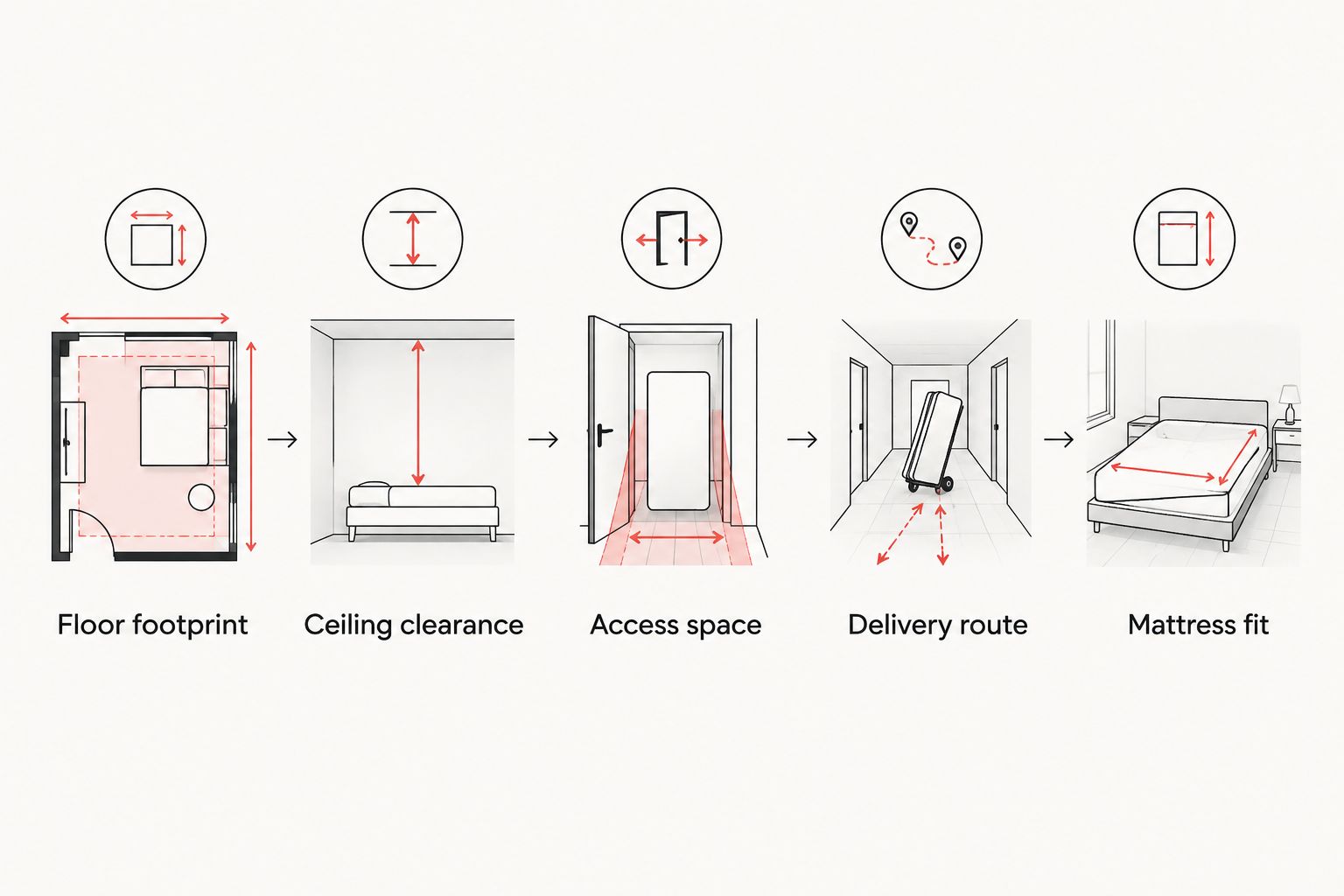
Painter's tape helps you test the outside footprint without buying anything. Tape the access area too; an outline that shows only the bed hides the space needed to climb in and out.
Approve the layout with the bedroom door and closet doors open. A clear rectangle on an empty floor is not the same as a bedroom that works on a busy school morning.
Keep mattress compatibility separate from frame dimensions
Standard mattress names describe the sleeping surface, not the assembled bed. A nominal twin mattress measures 38 by 75 inches, while a nominal full measures 54 by 75 inches; verify the actual mattress manufacturer's dimensions before ordering.
Those familiar dimensions give you a useful starting point. They do not establish the bed's outside footprint, the permitted mattress thickness, or compatibility with a particular frame.
If your 2026 room plan needs a shorter bed, ask whether the constraint concerns the frame or the sleeping surface. Reducing decorative projection is a different request from shortening the mattress opening, and neither should be assumed possible without the builder's confirmation.
A nonstandard opening also deserves a replacement plan. Identify a compatible mattress before approving the bed, and keep its specification with the order paperwork so a future replacement does not become another sizing project.
Does a thicker mattress solve a sleeper-fit problem?
A thicker mattress is not a substitute for checking the bed's specified mattress limits. On the upper bunk, extra mattress thickness reduces the guardrail height remaining above the sleeping surface.
Choose the frame and mattress together. Comfort matters, but it must fit within the manufacturer's requirements rather than override them.
Safety checks come before size approval
For a 2026 purchase, use the U.S. Consumer Product Safety Commission's bunk-bed guidance and the manufacturer's instructions as your safety references. CPSC guidance says children younger than 6 years should not use the upper bunk, and upper guardrails must extend at least 5 inches above the mattress surface.
These are safety checks, not custom-design specifications. Do not calculate a new guardrail or sleeping-platform design yourself from those figures; ask the builder to confirm the complete configuration and its mattress requirements.
Never remove a required guardrail to make a custom layout work. The top-bunk guardrail safety guide addresses that decision directly. A wall beside the bed does not make the manufacturer's guardrail instructions optional.
Check sleeper fit separately from mattress fit. Confirm the intended user's age, the documented weight limit, and any restrictions in the instructions; a mattress that fits the opening does not establish who can safely use the bunk.
What should you ask a custom bunk bed builder?
Send a short specification rather than a general request for a custom bed. The builder should be able to identify the proposed configuration without guessing what you meant.
Include these details:
- The room's measured usable length, width, and ceiling shape.
- The maximum finished outside dimensions you can accommodate.
- The intended mattress dimensions and thickness for each bunk.
- The sleepers' needs and the access arrangement you want reviewed.
- The delivery route and whether assembly is part of the request.
- A request to identify dimensional changes separately from other selections.
Ask for a drawing or written dimensional specification before approving the order. If a measurement changes during the discussion, request an updated version rather than relying on a message buried elsewhere.
Bunkbeddepot is best for families seeking solid wood bunk beds and custom configurations. Its stated offering includes handcrafted, made-in-USA bunk and loft beds; the practical limitation is that a brand-level description does not confirm a particular model's dimensions, finish details, or permitted alterations.
For Bunkbeddepot solid wood bunk beds, ask which model and configuration matches your drawing. Confirm model-specific construction and finishing details in the current product information rather than treating the whole collection as identical.
Is made to order the same as custom sized?
Made to order does not, by itself, confirm that a dimensional change is included. It describes an order being built, while your sizing question concerns the exact configuration the builder agrees to make.
For a Bunkbeddepot custom bunk bed inquiry, separate those questions: which dimensions are documented, which alterations are approved, and how are those alterations reflected in the quote?
Can I keep a standard mattress with a custom frame?
A standard mattress belongs in a custom frame only when the builder confirms the opening, support system, and permitted thickness are compatible. Keeping familiar mattress dimensions gives you a clear specification to discuss, but it does not guarantee that a requested outside dimension works.
What should a 2026 custom bunk bed quote show?
A 2026 custom bunk bed quote should identify the exact configuration you are approving, including finished dimensions and mattress requirements. Ask it to distinguish frame changes from delivery and assembly, then keep the matching drawing with the accepted quote.
FAQ
Does custom bunk bed sizing cost extra?
A configuration-specific quote determines whether custom bunk bed sizing costs extra. Ask the builder to identify any charge for your requested dimensions separately from other selections and services.
Does made to order mean I can choose any bunk bed dimensions?
Made to order does not confirm that every dimension can be changed. Ask the builder to approve your exact outside dimensions, mattress opening, and access arrangement.
Can I use a regular twin mattress in a custom bunk bed?
You can use a regular twin mattress only when the builder confirms compatibility with the exact frame. Check the mattress's actual dimensions and the bed's permitted mattress thickness.
What measurements should I send for a custom bunk bed?
Send the usable room dimensions, ceiling shape, maximum bed footprint, mattress specifications, and delivery-route constraints. Include door swings and the space needed to approach the ladder or stairs.
Can a child younger than 6 sleep on the upper bunk?
Children younger than 6 years should not use the upper bunk, according to U.S. Consumer Product Safety Commission guidance. Follow the manufacturer's instructions and age restrictions as well.
How high should a bunk bed guardrail sit above the mattress?
Upper bunk guardrails must extend at least 5 inches above the mattress surface under U.S. Consumer Product Safety Commission guidance. Use the manufacturer's specified mattress size and thickness rather than treating that minimum as a custom-design plan.
What should I confirm before ordering a Bunkbeddepot custom bunk bed?
Confirm the exact model, approved dimensions, mattress requirements, access arrangement, and written quote. Verify construction and finishing claims against the current information for that model.
One last thing
Measure the bedding routine, not just the bed. Stand where you will tuck in a sheet, help a child settle down, or reach the upper mattress; a layout that barely fits the frame can leave those everyday jobs awkward.
Then ask the useful question: what needs to change for this room to work? Sometimes the answer is a different layout rather than a different mattress size. Make that decision before approving the dimensions, and leave room for the bedtime stories as well as the furniture.


