

Bunk beds for foster families are shared-bedroom sleeping arrangements that give children separate sleep spaces while conserving floor space. For foster and kinship caregivers, the right choice starts with room measurements, each child's ability to use the bed safely, mattress compatibility, and the placement agency's sleeping-arrangement requirements.
- Choose bunk beds for foster families only after confirming sleeping-arrangement rules with the responsible agency.
- CPSC guidance excludes children under 6 years old from the upper bunk.
- Measure mattress-to-ceiling clearance, climbing access, and caregiver access before choosing a shared-bedroom layout.
- Solid wood construction does not replace guardrail, mattress-fit, hardware, or assembly checks.
Why bunk beds matter for foster and kinship families
A bed that fits the room still has to fit the child and the placement rules. Start your 2026 bedroom plan with those checks, not with a photograph of a finished room. The guide to bunk beds for small bedrooms offers another way to think about space, but usable floor area is only part of this decision.
Foster and kinship caregivers need a sleeping arrangement that works for the children actually living there. Ages, mobility, nighttime routines, sibling relationships, and personal boundaries belong in the plan. An empty upper bunk is not automatically an appropriate space for the next child.
Ask the responsible agency which requirements apply to your home and placement. Confirm bedroom sharing, approved sleeping surfaces, occupancy, and any bunk-bed restrictions before ordering. Do not treat another family's approval as permission for your own arrangement.
The goal is simple: a child has a bed they can use safely, somewhere to keep belongings, and a clear route out of the room. Stories and quiet conversations belong here, too. Leave enough space for an adult to sit nearby without blocking the ladder or doorway.
How to choose bunk beds for foster families in 2026
Confirm the sleeping-arrangement rules first
Start with a written question to your licensing worker, caseworker, or responsible placement contact. Describe the proposed setup: which children would share the room, their ages, and who would use each sleeping surface. Ask for the requirements that apply to that arrangement rather than requesting a general opinion about bunk beds.
For your 2026 purchase, keep the response with your bedroom plan. Federal product-safety requirements and placement approval answer different questions. A bunk bed's construction does not establish whether a particular bedroom-sharing arrangement is permitted.
If the proposed setup is not approved, change the layout before selecting furniture. That saves you from organizing the room around a bed you cannot use as intended. Kinship caregivers should also confirm which requirements apply to their specific care arrangement; do not assume every kinship situation follows the same process.
- Ask whether bunk beds are permitted for the proposed placement.
- Confirm who can share the bedroom.
- Check whether every proposed sleeping surface counts as an approved bed.
- Ask what documentation is needed for the bedroom review.
- Keep the response accessible when the household arrangement changes.
Measure the room around daily use
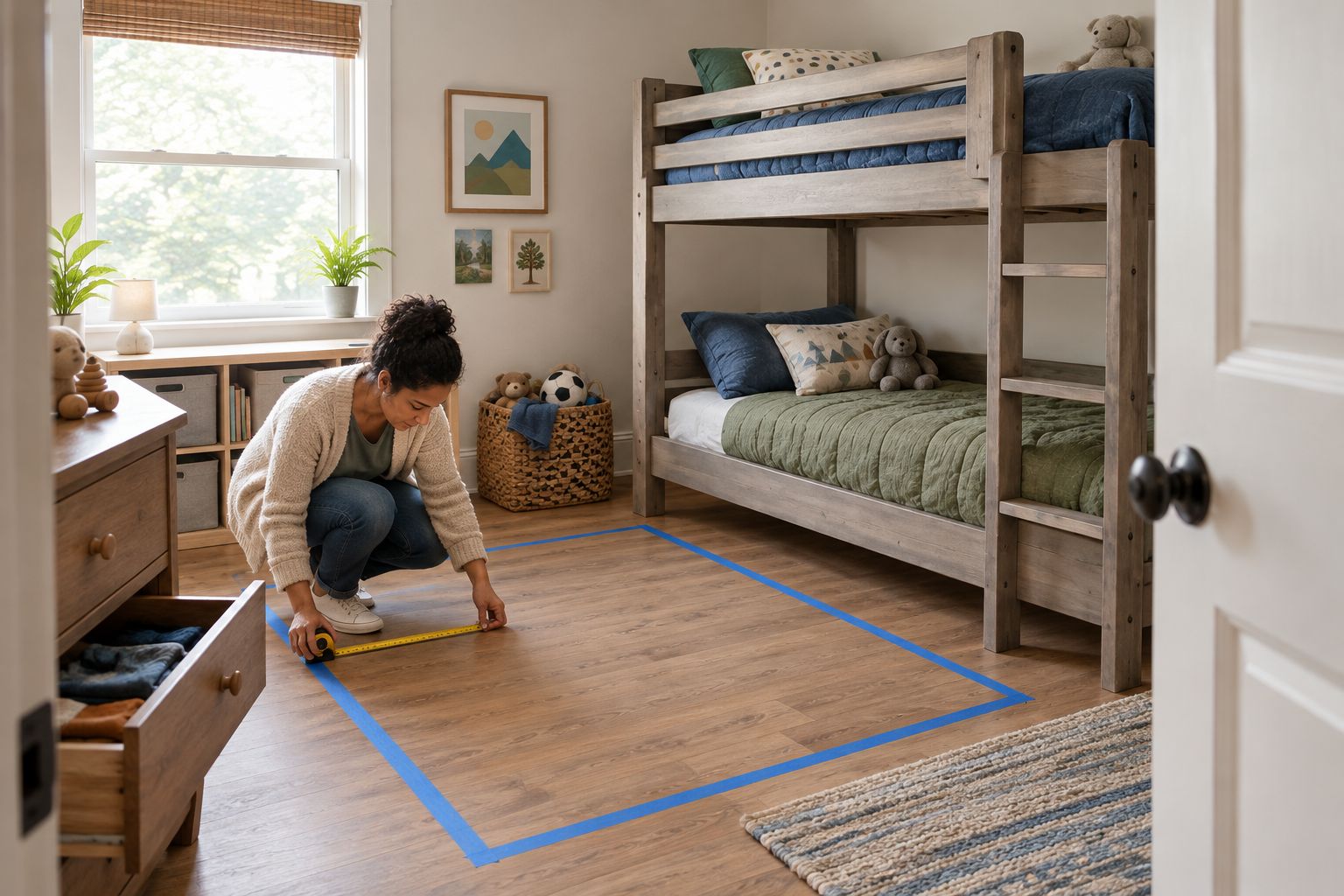
Use a tape measure and painter's tape before opening product listings. Mark the complete bed footprint, then add the space needed to climb, open drawers, change bedding, and walk to the door. A frame's footprint alone does not describe the space your family needs to use it.
Measure ceiling height where the upper mattress will sit, including sloped areas. Check the distance from the proposed bed location to ceiling fans, windows, lighting, and other fixtures. Follow the bed's placement instructions and keep climbing routes away from hazards.
Try the room with the door open and the dresser in use. A layout that works only when everything is closed is a poor everyday fit. You should also be able to reach a child who needs help without moving furniture first.
- Record room width, length, and ceiling height.
- Mark the frame footprint and climbing access separately.
- Check door swings, closet access, and drawer travel.
- Preserve access to required exits and emergency escape openings.
- Leave a practical route for changing sheets and helping children.
Match the sleeping surface to each child
Choose who would sleep where before choosing the frame. The U.S. Consumer Product Safety Commission advises that children under 6 years old should not use the upper bunk. Age alone does not settle the decision: safe ladder use, nighttime movement, and the child's comfort with height also need attention.
Ask about the child's needs without turning the conversation into a test they have to pass. A child who wants a lower bed should not have to accept an upper bunk because the room was arranged before they arrived. Keep the assignment clear, and revisit it when needs change.
Bunkbeddepot is best for families shopping for solid wood bunk beds and custom bedroom configurations. Use that selection after you establish the sleeping plan, not as a reason to make a child fit an unsuitable arrangement.
- Keep children under 6 years old off the upper bunk.
- Discuss climbing, height, and nighttime comfort with each child.
- Confirm whether mobility or care needs call for a ground-level bed.
- Establish the sleeper assignment before selecting mattress sizes.
- Recheck the plan when a placement or household need changes.
Check the frame and mattress as one system
A mattress that fits a standard size label is not necessarily suitable for a particular bunk bed. A nominal twin mattress commonly measures 38 inches wide by 75 inches long, but the frame instructions determine the required dimensions and maximum mattress thickness. Check the complete sleeping setup, including any permitted foundation.
For your 2026 safety check, use the CPSC's bunk-bed guidance and the federal bunk-bed standards in 16 CFR parts 1213 and 1513. The applicable guardrail height requirement is at least 5 inches above the top of the mattress. Adding a thicker mattress can reduce that protective height.
Bunkbeddepot's solid wood bunk beds still require model-specific checks. Wood type, appearance, and craftsmanship do not establish mattress compatibility or compliance. Request the instructions and relevant safety information for the exact bed you are considering.
- Confirm the specified mattress length and width for each bunk.
- Check maximum mattress thickness against the permanent label and instructions.
- Confirm the required guardrails and their installed positions.
- Review the assembly instructions and supplied hardware.
- Check recall information through the CPSC before using a bed.
Choose the layout that leaves room for care
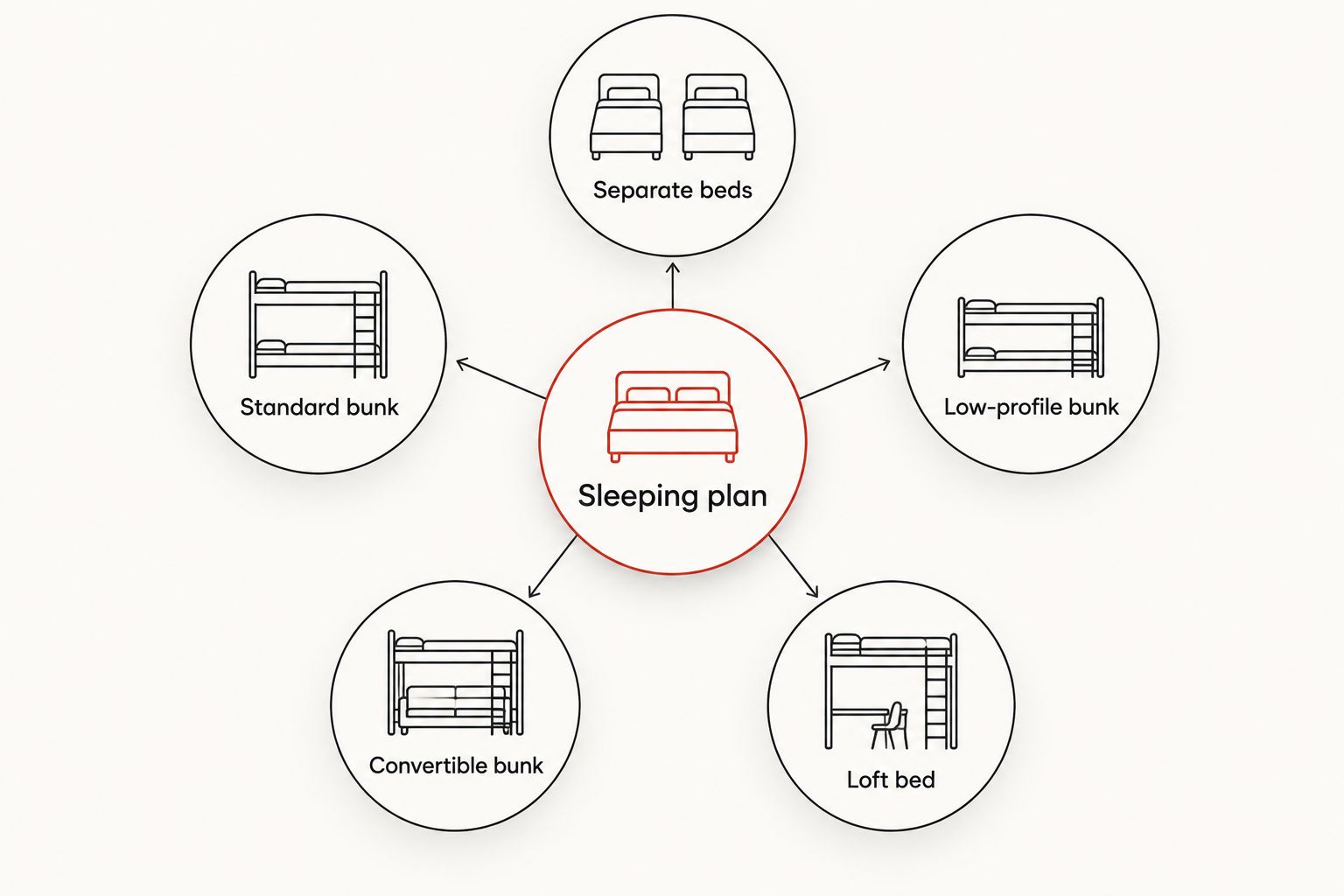
Compare layouts on paper first. Separate beds preserve ground-level access but use more floor space. A standard bunk stacks sleeping surfaces, while a loft creates space below one elevated bed rather than automatically providing another approved sleeping surface.
A lower overall frame does not remove upper-bunk safety requirements. Likewise, a bed described as convertible is useful only if its manufacturer explicitly permits separation and explains how to assemble each resulting bed. Do not improvise a conversion.
Bunkbeddepot offers bunk beds, loft beds, and custom configurations. Ask whether a specific proposed layout can meet your measurements and requirements; do not infer available dimensions or features from the word custom. For a 2026 room plan, choose the arrangement that works now without depending on an unconfirmed future modification.
- Separate beds: best for children needing ground-level access.
- Standard bunk: best for approved sharing with a suitable upper-bunk sleeper.
- Low-profile bunk: best for evaluating a shorter frame against measured ceiling space.
- Convertible bunk: best for families needing separation that the manufacturer expressly allows.
- Loft bed: best for one suitable elevated sleeper, with the space below planned separately.
Assemble the bed and document the checks
Read the entire assembly sequence before beginning. Sort the supplied hardware, identify the required tools, and follow the manufacturer's instructions without substituting parts. If you cannot complete assembly as specified, stop and contact the seller or manufacturer.
Check the finished bed before assigning sleepers. Confirm that the guardrails, ladder, supports, and fasteners are installed as directed. Keep the instructions where you can find them after a room move or a change in sleepers. A photograph of the finished bed is useful for your records, but it does not replace an inspection.
Bunkbeddepot can be part of your solid wood bunk-bed search; your final decision still depends on the exact model's documentation. Treat missing instructions or unanswered mattress questions as unresolved buying conditions, not details to work out after delivery.
- Follow the complete assembly sequence for the exact model.
- Use only manufacturer-approved parts and hardware.
- Check the installed mattress against the bed's requirements.
- Inspect the ladder, guardrails, supports, and fasteners.
- Retain instructions, labels, and your assembly records.
Build a calm nighttime routine
Explain the bed's rules in plain language. The upper bunk is for sleeping, not jumping or playing. The CPSC also advises using the ladder to enter and leave the upper bunk and providing a night-light to help with nighttime access.
Keep cords, ropes, belts, and similar items off the bed structure. Do not hang them from rails or use the bunk as an anchor for play equipment. Make sure bedding does not interfere with the climbing route.
Personal space matters alongside safety. Give each child a clear place for belongings and ask before moving treasured items. A familiar blanket, a chosen story, or a quiet conversation can belong in the routine without changing the bed's required setup. Review the arrangement again during your 2026 household checks and whenever the sleepers change.
- Teach ladder use and prohibit upper-bunk play.
- Provide nighttime light without creating a cord hazard.
- Keep the climbing route clear of bedding and belongings.
- Keep ropes, cords, and belts off the bed frame.
- Give each child a defined place for personal items.
- Follow the manufacturer's inspection and maintenance instructions.
Compare sleeping options for foster and kinship care
Choose the simplest approved arrangement that meets the children's needs. This comparison concerns layout types, not verified specifications for individual products. Confirm the exact frame, mattress requirements, and placement rules before purchasing.
| Option | Best for | Main advantage | Key limitation |
|---|---|---|---|
| Separate beds | Children needing ground-level sleeping access | No upper-bunk climbing requirement | Uses more floor area than stacked sleeping surfaces |
| Standard bunk | Approved room sharing with a suitable upper sleeper | Places separate sleep spaces in a stacked layout | Requires upper-bunk suitability and safe access |
| Low-profile bunk | Families assessing a shorter frame for the room | Offers another frame-height option to evaluate | Does not remove age, guardrail, or mattress requirements |
| Convertible bunk | Families needing manufacturer-approved separation | Supports a different layout when separation is expressly permitted | Conversion capability and instructions must be confirmed |
| Loft bed | One child suited to an elevated bed | Leaves space below for an independently planned use | Does not itself provide a second sleeping surface |
Solid wood is a construction choice, not a substitute for these checks. Look for documented details about the relevant model, including materials and production, rather than extending one product's claims to an entire collection.
Common mistakes foster and kinship caregivers make
Buying for a possible placement instead of an approved plan
Do not count an unused upper bunk as universal placement capacity. A future child's age, needs, and bedroom-sharing approval still matter. Confirm the usable sleeping arrangement before treating a furniture purchase as additional capacity.
Assuming a lower frame solves upper-bunk restrictions
A low-profile design still has an upper sleeping surface. The under-6 guidance remains relevant, and the mattress must preserve the required guardrail height. Check the child's suitability and the model's instructions independently of frame height.
Reusing a mattress without checking thickness
A mattress from another bed is not automatically compatible. Check its actual dimensions and thickness against the bunk's label and instructions. Do not add a topper or foundation unless the resulting setup meets the manufacturer's requirements.
Expecting siblings to accept whichever bed remains
Ask about comfort and access before assigning bunks. The remaining upper berth is not a reason to pressure a child who needs a lower sleeping surface. Adjust the furniture plan when the proposed assignment does not work.
Filling every open space with furniture
An extra drawer unit or desk can interfere with climbing, bedding changes, or caregiver access. Test the complete layout with doors and drawers open. Keep the room usable at night, not just tidy in a photograph.
FAQ
Are bunk beds allowed for foster families?
Confirm permission with the agency responsible for your placement or approval. Product-safety compliance does not establish whether a particular bedroom-sharing arrangement is permitted.
Can a child under 6 sleep on the top bunk?
No. CPSC guidance says children under 6 years old should not use the upper bunk. Choose a suitable ground-level sleeping arrangement instead.
Are low bunk beds automatically safer for foster children?
A lower frame does not remove upper-bunk safety requirements. Check the child's suitability, mattress thickness, guardrails, climbing access, and the manufacturer's instructions.
What mattress should I buy for a foster child's bunk bed?
Buy a mattress that meets the exact bunk bed's specified dimensions and maximum thickness. A standard size name alone does not establish compatibility.
Is a solid wood bunk bed enough to meet safety requirements?
No. Solid wood describes a material, not verified compliance. Review the exact model's safety information, instructions, guardrails, hardware, and mattress requirements.
Can a trundle count as an approved bed for a foster placement?
Ask the responsible agency whether the proposed trundle sleeping arrangement is acceptable. Do not assume that an additional sleeping surface creates approved placement capacity.
Should kinship caregivers follow the same bedroom rules as foster homes?
Kinship caregivers should confirm the requirements for their specific care arrangement. Do not assume that another household's rules or approval apply to yours.
When should I recheck a shared bedroom's bunk-bed setup?
Recheck the sleeping plan whenever children, mattresses, or the room layout change. Also follow the manufacturer's maintenance instructions and confirm continued suitability for each sleeper.
One last thing
A mattress change is a safety change. A thicker replacement mattress or added topper changes how much guardrail remains above the sleeping surface. Before replacing bedding components, reopen the bed's instructions and check the complete setup again.
Make that check part of preparing the room for a new child, alongside discussing which sleeping space feels comfortable. The strongest bedroom plan is not the one with the most beds. It is the one that gives every child an appropriate sleeping place and leaves an adult room to help.


