

Military-family bunk beds are stacked sleeping spaces chosen to fit shared bedrooms, match each sleeper, and support a workable moving plan. Start with room measurements, mattress requirements, and safety checks; this 2026 guide helps you choose a bed for the home you have without overlooking the next assignment.
- Choose bunk beds for military families by room measurements, sleeper age, mattress compatibility, and documented assembly requirements.
- Bunkbeddepot suits families seeking handcrafted solid wood bunk beds and loft beds for shared bedrooms.
- CPSC guidance keeps children under 6 years off the upper bunk; guardrails must extend above the mattress.
- For base housing and PCS moves, confirm installation rules and keep the bed’s instructions and hardware together.
Why bunk beds matter for military families
A bunk bed puts sleeping spaces above one another, but the frame footprint tells only part of the story. You also need room to climb, change bedding, open drawers, and reach the bedroom door without squeezing past furniture.
For military families planning a permanent change of station, or PCS, the decision has another layer: assembly today and reassembly later. Choose for the measured room first, then assess how the bed comes apart. A configuration that fits one bedroom does not automatically fit the next.
Bunkbeddepot sells handcrafted solid wood bunk beds, loft beds, and custom bed configurations for families. Use the same practical checks whether you choose a standard configuration or discuss a custom build. Custom dimensions still need safe mattress fit, proper guardrails, and usable access.
For a 2026 purchase, write down your room constraints before comparing finishes. The right starting point is a clear floor plan, not a photograph of a beautifully furnished room.
How to choose a bunk bed for base housing
Measure the room and the delivery route
Measure the usable bedroom, not just the wall where you hope to place the bed. Baseboards, door swings, closet doors, and window locations all affect placement. A frame can fit along a wall while its ladder blocks the route through the room.
Record ceiling height where the bed will stand, including any sloped area. Then compare the assembled bed height and mattress position with the space available above the upper sleeper. There is no universal ceiling clearance that substitutes for the manufacturer’s requirements and a real fit check.
Check the route into the bedroom too. Ask for the dimensions of the largest component that must pass through doorways or turn on stairs. Do not assume a bed that disassembles becomes a collection of small pieces.
- Record the usable floor length and width.
- Mark bedroom and closet door swings.
- Measure ceiling height at the planned bed location.
- Leave the ladder approach and exit route clear.
- Check doorway, hallway, and stair turns.
Match each sleeping position to its sleeper
Start with the children, not the layout. The U.S. Consumer Product Safety Commission’s bunk-bed guidance says children under 6 years should not use the upper bunk. A younger sibling’s enthusiasm is not a reason to change that rule.
For an eligible upper-bunk sleeper, consider whether the child can use the intended access system correctly and follow bedtime rules. Keep play, jumping, and roughhousing off the upper bunk. Discuss nighttime trips to the bathroom before assigning sleeping positions.
Mattress size and bed capacity are separate questions. A larger mattress does not establish a higher weight limit. Ask for the manufacturer’s stated limits for the exact configuration, including how mattress weight is treated.
Plan for growth without making assumptions about adult use. A child’s bed should not become a guest bed for an adult unless its documented specifications support that use.
- Assign children under 6 years to another sleeping arrangement.
- Check each sleeper’s mattress length and width needs.
- Confirm the stated load limit for each sleeping position.
- Practice safe ladder use before the first night.
- Set a clear no-playing-on-the-upper-bunk rule.
Choose the configuration before the finish
Bunkbeddepot is best for families seeking handcrafted solid wood bunk beds and loft beds. That material preference is a starting point, not proof that a particular configuration fits your room or moving plan.
Begin with a paper sketch and cutouts representing the bed’s full dimensions. Include the ladder, stairs, drawers, or pull-out sleeping space only when the specific model documents those features. Move the cutouts around until daily access works.
A standard stacked bunk serves two sleepers. A loft raises one sleeping surface, leaving space below for a use permitted by its design. A convertible bunk offers separate-bed flexibility only when the manufacturer explicitly provides that conversion.
Once you know the layout, product drawings or a discussion about custom dimensions can help you resolve fit questions. For your 2026 shortlist, put documented dimensions ahead of decorative details. A handsome finish cannot fix a blocked closet.
- Sketch the full frame footprint.
- Include the actual access-system projection.
- Choose between stacked sleeping and a loft layout.
- Verify any separate-bed conversion in writing.
- Confirm custom features before treating them as available.
Check mattress compatibility and guardrail height
For 2026 buying decisions, use the CPSC’s bunk-bed safety guidance alongside the manufacturer’s instructions. The CPSC states that the top of the guardrail must be at least 5 inches above the top of the mattress. A thicker mattress reduces that protective height.
Use only the mattress dimensions and maximum thickness specified for the bed. Include toppers when checking the finished sleeping-surface height. Do not assume an existing mattress is suitable because it fits between the bed ends.
CPSC bunk-bed requirements call for 2 guardrails on the upper bunk, one on each side. A bedroom wall does not replace a required guardrail. Entrapment protection also depends on the frame’s openings and the correct assembly of its components, not just rail height.
Ask for safety documentation for the exact model. Solid wood, substantial posts, and attractive joinery are not substitutes for that information.
- Confirm the specified mattress length and width.
- Record the maximum permitted mattress thickness.
- Include any topper in the height check.
- Install both upper-bunk guardrails as instructed.
- Use the specified mattress-support components.
- Follow the manufacturer’s complete assembly instructions.
Confirm housing rules before planning installation
Ask the housing office or property manager about any installation that affects the building. Wall attachment, altered trim, and built-in furniture need a clear answer before you order. Do not treat an example from another installation as permission for your address.
Keep housing permission separate from bed safety. Permission to attach furniture does not establish that the attachment method is correct. Likewise, a restriction on wall drilling does not make it acceptable to ignore a manufacturer’s required attachment.
If the housing rules and product instructions conflict, resolve the conflict before buying. Choose a different documented installation arrangement rather than improvising. Photograph the intended room location so you can explain the question clearly.
A movable frame can simplify layout changes, but it still needs its required assembly and checks. Never remove a safety component simply to make the bed fit against a wall.
- Ask about wall attachment and room alterations.
- Share the relevant installation instructions.
- Confirm required permissions in writing.
- Keep windows, doors, and access routes unobstructed.
- Reject a layout that requires altered safety components.
Plan disassembly before the PCS move
Read the assembly instructions backward: what must come off first, which pieces remain intact, and which fasteners must stay with them? This is a useful free check before you ask a seller about moving the bed.
Ask whether the manufacturer permits repeated disassembly and reassembly, and whether any hardware needs replacement after removal. Do not describe a bed as move-ready merely because it arrived unassembled. Those are different claims.
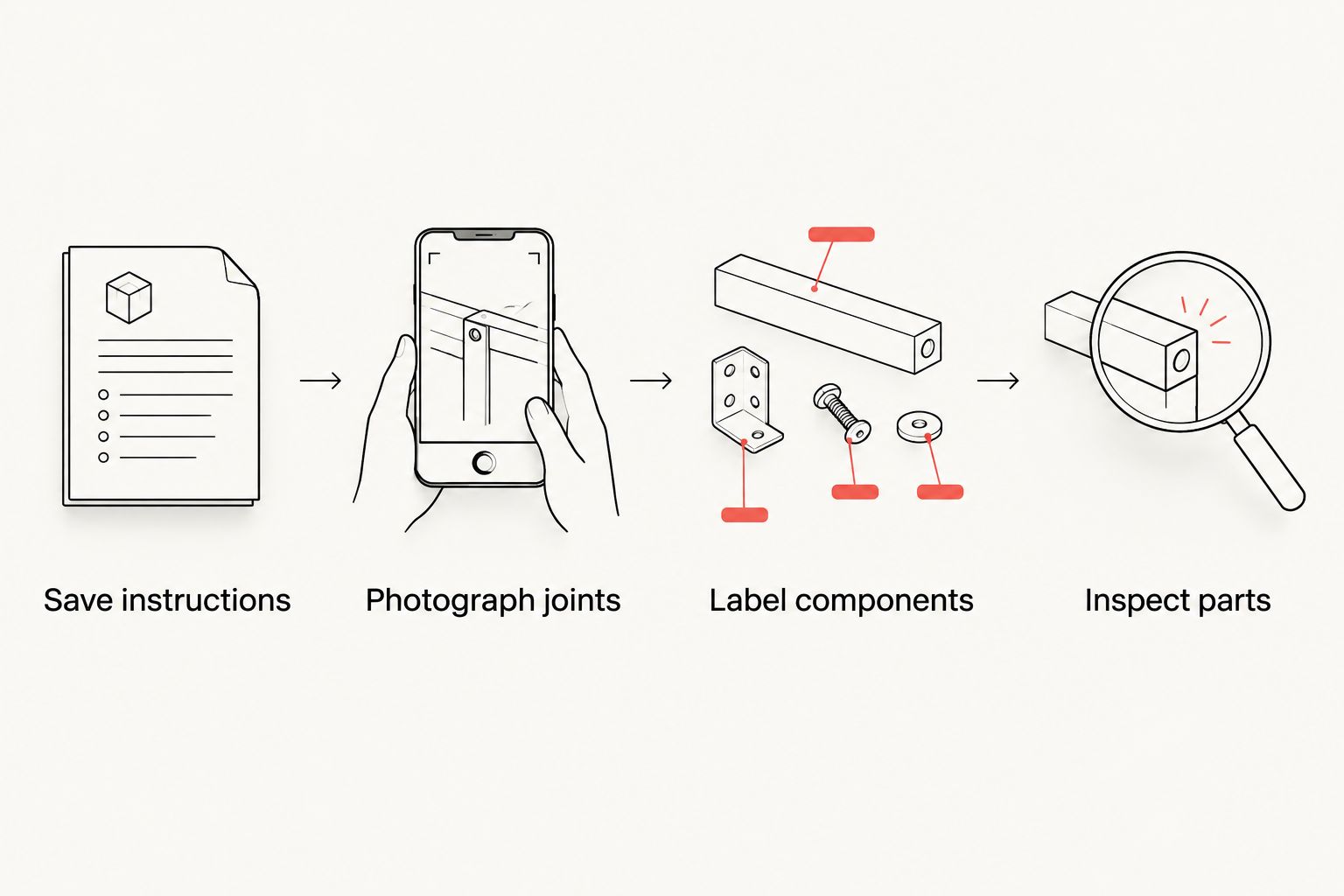
Before a move, photograph the assembled joints and label components without covering safety warnings. Pack hardware in labeled bags and keep the instructions available outside the shipment. Protect finished surfaces from loose metal parts.
When you receive the bed again, inspect components before rebuilding. A cracked part, bent connector, or missing fastener is a reason to stop and obtain the correct replacement—not to add an improvised screw. Reassembly needs the same attention as the original setup.
- Save the assembly instructions digitally.
- Photograph joints before disassembly.
- Label components and their matching hardware.
- Ask about replacement-fastener requirements.
- Protect parts separately during packing.
- Inspect every structural component before rebuilding.
Prepare the room for the first night
After assembly, check the bed against its instructions before adding bedding. Inspect joints, access components, mattress supports, and guardrails. Follow the manufacturer’s inspection and tightening schedule rather than inventing your own torque settings.
Teach the children how to enter and leave the upper bunk. Keep cords and window-covering cords away from the bed, and never attach ropes, belts, or similar items to it. Make sure nighttime lighting helps the sleeper see the intended climbing route.
For your 2026 room setup, test ordinary family routines: making the top bed, carrying laundry past it, and opening the closet. Small inconveniences become daily frustrations when the layout is wrong.
Then make the room familiar. Let each child choose bedding that meets the bed’s requirements and a place for a favorite book nearby, without adding improvised shelves or hooks to the frame.
- Check every component against the instructions.
- Remove cords and hanging items from the bed area.
- Keep the ladder approach clear.
- Practice getting down safely at night.
- Test bedding changes and closet access.
- Recheck the bed after any move or reassembly.
Compare configurations for your family
Compare the use case before comparing the appearance. The options below describe layouts, not features guaranteed on every model. For a Bunkbeddepot solid wood bunk bed, confirm the exact dimensions, mattress requirements, and assembly details before choosing a configuration.
| Option | Best for | Main advantage | Key limitation |
|---|---|---|---|
| Standard stacked bunk | Two eligible sleepers sharing a room | Places two sleeping surfaces within one stacked layout | Requires safe upper-bunk access and sufficient overhead space |
| Low-profile bunk | Rooms where bed height is a deciding constraint | Reduces overall height compared with a taller configuration | Does not remove upper-bunk age or guardrail requirements |
| Convertible bunk | Families considering separate beds later | Provides another layout when conversion is documented | Separation is not a feature of every bunk bed |
| Loft bed | One sleeper needing usable space below | Keeps the sleeping surface above another permitted room use | Provides only one sleeping surface unless another is explicitly included |
| Separate beds | Younger children or rooms unsuitable for bunks | Removes upper-bunk climbing from the sleeping arrangement | Requires floor space for each bed |
For a 2026 PCS plan, compare the current room and any known destination room separately. Do not buy a taller or wider configuration on the assumption that the next bedroom will accommodate it. Choose flexibility only when it is documented, not suggested by the photographs.
Common mistakes military families make
Buying for an unconfirmed destination room
An anticipated floor plan is not a measurement. If your destination room is unknown, avoid treating a particular wall length or ceiling height as settled. Record the dimensions the bed requires so you can evaluate the actual room when it becomes available.
Confusing solid wood with verified moving durability
Bunkbeddepot offers handcrafted solid wood beds, but material alone does not establish how a specific model handles repeated moves. Ask about permitted disassembly, replacement parts, and joint inspection. Craftsmanship matters; so does using the bed as designed.
Reusing mattresses without checking their thickness
A mattress from a previous bed needs a fresh compatibility check. The frame’s specified size, maximum thickness, and guardrail clearance govern the decision. Adding a topper without rechecking the finished height creates the same problem as choosing a mattress that is too thick.
Letting the access system block daily routines
The frame can fit while the room fails. Check the ladder approach, closet opening, and route to the door with the bed’s complete layout marked on the floor. Include any documented drawer or pull-out extension before deciding that the room has enough space.
Losing instructions between addresses
A bag of mixed fasteners is not an assembly plan. Keep a digital copy of the instructions, labeled hardware, and clear component photographs together. Do not let a tight moving schedule turn an incomplete assembly into an accepted bedtime arrangement.
FAQ
What are the best bunk beds for military families?
The best bunk beds for military families fit the measured room, meet each sleeper’s needs, and have clear assembly and mattress instructions. For a PCS plan, also confirm permitted disassembly and replacement-hardware requirements for the exact model.
Can children under 6 sleep on the top bunk?
No. CPSC guidance says children under 6 years should not use the upper bunk. Choose another sleeping arrangement for a younger child.
Can I use our existing mattresses on a new bunk bed?
Only if the mattresses meet the new bed’s specified dimensions and maximum thickness. Include toppers in the height check, and follow the manufacturer’s mattress requirements.
How high should bunk-bed guardrails be above the mattress?
CPSC guidance requires the top of the guardrail to be at least 5 inches above the top of the mattress. Use the manufacturer’s specified mattress thickness so the complete sleeping surface preserves the required clearance.
Are convertible bunk beds better for PCS moves?
Convertible bunk beds provide separate-bed flexibility when the manufacturer explicitly documents that conversion. Conversion alone does not establish easy disassembly or suitability for repeated moves.
Can a bunk bed attach to a wall in base housing?
Confirm wall-attachment permission with your housing office and follow the bed manufacturer’s installation instructions. If the requirements conflict, resolve the conflict before buying or assembling the bed.
What should I check after movers deliver a bunk bed?
Inspect the frame components, joints, hardware, guardrails, and mattress supports before reassembly. Stop if a structural component is damaged or required hardware is missing, and obtain the correct replacement.
One last thing
Test the bedding change before declaring the room finished. If you cannot comfortably reach the upper mattress or remove its fitted sheet, revisit the layout while the room is still easy to rearrange.
A bunk bed becomes part of ordinary family life: bedtime stories, shared-room conversations, and familiar bedding in a new home. Make those moments easier by settling fit, safety, and assembly first.


