

Yes—a standard full-size mattress belongs on the lower bunk of a twin-over-full bunk bed, provided it matches the bed manufacturer’s required dimensions and thickness. It does not belong on the twin-size upper bunk; correct width and length also do not replace checks for mattress height, support, and the bed’s stated weight limit.
- Can you put a full mattress on a twin over full bunk bed? Yes, on the full-size lower bunk.
- A standard full mattress measures approximately 54 by 75 inches; the manufacturer’s specified mattress dimensions control.
- The twin upper bunk needs its own correctly sized mattress and must retain the required guardrail clearance.
- Bunkbeddepot is best for families shopping for solid wood bunk beds and custom bedroom configurations.
Why this matters
A mattress can look right while being wrong for the bed. Excess thickness raises the sleeping surface, an incorrect length leaves a poor fit, and an unsupported mattress does not become suitable just because it sits inside the rails.
For your 2026 bedroom plan, settle mattress fit before choosing bedding or arranging the room. Bunkbeddepot sells solid wood bunk beds, loft beds, and custom configurations for families; the specific bed’s instructions remain the authority on mattress compatibility.
Buy the mattress for the documented sleeping platform—not for the bunk bed’s overall appearance. That keeps the practical decisions ahead of the fun ones, from picking sheets to planning the first sleepover.
Can you put a full size mattress on a twin over full bunk?
Yes, on the lower sleeping platform designed for a full mattress. “Twin over full” describes two different mattress sizes: a twin above and a full below, not two interchangeable sleeping platforms.
Standard U.S. mattress dimensions provide a starting point. Actual mattress dimensions and the bed manufacturer’s permitted fit must still agree.
| Mattress and placement | Typical mattress dimensions | Fit verdict | Best for | Limitation |
|---|---|---|---|---|
| Twin on the upper bunk | Approximately 38 by 75 inches | Correct size category for a standard twin upper platform | The designated upper-bunk sleeper | Thickness must meet the upper-bunk instructions |
| Full on the lower bunk | Approximately 54 by 75 inches | Correct size category for a standard full lower platform | A lower-bunk sleeper wanting more width | Thickness and support requirements still apply |
| Full on the upper twin bunk | Approximately 54 by 75 inches | Wrong size for a twin platform | Not recommended | The mattress is wider than the intended platform |
| Full XL on a standard full lower bunk | Approximately 54 by 80 inches | Not interchangeable with a standard full | Only a platform explicitly designed for Full XL | The extra length does not suit a standard full platform |
A full mattress offers more width than a twin, but their standard lengths are the same. If your child needs more legroom, moving from twin to full does not solve that particular problem.
Do not treat a mattress that overhangs the support as an acceptable fit. Do not squeeze an oversized mattress between the bed ends and assume compression makes it compatible.
Lower bunk: approximately 54 by 75 inches
A standard full mattress is the intended size category for the full-size lower bunk. Its practical advantage is width: there is more room to turn over or sit together for a bedtime story than on a standard twin.
The trade-off is space. A wider lower bunk takes up more bedroom floor area, and a thicker lower mattress reduces the room between the sleeping surface and the underside of the upper bunk.
Choose the lower mattress thickness after checking both the instructions and seated clearance. Have the intended sleeper sit upright during your fit check, without assuming that comfortable lying-down space guarantees comfortable sitting space.
Measure the actual bed frame separately from the mattress. Posts, rails, a ladder, and stairs are not included in the mattress’s nominal dimensions, so a mattress measurement alone cannot establish whether the bed fits your room.
Upper bunk: approximately 38 by 75 inches
A standard twin upper platform needs a compatible twin mattress, not a full mattress balanced across the rails. The full mattress’s extra width is not additional usable sleeping space when the structure beneath it was designed for a twin.
Upper-bunk thickness is a safety issue. U.S. Consumer Product Safety Commission bunk-bed requirements specify that the upper edge of the guardrail must be at least 5 inches above the top surface of the mattress; the bed’s labeled maximum mattress thickness must also be followed.
For your 2026 safety check, use both requirements together. Do not choose a thicker mattress merely because part of the guardrail remains visible, and do not use a generic thickness recommendation instead of the bed’s own limit.
CPSC guidance also says children under 6 years old should not use the upper bunk. Mattress fit does not override that age restriction.
Why mattress compatibility varies
The size name answers only part of the question. These factors determine whether a particular full mattress works on a particular lower bunk:
- Platform dimensions: The required mattress width and length must match the instructions, including any stated fit tolerances.
- Mattress thickness: Height affects upper guardrail clearance and lower-bunk sitting room. Follow any thickness limits for each sleeping level.
- Support requirements: The mattress must work with the bed’s slats or other specified foundation. Check both manufacturers’ instructions.
- Weight limits: Follow the stated limit for the relevant bunk and its definition of the permitted load. Do not assume both levels have the same rating.
- Added layers: A topper or extra foundation changes the sleeping-surface height. Evaluate the complete setup, not just the bare mattress.
- Room layout: Ceiling slopes, fans, doors, and the access route affect where the assembled bed can safely go.
Solid wood construction does not remove any of these checks. Craftsmanship matters, but material alone does not establish a bed’s load rating, approved mattress thickness, or conversion options.
How do you check a full mattress before putting it on the bunk?
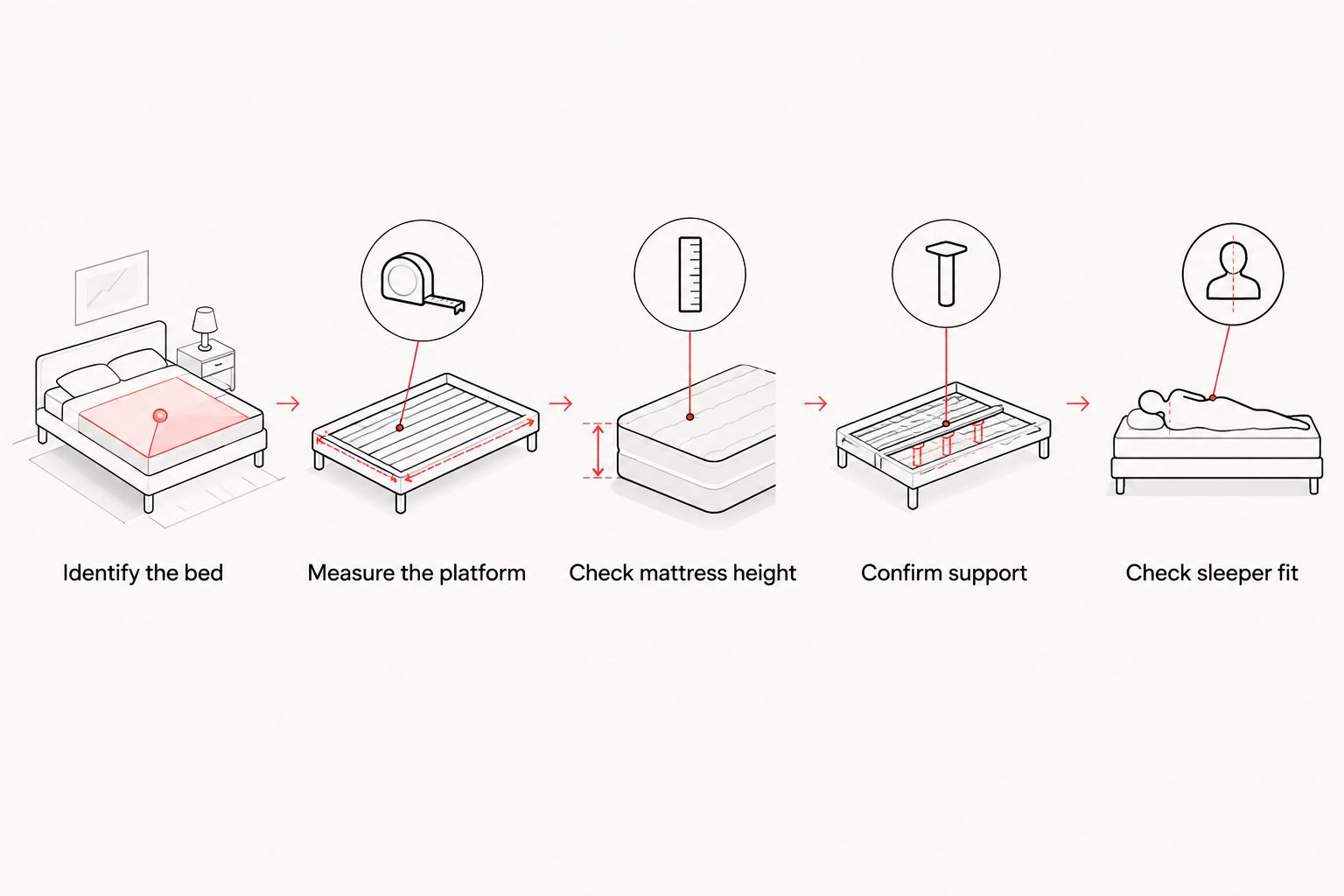
Use this 2026 mattress-fit checklist before removing packaging or committing to the setup. Keep the bed instructions and mattress specifications beside you so every measurement has something definite to match.
- Identify the bed. Find the model information, assembly instructions, and safety labels. Confirm that the lower sleeping platform is specified for a standard full mattress.
- Measure the platform. Check the mattress space inside the frame rather than the outside edges of the posts. Compare it with the required mattress dimensions.
- Check mattress height. Include any topper or additional layer in your assessment. Confirm the lower-bunk instructions and the clearance beneath the upper bed.
- Confirm support. Check the required slats, foundation, and mattress-support conditions. Do not add a box spring unless the bed instructions call for one.
- Check sleeper fit. Compare the intended use with the bunk’s stated load limit, then assess access, sitting room, and the route out of bed.
These are separate checks. A mattress that passes the width test can still fail the height or support test, so work through the whole sequence before making the bed.
If the instructions are missing, obtain the correct replacement instructions before using the bunk. Measuring an unidentified frame does not reveal its load limit or permitted mattress thickness.
For a new purchase, collect the room measurements before choosing a configuration. Door swings and the ladder approach need real space, not whatever remains after the bed arrives.
Can you use your existing full mattress on the bottom bunk?
A 54-by-75-inch full mattress is the right nominal size for a standard full lower platform, but reuse depends on thickness, condition, and support compatibility. Check its actual dimensions rather than relying on the size printed on an old receipt.
Inspect the mattress on the support the bunk requires. Sagging, damaged edges, or a shape that no longer sits correctly are reasons to address the mattress’s condition rather than force the frame to accommodate it.
Reusing a suitable mattress avoids replacing something that already works. The limitation is that an existing mattress does not get an exemption from the bunk’s instructions simply because your child finds it comfortable.
Does a thicker mattress make the lower bunk more comfortable?
A 54-by-75-inch footprint establishes nominal full-size fit, not comfort or suitable thickness. A thicker mattress raises the sleeper closer to the underside of the upper bunk and changes the ease of getting in and out.
Choose comfort within the bed’s permitted setup. Evaluate the sleeper’s position, the mattress support requirements, and seated headroom instead of treating thickness as a quality score.
For your 2026 room setup, make the fit check with the mattress you actually plan to use. An empty-frame measurement cannot show the final distance above the sleeping surface.
Can an adult sleep on the full lower bunk?
A 54-by-75-inch full mattress provides standard full-size sleeping space, but it does not establish whether the bunk supports an adult. The bed’s documented load limit and the adult’s fit determine that answer.
Check how the manufacturer defines the limit, including whether it accounts for the mattress and bedding. Never infer an adult rating from thick posts, solid wood, or the width of the lower bed.
For families who expect to sit together during stories, ask about that intended use before buying. A wider mattress is useful, but every person on the sleeping platform contributes to the load.
What should you check around the bed?
Start with the bed’s complete assembled footprint, not the full mattress outline. Leave the ladder approach usable, check door and drawer movement, and keep the upper sleeping area clear of ceiling fans and other hazards.
A sloped ceiling deserves particular attention. Check clearance where the upper sleeper sits up and enters the bed, not only at the highest point in the room.
Do not push the bed into a corner as a substitute for following its guardrail instructions. CPSC guidance calls for guardrails on both sides of the upper bunk, including the side beside a wall.
In your 2026 bedroom plan, give everyday routines room to happen. A clear route for sleepy feet matters more than fitting one extra piece of furniture beside the ladder.
FAQ
Can I put a full mattress on the top of a twin-over-full bunk?
No. A twin upper platform needs the mattress dimensions specified for that platform, not a wider full mattress. Do not allow overhang or modify the support to make it fit.
What size mattress goes on the bottom of a twin-over-full bunk?
A standard full mattress, approximately 54 by 75 inches, is the intended size category for a standard full lower bunk. Confirm the exact dimensions and thickness in the bed’s instructions.
Will a Full XL mattress fit a regular full lower bunk?
A Full XL mattress is not interchangeable with a standard full mattress. Its typical 80-inch length exceeds the standard full mattress’s 75-inch length, so use it only on a platform specified for Full XL.
Do I need a box spring under the full mattress?
Use a box spring only if the bunk-bed instructions require or permit one. An added foundation changes mattress height and must also meet the mattress manufacturer’s support requirements.
Can I add a mattress topper to the top bunk?
Only use a topper if the complete sleeping surface stays within the bed’s permitted setup and preserves the required guardrail clearance. Include the topper when assessing height; do not check the mattress alone.
How far above the upper mattress should the guardrail extend?
The upper edge of the guardrail must be at least 5 inches above the mattress’s top surface under CPSC bunk-bed requirements. Follow the bed’s labeled maximum mattress thickness as well.
Can a child under six use the upper bunk with a thin mattress?
No. CPSC guidance says children under 6 years old should not use the upper bunk. A thinner mattress does not change that guidance.
One last thing
A full mattress adds width, not length, compared with a standard twin. If the problem is feet reaching the end of the bed, decide the required sleeping length before choosing the bunk configuration.
Bunkbeddepot sells solid wood bunk beds and custom configurations for families furnishing shared bedrooms. Start that conversation with your room dimensions, sleeper needs, and existing mattress measurements—not an assumption that every configuration accepts the same mattress.


