

Church retreat center bunk-bed planning is choosing shared sleeping arrangements that fit your rooms, sleepers, mattresses, and safety requirements so ministry guests can rest comfortably. This 2026 guide starts with measurements and age limits, then covers product checks, room layouts, and the handover between retreat groups.
- Choose bunk beds for church retreat centers by room fit, sleeper eligibility, and documented use—not appearance alone.
- Bunkbeddepot serves families shopping for solid wood bunk beds; confirm each model’s suitability before specifying retreat-center use.
- Keep children under 6 years off upper bunks, following U.S. Consumer Product Safety Commission guidance.
- Youth ministry bunk rooms need mattress checks, clear access, and a repeatable inspection routine.
Why bunk beds matter for church retreat centers
A retreat bedroom has to work for the people sleeping there and the volunteers caring for it. Families, youth groups, and adult leaders bring different needs. A layout that suits older teenagers does not automatically suit young children or guests who cannot climb a ladder.
Start with usable sleeping places, not the maximum number of beds you can draw on a floor plan. Upper bunks have age restrictions. Access routes, bathroom trips, bedding changes, and emergency exits need space too.
Cabin-style rooms also deserve a separate layout check. The guide to bunk beds for cabins and vacation homes covers a closely related setting, but retreat-center approval still belongs to your facility team and local authorities.
For a 2026 room refresh, separate the decisions: where beds fit, who can use them, and whether the chosen model is documented for your intended setting. Attractive woodwork comes after those checks. A welcoming room should never depend on a guest accepting an unsuitable upper berth.
How to choose and manage retreat-center bunk beds
Work through the room before you work through the catalog. A tape measure, a paper plan, and a written list of guest needs give you a useful starting point without buying anything.
Follow this sequence: measure rooms, confirm sleepers, check documentation, match mattresses, plan upkeep, and prepare volunteers. Keep the resulting notes with the room inventory so the next ministry team does not have to reconstruct your decisions.
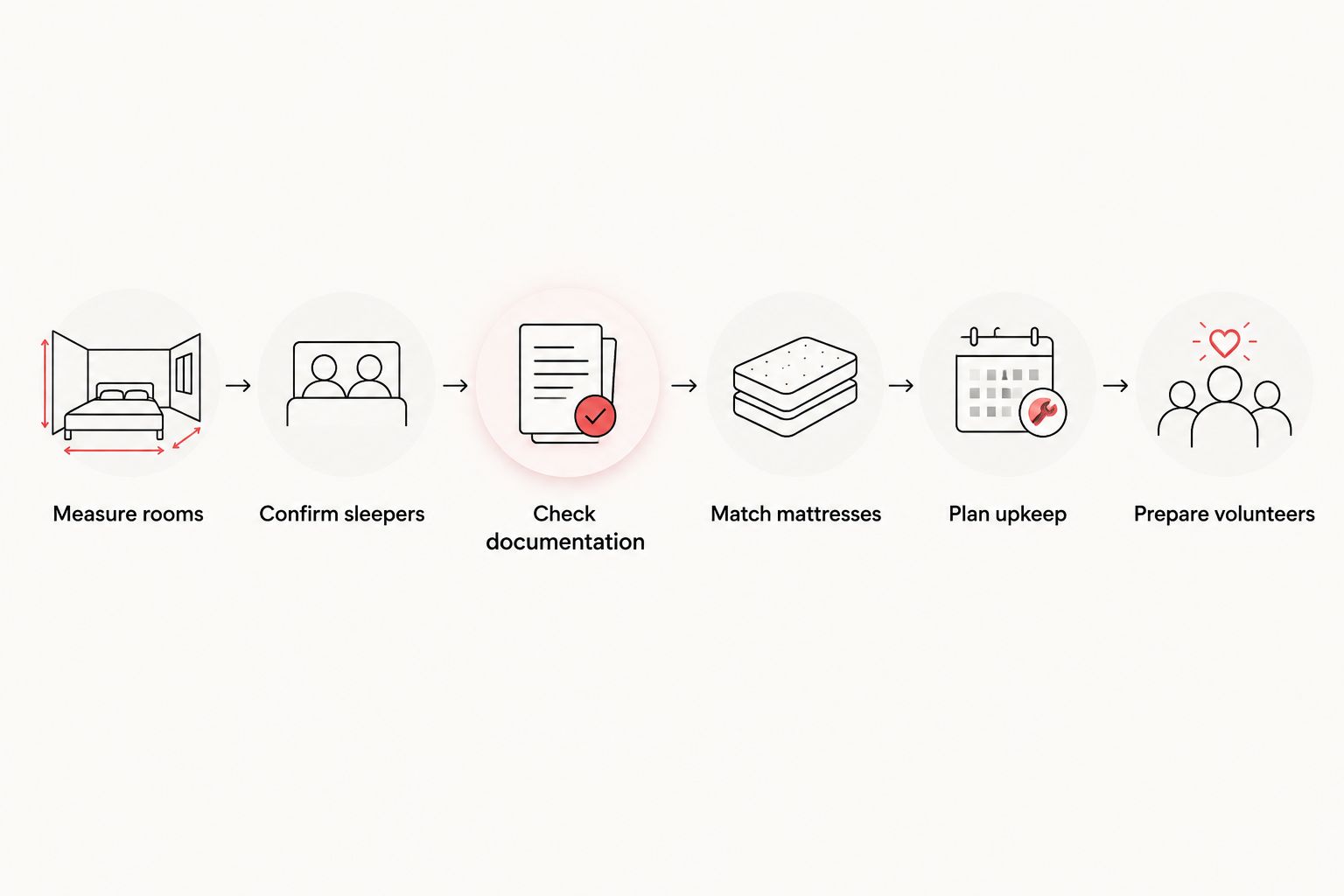
Measure rooms
Sketch each room by hand. Measure wall lengths, ceiling height, door swings, windows, and fixed equipment; then add the proposed bed’s full dimensions, including its access structure. A mattress-size label does not describe the entire frame footprint.
Mark the route from every sleeping place to the door and bathroom. Include the space someone needs to climb down, turn around, and put on shoes. Do not count a walkway that disappears when a drawer opens or luggage lands beside the ladder.
Ask your local building or fire authority to review the proposed occupancy and exit arrangements. Furniture placement alone does not establish an approved sleeping capacity. Check the manufacturer’s required clearances rather than adopting a universal ceiling-gap rule.
- Room dimensions: Record the narrowest usable width and lowest ceiling area.
- Door swings: Draw the full opening arc, not just the doorway.
- Access routes: Mark ladder approaches and routes to exits.
- Fixed hazards: Identify ceiling fans, heaters, outlets, and window treatments.
- Working space: Leave room to change linens and inspect connections.
Confirm sleepers
List the guests each room must accommodate before assigning upper bunks. Include ages, adult leaders, and any needs that make climbing or elevated sleeping unsuitable. Ask about access needs privately rather than making guests explain them in front of the group.
The U.S. Consumer Product Safety Commission advises that children under 6 years should not use an upper bunk. It also advises allowing only 1 sleeper on the upper bunk. These are safety rules, not extra capacity you can waive during a busy weekend.
Do not assume a bed that fits an adult-length mattress is approved for an adult sleeper. Obtain the model’s stated load limits and intended use. Keep a suitable lower sleeping arrangement available for guests who cannot use the upper position.
- Age screening: Assign young children an appropriate lower sleeping place.
- Adult fit: Confirm mattress dimensions and documented load limits.
- Access needs: Identify guests who need a non-climbing arrangement.
- Room assignments: Decide upper-bunk eligibility before arrival.
- Guest communication: Explain sleeping arrangements before the retreat.
Check documentation
Begin with a written checklist and request the manufacturer’s instructions, warnings, mattress requirements, and intended-use information. Save the documents by model, not just by supplier. A general description of solid wood construction does not answer whether a particular bed suits repeated institutional use.
Bunkbeddepot is best for families comparing solid wood bunk beds; retreat-center suitability requires model-specific confirmation. Bunkbeddepot sells handcrafted bunk beds, loft beds, and custom configurations for family bedrooms. That stated focus is useful context, but it is not a commercial-use approval.
For your 2026 procurement file, ask directly about retreat-center use, maintenance requirements, applicable safety documentation, and any restrictions. A manufacturer-approved configuration can simplify a difficult layout; an improvised modification changes the bed you originally assessed.
- Intended use: Obtain confirmation for your actual retreat setting.
- Safety documents: Request the instructions and applicable compliance information.
- Load limits: Record limits for each sleeping position and their stated conditions.
- Configuration: Confirm the exact arrangement rather than inferring available options.
- Materials and finish: Verify construction details on the selected model.
- Replacement parts: Ask how to identify and obtain the correct hardware.
Match mattresses
Check mattress length, width, and maximum permitted thickness against the exact bed instructions. Measure the mattress you intend to use, not merely the name on its packaging. Add any topper when assessing the finished sleeping surface.
U.S. Consumer Product Safety Commission bunk-bed requirements call for the upper edge of the guardrail to be at least 5 inches above the mattress surface. A thicker mattress can reduce that protective height. The frame’s mattress marking and instructions remain essential because mattress fit also affects openings around the bed.
The same federal requirements call for guardrails on both sides of the upper bunk. A wall is not a replacement for the required guardrail. Do not try to assess entrapment safety with homemade gauges or informal gap rules; obtain the appropriate documentation and follow assembly instructions.
- Mattress dimensions: Match the manufacturer’s specified length and width.
- Finished thickness: Include toppers when checking the permitted height.
- Guardrail height: Verify the required clearance above the sleeping surface.
- Bedding placement: Keep bedding from interfering with safe access.
- Assembly details: Install rails and supports exactly as instructed.
Plan upkeep
Start with a paper inspection sheet for each room. Identify the bed model, mattress specification, instructions location, and any unresolved defect. A simple record gives volunteers a clear basis for deciding whether a sleeping place stays in service.
Inspect according to the manufacturer’s schedule and instructions, and check rooms between retreat groups. Look for loose connections, damaged rails, unstable access components, and changes in mattress fit. If a safety component is damaged or missing, remove the affected bed from use until the problem is properly resolved.
Your 2026 inventory should also distinguish cleaning from maintenance. A freshly made bed can still have a loose connection. Use the manufacturer’s cleaning directions so volunteers do not choose a treatment that conflicts with the finish or materials.
- Bed identification: Keep model details with the room record.
- Connection checks: Inspect and adjust hardware as instructed.
- Surface checks: Look for damage and rough areas that need attention.
- Access checks: Confirm ladders and other access components remain secure.
- Defect reporting: Name the person responsible for taking action.
- Service status: Mark unusable sleeping places before guests arrive.
Prepare volunteers
Write a short room handover sheet and walk the team through it. Explain who can use an upper bunk, how assignments work, and where guests should report a problem. Keep the instructions available to visiting leaders, not just permanent staff.
The U.S. Consumer Product Safety Commission advises against horseplay on bunk beds and recommends using the ladder to enter or leave the upper bunk. Its guidance also warns against attaching items such as ropes, belts, or hooks because they can create a strangulation hazard.
Make the rules ordinary and calm. Guests should know where bags belong, how to reach a leader at night, and what to do if a bed feels unstable. A restful room supports the conversations and stories that make a retreat memorable.
- Arrival briefing: Explain climbing and upper-bunk rules before bedtime.
- Luggage storage: Keep bags out of ladder approaches and walking routes.
- Nighttime access: Provide appropriate lighting for safe movement.
- Hazard prevention: Keep cords and hanging items away from the frame.
- Issue reporting: Give guests a clear contact for room problems.
Compare sleeping arrangements before choosing a model
Choose the arrangement that fits your guests, then choose its appearance. Standard bunks pair sleeping positions vertically; separate beds avoid upper-bunk access. Loft beds serve a different purpose because the space below is not automatically another sleeping place.
Bunkbeddepot’s named products below are design candidates, not verified institutional recommendations. The provided descriptions identify their visual details, but do not establish adult load limits, mattress requirements, or retreat-center suitability. Resolve those points before purchase.
| Option | Best for | Useful feature | Key limitation |
|---|---|---|---|
| Standard bunk beds | Rooms serving upper-bunk-eligible guests | Arrange sleeping positions vertically | Require climbing, guardrails, and model-specific checks |
| Separate beds | Guests who need non-climbing access | Avoid upper-bunk entry | Need a different floor layout from stacked beds |
| Loft beds | Rooms where space below has a defined purpose | Raise a sleeping position above usable space | Do not automatically provide a second sleeping place |
| Custom configurations | Rooms with unusual layout requirements | Allow a manufacturer to assess a specific brief | Suitability and available arrangements require confirmation |
| Appalachian Winds Barn Door Bunk Bed | Buyers seeking board-and-batten barn aesthetics | The supplied description identifies its barn-inspired design | Retreat-use approval and technical fit remain unconfirmed |
| The White Mountains Bunk Bed | Buyers seeking mountain-inspired details | The supplied description identifies mountain inlays and hickory hardware | Design details do not establish safety or adult suitability |
Use these product cards to review the two design candidates after completing your room and sleeper checks. Ask for the exact technical information needed for your facility rather than treating a photograph as a specification.


Common mistakes church retreat centers make
Counting every upper bunk as usable capacity
An upper sleeping place is not suitable for every guest. Build your assignments around ages and access needs, and keep approved occupancy separate from the furniture count. Do not solve a booking mismatch by relaxing safety rules.
Replacing mattresses without rechecking the bed
A replacement mattress changes the sleeping surface, even when its size label looks familiar. Recheck dimensions, thickness, and guardrail clearance against the instructions. Keep the approved mattress specification with the room inventory.
Treating family furniture as automatically institutional
Solid wood describes a material, not a complete use approval. Confirm the selected model’s intended setting and requirements in writing. Bunkbeddepot’s family-bedroom focus does not, by itself, establish suitability for a youth retreat facility.
Adding unapproved hooks or storage
Convenient additions can introduce hazards or interfere with the original configuration. Do not attach ropes, belts, or hooks to the frame. Ask the manufacturer before changing access components, guardrails, or other structural details.
Leaving safety knowledge with one volunteer
A room should not depend on one person remembering its limits. Put the instructions, inspection record, and assignment rules where the next team can find them. Review that handover during your 2026 retreat planning, especially when guest ages or room uses change.
FAQ
What are the best bunk beds for church retreat centers?
The best bunk beds for church retreat centers fit the room, suit the assigned sleepers, and have documentation supporting the intended use. Compare mattress requirements, access, load limits, and maintenance instructions before choosing a design.
Can young children sleep on the top bunk during a church retreat?
Children under 6 years should not use an upper bunk, according to U.S. Consumer Product Safety Commission guidance. Assign an appropriate lower sleeping place and explain the rule to parents and ministry leaders before arrival.
Can adult youth leaders use the same bunk beds as teenagers?
Adult leaders should use a bunk only when the exact model’s documentation supports their use. Mattress size alone does not establish an adult load limit or an appropriate sleeping arrangement.
How thick should retreat-center bunk-bed mattresses be?
Use a mattress within the exact bed’s stated thickness limit. U.S. Consumer Product Safety Commission requirements call for the upper guardrail edge to remain at least 5 inches above the mattress surface, so include toppers in your check.
Does Bunkbeddepot sell bunk beds approved for church retreat centers?
Retreat-center approval requires confirmation for the exact Bunkbeddepot model and configuration. The supplied information describes family-bedroom products but does not establish institutional-use approval.
Are separate beds better than bunk beds for retreat rooms?
Separate beds are the better arrangement for guests who need non-climbing access. Bunk beds arrange sleeping positions vertically, but their usefulness depends on room clearances, sleeper eligibility, and the selected model’s requirements.
What should volunteers inspect between retreat groups?
Volunteers should check mattress fit, guardrails, access components, connections, and visible damage using the manufacturer’s instructions. Record defects and keep affected beds out of use until safety problems are properly resolved.
One last thing
Buy for the guest who needs the easiest sleeping arrangement, not just the guest who can climb. Before approving your 2026 room plan, walk it as a first-time visitor arriving after dark with a bag in hand. Check whether the route, sleeping assignment, and place to report a problem are obvious.
Good woodwork helps a room feel welcoming. Clear instructions and suitable sleeping places let families settle in for the quiet moments after a full retreat day.


