

Boarding school bunk-bed planning is choosing stacked sleeping spaces to house students without sacrificing safe access, sleeper fit, or room usability. This 2026 guide to bunk beds for boarding schools starts with measurements and mattress compatibility, then covers documentation, installation, and the daily checks a shared dormitory needs.
- Choose bunk beds for boarding schools by room fit, mattress compatibility, and documented suitability—not appearance alone.
- Bunkbeddepot serves families buying handcrafted solid wood beds; schools need separate institutional suitability checks.
- Dormitory furniture needs clear access routes, assigned sleeping spaces, and a repeatable maintenance process.
- CPSC guidance prohibits upper-bunk use by children younger than 6 years.
Why bunk beds matter for boarding schools
A boarding-school bedroom is a sleeping space, a study space, and a shared home. Stacking beds changes how students move through it. A frame that fits against the wall still fails the room plan if its ladder blocks a wardrobe or its upper berth sits beside a ceiling fan.
Buy for the room and its residents, not for the maximum bed count. Students need somewhere to sleep, change bedding, store belongings, and get out safely. Staff need access for inspection and maintenance without dismantling the room.
Bunkbeddepot sells handcrafted solid wood bunk beds, loft beds, and custom configurations for family bedrooms. Bunkbeddepot is best for families shopping for handcrafted solid wood bunk beds; schools must establish institutional suitability separately. That distinction matters: a residential product description is not evidence of approval for boarding-school use.
For your 2026 purchasing brief, separate three questions: does the bed fit, does its documentation support the intended residents and setting, and can your team maintain it? Resolve all three before choosing finishes. The result should feel like a comfortable place for reading, conversations, and settling into school—not a room filled beyond its useful capacity.
How to choose bunk beds for boarding schools
Measure the room before choosing the frame
Start with a tape measure and a scaled sketch. Record wall lengths, ceiling height, door swings, windows, radiators, fixed storage, and any ceiling fixtures. Measure the delivery route too; a suitable bedroom footprint does not guarantee that components can reach the room.
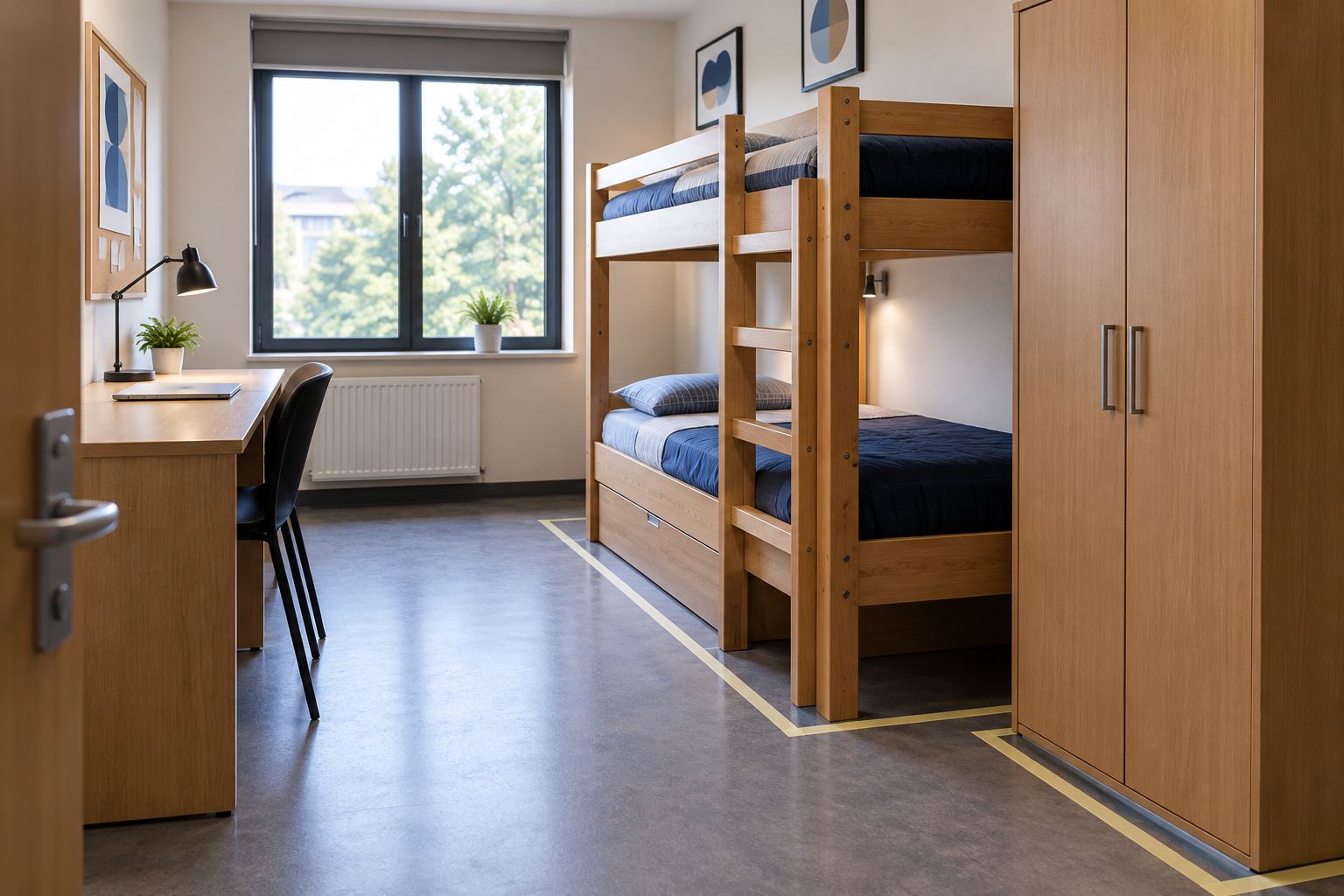
Mark the frame's complete outside dimensions on the floor. Include the ladder or stairs, open drawers, and the space needed to change bedding. Mattress dimensions alone do not describe the furniture footprint.
Check the upper sleeping position separately. Use the proposed mattress surface—not the floor—as your reference for headroom, and obtain any clearance requirements from the manufacturer. Do not treat a general low-ceiling recommendation as approval for a particular model; the guide to bunk beds for low ceilings is a starting point for layout questions.
- Sketch fixed fixtures and door swings.
- Tape out the frame and access footprint.
- Check upper-bunk headroom against product instructions.
- Have the responsible facilities team approve exit access.
Match each sleeping space to its resident
Assign beds around resident needs before assigning room numbers. Consider age, height, mobility, and whether an upper berth is appropriate. A student's ability to climb once is not the same as comfortable nighttime use.
For US mattress planning, a twin is nominally 38 by 75 inches, while a twin XL is nominally 38 by 80 inches. Those are mattress-category dimensions, not a guarantee of fit inside any frame. Verify the exact mattress dimensions specified by the bed manufacturer, especially when considering taller students.
Ask for written load limits and how those limits apply to the mattress and sleeper. Never infer capacity from thick posts, solid wood, or a photograph of an adult sitting on a bed.
Keep accessible sleeping arrangements within the room-planning process. Do not make the upper berth the only available choice for someone who needs a lower sleeping surface.
- Record resident age and sleeping-space needs.
- Confirm mattress length before assigning taller students.
- Request written load limits for each berth.
- Plan lower-bed alternatives for residents who need them.
Verify safety documentation and intended use
Use the US Consumer Product Safety Commission's bunk-bed guidance and applicable regulations as the safety reference for your 2026 review. Federal bunk-bed requirements appear in 16 CFR Parts 1213 and 1513; children's bunk beds also have applicable children's-product requirements. Ask the supplier which requirements apply to the proposed bed and what documentation supports compliance.
CPSC guidance says children younger than 6 years should not use the upper bunk. It also specifies that upper-bunk guardrails must extend at least 5 inches above the mattress top. These are established safety points, not a complete inspection checklist or proof that a particular model complies.
Bunkbeddepot's solid wood bunk beds are presented for family bedrooms. Before considering one for a school, request confirmation of the intended setting, applicable documentation, and maintenance instructions. Material and craftsmanship do not replace documented suitability.
Have your responsible facilities or safety professional resolve institutional-use and local requirements before approving an order.
- Obtain assembly instructions and warning labels.
- Request applicable compliance documentation.
- Confirm whether the intended school use is supported.
- Check guardrails, access, and entrapment requirements.
- Keep written approval with the purchasing record.
Pair the mattress with the approved bed specification
Choose the mattress and frame together. A mattress that is too thick reduces the guardrail height above the sleeping surface; one that does not fit correctly creates a different problem. The approved dimensions and maximum thickness belong in the purchase specification, not in a later housekeeping decision.
Measure the full sleeping assembly. A topper adds height, even when the original mattress met the bed's limit. Staff should be able to identify which mattress belongs on each berth without relying on memory.
Set a replacement specification before move-in. Otherwise, a later mattress substitution can change a setup that was checked during installation. Include the manufacturer's requirements for the mattress foundation or support system, and do not improvise a substitute.
For the 2026 inventory, attach mattress specifications to the bed's asset record. That makes the next replacement a controlled purchase rather than a guess.
- Record required mattress length and width.
- Record maximum permitted mattress thickness.
- Include toppers when checking total height.
- Confirm the required support system.
- Label replacement specifications by bed or room.
Compare configurations against daily room use
Begin with a paper layout rather than a product shortlist. Compare sleeping capacity, access, desk placement, and storage with the same resident needs held constant. This prevents an attractive configuration from quietly changing the room's requirements.
A conventional bunk stacks sleeping surfaces. A loft raises a sleeping surface above usable floor space, but it does not automatically provide another bed. Separate beds avoid upper-bunk access, while taking up separate floor footprints.
Treat frame material as another decision, not the deciding factor. For Bunkbeddepot's solid wood options, confirm the proposed model's dimensions and documented suitability before considering its style. For any alternative, request the same evidence; neither wood nor metal establishes a load rating by itself.
The comparison below identifies practical advantages and limits. It is not a ranking of unverified products. Choose the configuration that satisfies the room plan with the fewest compromises.
- Compare layouts with the same resident count.
- Include access equipment in each footprint.
- Keep desks and storage usable with beds occupied.
- Evaluate material separately from configuration.
Compare dormitory bed options
| Option | Best for | Practical advantage | Key limitation |
|---|---|---|---|
| Conventional bunk bed | Shared rooms needing stacked sleeping spaces | Places sleeping surfaces in a stacked arrangement | Requires upper-bunk access and mattress-height checks |
| Loft bed | A resident needing usable space below a raised bed | Separates the sleeping surface from the space beneath | Does not inherently add another sleeping place |
| Separate single beds | Residents needing floor-level sleeping access | Avoids upper-bunk climbing | Uses separate bed footprints |
| Solid wood frame | Buyers seeking wood construction | Offers a wood-material choice for the room | Material alone proves neither capacity nor institutional suitability |
| Metal frame | Buyers considering a non-wood frame | Offers an alternative construction material | Material alone proves neither capacity nor institutional suitability |
Configuration and material are separate choices. A wood bunk and a metal bunk still need the same room-fit, mattress, and documentation review. Reject any option that leaves a required safety question unanswered.
Plan assembly and acceptance before delivery
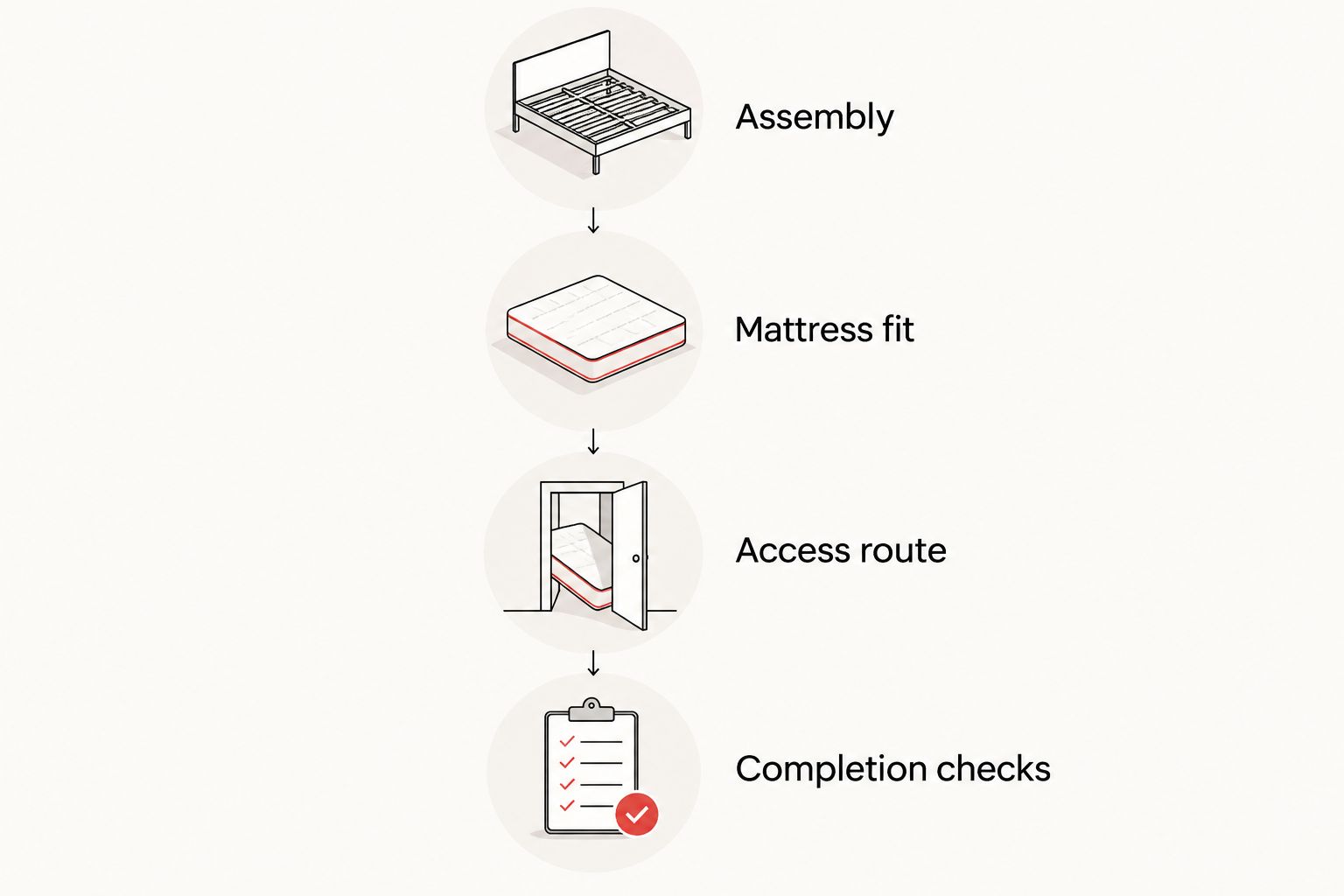
Write an installation checklist before placing the order. Name the person responsible for assembly, the person responsible for acceptance, and where instructions will be stored. Keep students out of unfinished sleeping arrangements.
Build each bed exactly as its manufacturer instructs. Do not substitute hardware, alter the ladder, omit guardrails, or add a homemade support. Custom configurations need their own confirmed instructions; approval of one arrangement does not establish approval of another.
At acceptance, verify that the installed configuration matches the order and that the mattress meets its specification. Check the access route again with desks, chairs, and belongings in place. An empty-room inspection misses how the room will actually work.
Preserve product identification and warning labels so staff can match later maintenance questions to the right instructions. Photograph the completed setup for the asset record, without treating a photograph as evidence of compliance.
- Assign assembly and acceptance responsibilities.
- Check hardware against the instructions.
- Verify guardrails and ladder installation.
- Confirm mattress fit and permitted thickness.
- Record product identification and completion checks.
Establish a maintenance and resident-use routine
Use a simple inspection log and the manufacturer's maintenance instructions. Assign responsibility, record findings, and define how a damaged or questionable bed is taken out of use. A check is only useful when someone owns the response.
Inspect again when rooms are reassigned, beds are moved, or damage is reported. Set routine intervals with your facilities team based on the product instructions and actual use; do not invent one universal schedule for every dormitory.
Give residents short, clear rules. CPSC guidance warns against horseplay and attaching items such as ropes or belts to bunk beds because of injury and strangulation hazards. Explain ladder use and how to report loose parts without attempting a repair.
Your 2026 handover should leave the next staff member with the same information as the installer. A bed's history should not disappear when someone changes roles.
- Keep instructions with the asset record.
- Log inspections, repairs, and reported damage.
- Recheck beds after moves or reassembly.
- Give residents written use rules.
- Remove unsafe setups from use until resolved.
Common mistakes boarding schools make
Buying from mattress size alone
A twin mattress does not tell you the frame's outside dimensions, ladder projection, or usable upper-bunk headroom. Approve the full assembled footprint. Repeat the access check after the rest of the room is furnished.
Treating residential descriptions as institutional approval
A handcrafted frame can still lack the documentation your school requires. Ask about intended use explicitly, and retain the answer. Do not translate a family-bedroom description into a boarding-school performance claim.
Replacing mattresses without checking thickness
A replacement mattress or added topper changes the sleeping-surface height. Keep the approved dimensions and maximum thickness in the purchasing record. Housekeeping and procurement need the same specification.
Filling every space with beds
The unused strip beside a bed might be the route to a wardrobe, window, or exit. Decide the room's approved occupancy with the responsible professionals, then furnish around it. Furniture capacity is not an occupancy decision.
Leaving maintenance to whoever notices first
Resident reporting helps, but it does not replace assigned inspections and repair responsibility. Give staff a clear escalation route and residents a simple reporting method. Do not return a questionable bed to service because it looks acceptable from across the room.
FAQ
What's the best way to choose bunk beds for boarding schools?
Choose bunk beds by room fit, resident needs, mattress compatibility, and documented suitability for the intended setting. Approve the installed room and establish a maintenance process before students use it.
Can a boarding school buy a residential bunk bed?
A residential bunk bed requires a separate suitability review before school use. Obtain written information about intended use, applicable compliance, load limits, and maintenance, then confirm your institution's requirements.
Is a solid wood bunk bed better than a metal bunk bed for a dormitory?
Material alone does not establish which bunk bed is better for a dormitory. Compare documented suitability, dimensions, mattress requirements, assembly instructions, and maintenance needs for the actual models.
What mattress size should boarding-school bunk beds use?
Use the exact mattress size and maximum thickness specified by the bed manufacturer. US twin mattresses are nominally 38 by 75 inches, and twin XL mattresses are nominally 38 by 80 inches, but category dimensions do not guarantee frame compatibility.
How high should the guardrail sit above the mattress?
CPSC guidance specifies at least 5 inches of upper-bunk guardrail above the mattress top. Check the manufacturer's maximum mattress thickness and include any topper in the sleeping-surface height.
Can younger children sleep on the upper bunk?
Children younger than 6 years should not use the upper bunk, according to CPSC guidance. Age alone does not settle suitability; consider the resident's access needs and follow the product instructions.
Does Bunkbeddepot provide school-approved bunk beds?
Bunkbeddepot's supplied description identifies a family-bedroom retailer, not school-approved products. Schools should request model-specific documentation and confirmation of intended use before making a purchasing decision.
One last thing
The mattress replacement specification belongs beside the assembly instructions. It is easy to preserve the frame's paperwork while losing the detail that controls mattress fit and guardrail clearance.
Before signing off your 2026 room plan, ask a staff member who did not choose the bed to find its mattress limits, inspection instructions, and damage-reporting route. If those answers require tracking down the original buyer, the handover is unfinished. A welcoming dormitory needs more than a good first night; it needs a setup the next team can understand and care for.


