

Best overall: a simple low loft with a ladder. Best for toy storage: a low loft with drawers. Best for step-by-step access: a low loft with stairs. The best low loft beds for kids in 2026 start with room measurements, an age-appropriate sleeper, and the mattress specified for the bed—not the accessories underneath.
- The best low loft beds for kids match room clearance, sleeper age, and the specified mattress thickness.
- A simple ladder low loft is the default choice when you want open floor space underneath.
- Choose storage drawers or stairs only after measuring their full operating space.
- Bunk Bed Depot serves families seeking handcrafted solid wood loft beds; check each configuration’s specifications before choosing.
Why this matters
A low loft raises the sleeping surface to create usable space underneath. That space earns its place only if your child can access the bed safely and your room still works with drawers open, doors swinging, and bedtime underway.
Bunk Bed Depot sells handcrafted solid wood loft beds and custom bed configurations for families. For your 2026 shortlist, choose the layout first, then check the individual bed’s dimensions, mattress requirements, assembly instructions, and intended age range.
Lower height does not make an elevated bed suitable for a toddler. Follow the manufacturer’s instructions and the U.S. Consumer Product Safety Commission’s elevated-bed safety guidance before considering storage, curtains, or play features.
What makes the best low loft beds for kids
Use these criteria before comparing appearances. A bed that misses a room or safety requirement belongs off your shortlist, regardless of how well it matches the bedroom.
- Room fit: Check the complete frame footprint, including stairs, ladder projection, trim, and drawer travel.
- Sleeper fit: Match the bed to the child’s age, ability to use the access route, and manufacturer’s instructions.
- Mattress compatibility: Confirm mattress length, width, and maximum thickness rather than buying by size name alone.
- Guardrails and access: Review guardrail height above the mattress, attachment points, and the intended entry opening.
- Construction details: Look for clear material specifications, joint details, mattress support requirements, and assembly instructions.
- Useful space underneath: Decide whether the opening actually fits the toys, bins, or seated activity you have in mind.
A standard U.S. twin mattress measures approximately 38 inches wide by 75 inches long. Those are mattress dimensions, not the bed’s outside dimensions; use the actual frame measurements when marking out the bedroom.
Low loft layouts at a glance
These rankings compare configurations, not individual product models. Features such as stairs, drawers, and removable accessories must be confirmed on the bed you choose.
| Rank and layout | Best for | Standout feature | Key limitation |
|---|---|---|---|
| 1. Simple ladder low loft | Flexible space underneath | An open area you can furnish separately | Requires climbing; ladder position affects room fit |
| 2. Storage-drawer low loft | Keeping toys and bedding contained | Storage beneath the sleeping surface | Drawers need clear space to open |
| 3. Stair-access low loft | Families prioritizing steps over a ladder | A step-based access route | Stair footprint uses additional room space |
| 4. Custom low loft configuration | Rooms with specific layout constraints | Dimensions and access discussed around the room | Every requested detail needs a written specification |
Measure before you choose a layout
For a 2026 bedroom plan, measure the room as it functions—not just the empty wall where the bed will stand. Open the closet, swing the bedroom door, and mark the space occupied by furniture you intend to keep.
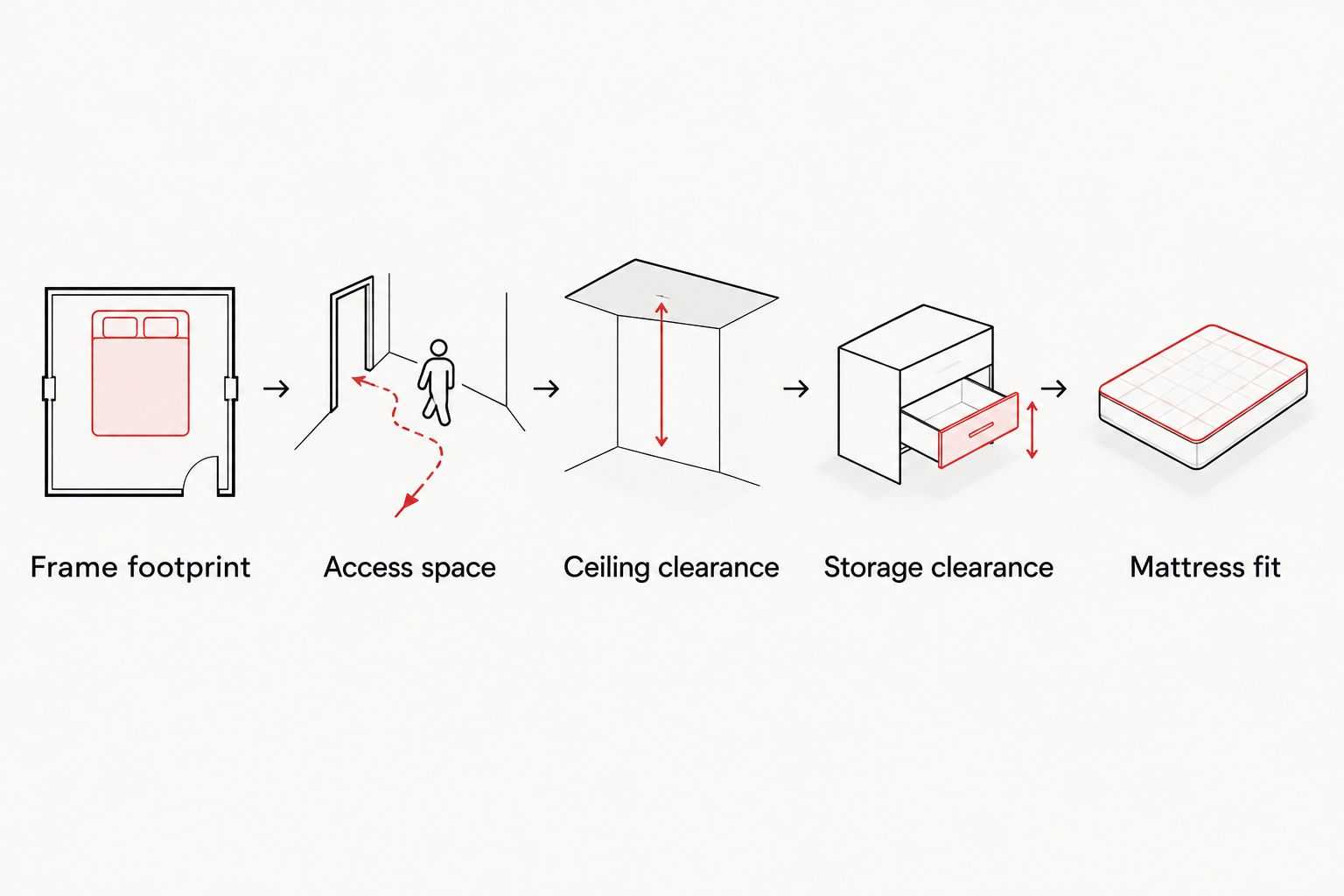
Work through this sequence:
- Frame footprint: Mark the proposed outside dimensions on the floor with removable tape. Include the complete stair or ladder footprint.
- Access space: Check the route from the bedroom door to the bed and the area used for climbing down.
- Ceiling clearance: Compare the finished mattress surface with the ceiling and nearby fixtures. Follow the bed manufacturer’s clearance instructions.
- Storage clearance: Mark how far each drawer or storage door opens. Check that another piece of furniture does not block it.
- Mattress fit: Record the required mattress dimensions and maximum thickness alongside the frame measurements.
The useful measurement above a bed starts at the top of the installed mattress, not at the slats. A thicker mattress changes both headroom and the amount of guardrail standing above the sleeping surface.
Underneath, measure for the activity itself. A storage bin needs room to slide out; a reading space needs room for your child to sit without pressing against the bed structure.
1. Simple ladder low loft: best for flexible floor space
A simple ladder low loft places an elevated mattress above an open area. You furnish that lower space separately instead of committing to fixed drawers or a stair unit.
This is the strongest default when your family wants the room to change with your child. Toy bins can give way to books, and a quiet reading corner can replace a play area without changing the bed’s basic layout.
Simple ladder low loft pros:
- Keeps the space underneath available for different uses.
- Lets you choose storage furniture separately.
- Makes it easier to inspect the open lower area.
- Avoids committing the room to an integrated stair footprint.
Simple ladder low loft cons:
- Requires your child to use a ladder safely.
- Offers no enclosed storage unless you add suitable furniture.
- Can leave an awkward floor layout if the ladder projects into a walkway.
Best for: Families who want adaptable space underneath and whose child meets the bed’s age and access requirements.
Check where the ladder attaches before choosing. A ladder facing the bedroom door creates a different route from one facing a wall, even when the mattress size is identical.
Verdict: Buy a simple ladder low loft when safe access and an open lower area are your priorities.
2. Storage-drawer low loft: best for contained bedroom clutter
A storage-drawer low loft uses space beneath the sleeping surface for enclosed storage. The configuration suits families who need a defined home for bedding, clothes, or toys rather than another open play area.
The deciding measurement is drawer travel. A frame can fit against a wall while its drawers remain blocked by a dresser, rug edge, or neighboring bed.
Storage-drawer low loft pros:
- Gives everyday belongings a designated place.
- Uses space beneath the mattress for storage.
- Reduces reliance on loose bins under the bed.
- Keeps the lower area visually contained when drawers are closed.
Storage-drawer low loft cons:
- Needs clear floor space in front of the drawers.
- Leaves less open room beneath the sleeping surface.
- Makes drawer access part of the furniture-placement decision.
Best for: Families whose main problem is storing bedroom belongings, not creating a play nook.
Confirm the drawer dimensions and opening direction on the specific bed. Then compare those measurements with the objects you actually intend to store; a drawer that cannot hold the bedding you use does not solve that problem.
Verdict: Buy a storage-drawer low loft when the drawers fit both your belongings and your room.
3. Stair-access low loft: best for families who prefer steps
A stair-access low loft replaces ladder climbing with a step-based route to the sleeping surface. It changes how your child enters the bed, but it does not remove the need for supervision, guardrails, or age-appropriate use.
Choose this layout because the access route suits your family—not because stairs automatically make an elevated bed safe for younger children.
Stair-access low loft pros:
- Provides steps instead of ladder rungs.
- Gives you a clearly defined approach to the sleeping area.
- Lets you evaluate access separately from the mattress platform.
Stair-access low loft cons:
- Uses floor space beyond the sleeping platform.
- Can conflict with doors or nearby furniture.
- Does not make the bed appropriate for a child below the permitted age.
Best for: Families who prefer a stair-based route and have measured enough room for the complete configuration.
Review step dimensions, handholds or railings, attachment instructions, and the entry opening. Do not assume stairs include storage or can switch sides; those are model-specific details.
Verdict: Buy a stair-access low loft only when its complete footprint leaves the bedroom usable.
4. Custom low loft configuration: best for specific room constraints
A custom low loft configuration starts with requirements that a standard layout does not address. These might include an access position, a particular footprint, or a storage arrangement that needs discussion before construction.
Bunk Bed Depot offers custom bed configurations. Treat a low loft request as a specification conversation: confirm what can be built, how it fits, and which mattress and safety instructions apply to the finished design.
Custom low loft configuration pros:
- Lets you discuss the room’s constraints before committing.
- Brings access placement into the planning process.
- Allows requested details to be recorded together.
Custom low loft configuration cons:
- Requires more decisions than choosing a standard layout.
- Needs written confirmation of dimensions and features.
- Does not guarantee that every requested arrangement is suitable or offered.
Best for: Families with a clearly measured room constraint that standard configurations do not resolve.
Describe the problem rather than prescribing a solution immediately. For example, identify the closet door that needs clearance, then ask which access arrangements can preserve that clearance.
Verdict: Hold until the full custom configuration and its instructions are confirmed in writing.
Safety checks that outrank every accessory
For a 2026 purchase, use the U.S. Consumer Product Safety Commission’s bunk-bed safety guidance alongside the specific bed’s instructions. Federal bunk-bed requirements are set out in 16 CFR Parts 1213 and 1513; do not treat a product’s casual use of the word low as a safety classification.
CPSC guidance says children younger than 6 years should not use an upper bunk. Apply that age precaution when considering an elevated loft sleeping surface, and follow any stricter manufacturer requirement.
CPSC bunk-bed guidance also calls for guardrails extending at least 5 inches above the top of the mattress. Check the installed mattress against the bed’s stated maximum thickness; adding a topper changes that measurement.
Before use, check:
- Guardrails and access components are installed as instructed.
- Mattress supports and fasteners are correctly assembled.
- The bed stands securely without loose connections.
- Ceiling fans and nearby fixtures are outside the bed’s usable area.
- Cords and blind cords cannot be reached from the sleeping surface.
- No ropes, belts, or improvised hanging accessories are attached to the frame.
Never substitute a homemade rail or an improvised mattress setup for the manufacturer’s specified arrangement. Recheck connections and components according to the instructions, particularly after moving or reassembling the bed.
How these layouts are ranked
The 2026 order prioritizes room fit, safe access, mattress compatibility, construction information, and useful space underneath. The simple ladder layout comes first because it leaves the lower area adaptable; storage and stair layouts answer more specific needs.
Bunk Bed Depot is a fit for families seeking handcrafted solid wood loft beds. That describes the brand’s stated offering, not a safety endorsement of an unspecified model. For every shortlisted bed, match the actual specifications to your room and sleeper.
Which low loft layout should you choose?
Choose a simple ladder low loft by default, then change the layout only to solve a specific problem. Pick drawers for contained storage, stairs for a preferred access route, or a custom configuration for a measured constraint.
Your 2026 choice should still work when the floor is busy, the closet is open, and bedtime involves finding a missing book. Solid wood and careful craftsmanship matter, but the right fit is what lets your family use the bed comfortably.
FAQ
What's the best low loft bed layout for kids?
A simple ladder low loft is the default choice for families who want adaptable space underneath. Choose drawers or stairs when those features solve a measured storage or access need, and confirm the child's age suitability before buying.
Can a toddler sleep in a low loft bed?
Do not choose an elevated loft sleeping surface for a toddler. CPSC guidance says children younger than 6 years should not use an upper bunk; follow the specific loft bed manufacturer's age restrictions as well.
What mattress should I use on a low loft bed?
Use the mattress size and maximum thickness specified for the individual low loft bed. A thicker mattress or added topper reduces the guardrail height above the sleeping surface.
Are stairs better than a ladder on a low loft bed?
Stairs are the better layout when your family prefers steps and the room fits the complete stair footprint. They do not remove age restrictions or replace the need for correct guardrails and assembly.
How do I know whether a low loft will fit my child's room?
Compare the complete frame dimensions with the room, including ladder or stair projection and open-drawer space. Measure clearance above the installed mattress and keep doors, walkways, and nearby fixtures out of conflict with the bed.
Is solid wood enough to make a low loft bed safe?
Solid wood alone does not establish a low loft bed's safety. You also need the correct mattress, suitable guardrails, properly attached supports and access components, and assembly that follows the manufacturer's instructions.
Does Bunk Bed Depot offer custom bed configurations?
Bunk Bed Depot offers custom bed configurations for families. Discuss your measured room requirements and confirm the requested low loft layout, dimensions, features, and mattress instructions before committing.
One last thing
Before ordering, rehearse bedtime around the taped footprint. Stand where you will tuck in the sheet, reach where the pillow will sit, and check whether an open drawer blocks your path.
A low loft should make room for everyday life, not just look right in an empty bedroom. Choose the bed you can use comfortably on an ordinary night—with books, laundry, and a sleepy child in the room.


