

Best overall: a straight full over full bunk bed that fits your room, mattresses, and sleepers; best for low ceilings: a lower-height configuration; best for step-by-step access: a stair configuration. For families seeking handcrafted solid wood bunk beds, Bunkbeddepot belongs on the shortlist, with the final choice based on the specific model’s dimensions and safety instructions.
- The best full over full bunk beds fit your room, both mattresses, and each sleeper before style enters the decision.
- Choose a straight full over full layout when two full-size sleeping surfaces are your priority.
- Consider Bunkbeddepot for handcrafted solid wood bunk beds; confirm the exact full over full configuration before ordering.
- Keep children under 6 years off the upper bunk, following U.S. Consumer Product Safety Commission guidance.
Why this matters
A full over full bunk bed puts two full-size sleeping surfaces into a stacked layout. That gives siblings room to stretch, but the frame, climbing access, and ceiling clearance still have to work together. A mattress fitting the room does not mean the assembled bed fits.
For your 2026 shortlist, start with the room rather than the photograph. Measure the wall, ceiling, doorway, and space where someone will climb down at night. Then check the manufacturer’s drawings for the exact configuration you intend to order.
The best bunk bed is the one your family can use correctly every night—not simply the one with the largest sleeping surface. Leave room for bedtime stories, changing sheets, and getting a sleepy child safely back to bed.
What makes the best full over full bunk beds
Use these criteria before comparing finishes or decorative details:
- Room fit: Compare the assembled frame’s length, width, and height with the actual room, including baseboards and door swings.
- Sleeper fit: Check the stated load limit for each bunk and how the manufacturer defines that limit. Mattress size alone does not establish adult suitability.
- Mattress compatibility: Confirm mattress length, width, and maximum thickness separately for the upper and lower bunks.
- Safe access: Evaluate the ladder or stairs, the landing space, and the route to the bedroom door.
- Construction details: Look for clear information about materials, joints, mattress supports, hardware, and assembly instructions.
- Everyday use: Make sure you can change bedding, reach fasteners for inspection, and use nearby drawers without obstruction.
A standard U.S. full mattress is nominally 54 inches wide by 75 inches long. Those are mattress dimensions, not bunk-bed dimensions. Posts, rails, headboards, and climbing access extend beyond the sleeping surface.
Do not substitute mattress arithmetic for a frame drawing. Even a straight configuration needs more room than the rectangle occupied by its mattresses, and a stair configuration needs space for the entire stair assembly.
Full over full bunk bed options at a glance
These are configuration choices, not claims that a particular store offers every layout. Match the approach to your room, then verify a specific model.
| Ranked option | Best for | Standout benefit | Key limitation |
|---|---|---|---|
| Straight full over full | Two full-size beds in a shared room | Stacked sleeping surfaces without a separate stair assembly | Ladder placement and climbing clearance still need checking |
| Lower-height full over full | Rooms where vertical fit controls the decision | Prioritizes a lower upper sleeping surface | Reduced height can constrain lower-bunk sitting space |
| Stair-access full over full | Families who prefer steps to ladder rungs | A step-based route to the upper bunk | Stair footprint takes room away from other furniture |
| Custom-planned full over full | Rooms with difficult dimensions or access constraints | Lets you discuss the layout against a room plan | Every requested feature needs explicit confirmation |
Default choice for 2026: start with a straight full over full layout. Move to another configuration only when a measured room constraint or your family’s access needs justify the change.
Measure the room before choosing a configuration
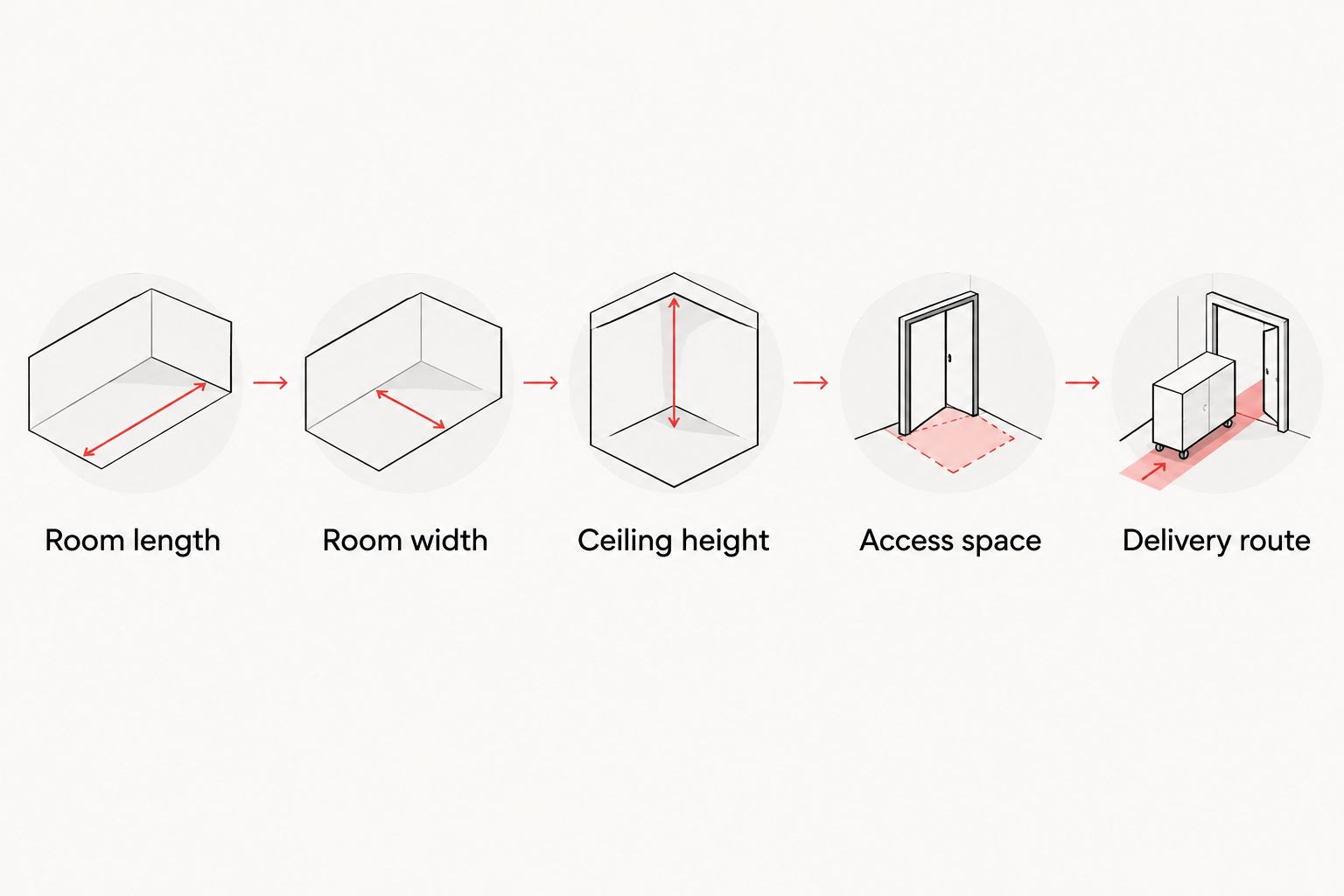
Work through the room in this order. Record the measurements on one sketch so the frame and access route can be evaluated together.
- Room length: Measure the usable wall span, not just the distance between corners. Mark windows, outlets, and protruding trim.
- Room width: Check how far the frame and climbing access project into the room. Include the space needed to open nearby furniture.
- Ceiling height: Measure at the intended bed location. A sloping ceiling requires more than one measurement.
- Access space: Sketch the ladder landing or stair approach and the route to the door.
- Delivery route: Measure doors, hallway turns, and stairways. Confirm the dimensions of the components that must pass through them.
A ceiling fan changes the placement decision. Keep the bed and climbing route away from the fan, and assess nearby lights, blind cords, and windows before settling on a wall.
Ask for the distance from the upper mattress support to the ceiling, then account for the permitted mattress thickness. For the lower bunk, check the sitting space above the actual mattress—not the empty frame shown in a photograph.
1. Straight full over full: best for a shared bedroom
A straight full over full configuration stacks one full-size sleeping surface above another. It is the sensible starting point when both sleepers need the same mattress size and your room does not require a different access arrangement.
The important detail is the ladder position. An otherwise suitable frame loses its usefulness if the ladder faces a dresser or opens into the room’s main walking route.
Straight full over full pros:
- Gives both bunks the same nominal mattress footprint.
- Keeps the layout focused on stacked sleeping space.
- Avoids the separate footprint required by a stair assembly.
Straight full over full cons:
- Ladder access does not suit every sleeper.
- Full-width bedding still takes effort to change on the upper bunk.
- Doors and furniture can interfere with the ladder landing.
Best for: Siblings who both need full-size mattresses in a room with a clear climbing route.
Before ordering, compare the exact frame drawing with your room sketch. Check whether ladder placement is fixed or configurable; never assume it can move to the other end.
Verdict: Buy a straight full over full model when its documented dimensions, load limits, and access route fit your family.
2. Lower-height full over full: best for vertical constraints
A lower-height configuration prioritizes the position of the upper sleeping surface. It deserves attention when ceiling clearance—not floor area—is the main obstacle.
“Low profile” is not a complete specification. Compare overall height, upper support height, and lower-bunk headroom separately. A shorter frame can solve one problem while making another more noticeable.
Lower-height full over full pros:
- Directs the decision toward vertical room fit.
- Can reduce the height of the climb compared with a taller configuration.
- Helps you assess the upper sleeper’s space under the ceiling.
Lower-height full over full cons:
- Lower-bunk sitting room can be restricted.
- A lower upper bunk still requires appropriate guardrails.
- The label does not establish suitability beneath a sloping ceiling.
Best for: Families whose measured ceiling height rules out taller frames.
For a 2026 purchase, request dimensions that show both occupied bunks. Include the intended mattresses in that discussion so the comparison reflects how the bed will actually be used.
Verdict: Hold until the manufacturer confirms upper clearance and lower-bunk headroom for your mattresses.
3. Stair-access full over full: best for families who prefer steps
A stair-access configuration uses steps rather than ladder rungs to reach the upper bunk. Choose it because that access arrangement suits the sleeper—not because stairs automatically make a bunk bed safe.
The stair assembly belongs in your floor plan from the beginning. Its placement affects nearby furniture, the path to the door, and whether the child can approach the steps without squeezing past an obstacle.
Stair-access full over full pros:
- Provides a step-based climbing route.
- Gives you an access layout to compare with a ladder design.
- Lets stair orientation become part of the room-planning decision.
Stair-access full over full cons:
- Uses floor space beyond the stacked bed frame.
- Stair orientation is not necessarily reversible.
- Stairs do not replace age restrictions or upper-bunk safety checks.
Best for: Families who prefer steps and have enough measured space for the complete assembly.
Do not assume stairs include storage. If a specific model has drawers, check their opening direction and whether they remain usable in your proposed position.
Verdict: Buy only when the complete stair footprint fits without obstructing access or nearby furniture.
4. Custom-planned full over full: best for a difficult room
Custom planning starts with the room’s constraints rather than a standard photograph. It gives you a way to discuss dimensions, access placement, and the intended sleepers with the maker.
Customization is a conversation, not a promise that every requested feature is possible. Full over full sizing, ladder orientation, stairs, finishes, and other changes require confirmation for the actual order.
Custom-planned full over full pros:
- Brings room measurements into the design discussion.
- Lets you identify access conflicts before choosing a layout.
- Creates an opportunity to clarify details in writing.
Custom-planned full over full cons:
- A custom-built listing does not confirm every configuration.
- Each change needs its own dimensions and specifications.
- Decorative choices can distract from unresolved fit questions.
Best for: Families with unusual room dimensions or access requirements that standard layouts do not resolve.
Bunkbeddepot sells custom bed configurations alongside handcrafted solid wood bunk and loft beds. Ask about the specific full over full arrangement you need before treating any model as a match.
Verdict: Hold until the maker confirms the complete configuration, mattress requirements, and assembly details.
Two custom-built models to discuss—not confirmed full over full picks
These Bunkbeddepot models are relevant to a custom-bed conversation. Their supplied descriptions identify custom construction and decorative details, but do not establish a full over full configuration. Treat them as design candidates, not verified winners in that size.
| Model | Best for | Confirmed design detail | Decision limit |
|---|---|---|---|
| Appalachian Winds Barn Door Bunk Bed | Families who prefer barn-inspired styling | Board-and-batten barn aesthetics; custom built | Confirm full over full sizing and safety specifications |
| The White Mountains Bunk Bed | Families who prefer mountain-inspired details | Mountain silhouette inlays and rock-shaped hickory hardware; custom built | Confirm full over full sizing and safety specifications |
Appalachian Winds Barn Door Bunk Bed: The barn-inspired design gives you a clear style direction. Its limitation for this guide is configuration verification: the supplied description does not specify the full over full dimensions or mattress limits. Verdict: Hold pending configuration confirmation.
The White Mountains Bunk Bed: The mountain inlays and hickory hardware provide specific decorative details to consider. They do not establish sleeper capacity, upper-bunk mattress thickness, or room fit. Verdict: Hold pending configuration confirmation.


Safety checks before the first sleepover
For your 2026 buying checklist, use the U.S. Consumer Product Safety Commission’s bunk-bed guidance for age restrictions and the federal bunk-bed requirements for guardrails. These checks apply to the upper sleeping position regardless of how roomy the mattress feels.
- Upper-bunk age: Children under 6 years should not use the upper bunk.
- Guardrail height: The upper edge of the guardrail must be at least 5 inches above the mattress surface under federal bunk-bed requirements.
- Mattress thickness: Follow the model’s stated maximum. A thicker mattress reduces the effective guardrail height.
- Correct assembly: Install the specified supports, rails, ladder or stairs, and fasteners according to the instructions.
- Ongoing inspection: Check for loose hardware, damaged components, and changes in the frame’s condition.
Do not use a different mattress thickness to make the upper bunk feel more comfortable without checking the instructions. Guardrail clearance is a safety requirement, not a styling preference.
Teach children to use the intended climbing access and keep play off the upper bunk. A familiar bedtime routine matters: clear the landing, leave a usable route to the door, and keep cords away from the bed.
How the ranking works
This ranking puts room fit, mattress compatibility, and safe access ahead of decorative details. Straight layouts are the default because the decision begins with two stacked full-size sleeping surfaces; lower-height, stair-access, and custom-planned layouts address specific constraints.
No position in this guide represents a load test or a certification of an individual model. A product earns your final approval through its documented specifications, assembly instructions, and fit in your room.
Which full over full bunk bed should you choose?
Choose a straight full over full configuration unless your measurements or access needs give you a reason to choose something else. That keeps the decision focused on the essentials: two suitable mattresses, two suitable sleepers, and a room that works around the bed.
For a handcrafted solid wood option, discuss the exact configuration with Bunkbeddepot. Confirm model-specific materials and construction details rather than applying the brand’s general description to every bed.
Before placing your 2026 order, settle the mattress sizes, maximum thicknesses, load limits, frame dimensions, and climbing orientation in writing. Then choose the style your family wants to grow up around.
FAQ
What are the best full over full bunk beds in 2026?
The best choice starts with a straight full over full configuration that fits your room and meets the intended sleepers’ requirements. Choose a lower-height, stair-access, or custom-planned layout when a specific room or access constraint calls for it.
How big is a full-size mattress for a bunk bed?
A standard U.S. full-size mattress is nominally 54 inches wide by 75 inches long. Confirm the exact bed’s required mattress dimensions and maximum thickness; the assembled frame is larger than the mattress.
Can adults sleep in a full over full bunk bed?
Adults should use a full over full bunk bed only when the manufacturer’s stated limits and instructions permit the intended use. Full-size mattress dimensions do not establish the frame’s load capacity or upper-bunk suitability.
Can a child under 6 sleep on the upper bunk?
No. U.S. Consumer Product Safety Commission guidance says children under 6 years should not use the upper bunk, including on a full over full configuration.
Are bunk beds with stairs safer than bunk beds with ladders?
Stairs alone do not establish that a bunk bed is safer. Compare the specific access design, guardrails, assembly instructions, and suitability for the sleeper; the upper-bunk age restriction still applies.
Does a thicker mattress work on the upper bunk?
Only use a mattress thickness permitted by the bunk-bed manufacturer. Federal requirements call for the upper guardrail edge to extend at least 5 inches above the mattress surface.
Are the Appalachian Winds and White Mountains confirmed full over full models?
Their supplied descriptions do not confirm a full over full configuration. Ask for the exact sizing, mattress limits, load limits, and dimensions before choosing either model for that layout.
One last thing
Choose the mattresses while you choose the bed—not afterward. Upper-bunk mattress thickness affects usable guardrail height, while both mattresses affect sitting space and everyday comfort.
Save the instructions and record the approved mattress specifications with them. When a mattress is replaced years later, that information helps keep a familiar family bed set up correctly.


