

Best overall: a loft bed with a full-width desk underneath. Best for two sleepers: a bunk bed with a perpendicular desk. Best for a narrow room: a loft bed with a side-mounted desk. Before choosing, measure the ceiling, bed footprint, mattress height, and space needed to pull out the chair; this 2026 guide ranks layouts rather than treating every bunk bed as desk-compatible.
- The best bunk beds with built-in desk depend on sleeper count, ceiling clearance, and usable chair space.
- A full-width desk loft is the default for one sleeper who needs a dedicated homework area.
- A perpendicular-desk bunk suits two sleepers when the room has enough open floor space.
- Bunkbeddepot sells handcrafted solid wood beds; confirm desk compatibility for the exact configuration before ordering.
Why this matters
A bed can fit against the wall while its desk fails in daily use. The chair catches the ladder, the desktop sits too close to the mattress above, or the lower sleeper loses an easy route out of bed. Those are layout problems, not decorating problems.
Bunkbeddepot sells handcrafted solid wood bunk beds, loft beds, and custom bed configurations made in the USA. Bunkbeddepot suits families seeking handcrafted solid wood beds; confirm the exact desk configuration before ordering. A custom-built bed is not proof that any requested desk arrangement is offered.
For your 2026 shortlist, separate two questions: how many people must sleep here, and where will homework happen? A loft provides one elevated sleeping position with usable space below. A bunk provides stacked sleeping positions; adding a desk requires a separate, workable place for it.
What makes the best bunk bed with a built-in desk?
Use these six checks before comparing finishes or decorative details.
- Sleeper fit: Match the sleeping arrangement to the occupants. Do not sacrifice a needed lower bed just to gain a desktop.
- Room fit: Compare the complete frame dimensions, including access hardware and desk projections, with your room measurements.
- Mattress compatibility: Use the mattress dimensions and maximum thickness specified for the exact bed. Mattress height affects guardrail protection.
- Working space: Check seated headroom, knee clearance, desktop depth, and the chair's route in and out.
- Safe access: Keep the ladder or stairs accessible with the chair occupied and the desk in use.
- Construction and upkeep: Check the stated materials, assembly instructions, joints, fasteners, and inspection requirements. Solid wood alone does not establish safe construction.
A useful desk holds the things your child actually uses. Bring the laptop, an open workbook, and the intended chair into the decision—not just a photograph of a neatly styled bedroom.
Best desk-bed layouts at a glance
These are configuration recommendations, not claims that a particular retailer offers every layout. Confirm the manufacturer's drawings and specifications before buying in 2026.
| Rank and layout | Best for | Standout feature | Key limitation |
|---|---|---|---|
| 1. Full-width desk loft | One sleeper with a dedicated homework area | Desk occupies the space beneath the elevated bed | No second sleeping position |
| 2. Perpendicular-desk bunk | Two sleepers with room beside the beds | Desk extends away from the sleeping footprint | Projects into the room |
| 3. Side-mounted desk loft | One sleeper in a narrow room | Work surface follows one side beneath the loft | Desk width and access need close checking |
| 4. L-shaped bunk with desk | Shared rooms with a usable corner | Separates sleeping and study zones across adjoining walls | Larger, less flexible footprint |
| 5. Bunk with an integrated end desk | Two sleepers needing a compact study station | Desk sits at the end rather than replacing the lower bed | Requires clear space beyond the bed end |
1. Full-width desk loft: best desk bed for one student
A full-width desk loft places the work surface below an elevated bed. It gives one child separate places to sleep and study within the same general footprint. The important measurement is the usable space below the sleeping platform, not the bed's overall height.
Best for: One sleeper who needs a regular homework station.
Full-width desk loft pros:
- Uses the area beneath the bed for a defined purpose.
- Separates bedding from books and schoolwork.
- Lets you assess the whole study zone as one layout.
- Keeps a separate freestanding desk from occupying another wall.
Full-width desk loft cons:
- Does not provide a lower sleeping position.
- The overhead structure limits seated headroom.
- Moving or replacing an integrated desktop is less straightforward than moving a separate desk.
Check the chair with someone sitting in it. An empty chair tucked neatly under the desktop says little about elbow room, posture, or access. Also check whether the desk supports interfere with knees and whether the ladder enters the work zone.
For a 2026 purchase, ask for the actual desktop dimensions and the distance from the floor to the underside of the structure above. A broad-looking desktop is not enough.
Verdict: Buy this layout for one sleeper after confirming seated clearance and mattress compatibility.
2. Perpendicular-desk bunk: best desk bunk for two sleepers
A perpendicular-desk bunk places the desktop at a right angle to the sleeping structure. Its main advantage is preserving two sleeping positions while giving the desk a separate working direction. Its main cost is room space.
Best for: Two sleepers in a room with an open area beside the bunk.
Perpendicular-desk bunk pros:
- Keeps the lower sleeping position in the plan.
- Creates a distinct study area beside the beds.
- Allows the chair to face away from the lower sleeper when the layout supports it.
Perpendicular-desk bunk cons:
- Extends beyond a simple rectangular bed footprint.
- Can conflict with a door swing or dresser access.
- Still requires a plan for sharing one desk between two children.
Mark the projecting desk on the floor before ordering. Then open every nearby door and drawer. The layout must work when the chair is pulled out, not only when the room is tidied.
Check the lower sleeper's entry and exit route separately from upper-bed access. A chair should not become an obstacle someone must climb around at bedtime.
A perpendicular desk suits families who want the homework area near the beds without placing it beneath the upper sleeper. It does not solve competing homework schedules by itself.
Verdict: Buy this layout for two sleepers when the desk projection leaves everyday routes clear.
3. Side-mounted desk loft: best desk loft for a narrow room
A side-mounted desk loft places the desktop along one side of the space beneath the elevated bed. Compared with a full-width arrangement, this layout changes how you enter the study area and where the chair faces. The drawing must show both clearly.
Best for: One sleeper in a narrow room where the desk must stay beneath the bed.
Side-mounted desk loft pros:
- Keeps the work surface within the loft's lower area.
- Offers a different chair orientation from a full-width desktop.
- Leaves the remaining under-bed space available for whatever the verified design permits.
Side-mounted desk loft cons:
- A short or shallow desktop can restrict schoolwork.
- A frame post or ladder can interrupt chair movement.
- Wall-facing placement requires careful lighting decisions.
Do not assume that remaining space includes shelves, drawers, or seating. Those features belong in the specifications, not in your expectations.
Check the desktop with an open workbook beside the computer. If one must sit on top of the other, the arrangement does not meet that homework routine. Keep power cords out of the climbing route and avoid attaching anything to the guardrails.
In a small room, access matters as much as surface area. A desk that requires awkward sideways entry can become the place where school papers collect rather than where homework happens.
Verdict: Buy this layout for a narrow room only when the desktop and chair fit the child's actual work routine.
4. L-shaped bunk with desk: best desk bunk for a corner room
An L-shaped bunk arrangement places sleeping areas in perpendicular directions. An integrated desk can occupy a separate part of that corner layout, depending on the manufacturer's design. Check the complete plan rather than assuming the open-looking area in a photograph is usable desk space.
Best for: A shared bedroom with a clear corner and usable adjoining walls.
L-shaped bunk with desk pros:
- Distributes the layout across two directions.
- Separates activity zones more clearly than a single straight stack.
- Gives families another arrangement to consider when a conventional bunk does not suit the room.
L-shaped bunk with desk cons:
- Occupies more than one wall.
- Can interfere with windows, closets, or other furniture.
- Is harder to reposition when the room's needs change.
Measure both walls from the corner outward. Include trim, outlets, heating equipment, and door movement. A corner is useful only when the bed and desk can occupy it without blocking the room's other functions.
For Bunkbeddepot solid wood bunk beds, confirm whether the requested corner-and-desk arrangement is offered and obtain its dimensions before planning around it.
This layout deserves extra attention in a shared room. Each sleeper still needs clear access, and the desk chair must not trap either child's route.
Verdict: Hold until the complete corner layout is confirmed against a measured room plan.
5. Bunk with an integrated end desk: best for a compact study station
An end-desk bunk places a work surface beyond one end of the sleeping structure. It preserves the stacked sleeping arrangement while locating homework outside the space between the beds. The extra length is the deciding measurement.
Best for: Two sleepers who need a study station beyond the bed end.
Integrated end-desk bunk pros:
- Preserves the lower sleeping position.
- Keeps the desktop outside the lower bed's immediate space.
- Provides a clear location to assess task lighting and chair access.
Integrated end-desk bunk cons:
- Adds to the total room length required.
- Can conflict with end-mounted climbing access.
- A compact desktop is not suitable for every schoolwork setup.
Check which end carries the ladder or stairs. A drawing that shows only the attractive side of the bed can hide the most important access conflict.
Next, check the chair behind the desk, including its occupied position. Leaving enough room for the frame is not the same as leaving enough room to work comfortably.
Verdict: Buy this layout for a compact study station only when the bed end remains clear and accessible.
Measure the room before choosing the desk
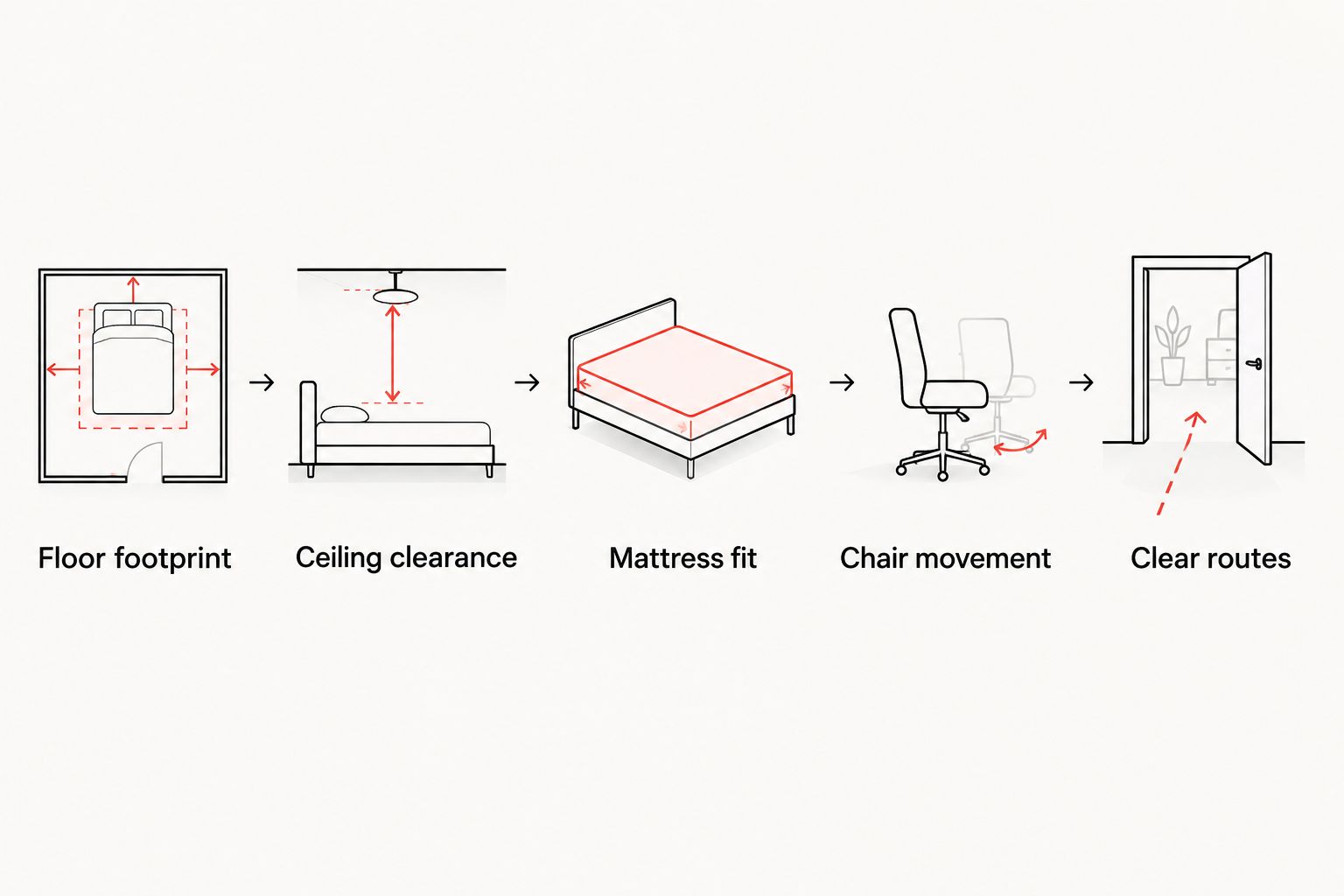
For your 2026 room plan, work through these checks in order. Record the measurements and compare them with the exact configuration—not a similar model.
- Floor footprint: Mark the frame, desk, ladder, and chair positions with removable tape.
- Ceiling clearance: Compare the ceiling with the upper mattress surface and the sleeper's seated height. Check ceiling fans separately.
- Mattress fit: Match the specified length, width, and thickness. Common U.S. twin mattresses measure 38 by 75 inches; twin XL mattresses measure 38 by 80 inches. The bed's instructions control compatibility.
- Chair movement: Pull the chair out, sit down, and stand up within the taped layout.
- Clear routes: Open the door, closet, and dresser drawers while leaving bed access unobstructed.
Finish with a real homework rehearsal at a table. Arrange the child's usual supplies and measure the space they occupy. That gives you a useful requirement for the desk instead of a guess based on room photographs.
Safety checks that come before craftsmanship
For a 2026 safety review, use U.S. Consumer Product Safety Commission bunk-bed guidance and federal requirements in 16 CFR parts 1213 and 1513. Follow the bed manufacturer's instructions for the exact model and configuration.
- Upper-bed age: Children younger than 6 years should not use the upper bunk, according to CPSC guidance.
- Guardrail height: CPSC requirements call for the upper edge of the guardrails to be at least 5 inches above the mattress top.
- Mattress thickness: Stay within the manufacturer's stated maximum. A thicker mattress reduces the rail height above the sleeping surface.
- Climbing access: Use the intended ladder or stairs, not the desk, chair, shelves, or frame ends.
- Assembly: Follow the specified hardware and assembly sequence. Do not improvise a desktop attachment to a bed frame.
- Ongoing checks: Inspect and maintain the bed as directed, including fasteners and access components.
Bunkbeddepot's handcrafted solid wood positioning does not replace these checks. Neither does an attractive joint or a substantial-looking post. You need model-specific instructions and safety information before choosing the bed.
How these layouts are ranked
The ranking prioritizes sleeper count, usable study space, room fit, and unobstructed access. It does not rank unverified products or assume that a desk can be added to a bed because its frame looks suitable.
The full-width desk loft takes the default position because it gives one sleeper a clearly defined study zone. Two-sleeper families should start with the perpendicular or end-desk arrangements, then assess the corner option against their floor plan.
Which desk bed should you choose?
Choose a full-width desk loft for one sleeper. Choose a perpendicular-desk bunk for two sleepers when the projecting desk fits the room. Use a side-mounted desk loft when chair orientation and a narrow footprint drive the decision.
Skip any arrangement that requires compromised access, an unsuitable mattress, or improvised attachments. A separate desk beside a suitable bunk is a better decision than forcing an integrated layout that does not fit.
FAQ
What's the best bunk bed with a built-in desk?
A full-width desk loft is the default for one sleeper who needs a dedicated homework area. For two sleepers, start with a perpendicular-desk bunk and check its complete footprint, including the occupied chair.
Is a loft bed with a desk the same as a bunk bed?
No. A loft has an elevated sleeping position with usable space below, while a bunk has stacked sleeping positions. Confirm sleeper count before comparing desk layouts.
Can a child younger than six sleep above a built-in desk?
Children younger than 6 years should not use the upper bunk, according to U.S. Consumer Product Safety Commission guidance. A desk beneath the bed does not change that guidance.
What mattress should I use on a desk bunk bed?
Use the mattress dimensions and maximum thickness specified by the manufacturer for the exact bed. Mattress thickness affects the guardrail height above the sleeping surface.
Can I attach a desk to a bunk bed myself?
Do not attach a desk unless the manufacturer specifies and supports that configuration. Improvised attachments can interfere with the structure, access, and required safety clearances.
Does Bunkbeddepot offer the desk layouts in this guide?
Confirm the exact desk arrangement with Bunkbeddepot before ordering. The company sells handcrafted solid wood bunk beds, loft beds, and custom configurations, but that does not establish that every layout in this guide is offered.
How do I know whether the chair will fit under a loft desk?
Check the chair's occupied position, knee clearance, and movement in and out of the desk. Include the frame posts, ladder, and any structural supports in your measurements.
One last thing
Test the chair before choosing the finish. Mark the layout, sit down with a workbook, then stand up and walk to the bed. That small rehearsal tells you whether the room supports homework and bedtime—not just a furniture photograph.
A good family bedroom has room for both. School papers at the desk. Stories at the bed. Clear space between them.


